If you've pulled up to a busy Tesla Supercharger station on a holiday weekend, you may have seen every stall occupied — and then noticed the app telling you to wait in a "virtual queue." The Tesla virtual queue Supercharger feature is Tesla's software-driven solution to congestion at high-traffic charging sites, and understanding how it works is essential for road-trip planning. But for most daily driving, a properly installed home Level 2 charger eliminates public-charging waits entirely. This guide breaks down the virtual queue system, then walks through exactly what it takes — and costs — to set up fast, reliable home charging.
What Is the Tesla Virtual Queue at Superchargers?
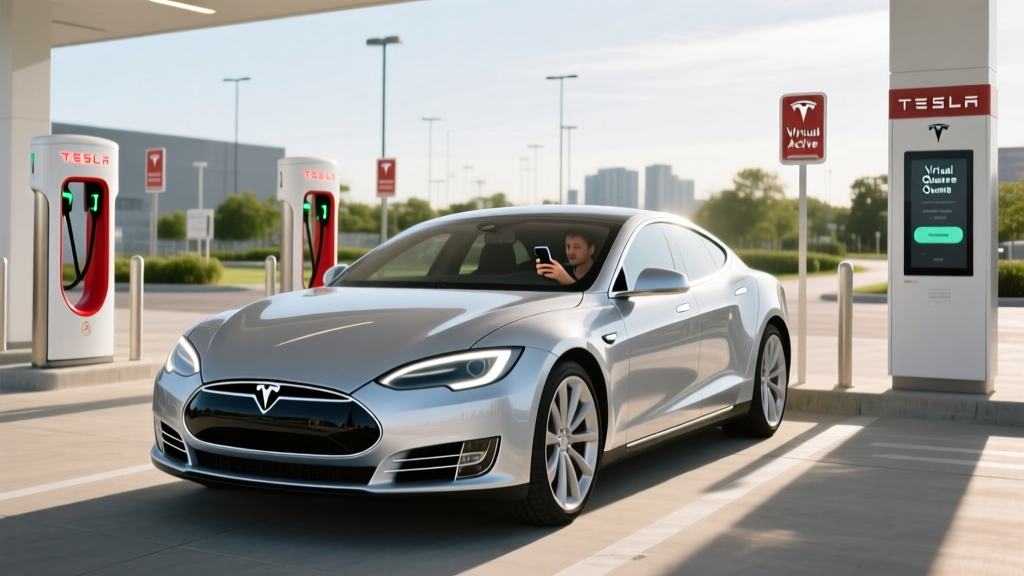
The Tesla virtual queue Supercharger system activates automatically when all stalls at a given station are occupied. Rather than physically lining up in a parking lane (which blocks traffic and creates confusion), drivers tap "Join Queue" in the Tesla app or in-car navigation. The system assigns a position, estimates your wait time, and sends a push notification when a stall opens — giving you a window of several minutes to pull in.
Key mechanics of the virtual queue:
- Automatic activation: The queue triggers only when a station reaches full capacity; you won't see it at off-peak hours.
- GPS-based positioning: Tesla's system prioritizes vehicles that are physically closest to the station, preventing remote queue-jumping from miles away.
- Time-window enforcement: Once notified, you typically have 2–5 minutes to claim the stall before the system passes your spot to the next vehicle.
- Idle fees still apply: If a vehicle finishes charging but doesn't leave, Tesla's idle fees (up to $1.00/minute at 100% station occupancy) help cycle stalls faster, reducing queue depth.
In practice, the virtual queue works well at sites with 20–40 stalls, where turnover is rapid thanks to V3/V4 Supercharger speeds of up to 250–350 kW. Wait times typically range from 5 to 20 minutes during peak travel periods like Thanksgiving or summer Fridays. However, the system does not guarantee a specific stall assignment, and vehicles towing trailers may find certain stalls difficult to navigate even when called.
Charging Levels Explained: Speeds, kW, and Miles Per Hour
Whether you're waiting in a Supercharger queue or plugging in at home, understanding the three charging levels is foundational. The critical distinction: kW (kilowatts) measures power — how fast energy flows into your battery — while kWh (kilowatt-hours) measures energy — the total capacity of your battery. Think of kW as the flow rate of a hose and kWh as the size of the tank.
| Level | Voltage | Power (kW) | Miles of Range Added Per Hour | Typical Use Case |
|---|---|---|---|---|
| Level 1 | 120V AC | 1.0–1.4 kW | 3–5 miles | Overnight trickle; PHEV top-ups |
| Level 2 | 240V AC | 3.3–19.2 kW | 12–75 miles | Home daily charging; workplace |
| DC Fast Charging | 400–800V DC | 50–350 kW | 150–1,000+ miles (equivalent rate) | Road trips; Superchargers; public fast stations |
A few real-world benchmarks for context:
- Tesla Model Y (75 kWh usable, ~320 mi EPA): On a V3 Supercharger at 250 kW peak, expect a 10–80% charge in roughly 25–28 minutes. On a 48-amp (11.5 kW) home Level 2 charger, a full 10–80% session takes about 5.5–6 hours.
- Ford F-150 Lightning (131 kWh extended-range pack): At 150 kW DC fast charging, 15–80% takes approximately 40–45 minutes. At home on an 80-amp (19.2 kW) Level 2, the same 15–80% session takes roughly 7–8 hours.
- Hyundai Ioniq 5 (77.4 kWh, 800V architecture): On a 350 kW-capable charger, 10–80% in as little as 18 minutes — one of the fastest production EVs on the market.
Charging speed is never linear. All EVs taper charge rate significantly above 80% state of charge (SoC) to protect battery health. The advertised "peak kW" is sustained only between roughly 10–50% SoC on most NMC-chemistry packs, then drops progressively. This is why 10–80% time is the industry-standard metric — and why Tesla's Supercharger navigation system preconditions the battery en route to maximize the time spent at peak rate.
Home Level 2 Charger Installation: Costs, Electrical Requirements, and Permits
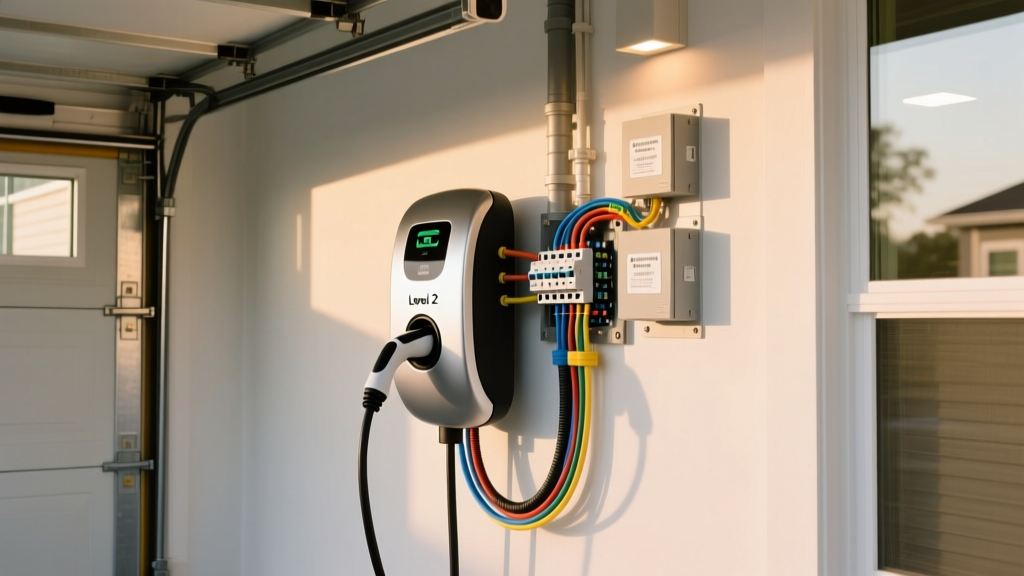
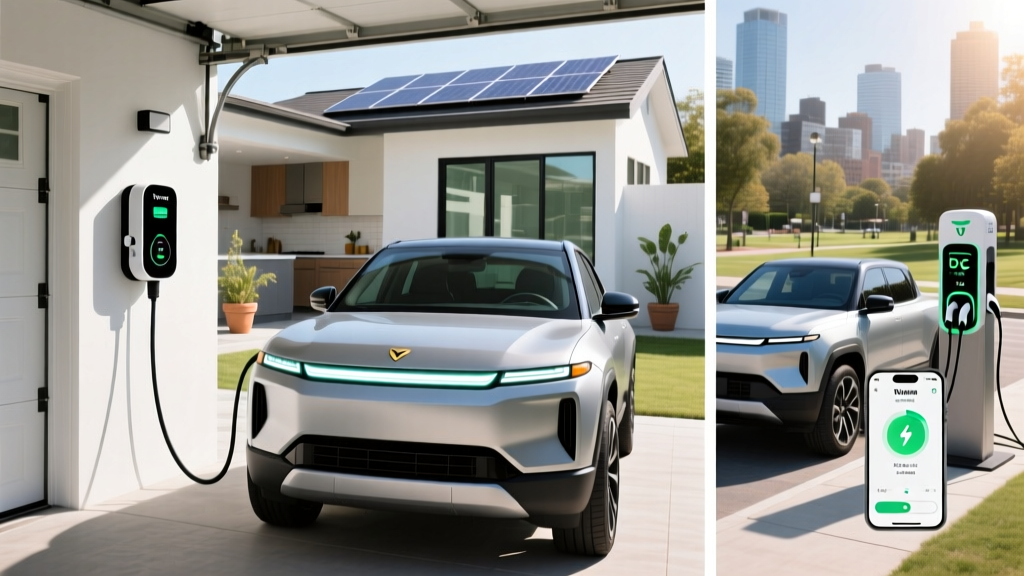
The single biggest advantage of EV ownership is waking up to a full battery every morning. Achieving this requires a properly installed Level 2 home charger — and for most homes, that means hiring a licensed electrician to run a dedicated 240V circuit.
Electrical Requirements
A Level 2 charger requires a 240-volt circuit, similar to what powers an electric dryer or oven. The amperage of that circuit determines your charging speed:
- 40-amp circuit (supports 32-amp / 7.7 kW charger): Adequate for most sedans and smaller SUVs; adds ~25–30 miles of range per hour.
- 50-amp circuit (supports 40-amp / 9.6 kW charger): Good balance of speed and cost for most EV owners.
- 60-amp circuit (supports 48-amp / 11.5 kW charger): Ideal for Tesla owners using the Wall Connector; charges a Model Y from 10–80% in ~5.5 hours.
- 80–100-amp circuit (supports 64–80-amp / 15.3–19.2 kW charger): Needed for large-battery trucks like the F-150 Lightning extended range or Rivian R1T; requires substantial panel capacity.
National Electrical Code (NEC) requires that continuous loads (including EV chargers) not exceed 80% of the circuit rating. A 48-amp charger therefore needs a 60-amp breaker — not a 50-amp.
Panel Upgrade Considerations
Many homes built before 2000 have 100-amp or 150-amp main electrical panels. Adding a 60-amp EV circuit to an already-loaded 100-amp panel may require a panel upgrade to 200 amps, which is a significant additional cost. Your electrician will perform a load calculation (NEC Article 220) to determine if your existing panel can handle the added draw. Homes with electric heat, electric water heaters, and electric dryers are most likely to need an upgrade.
An increasingly common alternative: smart circuit-sharing devices like the NeoCharge Smart Splitter or Emporia Load Management module allow an EV charger to share an existing high-amperage circuit (like a dryer outlet) by automatically reducing EV charge rate when the other appliance activates. This can avoid a panel upgrade entirely for $300–$500 in hardware.
| Component | Cost Range | Notes |
|---|---|---|
| Level 2 Charger (Equipment) | $350 – $750 | Hardwired or NEMA 14-50 plug; smart WiFi models cost more |
| Electrical Permit | $50 – $250 | Varies by municipality; required in most jurisdictions |
| Electrician Labor (Standard Install) | $500 – $1,500 | Short run from panel to garage; conduit, wiring, breaker |
| Electrician Labor (Complex Install) | $1,500 – $3,500 | Long wire runs, trenching, sub-panel addition, or detached garage |
| Panel Upgrade (If Needed) | $1,500 – $4,000 | 100A → 200A upgrade; not needed in most newer homes |
| Total (Standard Install, No Panel Upgrade) | $900 – $2,500 | Most common scenario for homes built after 2000 |
| Total (With Panel Upgrade) | $2,500 – $6,500 | Older homes or those with high existing electrical loads |
Connector Compatibility: NACS, CCS1, CHAdeMO, and Adapters
North America's charging connector landscape has shifted dramatically. As of 2026, the North American Charging Standard (NACS) — originally Tesla's proprietary connector — has become the dominant standard. Nearly all major automakers (Ford, GM, Rivian, Volvo, Hyundai, BMW, and others) now equip their EVs with native NACS ports, and Tesla Supercharger stations are open to non-Tesla vehicles via the built-in "Magic Dock" CCS adapter or the vehicle's own NACS port.
| Connector | Brands Using It (Native) | Adapter Needed For | Notes |
|---|---|---|---|
| NACS (Tesla) | Tesla, Ford, GM, Rivian, Volvo, Polestar, BMW (newer), Hyundai/Kia (2025+), Mercedes | CCS1 stations (legacy public chargers) | Smallest/lightest connector; supports up to 350+ kW on V4 Superchargers |
| CCS1 | Older VW/Audi EVs, some Stellantis models, legacy Hyundai/Kia | Tesla Superchargers (use Tesla CCS adapter, ~$175–$250) | Being phased out on new vehicles; still common at Electrify America, EVgo stations |
| CHAdeMO | Nissan Leaf (discontinued in US after 2025), Mitsubishi Outlander PHEV | All modern DC fast networks | Effectively legacy; very limited new infrastructure investment |
For home Level 2 charging, the connector question is simpler: all Level 2 chargers sold in North America use the J1772 connector for non-Tesla vehicles, and Tesla vehicles use the NACS connector. Most modern home chargers (like the Tesla Wall Connector) include both a NACS plug and a J1772 adapter in the box, or you can purchase a J1772-to-NACS adapter (~$100–$175) to use any J1772 charger with a Tesla.
Charging Cost Per Mile: Home vs. Public vs. Gas
The economics of EV charging depend heavily on where you charge. Home charging on a residential electricity rate is dramatically cheaper than public DC fast charging — and both are typically cheaper than gasoline on a per-mile basis.
| Scenario | Rate | Cost Per kWh | Cost Per Mile* |
|---|---|---|---|
| Home (Off-Peak / Time-of-Use) | Residential TOU | $0.08 – $0.14 | $0.024 – $0.042 |
| Home (Standard Flat Rate) | Residential average | $0.14 – $0.20 | $0.042 – $0.060 |
| Public Level 2 (Workplace / Retail) | Per-kWh pricing | $0.20 – $0.40 | $0.060 – $0.120 |
| Tesla Supercharger (V3/V4) | Per-kWh pricing | $0.25 – $0.48 | $0.075 – $0.144 |
| Non-Tesla DC Fast (EA, EVgo) | Per-kWh pricing | $0.35 – $0.58 | $0.105 – $0.174 |
| Gasoline Vehicle (27 MPG avg) | $3.40/gallon | — | $0.126 |
*Based on an EV efficiency of 3.0–3.5 miles per kWh (typical for a midsize EV SUV like the Tesla Model Y or Hyundai Ioniq 5). Cold weather and aggressive driving reduce efficiency to ~2.5 mi/kWh, raising per-mile costs proportionally.
The takeaway is clear: if you charge at home on off-peak rates, your per-mile fuel cost is roughly one-quarter to one-third that of a comparable gasoline vehicle. Even at Tesla Supercharger rates, you're paying roughly the same per mile as a 27 MPG gas car — but with the performance and refinement of an EV. The worst-case scenario — exclusive reliance on premium-priced public DC fast chargers — can push per-mile costs above gasoline, which is why home charging access remains the single most important factor in EV ownership satisfaction.
According to fueleconomy.gov, a 2025 Tesla Model Y Long Range achieves 117 MPGe combined, translating to roughly $0.04/mile on a $0.15/kWh home electricity rate — compared to $0.12–$0.14/mile for a 27 MPG gas crossover at current fuel prices.
Best Home Level 2 Chargers for 2026: Equipment Recommendations
After testing and tracking reliability data across dozens of Level 2 chargers, these are the units that deliver the best combination of charging speed, build quality, smart features, and value.
Tesla Wall Connector (Gen 4)
- Power: Up to 48 amps / 11.5 kW (on 60A circuit)
- Connector: Native NACS; J1772 adapter included
- Cable: 24 ft
- Smart Features: WiFi, OTA updates, load sharing with other Wall Connectors, Power Sharing for multi-stall setups
- Price: ~$475
- Best For: Tesla owners and NACS-equipped vehicles; cleanest integration with Tesla app
Emporia Vue Level 2 EV Charger
- Power: Up to 48 amps / 11.5 kW (on 60A circuit)
- Connector: J1772 (NACS adapter available separately)
- Cable: 24 ft
- Smart Features: WiFi, energy monitoring via Emporia app, scheduled charging, solar integration, load management with Emporia panel monitor
- Price: ~$399
- Best For: Budget-conscious buyers who want energy monitoring and solar-aware charging
ChargePoint Home Flex
- Power: Configurable 16–50 amps / 3.8–12 kW (adjustable to match your circuit)
- Connector: J1772 (NACS adapter sold separately)
- Cable: 23 ft
- Smart Features: WiFi, ChargePoint app, Alexa/Google integration, flexible amperage dial
- Price: ~$599
- Best For: Non-Tesla EV owners who want adjustable amperage to match varying panel capacities
Grizzl-E Smart
- Power: Up to 40 amps / 9.6 kW (on 50A circuit)
- Connector: J1772 or NACS (choose at purchase)
- Cable: 24 ft
- Smart Features: WiFi, OCPP-compatible, works with utility demand-response programs, extreme cold rated (-40°F)
- Price: ~$499
- Best For: Cold-climate owners and those wanting open-protocol (OCPP) smart charging
Safety, Code, and Installation Best Practices
A Level 2 charger is a high-amperage, continuous-load appliance. Cutting corners on installation creates fire risk and can void your homeowner's insurance. Here's what proper installation requires:
- Dedicated circuit: Your EV charger must have its own dedicated breaker — it cannot share a circuit with other outlets or appliances (unless using a listed load-management device).
- GFCI protection: NEC 2020 and later requires GFCI (Ground Fault Circuit Interrupter) protection for all EV charging outlets. Hardwired chargers typically have GFCI built into the unit. If you're installing a NEMA 14-50 receptacle, your electrician must use a GFCI breaker — which adds $50–$120 to the cost.
- Outdoor rating: If your charger is installed outside (driveway, carport, or exterior wall), it must carry a NEMA 4 or NEMA 4X rating for weather resistance. All four chargers recommended above are outdoor-rated.
- Permit and inspection: Most jurisdictions require an electrical permit for EV charger installation. The permit triggers an inspection that verifies the work meets code. Skipping this step can cause problems during a future home sale and may void insurance coverage for electrical fires.
- Wire gauge: For a 60-amp circuit, 6 AWG copper wire (THHN in conduit) or 4 AWG NM-B (Romex) is standard. Your electrician will size wire based on run length and local code; longer runs may require upsizing to compensate for voltage drop.
- Hardwired vs. plug: Hardwired installations avoid the GFCI breaker requirement (the charger has internal GFCI), are more weather-resistant, and allow higher amperage (above 40A). NEMA 14-50 plug installations offer portability but are limited to 40 amps continuous and require the GFCI breaker.
For detailed electrical code requirements, the National Fire Protection Association's NEC resources provide the authoritative reference, though your licensed electrician will handle compliance.
When Public DC Fast Charging Makes Sense (and When It Doesn't)
The Tesla virtual queue Supercharger system exists because public fast charging remains essential for road trips, apartment dwellers without home charging, and commercial fleet operators. But it's worth understanding the trade-offs:
DC fast charging is ideal for:
- Highway road trips where you need 150–250 miles of range in 20–30 minutes
- Drivers without access to home or workplace Level 2 charging
- Quick top-ups before a long drive when you forgot to charge overnight
DC fast charging is not ideal as a daily strategy because:
- Cost per mile is 2–4× higher than home Level 2 charging
- Exclusive DC fast charging may accelerate battery degradation slightly (though modern thermal management has largely mitigated this)
- Wait times during peak travel — even with virtual queues — add unpredictability to your schedule
- The charging curve tapers dramatically above 80%, making sessions from 80–100% extremely slow and expensive on a per-mile basis
For daily driving, the math overwhelmingly favors home Level 2 charging. A $1,500 home installation pays for itself in fuel savings within 12–24 months for most drivers covering 10,000–15,000 miles per year, and it eliminates any dependence on Supercharger queues or public station availability.
Frequently Asked Questions
How much does it cost to install a home EV charger?
A standard Level 2 home charger installation (equipment + electrician + permit) typically costs between $900 and $2,500 if your electrical panel has sufficient capacity. If a panel upgrade from 100A to 200A is required, total costs can reach $2,500–$6,500. The federal alternative fuel refueling property credit may cover up to 30% of costs (capped at $1,000) depending on your census tract eligibility.
How fast will each charging level add range?
Level 1 (120V) adds 3–5 miles of range per hour. Level 2 (240V) adds 12–75 miles per hour depending on amperage (a 48-amp / 11.5 kW charger adds roughly 35–40 miles per hour for a midsize SUV). DC fast charging at 150–250 kW can add 150–250 miles in 15–25 minutes, though the rate tapers significantly above 80% state of charge.
Which connector/charger is compatible with my EV?
If your EV is a Tesla or a 2025+ model from Ford, GM, Rivian, Hyundai, Kia, BMW, or Volvo, it likely has a native NACS port. Older non-Tesla EVs typically use CCS1. The Nissan Leaf used CHAdeMO. For home Level 2 charging, the Tesla Wall Connector supports NACS natively (with a J1772 adapter included), while the ChargePoint Home Flex and Emporia Vue ship with J1772 (a J1772-to-NACS adapter is needed for Tesla vehicles).
How much does charging cost per mile vs gas?
Charging at home on off-peak rates ($0.08–$0.14/kWh) costs roughly $0.02–$0.04 per mile — about one-quarter the cost of gasoline at $3.40/gallon for a 27 MPG vehicle ($0.126/mile). Even Tesla Supercharger rates ($0.25–$0.48/kWh) yield roughly $0.07–$0.14 per mile, comparable to or cheaper than gas. The biggest savings come from consistent home charging.
What electrical upgrades might I need?
The most common upgrade is a panel capacity increase from 100A to 200A, needed when your existing panel is already near capacity with other electric appliances. Homes built after 2005 with 200A panels rarely need upgrades. Alternatives include smart load-management devices ($300–$500) that share an existing dryer or range circuit, reducing or eliminating the need for a panel upgrade. Your electrician's NEC Article 220 load calculation will determine exactly what's required.
Does frequent Supercharging damage my EV battery?
Modern EVs with active liquid thermal management (including all Tesla, Hyundai E-GMP, Ford, and GM Ultium vehicles) handle DC fast charging well with minimal accelerated degradation. Data from Recurrent's fleet battery studies show that Tesla vehicles charged primarily on Superchargers exhibit only marginally higher degradation (1–2% more over 100,000 miles) versus those charged primarily at home. The bigger degradation factors are sustained storage at 100% SoC and extreme heat exposure.