If you've ever left your Tesla parked for a week and returned to find the battery lower than you left it, you've experienced what the EV community calls vampire drain — the gradual loss of charge while the car is parked and powered off. It's a common concern among Tesla owners and prospective buyers, especially those without home charging or those who travel frequently and leave their vehicles behind.
The short answer: a Tesla can typically sit for several weeks to a few months without charging, depending on settings, temperature, and battery size. But the details matter. In this guide, we'll quantify exactly how much range you lose per day, how to minimize it, and — critically — how to set up reliable home charging so you never have to worry about it.
How Much Range Does a Tesla Lose While Parked?
Tesla vehicles are never truly "off." Even when parked, onboard systems draw small amounts of power from the high-voltage traction battery: the battery management system (BMS), thermal monitoring, cellular connectivity, and app-related wake-ups all consume energy. This is vampire drain.
Here's what to expect in real-world conditions based on owner data and Tesla's own guidance:
- Normal conditions (Sentry Mode off, no app wake-ups): ~1–2 miles of range lost per day (~0.3–0.5 kWh/day)
- Sentry Mode enabled: ~5–10 miles per day (~1.5–3 kWh/day), depending on activity triggers
- Cold weather (below 32°F / 0°C): Add 1–2 additional miles/day due to battery thermal management
- Smart preconditioning or frequent app checks: Each wake cycle uses ~0.1–0.3 kWh
Let's put this into practical terms. A 2025 Tesla Model Y Long Range has a usable battery capacity of approximately 75 kWh and an EPA-rated range of 320 miles. If you park it at 80% state of charge (SoC) — roughly 256 miles — with Sentry Mode off and moderate temperatures, you'd lose approximately 1.5 miles per day. That means the battery would reach 20% SoC (roughly 64 miles) after about 128 days — over four months.
However, if you leave Sentry Mode on, that same drain accelerates to roughly 7 miles per day, reaching 20% in about 27 days. In extreme cold with Sentry Mode active, you could hit 20% in under three weeks.
Tesla officially recommends keeping your vehicle plugged in whenever possible and maintaining a charge limit between 50% and 80% for long-term storage. The BMS will protect the battery from dropping to dangerous levels (below ~5%), but allowing it to reach 0% can cause irreversible cell damage — a scenario you want to avoid.
Minimizing Vampire Drain: Settings That Matter
Before we get into charging infrastructure, here are the highest-impact settings to reduce phantom drain:
- Disable Sentry Mode when parked in a secure location. This single change cuts drain by 70–80%.
- Turn off cabin overheat protection if the car is parked in a garage or shaded area.
- Limit app wake-ups. Every time you open the Tesla app, the car powers up its computers. Resist the urge to check range obsessively.
- Enable "Energy Saving" mode (available in older software builds) or ensure your software is current — Tesla has improved sleep-state efficiency in 2024–2025 OTA updates.
- Set a charge limit of 50–60% for extended storage. LFP-equipped Model 3/Y vehicles (Standard Range/RWD trims) can sit at 100% without degradation concerns, but NMC batteries prefer partial SoC.
- Keep it plugged in. Even a standard 120V Level 1 outlet provides enough trickle charge (roughly 1.4 kW) to offset vampire drain indefinitely.
Home Charging Setup: Keeping Your Tesla Ready
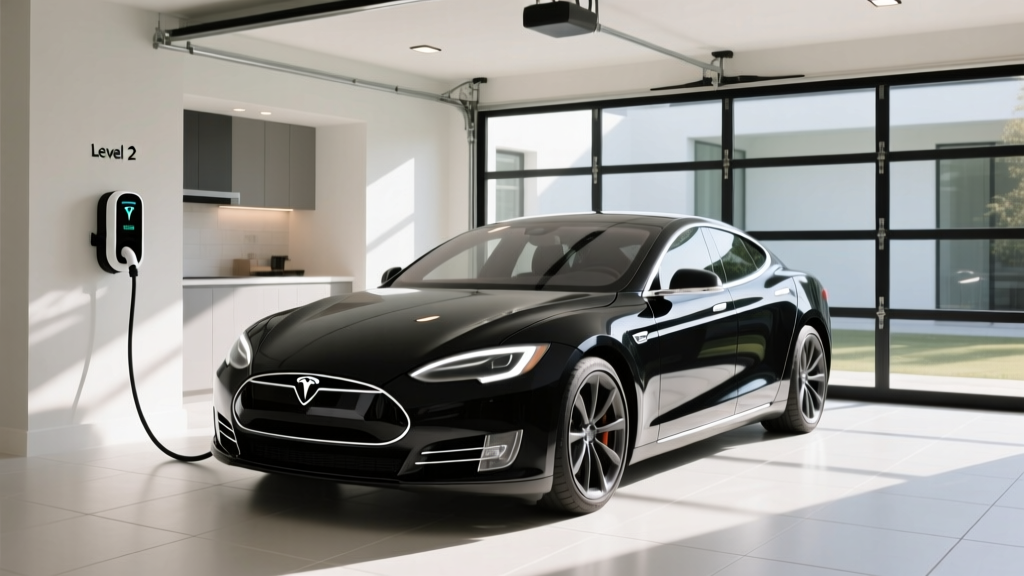
The most reliable way to prevent vampire drain and ensure your Tesla is always ready is a Level 2 home charger. Here's what you need to know about installation, electrical requirements, and costs.
Charging Levels Explained
| Level | Voltage / Amperage | Power (kW) | Miles of Range Added per Hour | Best For |
|---|---|---|---|---|
| Level 1 | 120V / 12A | ~1.4 kW | 3–5 mi/hr | Overnight top-up, offsetting vampire drain, emergency use |
| Level 2 | 240V / 32–48A | 7.7–11.5 kW | 25–44 mi/hr | Daily home charging, full overnight replenishment |
| DC Fast Charging | 400–800V DC | 50–250+ kW | 150–1,000+ mi/hr (peak) | Road trips, rapid replenishment on the go |
Important distinction: kW (kilowatts) measures power — the rate at which energy flows into your car. kWh (kilowatt-hours) measures energy — the total capacity of your battery. A 75 kWh battery charged at 11.5 kW (Level 2) takes roughly 6.5 hours from 0–100%. A 250 kW DC fast charger can add the same energy in under 20 minutes (though charge speed tapers significantly above 80% SoC due to battery protection protocols).
Electrical Requirements for Level 2 Installation
A Level 2 charger requires a 240-volt dedicated circuit — the same type of circuit your electric dryer or oven uses. Here are the specifics:
- Circuit rating: 40A or 50A breaker (for 32A or 40A continuous charging, respectively). The National Electrical Code (NEC) requires circuits to be rated at 125% of the continuous load, so a 40A charger needs a 50A breaker.
- Wire gauge: 6 AWG copper for 50A circuits; 8 AWG for 40A circuits (varies by run length and local code).
- Connector type: NEMA 14-50 (most common for EV charging) or hardwired connection. Hardwired installations avoid the ~$50–80 receptacle cost and are required in some jurisdictions for circuits above 50A.
- Panel capacity: Your home's electrical panel must have sufficient spare capacity. Most modern 200A panels can accommodate a 50A EV circuit. Older 100A panels may require a panel upgrade — a significant added cost.
Installation Cost Breakdown
| Component | Simple Install (Panel Adjacent) | Complex Install (Long Run / Panel Upgrade) |
|---|---|---|
| Charger unit (Level 2, 40–48A) | $400–$700 | $400–$700 |
| Electrical permit | $50–$150 | $50–$200 |
| Electrician labor (2–4 hrs simple / 6–10 hrs complex) | $300–$600 | $800–$2,000 |
| Wire, conduit, breaker | $100–$200 | $300–$800 |
| Panel upgrade (if needed — 100A to 200A) | N/A | $1,500–$3,500 |
| Total estimated cost | $850–$1,650 | $3,050–$7,200 |
The wide range reflects real variability. A garage with the panel on the same wall and a short wire run can be done for under $1,200 all-in. A detached garage requiring a 60-foot trench, conduit, and a panel upgrade can exceed $6,000. Always get at least three quotes from licensed electricians, and confirm they have EV charger installation experience.
Some utilities offer rebates of $200–$500 for Level 2 charger installation, and certain states provide additional incentives. Check your utility's website or the Alternative Fuels Data Center for current programs in your area.
Connector Compatibility: NACS, CCS, and Adapters
All current Tesla vehicles (Model S, 3, X, Y, and the Cybertruck) use the North American Charging Standard (NACS) connector — Tesla's proprietary design that has now been adopted by Ford, GM, Rivian, Volvo, and most major automakers as the industry standard starting in 2025.
| Connector | Used By | AC Level 2 | DC Fast Charging | Notes |
|---|---|---|---|---|
| NACS (Tesla) | Tesla (all models), Ford, GM, Rivian, Volvo, Polestar, others (2025+) | Yes | Yes — Tesla Supercharger network | Compact, no adapter needed for Teslas at Superchargers |
| CCS1 | Legacy non-Tesla EVs (2024 and earlier models from VW, Hyundai, BMW, etc.) | Yes (via J1772) | Yes — Electrify America, EVgo, ChargePoint | Tesla owners can use CCS stations with a $175 Tesla CCS adapter |
| CHAdeMO | Nissan Leaf, Mitsubishi Outlander PHEV (legacy) | No | Yes — declining network | Effectively discontinued for new vehicles |
For Tesla owners, the key takeaway is simple: your NACS connector works natively at all Tesla Superchargers (over 20,000 stalls in North America as of 2025). You can also access CCS-equipped public chargers from Electrify America and EVgo using Tesla's CCS adapter. Non-Tesla EVs with CCS ports can now access Tesla Superchargers using a NACS adapter or built-in NACS ports on 2025+ models from Ford, GM, and others.
Charging Time Examples: What to Expect
Charging speed is not linear. EVs charge fastest between roughly 10–50% SoC, then taper progressively to protect battery health. Here are realistic 10–80% charging times for common Tesla models:
| Model | Battery (kWh usable) | Level 2 (11.5 kW / 48A) | DC Fast (250 kW V3 Supercharger) | DC Fast (150 kW V2 Supercharger) |
|---|---|---|---|---|
| Model 3 RWD (LFP, 2025) | ~57.5 kWh | ~5 hrs | ~28 min | ~40 min |
| Model 3 Long Range (NMC) | ~75 kWh | ~6.5 hrs | ~25 min | ~38 min |
| Model Y Long Range (NMC) | ~75 kWh | ~6.5 hrs | ~25 min | ~38 min |
| Model S (NMC, 2025) | ~95 kWh | ~8.3 hrs | ~30 min | ~48 min |
Note that LFP (lithium iron phosphate) batteries in the Model 3 RWD can be charged to 100% regularly without degradation concerns, unlike NMC chemistry which benefits from an 80–90% daily limit. LFP also has a slightly lower energy density but offers a longer cycle life — a trade-off worth understanding if you plan to keep your vehicle long-term.
Cost to Charge: Home vs. Public vs. Gas
One of the strongest arguments for EV ownership is the per-mile energy cost. Here's how Tesla charging costs compare to gasoline:
| Scenario | Cost per kWh | Efficiency (kWh/mi) | Cost per Mile |
|---|---|---|---|
| Home charging (national avg. electricity) | $0.16/kWh | 0.28 kWh/mi (Model Y) | $0.045/mi |
| Home off-peak / time-of-use rate | $0.08/kWh | 0.28 kWh/mi | $0.022/mi |
| Tesla Supercharger (avg. 2025 pricing) | $0.32/kWh | 0.28 kWh/mi | $0.090/mi |
| Electrify America / public DC fast | $0.43/kWh | 0.28 kWh/mi | $0.120/mi |
| Gas vehicle (28 MPG combined, $3.40/gal) | — | — | $0.121/mi |
Home charging is dramatically cheaper than gasoline — roughly one-quarter to one-third the per-mile cost. Even public DC fast charging is now roughly cost-competitive with gas on a per-mile basis, though it remains more expensive than home charging. If your utility offers time-of-use rates and you charge overnight, your cost per mile can drop below $0.03.
For a driver covering 12,000 miles per year, the annual fuel savings of home-charging a Model Y versus a 28 MPG gas vehicle amount to approximately $1,380 ($540 for electricity vs. $1,452 for gasoline at the averages above).
Recommended Home Chargers for Tesla Owners
Here are three proven Level 2 chargers that pair well with Tesla vehicles, with exact specs:
Tesla Wall Connector (Gen 3)
- Power output: Up to 11.5 kW (48A at 240V)
- Connector: Native NACS — no adapter needed for Tesla vehicles
- Cable length: 24 feet
- Smart features: Wi-Fi enabled, OTA updates, power sharing between two units on one circuit, access control
- Price: ~$475
- Best for: Tesla-only households seeking seamless integration
ChargePoint Home Flex
- Power output: Up to 12 kW (50A at 240V) — configurable from 16A to 50A
- Connector: J1772 (NACS adapter included for Tesla) or NACS version available (2025+)
- Cable length: 23 feet
- Smart features: Wi-Fi, ChargePoint app scheduling, Alexa integration, utility demand-response compatible
- Price: ~$550–$700
- Best for: Multi-EV households (Tesla + non-Tesla) or those wanting flexible amperage
Emporia Vue Level 2 Charger
- Power output: Up to 11.5 kW (48A at 240V)
- Connector: J1772 (Tesla adapter included) or NACS (2025 model)
- Cable length: 24 feet
- Smart features: Wi-Fi, Emporia app with energy monitoring, solar integration, scheduled charging, load management
- Price: ~$400
- Best for: Budget-conscious buyers or homes with solar panels seeking integrated energy management
Safety and Electrical Code Considerations
EV charging involves sustained high-current draw — often for 6–10 hours continuously. This places demands on your electrical system that exceed typical household appliances. Key safety requirements include:
- Dedicated circuit: Your Level 2 charger must have its own dedicated circuit — it cannot share with other appliances. This is a NEC requirement.
- GFCI protection: The 2020 NEC (and most 2023/2026 local adoptions) requires GFCI protection for all outdoor receptacles used for EV charging. Hardwired installations may be exempt in some jurisdictions — ask your electrician.
- Outdoor rating: If your charger is installed outdoors, both the unit and the receptacle (if not hardwired) must carry a NEMA 4 or NEMA 4X weather-resistance rating. All three chargers recommended above are outdoor-rated.
- Permit and inspection: Virtually all jurisdictions require an electrical permit for a new 240V circuit. The inspection ensures proper wire gauge, breaker sizing, grounding, and GFCI compliance. Do not skip this — it protects your home and is required for insurance coverage of any electrical fire.
- Load calculation: A licensed electrician will perform a NEC Article 220 load calculation to confirm your panel can handle the added circuit. If your panel is already near capacity (common in older homes with electric heat, AC, and a dryer), a panel upgrade or a smart load-management device (such as the Emporia Smart Load Center) may be necessary.
Long-Term Storage: Best Practices for Leaving Your Tesla
If you're leaving your Tesla for an extended period — a month-long trip, a seasonal residence, or military deployment — follow this checklist:
- Plug it in. Even a Level 1 (120V) connection will offset vampire drain indefinitely. Set the charge limit to 50% for NMC batteries or 100% for LFP.
- Disable Sentry Mode, cabin overheat protection, and smart preconditioning.
- Check tire pressure and inflate to the door-jamb spec. Flat-spotting can occur after 30+ days of stationary parking.
- Enable "Sleep" mode if available in your software version, and ask a trusted person to check the Tesla app once per week (minimizing wake cycles).
- If you cannot plug in: Charge to 80–90% before departure, disable all power-drawing features, and expect to lose roughly 1–2 miles per day. A Model Y Long Range at 90% (288 miles) should maintain above 20% SoC for approximately 4 months under these conditions.
Tesla's BMS will prevent the battery from reaching a truly damaging 0% state under normal circumstances. However, if the 12V auxiliary battery dies (a separate concern from the traction battery), it can prevent the car from "waking up" to charge. Keeping the vehicle plugged in also maintains the 12V battery via the DC-DC converter.
Frequently Asked Questions
How much does it cost to install a home EV charger?
A typical Level 2 home charger installation costs between $850 and $1,650 for a straightforward setup (panel nearby, short wire run, no panel upgrade). Complex installations requiring long conduit runs, trenching, or a panel upgrade from 100A to 200A can range from $3,000 to $7,200. Always budget for the charger unit ($400–$700), electrician labor ($300–$2,000), permits ($50–$200), and materials ($100–$800).
How fast will each charging level add range?
Level 1 (120V) adds roughly 3–5 miles per hour. Level 2 (240V, 48A) adds 30–44 miles per hour, easily replenishing a full day's driving overnight. DC fast charging (150–250 kW) can add 150–200+ miles in 15 minutes, though speed tapers significantly above 80% SoC.
Which connector is compatible with my Tesla?
All Tesla vehicles use the NACS connector natively. This works at all Tesla Superchargers without an adapter. To use CCS-equipped public chargers (Electrify America, EVgo), you'll need the Tesla CCS Adapter (~$175). Starting in 2025, many non-Tesla EVs also adopted NACS, so the Supercharger network is increasingly cross-compatible.
How much does charging cost per mile vs. gas?
Home charging a Tesla Model Y at the national average electricity rate of $0.16/kWh costs approximately $0.045 per mile. A comparable gas vehicle at 28 MPG and $3.40/gallon costs $0.121 per mile — nearly three times more. Even Supercharging at $0.32/kWh ($0.09/mile) undercuts gasoline.
What electrical upgrades might I need?
If your home has a 200-amp electrical panel with spare breaker slots and sufficient load capacity, you likely need no upgrade. Homes with 100-amp panels, electric heating, or heavy existing loads may require a panel upgrade ($1,500–$3,500) or a smart load-management device to avoid overloading the service. A licensed electrician's load calculation is the definitive answer — never skip this step.
Can I leave my Tesla unplugged for a month?
Yes, in most cases. With Sentry Mode off and moderate temperatures, expect to lose roughly 30–60 miles of range over 30 days. Start with at least 70–80% SoC, disable all standby power features, and your Tesla will be fine. In extreme cold or with Sentry Mode active, plug in or arrange for someone to check on it weekly.