What Is the Tesla V4 Supercharger Payment Kiosk?
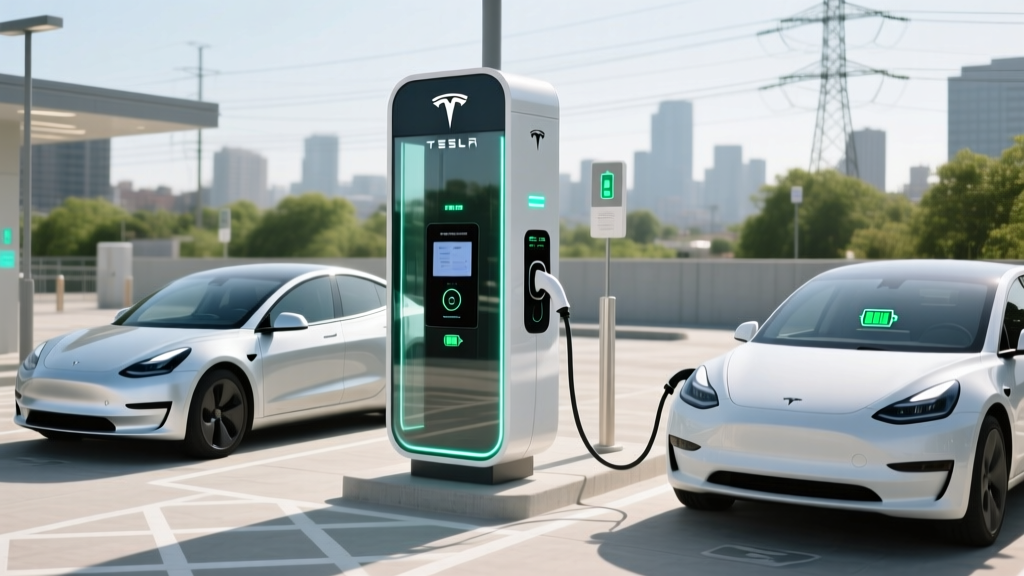
For years, Tesla's Supercharger network was an exclusive walled garden — proprietary connectors, app-only billing, and zero access for non-Tesla EVs. That changed as Tesla opened its network to CCS-equipped vehicles and deployed the V4 Supercharger architecture. The Tesla V4 Supercharger payment kiosk is a standalone payment terminal installed at select V4 sites, designed to let drivers of non-Tesla EVs initiate and pay for a charging session without needing the Tesla app or a Tesla account.
This matters because Tesla's NACS (North American Charging Standard) connector is now the industry standard, adopted by Ford, GM, Rivian, Hyundai, and virtually every major automaker for 2025+ models. But millions of existing CCS1-equipped EVs — like the Hyundai Ioniq 5, Kia EV6, and Volkswagen ID.4 — still need adapter access or a payment workaround at Tesla stalls. The V4 payment kiosk bridges that gap.
Charging Levels Explained: Speeds, Power, and Range Added
Before diving into V4 specifics, it's essential to understand the three EV charging levels and how power (kW) translates to range added. Remember: kW (kilowatts) measures power — the rate of energy delivery, while kWh (kilowatt-hours) measures energy — the total capacity of your battery. Confusing these is the most common EV literacy mistake.
| Level | Voltage / Power | Typical kW | Miles of Range / Hour | Best Use Case |
|---|---|---|---|---|
| Level 1 | 120V AC | 1.4–1.9 kW | 3–5 mi/hr | Overnight top-up, PHEVs |
| Level 2 | 240V AC | 7.2–19.2 kW | 20–60 mi/hr | Home daily charging, workplace |
| DC Fast Charging | 400–800V DC | 50–350+ kW | 150–1,000+ mi/hr (peak) | Road trips, rapid top-up |
The Tesla V4 Supercharger cabinet delivers up to 250 kW per stall (with some V4 deployments supporting up to 350 kW on the latest CCS2/NACS posts). For context, a Tesla Model Y Long Range (75 kWh usable battery) charging at a V4 stall can add roughly 200 miles of range in 15 minutes during peak charge rate, though the charge curve tapers significantly above 80% state of charge (SoC).
Tesla V4 Supercharger Specs: Power, Connectors, and Charging Times
The V4 architecture differs from the older V3 Superchargers in several key ways. Here's what you need to know:
- Peak power: 250 kW per stall (V4 cabinet); newer posts in some markets support up to 350 kW
- Connectors at stall: Native NACS (Tesla) cable; integrated CCS1 Magic Dock adapter at open-network sites
- Payment kiosk: Standalone credit/debit card terminal at select V4 sites for non-Tesla vehicles
- Cable length: V4 cables are longer than V3 (~9.5 ft vs ~8 ft), improving reach to charge ports on either side
- Stall design: V4 posts are slimmer, with the power cabinet separated from the charging post (reducing noise and enabling easier maintenance)
Real-World Charging Times at V4 (10–80% SoC)
Peak kW is not sustained kW. Every EV's charge curve tapers as the battery fills. Here's what to expect at a V4 stall in real-world conditions:
| Vehicle (Battery Size) | Peak Charge Rate | 10–80% Time (est.) | Notes |
|---|---|---|---|
| Tesla Model Y LR (75 kWh) | 250 kW | ~22–25 min | Peaks early, tapers after 50% |
| Ford F-150 Lightning Ext. (131 kWh) | ~150–170 kW | ~38–44 min | Large battery, lower peak C-rate |
| Hyundai Ioniq 5 (77.4 kWh) | ~150 kW (via adapter) | ~28–34 min | Adapter may limit peak; 800V arch. |
| Rivian R1T Dual (128.9 kWh) | ~200 kW | ~35–40 min | NACS native on 2025+ models |
Home EV Charger Installation: Costs, Electrical Requirements, and Equipment
Public DC fast charging is essential for road trips, but 80%+ of EV charging happens at home. A properly installed Level 2 home charger is the single best investment for EV ownership. Here's what's involved.
Electrical Requirements for Level 2 Home Charging
A Level 2 charger requires a 240-volt dedicated circuit, similar to what powers an electric dryer or oven. The most common configurations:
- NEMA 14-50 outlet (50A circuit / 40A continuous): The most versatile setup. Supports chargers up to 9.6 kW (40A × 240V). Requires a 50-amp double-pole breaker.
- Hardwired 60A circuit (48A continuous): Delivers up to 11.5 kW. Required for higher-output chargers like the ChargePoint Home Flex at max settings. No outlet — wires connect directly to the charger.
- NEMA 6-50 outlet (50A circuit): Less common, but works for some installations. Only provides 240V without a neutral wire.
Do You Need a Panel Upgrade?
This is the most overlooked cost in home charging. If your home has a 100-amp electrical panel (common in homes built before 2000), adding a 50A EV circuit may max out your panel's capacity. An electrician will perform a load calculation to determine if your panel can handle the additional draw. If not, a panel upgrade to 200A typically costs $1,500–$3,500 before any charger work begins. Homes with 200A panels usually have sufficient headroom.
| Component | Low Estimate | High Estimate | Notes |
|---|---|---|---|
| Level 2 charger equipment | $300 | $750 | ChargePoint Flex, Wall Connector, etc. |
| Electrician labor (outlet install) | $400 | $1,200 | Depends on run length, conduit, wall type |
| Permit fee | $50 | $250 | Varies by municipality |
| Panel upgrade (if needed) | $1,500 | $3,500 | 100A → 200A upgrade; not always required |
| Total (no panel upgrade) | $750 | $2,200 | Most common scenario |
| Total (with panel upgrade) | $2,250 | $5,700 | Older homes with 100A service |
The federal Alternative Fuel Vehicle Refueling Property Credit (IRC §30C) offers up to $1,000 (30% of equipment + installation costs) for home charger installs in eligible census tracts. Check the IRS §30C guidelines for current eligibility — census-tract requirements apply and rules are subject to change.
Recommended Home Level 2 Chargers (2026)
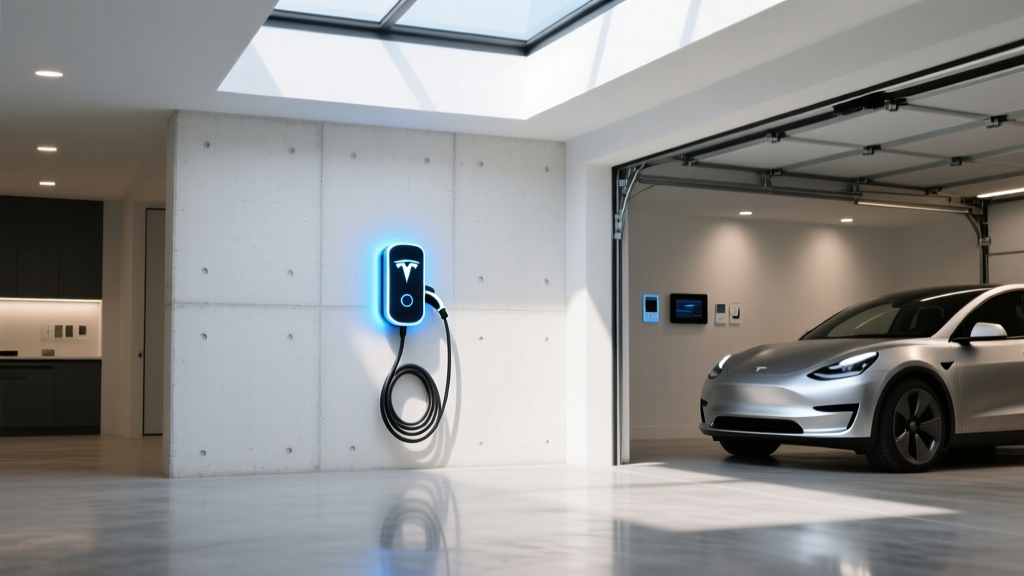
Tesla Wall Connector (Gen 3)
- Power output: Up to 11.5 kW (48A hardwired) or 9.6 kW (NEMA 14-50)
- Connector: Native NACS; J1772 adapter included for non-Tesla EVs
- Cable length: 24 ft
- Smart features: Wi-Fi, OTA updates, power sharing between two units, access control
- Price: ~$475
ChargePoint Home Flex
- Power output: Up to 12 kW (50A) — configurable from 16A to 50A
- Connector: NACS or J1772 (select at purchase)
- Cable length: 23 ft
- Smart features: Wi-Fi, ChargePoint app scheduling, Alexa integration, amperage adjustment
- Price: ~$550–$650
Emporia Level 2 Smart Charger
- Power output: Up to 11.5 kW (48A hardwired)
- Connector: J1772 (NACS adapter available separately)
- Cable length: 24 ft
- Smart features: Wi-Fi, energy monitoring via Emporia Vue, solar integration, scheduling
- Price: ~$350–$400
Connector Compatibility: NACS, CCS1, CHAdeMO, and Adapter Needs
The connector landscape has consolidated dramatically. As of 2026, NACS is the dominant standard in North America, but millions of CCS1-equipped vehicles remain on the road. Here's how compatibility breaks down:
| Connector | Brands Using It (2026) | Tesla Supercharger Access | Adapter Needed? |
|---|---|---|---|
| NACS (Tesla) | Tesla, Ford, GM, Rivian, Hyundai, Kia, Volvo, Polestar, BMW, Mercedes (new models) | Native — plug and charge | None for Superchargers; CCS adapter needed for Electrify America, etc. |
| CCS1 | Older Hyundai/Kia (pre-2025), VW ID.4 (pre-2025), BMW i4 (pre-2025), legacy models | Via Magic Dock adapter at open sites, or aftermarket NACS-to-CCS adapter | Yes — NACS-to-CCS adapter (~$200–$300) or use built-in Magic Dock |
| CHAdeMO | Nissan Leaf (discontinued), Mitsubishi Outlander PHEV (older) | No — not compatible | No viable adapter; use CHAdeMO-specific networks |
At Tesla V4 Supercharger sites with payment kiosks, the Magic Dock — a built-in CCS1 adapter integrated into the NACS cable — allows CCS-equipped vehicles to connect directly. You unlatch the NACS portion, extend the CCS adapter sleeve, and plug into your CCS port. Not all V4 sites have Magic Dock; check the Tesla app or your vehicle's navigation for "Open to Non-Tesla EVs" site labels.
Charging Costs: Home vs. Public DC Fast Charging vs. Gas
The economics of EV charging depend heavily on where and when you charge. Here's a realistic breakdown:
| Scenario | $/kWh or $/gal | Vehicle Efficiency | Cost Per Mile |
|---|---|---|---|
| Home charging (off-peak utility rate) | $0.10–$0.14/kWh | 3.5 mi/kWh (e.g., Model Y) | $0.03–$0.04/mi |
| Home charging (standard rate, no TOU) | $0.16–$0.20/kWh | 3.5 mi/kWh | $0.05–$0.06/mi |
| Tesla V4 Supercharger (avg.) | $0.28–$0.36/kWh | 3.5 mi/kWh | $0.08–$0.10/mi |
| Electrify America / EVgo DCFC | $0.35–$0.55/kWh | 3.0 mi/kWh | $0.12–$0.18/mi |
| Gasoline (30 MPG combined vehicle) | $3.40/gal | 30 MPG | $0.11/mi |
The takeaway: home charging is dramatically cheaper than gas, typically 3–4 cents per mile vs. 11 cents. Even at Tesla V4 Supercharger rates, you're paying roughly the same per mile as a fuel-efficient gas car. The worst-case scenario — frequent use of premium-priced third-party DC fast chargers — can exceed gas costs per mile. This is why home charging access is the single biggest financial factor in EV ownership.
At V4 Supercharger sites with payment kiosks, non-Tesla EV drivers may pay a slightly higher per-kWh rate than Tesla owners (typically $0.02–$0.06/kWh more), reflecting the open-network pricing tier. Tesla has been gradually reducing this surcharge as NACS adoption grows.
Safety, Electrical Code, and Installation Best Practices
EV charging involves sustained high-current draw over many hours — this is more demanding on your electrical system than intermittent loads like a dryer. Key safety and code considerations:
- Dedicated circuit required: Your Level 2 charger must be on its own dedicated double-pole breaker. Never share the circuit with other appliances.
- GFCI protection: NEC 2020 and later require GFCI protection for EV outlets in garages. Hardwired chargers may have GFCI built into the unit. Your electrician will ensure compliance with local code amendments.
- Outdoor-rated equipment: If your charger is installed outdoors, both the charger (NEMA 4 rating) and any outlet cover must be rated for wet locations. The Tesla Wall Connector and ChargePoint Home Flex both carry NEMA 4 outdoor ratings.
- Wire gauge: A 50A circuit requires 6 AWG copper wire (or 4 AWG aluminum). A 60A circuit requires 4 AWG copper. Undersized wire is a fire hazard — this is not a DIY project.
- Permit and inspection: Most jurisdictions require a permit and post-installation inspection for EV charger circuits. Skipping this can void homeowner's insurance coverage for electrical fires.
Frequently Asked Questions
How much does it cost to install a home EV charger?
For most homes with a 200-amp panel, expect $750–$2,200 total (charger equipment + electrician labor + permit). If your home has an older 100-amp panel that needs upgrading to 200A, add $1,500–$3,500 for the panel work, bringing the total to $2,250–$5,700. The federal §30C credit can offset up to $1,000 of these costs in eligible areas.
How fast will each charging level add range?
Level 1 (120V) adds 3–5 miles per hour — adequate for PHEVs with small batteries but impractical for full BEVs. Level 2 (240V) adds 20–60 miles per hour depending on amperage, easily replenishing a full overnight charge. DC fast charging at a Tesla V4 Supercharger can add 150–200+ miles in 15 minutes at peak rate, though the charge curve tapers significantly above 80% SoC.
Which connector/charger is compatible with my EV?
If you drive a 2025+ model from Ford, GM, Hyundai, Kia, Rivian, or most other brands, your vehicle likely has a native NACS port and can plug directly into Tesla Superchargers (including V4). If you drive a pre-2025 EV with a CCS1 port (older Ioniq 5, EV6, ID.4, etc.), you'll need either a Tesla Magic Dock adapter (built into some V4 stalls at open sites) or an aftermarket NACS-to-CCS adapter (~$200–$300). CHAdeMO vehicles (Nissan Leaf) cannot use Tesla Superchargers.
How much does charging cost per mile vs. gas?
Home charging on off-peak utility rates costs roughly $0.03–$0.04 per mile — about one-third the cost of gasoline at $3.40/gal in a 30 MPG car ($0.11/mi). Even at Tesla V4 Supercharger rates ($0.28–$0.36/kWh), you're paying $0.08–$0.10/mile, comparable to gas. The savings gap narrows when relying exclusively on expensive third-party DC fast chargers ($0.12–$0.18/mi).
What electrical upgrades might I need for a home charger?
The most common upgrade is a panel upgrade from 100A to 200A service, required when your existing panel lacks headroom for a dedicated 50A or 60A EV circuit. Your electrician will perform a NEC Article 220 load calculation. Other potential upgrades include running new conduit from the panel to your garage or parking spot (especially if the panel is on the opposite side of the house), upgrading the meter base, or adding a sub-panel in the garage. Always get a detailed quote that itemizes these possibilities before work begins.
Do I need the Tesla app to use a V4 Supercharger payment kiosk?
No. The V4 payment kiosk was specifically designed for non-Tesla EV drivers who don't have or want the Tesla app. You simply plug in, walk to the kiosk, tap a credit or debit card, select your stall number, and charging begins. Tesla owners continue using the seamless plug-and-charge experience with automatic account billing. Note that pricing at the kiosk may be slightly higher than Tesla-owner rates.