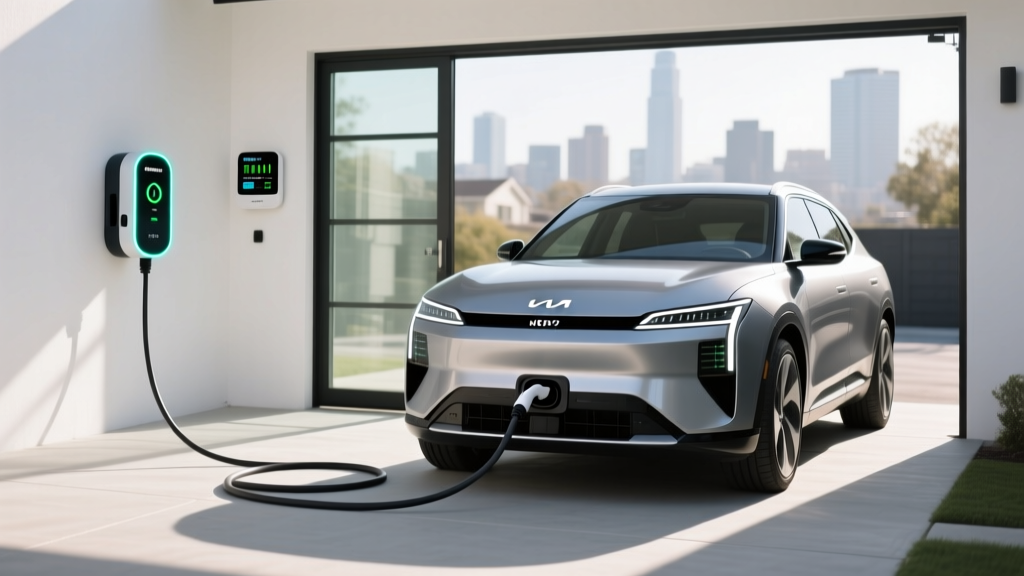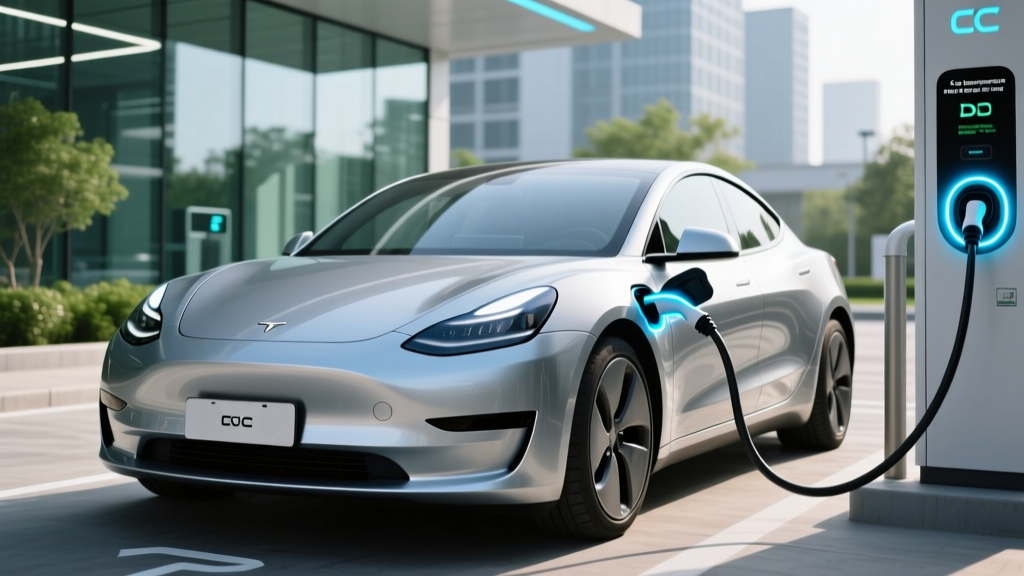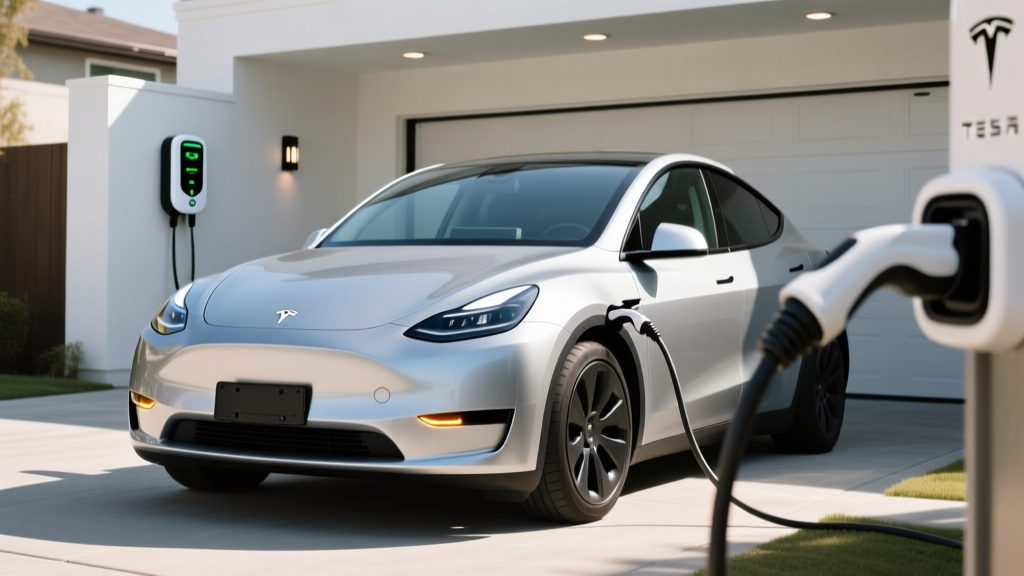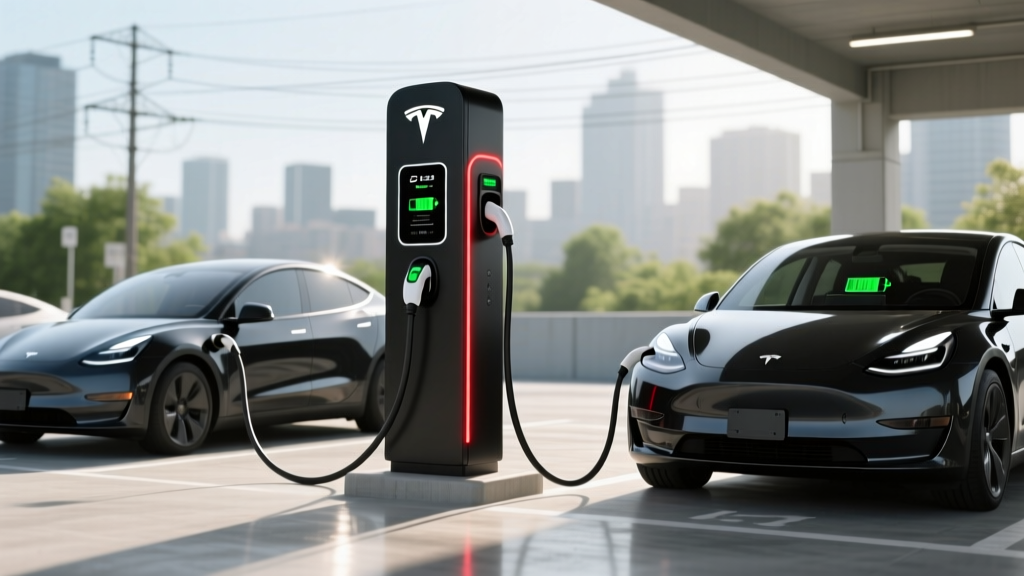
The Tesla V4 Supercharger represents the current generation of DC fast charging hardware deployed across Tesla's network, and its implications extend well beyond Tesla owners. With cabinets capable of delivering up to 350 kW to a single stall and native CCS support via adapter, the V4 architecture is reshaping what EV drivers can expect from public fast charging. But public infrastructure is only half the equation — most EV owners do 80% or more of their charging at home on Level 2 equipment.
This guide covers the V4 charger's real-world performance, connector compatibility across brands, and the complete picture of home charging installation — from electrical panel requirements to total cost breakdowns with 2026 pricing.
What the V4 Charger Actually Delivers
The V4 Supercharger cabinet supports up to four charging posts, each capable of pulling up to 350 kW of DC power — a substantial jump from the 250 kW ceiling of the V3 network. In practice, whether your vehicle actually receives that peak rate depends on its onboard charge acceptance, battery state of charge (SoC), and battery temperature.
A vehicle like the Tesla Model 3 Long Range (82 kWh usable, NMC chemistry) arriving at a V4 stall with a preconditioned battery at roughly 10% SoC can sustain peak rates for a narrow window before the charge curve tapers. Real-world testing shows 10-80% charges in approximately 15-18 minutes at a V4 station, compared to 22-25 minutes on a V3 cabinet limited to 250 kW. Above 80% SoC, charging speed drops significantly — this is a battery-protection behavior common to all lithium-ion chemistries, not a V4 limitation.
For vehicles with lower charge acceptance — say, a Chevrolet Equinox EV capped at roughly 150 kW peak — the V4 cabinet's extra headroom doesn't shorten charge times. You'll only extract the benefit if your vehicle's battery management system (BMS) can negotiate higher rates.
Charging Levels Explained: Speeds and Range Added
Understanding the three charging levels is essential before evaluating any charger hardware. The critical distinction: kW (kilowatts) measures power — how fast energy flows into the battery. kWh (kilowatt-hours) measures energy — the battery's total capacity. Think of kW as the flow rate of a hose and kWh as the size of the bucket.
| Level | Voltage | Power (kW) | Miles of Range Per Hour | Typical Use Case |
|---|---|---|---|---|
| Level 1 | 120V AC | 1.0–1.4 kW | 3–5 mi/hr | Overnight top-ups, PHEVs, emergency |
| Level 2 | 240V AC | 3.3–19.2 kW | 12–75 mi/hr | Home daily charging, workplace, destinations |
| DC Fast | 400–800V DC | 50–350 kW | 150–1,000+ mi/hr (peak) | Road trips, rapid top-ups, commercial fleets |
A 48-amp Level 2 home charger on a 60-amp circuit delivers up to 11.5 kW — enough to fully replenish a 75 kWh battery overnight in roughly 7 hours. For most daily driving (30-50 miles), even a 32-amp (7.7 kW) Level 2 unit restores a full day's use in 2-3 hours.
Connector Compatibility: NACS, CCS1, and CHAdeMO
The connector landscape has consolidated significantly since Ford, GM, Rivian, and most major automakers adopted the North American Charging Standard (NACS) for their EVs starting in the 2025-2026 model years. The V4 Supercharger posts feature an integrated CCS1 cable in addition to the native NACS connector, meaning non-Tesla EVs with CCS ports can charge without an adapter at many V4 locations.
| Connector | Native Vehicles | Adapter Needed for V4? |
|---|---|---|
| NACS (Tesla standard) | Tesla (all), Ford (2025+), GM (2025+), Rivian, Hyundai/Kia (2026+), others | No — plug directly into V4 NACS cable |
| CCS1 | Older Ford/GM/Hyundai/Kia/VW models (pre-NACS transition) | No — V4 posts include CCS1 cable; or use CCS-to-NACS adapter at NACS-only posts |
| CHAdeMO | Nissan Leaf (legacy), Mitsubishi Outlander PHEV (older) | Yes — CHAdeMO-to-CCS adapter required; limited availability |
If you drive a pre-2025 EV with a CCS1 port, Tesla's Magic Dock adapter (built into some V3/V4 stalls) or a third-party CCS-to-NACS adapter (such as the Lectron or A2Z unit, typically $150-$220) lets you access the Supercharger network. According to Tesla's non-Tesla Supercharging support page, the Tesla app is required to initiate and monitor charging sessions at Superchargers for non-Tesla vehicles.
Home Charging Installation: Electrical Requirements and Costs
Installing a dedicated Level 2 home charger is the single most impactful upgrade for EV ownership convenience. Here's what the electrical work actually involves.
Circuit and Voltage Requirements
A typical 48-amp Level 2 charger requires a dedicated 60-amp, 240-volt circuit using 6 AWG copper wire (or 4 AWG aluminum). The National Electrical Code (NEC) requires that continuous loads — which EV charging qualifies as — not exceed 80% of the circuit breaker rating. So a 60A breaker supports 48A continuous draw; a 50A breaker supports 40A.
Hardwired installations are preferred over plug-in (NEMA 14-50 outlet) setups for chargers rated above 40 amps, as they eliminate the outlet as a potential failure point and avoid the NEC requirement for GFCI breakers on receptacles — which can cause nuisance tripping with some EVSE units.
Panel Upgrade Considerations
This is the cost variable most online guides gloss over. If your home has a 100-amp electrical panel — common in homes built before the 1990s — adding a 60-amp EV circuit may push your total calculated load beyond the panel's capacity. A licensed electrician will perform a load calculation per NEC Article 220 to determine if an upgrade is needed.
A panel upgrade from 100A to 200A typically costs $1,500-$3,500 depending on your utility's requirements, local labor rates, and whether a new meter base or service drop is needed. Homes with existing 200A panels usually have sufficient headroom for a Level 2 charger without an upgrade.
| Component | Cost Range | Notes |
|---|---|---|
| Level 2 EVSE equipment | $300–$700 | 40A–48A smart charger, 25ft cable |
| Electrical labor (standard install) | $500–$1,500 | Run from panel to garage/carport; varies by distance and wall type |
| Permit and inspection | $50–$250 | Required in most jurisdictions; varies by municipality |
| Panel upgrade (if needed) | $1,500–$3,500 | 100A to 200A service upgrade |
| Total (no panel upgrade) | $850–$2,450 | Most common scenario for modern homes |
| Total (with panel upgrade) | $2,350–$5,950 | Older homes with 100A service |
The federal Alternative Fuel Vehicle Refueling Property Credit (IRC §30C) offers up to $1,000 (30% of equipment and installation costs) for home charger installations placed in service, subject to census-tract eligibility requirements. Check the IRS guidelines and consult a tax professional, as eligibility depends on your specific location and tax situation.
Charging Cost Per Mile: Home vs. Public vs. Gas
One of the strongest economic arguments for EVs is the per-mile fuel cost, but the savings vary dramatically depending on where and when you charge.
| Charging Scenario | Rate ($/kWh) | Cost Per Mile* | Annual Cost (12,000 mi) |
|---|---|---|---|
| Home Level 2 (off-peak/utility rate) | $0.12–$0.16 | $0.036–$0.048 | $432–$576 |
| Home Level 2 (standard residential rate) | $0.16–$0.22 | $0.048–$0.066 | $576–$792 |
| Public Level 2 (network pricing) | $0.25–$0.49 | $0.075–$0.147 | $900–$1,764 |
| DC Fast Charging (public) | $0.35–$0.65 | $0.105–$0.195 | $1,260–$2,340 |
| Gasoline vehicle (28 MPG combined) | $3.40/gal avg | $0.121 | $1,452 |
*Based on an EV averaging 3.0 miles per kWh (roughly 33 kWh/100mi, typical for a midsize crossover EV like the Tesla Model Y or Hyundai Ioniq 5). Data sourced from fueleconomy.gov efficiency ratings.
Home charging on an off-peak utility rate delivers the lowest per-mile cost — often one-quarter the cost of gasoline. Even public DC fast charging at premium rates can match or beat gasoline on a per-mile basis. However, if you rely exclusively on public DC fast charging at $0.50+/kWh networks, your "fuel" costs can exceed those of an efficient hybrid. This is why home charging access remains the single most important factor in EV ownership economics.
Recommended Home Level 2 Chargers (2026)
While the V4 Supercharger handles road-trip fast charging, your daily charging will happen at home. Here are proven Level 2 units with the specs that matter:
Tesla Wall Connector (Gen 4)
Power: Up to 11.5 kW (48A) on a 60A circuit
Connector: NACS native; J1772 adapter included for non-Tesla EVs
Cable length: 24 feet
Smart features: Wi-Fi, OTA updates, power-sharing between two units on one circuit, load management
Price: ~$475
Best for: Tesla owners and NACS-equipped vehicles; cleanest integration with the Tesla ecosystem
ChargePoint Home Flex
Power: Up to 12 kW (50A) on a 60A circuit, configurable down to 16A for lower-capacity panels
Connector: J1772 native (NACS adapter available separately)
Cable length: 23 feet
Smart features: Wi-Fi, app scheduling, Alexa integration, detailed energy tracking
Price: ~$550-$650
Best for: Non-Tesla EVs with J1772/CCS ports; flexible amperage settings for older panels
Emporia Level 2 EV Charger
Power: Up to 11.5 kW (48A) on a 60A circuit
Connector: J1772 native
Cable length: 24 feet
Smart features: Wi-Fi, solar integration with Emporia Vue energy monitor, scheduled charging, energy dashboard
Price: ~$350-$400
Best for: Budget-conscious buyers; homes with solar panels seeking integrated energy management
Real-World Charging Times: What to Expect
Manufacturer-advertised charge times assume ideal conditions: a preconditioned battery, low state of charge, and peak-rate-capable infrastructure. Here's how common EVs perform in realistic scenarios.
| Vehicle (Battery kWh) | V4 DC Fast (350 kW capable) | V3 DC Fast (250 kW) | Home Level 2 (11.5 kW) | Home Level 2 (7.7 kW) |
|---|---|---|---|---|
| Tesla Model 3 LR (82 kWh, NMC) | ~15–18 min | ~22–25 min | ~5.0 hrs (0-100%) | ~7.5 hrs (0-100%) |
| Ford F-150 Lightning Ext. (131 kWh, NMC) | ~28–35 min* | ~38–42 min* | ~8.5 hrs (0-100%) | ~12.5 hrs (0-100%) |
| Hyundai Ioniq 5 (77.4 kWh, NMC) | ~18–20 min** | ~22–25 min** | ~4.8 hrs (0-100%) | ~7.0 hrs (0-100%) |
| Chevrolet Equinox EV (85 kWh, NMC) | ~25–30 min*** | ~30–35 min*** | ~5.2 hrs (0-100%) | ~8.0 hrs (0-100%) |
*F-150 Lightning peak acceptance ~170 kW; V4 headroom not fully utilized.
**Ioniq 5 with 800V architecture peaks at ~240 kW; benefits substantially from V4 cabinet capacity.
***Equinox EV peak acceptance ~150 kW.
Charge curve taper matters: a vehicle might accept 250 kW at 15% SoC but drop to 80 kW by 60% SoC and 40 kW by 80%. The 10-80% time captures this taper realistically. Charging from 80-100% can take nearly as long as the 10-80% segment — plan your road-trip stops around the 80% mark to avoid wasting time at the tail end of the curve.
Cold weather significantly impacts charging speed. In sub-40°F conditions, a battery that hasn't been preconditioned (via the vehicle's navigation routing to the charger) may accept only 50-100 kW even at a 350 kW V4 stall until the pack warms up. Always use your EV's built-in navigation to route to a fast charger — this triggers battery preconditioning automatically in most modern EVs.
Safety, Code, and Installation Best Practices
EV charging is a high-draw, long-duration electrical load — unlike an oven that cycles on and off, a Level 2 charger may pull maximum current continuously for 6-10 hours. This makes proper installation non-negotiable.
- Dedicated circuit: Your Level 2 charger must have its own dedicated circuit — not shared with other appliances. A 60A breaker with 6 AWG wire for a 48A charger is the standard configuration.
- GFCI considerations: The 2020 NEC requires GFCI protection on 240V receptacles, which can cause nuisance tripping with certain EVSEs. Hardwired installations are exempt from this requirement and are generally preferred for reliability.
- Outdoor rating: If your charger is installed outdoors or in an exposed carport, ensure the EVSE carries a NEMA 4 or IP65 weather rating. All units listed above meet outdoor-use standards.
- Permit and inspection: Most municipalities require an electrical permit for a new 240V circuit. The inspection ensures the wire gauge, breaker size, and grounding meet code. Skipping the permit risks insurance claim denials if an electrical fire occurs.
- Use a licensed electrician: While some jurisdictions allow homeowner electrical work, a licensed electrician ensures the load calculation is correct, the installation meets NEC requirements, and the work passes inspection. Get at least two quotes — labor rates vary significantly by region.
Frequently Asked Questions
How much does it cost to install a home EV charger?
For a standard 48-amp Level 2 charger on a 60-amp circuit, expect $850–$2,450 total (equipment + electrician + permit) if your electrical panel has sufficient capacity. If a panel upgrade from 100A to 200A is required, add $1,500–$3,500, bringing the total to $2,350–$5,950. The federal §30C credit may offset up to $1,000 of these costs if your census tract qualifies.
How fast will each charging level add range?
Level 1 (120V) adds 3–5 miles of range per hour. Level 2 (240V, 48A) adds roughly 30–40 miles per hour for most EVs. DC fast charging at a V4 Supercharger can add 150–200+ miles in 15 minutes at peak rates, though sustained speed depends on your vehicle's charge acceptance and battery SoC.
Which connector and charger is compatible with my EV?
If your EV is a 2025+ model from Tesla, Ford, GM, Rivian, or Hyundai/Kia, it likely has a native NACS port and plugs directly into V4 Supercharger NACS cables. Older CCS1-equipped EVs can use the CCS1 cable integrated at many V4 posts or a CCS-to-NACS adapter. CHAdeMO vehicles (older Nissan Leaf) need a CHAdeMO-to-CCS adapter and have limited Supercharger access.
How much does charging cost per mile vs. gas?
Home Level 2 charging on a standard residential rate costs roughly $0.04–$0.07 per mile — about one-third to one-half the cost of gasoline at $3.40/gallon in a 28 MPG vehicle ($0.12/mi). Public DC fast charging at $0.45–$0.65/kWh costs $0.10–$0.20 per mile, which can equal or slightly exceed gasoline costs depending on your EV's efficiency.
What electrical upgrades might I need?
The most common upgrade is a panel capacity increase from 100A to 200A service ($1,500–$3,500). Some homes may also need a new meter base, service drop from the utility, or sub-panel installation if the charger location is far from the main panel (such as a detached garage). Your electrician's load calculation per NEC Article 220 determines what's required.