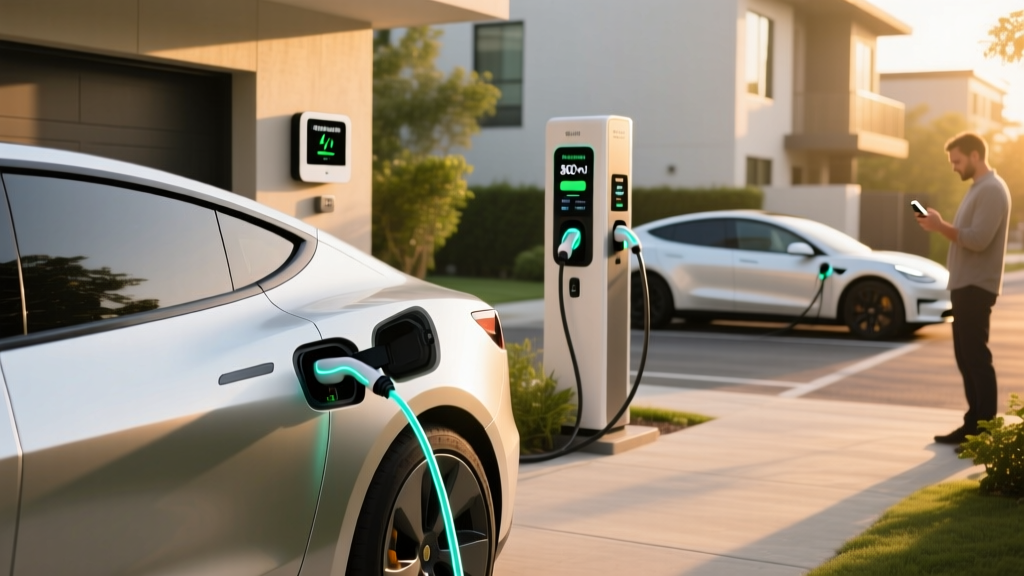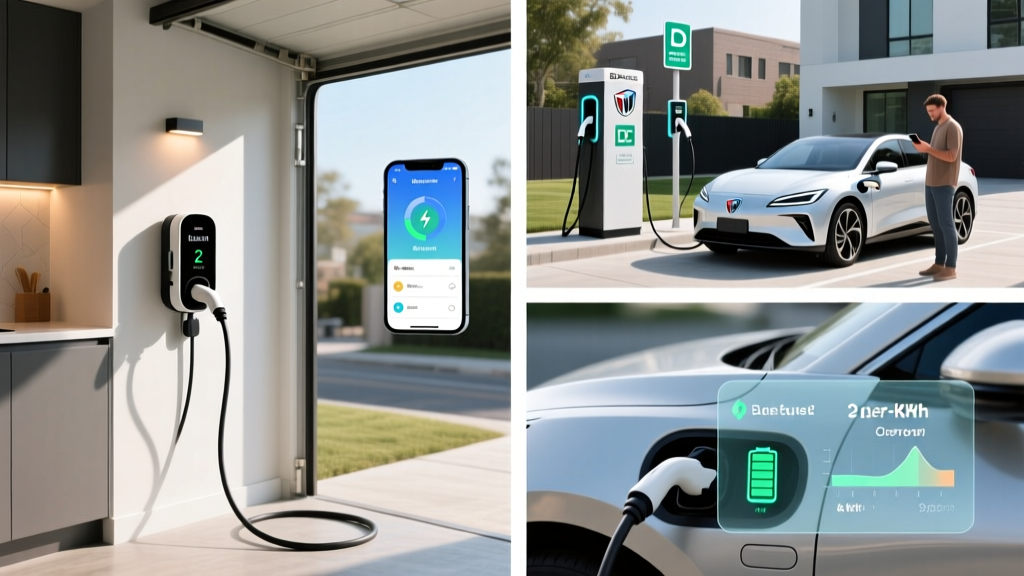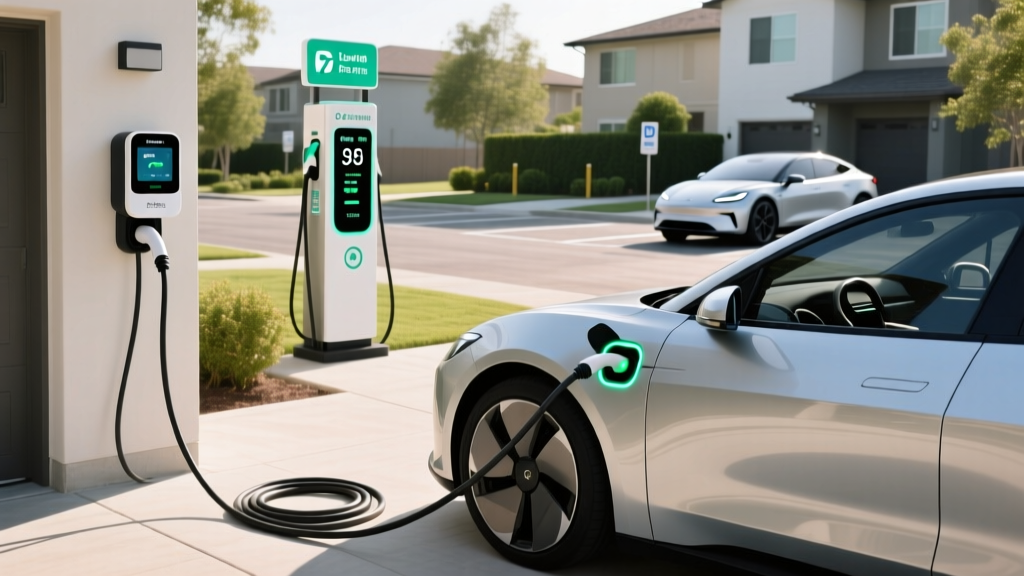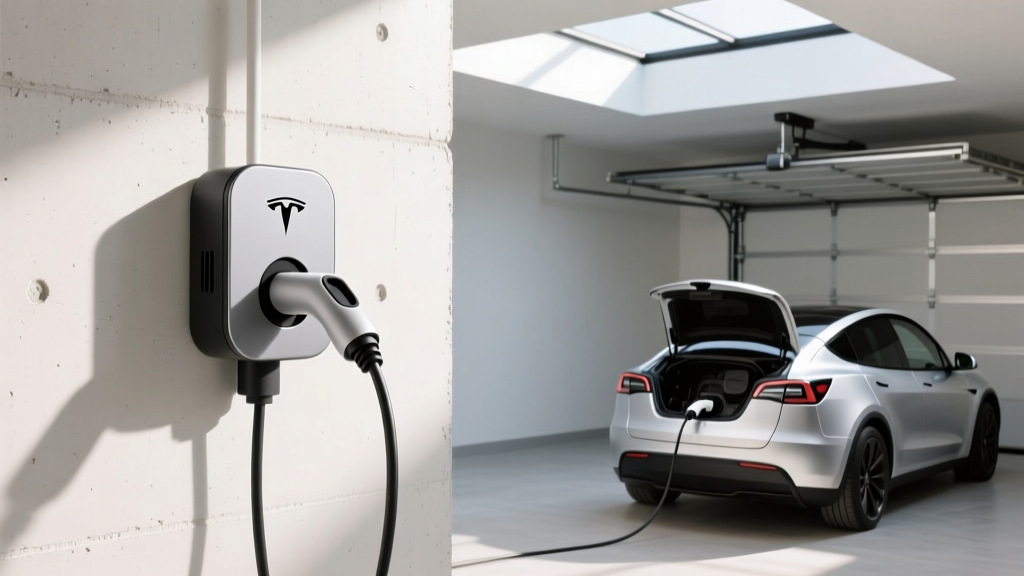
If you own a Tesla today but plan to buy a Hyundai, Ford, or Rivian tomorrow — or vice versa — home charging just got a lot simpler. The Tesla Universal Wall Connector solves the connector-fragmentation problem that has plagued EV owners since the CCS-versus-NACS split began. By integrating both the North American Charging Standard (NACS) plug and a built-in J1772 adapter (which also covers CCS1 vehicles via their own adapters), this single wall unit can charge virtually any EV sold in North America without swapping hardware.
But does the convenience justify the $599 price tag, and what does a real installation look like in 2026? We break down the specs, the install math, and how it stacks up against dedicated NACS or J1772 chargers.
What Makes the Tesla Universal Wall Connector Different
The Universal Wall Connector ships with a permanently attached NACS (Tesla-style) connector and includes a J1772 adapter that snaps onto the cable end. This means:
- Tesla vehicles (Model 3, Y, S, X, Cybertruck) plug in natively via NACS.
- Non-Tesla EVs with J1772 inlets — most pre-2025 models from Ford, Hyundai, Kia, VW, BMW, Rivian, and others — use the included adapter.
- CCS1 vehicles can charge on Level 2 AC using the J1772 portion of their CCS1 inlet (the DC fast pins aren't used at home).
- NACS-adopting vehicles (2025+ Ford, GM, Rivian, Hyundai, Kia, etc.) plug in directly as they transition to the Tesla connector.
The unit delivers up to 11.5 kW (48 amps) on a 60-amp dedicated circuit, or you can dial it down to 40A/9.6 kW or 32A/7.7 kW to match your panel's capacity. At 11.5 kW, it adds roughly 44 miles of range per hour for a Model 3 — enough to fully replenish overnight for nearly any daily commute.
Charging Levels Explained: What Speed Are You Actually Getting?
Before evaluating any home charger, you need to understand the three charging tiers. Power is measured in kW (kilowatts) — that's the rate of energy flow. Energy stored in your battery is measured in kWh (kilowatt-hours) — the total capacity. A 75 kWh battery charged at 11.5 kW takes roughly 6.5 hours from empty to full.
| Level | Voltage | Power (kW) | Miles of Range / Hour | Best For |
|---|---|---|---|---|
| Level 1 | 120V AC | 1.4 kW | 3–5 mi/hr | Emergency top-ups, PHEVs |
| Level 2 (Home/Public) | 240V AC | 3.3–19.2 kW | 12–70 mi/hr | Daily home charging |
| DC Fast Charging | 400–800V DC | 50–350 kW | 150–1,200+ mi/hr | Road trips, rapid top-ups |
The Tesla Universal Wall Connector is a Level 2 charger. For context, a typical 82 kWh battery (like a long-range Model Y or Ford Mustang Mach-E) charging from 10% to 80% at 11.5 kW takes approximately 5 hours. At a lower 7.7 kW (32A), that same charge stretches to about 7.5 hours. Either way, an overnight session easily covers it.
Real-World Charge Times: 10% to 80% by Battery Size
Here's what to expect with the Universal Wall Connector at its maximum 11.5 kW output, using common 2025/2026 EV battery capacities:
| Vehicle (Example) | Battery (kWh usable) | 10–80% Time | Range Recovered |
|---|---|---|---|
| Tesla Model 3 RWD | 57.5 kWh (LFP) | ~3.5 hours | ~215 miles |
| Tesla Model Y Long Range | 75 kWh (NMC) | ~4.5 hours | ~235 miles |
| Ford Mustang Mach-E ER | 91 kWh (NMC) | ~5.5 hours | ~230 miles |
| Hyundai Ioniq 5 (Std Range) | 58 kWh (NMC) | ~3.5 hours | ~195 miles |
| Rivian R1T Dual-Motor | 128 kWh (NMC) | ~7.8 hours | ~270 miles |
These times assume your EV's onboard charger can accept the full 11.5 kW. Most modern EVs accept 11.5 kW or higher on AC, but some older or base models are limited to 7.2 or 9.6 kW, which would cap your charge speed regardless of the wall unit's capability.
Installation Cost Breakdown: What You'll Actually Pay
The charger itself is only part of the equation. A licensed electrician must run a dedicated 240V circuit from your panel, and costs vary enormously based on your home's wiring and distance from the panel to the garage or driveway.
| Component | Simple Install (Near Panel) | Complex Install (Far / Upgrade Needed) |
|---|---|---|
| Tesla Universal Wall Connector | $599 | $599 |
| Electrician labor (2–6 hours) | $500–$800 | $1,200–$2,500 |
| Wiring, conduit, breaker (60A) | $200–$400 | $500–$1,200 |
| Permit and inspection | $50–$150 | $100–$300 |
| Electrical panel upgrade (if needed) | $0 | $1,500–$3,500 |
| Total | $1,350–$1,950 | $4,100–$8,100 |
When Will You Need a Panel Upgrade?
Homes with a 100-amp main service panel often lack the headroom for a 60-amp EV circuit, especially if you already run electric HVAC, a dryer, and an electric range. An electrician will perform a load calculation per NEC Article 220 to determine if your panel can support the additional draw. If not, upgrading to a 200-amp panel typically costs $1,500–$3,500 installed.
Some utilities and state programs offer rebates of $250–$1,000 for panel upgrades tied to EV adoption — check with your local provider. The federal Residential Clean Energy Credit (IRS §25D) does not cover EV chargers; however, the Alternative Fuel Vehicle Refueling Property Credit (§30C) may cover up to 30% of charger and installation costs (max $1,000) if you live in an eligible census tract. Consult a tax professional for your specific eligibility.
Connector Compatibility: Will It Work With Your EV?
The North American EV landscape has been converging on NACS, but thousands of CCS1 and J1772 vehicles remain on the road. Here's how the Universal Wall Connector covers them:
| Connector Type | How It Connects | Example Vehicles |
|---|---|---|
| NACS (Tesla) | Direct plug (native cable) | Tesla Model 3/Y/S/X/Cybertruck; 2025+ Ford F-150 Lightning, GM Equinox EV, Rivian R1T/R1S (NACS port) |
| J1772 | Snap-on included adapter | Pre-2025 Ford Mach-E, VW ID.4, BMW i4, Hyundai Ioniq 5, Kia EV6, Nissan Leaf (Level 2) |
| CCS1 (AC portion) | Snap-on J1772 adapter (uses upper J1772 section of CCS inlet) | Most 2022–2024 non-Tesla EVs for Level 2 home charging |
| CHAdeMO | Not compatible — requires separate CHAdeMO adapter (rare) | Nissan Leaf (DC fast only uses CHAdeMO; Level 2 AC uses J1772) |
Key takeaway: For Level 2 home charging, virtually every EV sold in the US can use this charger. CHAdeMO is only relevant for DC fast charging, which doesn't apply to home wall connectors. If you own a Nissan Leaf, you'll use the J1772 adapter for home charging — it works perfectly.
Cost to Charge: Home vs. Public vs. Gas
One of the strongest arguments for home Level 2 charging is cost. Let's compare real-world $/kWh scenarios and translate that to cost per mile using a 2026 Tesla Model Y Long Range (rated at 28 kWh/100 mi, or roughly 3.6 mi/kWh) as our baseline.
| Scenario | $/kWh | Cost Per Mile | Annual Cost (12,000 mi) |
|---|---|---|---|
| Home off-peak (utility TOU rate) | $0.08–$0.12 | $0.022–$0.034 | $265–$405 |
| Home standard rate | $0.14–$0.18 | $0.039–$0.050 | $470–$605 |
| Public Level 2 (ChargePoint, EVgo) | $0.25–$0.49 | $0.070–$0.137 | $840–$1,645 |
| DC Fast Charging (EA, Tesla Supercharger) | $0.30–$0.55 | $0.084–$0.154 | $1,010–$1,850 |
| Gas equivalent (25 MPG avg, $3.40/gal) | — | $0.136 | $1,632 |
Home charging on an off-peak rate saves 70–85% per mile versus gasoline. Even at standard residential rates, you're paying roughly a third of the gas cost. Public DC fast charging approaches gas prices in some markets, which is why installing a Level 2 charger at home is the single highest-ROI upgrade an EV owner can make.
Equipment Comparison: Tesla Universal vs. Alternatives
Tesla Universal Wall Connector
- Power: Up to 11.5 kW (48A)
- Connector: NACS + included J1772 adapter
- Cable length: 24 feet
- Smart features: Wi-Fi, Tesla app scheduling, OTA firmware updates, load sharing with second unit
- Indoor/Outdoor: Rated for both (NEMA 3R)
- Price: $599
- Warranty: 4 years
ChargePoint Home Flex (NACS version)
- Power: Up to 12 kW (50A), adjustable down to 16A
- Connector: NACS (2025+ model); J1772 version also available
- Cable length: 23 feet
- Smart features: Wi-Fi, ChargePoint app, Alexa integration, flexible amperage dial
- Indoor/Outdoor: NEMA 3R rated
- Price: $549–$599
- Warranty: 3 years
Emporia Vue Level 2 Charger
- Power: Up to 11.5 kW (48A)
- Connector: J1772 (NACS adapter sold separately) or NACS version
- Cable length: 24 feet
- Smart features: Wi-Fi, Emporia app, integrates with Emporia Vue energy monitor for solar-aware charging
- Indoor/Outdoor: NEMA 4 (superior water/dust resistance)
- Price: $399–$449
- Warranty: 3 years
Our take: The Tesla Universal Wall Connector is the clear pick if your household has (or will have) both Tesla and non-Tesla EVs. The built-in adapter eliminates the need for a separate dongle that can get lost or damaged. If you exclusively own non-Tesla EVs and want the lowest price, the Emporia Vue is excellent value. The ChargePoint Home Flex earns points for its adjustable amperage dial — useful if your panel can't support a full 60A circuit.
Safety, Electrical Code, and Smart Features
A proper installation isn't just about getting power to the charger — it's about doing so safely and to code.
NEC Requirements for Home EV Chargers
- Dedicated circuit: Your EV charger must be on its own dedicated breaker — no sharing with other appliances.
- Breaker sizing: NEC requires the breaker to be rated at 125% of the continuous load. A 48A charger requires a 60A breaker; a 32A charger requires a 40A breaker.
- GFCI protection: The 2023 NEC (and most 2026 local adoptions) requires GFCI protection for outdoor receptacles and, in many jurisdictions, for hardwired EV chargers as well. The Tesla Universal Wall Connector has built-in ground-fault protection.
- Outdoor rating: If mounting outdoors, the unit must carry at minimum a NEMA 3R rating (rain and sleet). The Universal Wall Connector is rated NEMA 3R. For coastal or heavy-rain areas, consider a NEMA 4-rated enclosure or alternative charger.
- Permit: Most municipalities require an electrical permit for EV charger installation. The permit ensures a post-install inspection verifies safe wiring, correct breaker sizing, and code compliance. Permit fees typically run $50–$200.
Smart Charging Features Worth Using
The Tesla app lets you schedule charging during off-peak utility hours (typically 10 PM–6 AM), which can cut your per-kWh cost by 40–60% on time-of-use plans. You can also set a maximum charge level (e.g., 80% daily, 100% only for road trips) — a best practice for long-term battery health on NMC chemistry vehicles. For LFP batteries (Tesla Model 3 RWD), manufacturers recommend periodic 100% charges for cell balancing.
The load-sharing feature allows two Universal Wall Connectors on a single 60A circuit to dynamically split available current — ideal for two-car garages where running a second dedicated circuit would require a panel upgrade.
Frequently Asked Questions
How much does it cost to install a home EV charger?
For the Tesla Universal Wall Connector, expect $1,350–$1,950 for a straightforward install near your electrical panel, or $4,100–$8,100 if you need a panel upgrade, long conduit runs, or trenching for a detached garage. The charger itself is $599; the rest is labor, materials, and permits.
How fast will each charging level add range?
Level 1 (120V) adds 3–5 miles per hour — suitable only for PHEVs or emergency trickle charging. Level 2 at 11.5 kW adds roughly 35–44 miles per hour depending on vehicle efficiency. DC fast charging at 150–250 kW can add 150–300+ miles in 15–25 minutes, though charge speed tapers significantly above 80% state of charge.
Which connector/charger is compatible with my EV?
The Tesla Universal Wall Connector works with every EV sold in North America for Level 2 charging. Tesla and 2025+ NACS-adopting vehicles plug in directly. All other vehicles (CCS1 or J1772 inlet) use the included J1772 snap-on adapter. The only exception is CHAdeMO DC fast charging, which is irrelevant for home AC charging.
How much does charging cost per mile vs. gas?
Home charging on off-peak rates costs approximately $0.02–$0.03 per mile — roughly 80% less than gasoline at $3.40/gallon in a 25 MPG vehicle ($0.14/mile). Even public DC fast charging at $0.35–$0.55/kWh is competitive with gas at $0.08–$0.15/mile. The savings are most dramatic with consistent home charging.
What electrical upgrades might I need?
If your home has a 100-amp service panel, you may need an upgrade to 200 amps ($1,500–$3,500) to safely add a 60-amp EV circuit. Homes with 200-amp panels usually have sufficient capacity, though a load calculation by a licensed electrician is required. Older homes with knob-and-tube or aluminum wiring may need partial rewiring. Always get a professional assessment before purchasing equipment.
Can I install the Tesla Universal Wall Connector outdoors?
Yes. The unit carries a NEMA 3R rating, meaning it's protected against rain, sleet, and ice formation. For installations in areas with driving rain, heavy snow accumulation, or salt-air coastal environments, consider adding a weatherproof enclosure or choosing a NEMA 4-rated charger like the Emporia Vue.
Does the Tesla Universal Wall Connector qualify for any tax credits?
The charger and installation may qualify for the Alternative Fuel Vehicle Refueling Property Credit (IRS §30C), which covers up to 30% of costs, capped at $1,000. Eligibility depends on your census tract — the credit targets low-income and non-urban areas. It is separate from the §30D vehicle tax credit. Consult a tax professional and review current IRS guidance for your situation.