If you're upgrading your EV in 2026, Tesla's trade-in program occasionally includes a Supercharging credit—often 10,000 free miles or a set kWh allotment—as an incentive to buy new. It sounds appealing. But how does free Supercharging actually stack up against a home Level 2 charging setup in terms of cost, convenience, and long-term savings? Let's run the numbers.
How the Tesla Trade-In Supercharging Offer Works
Tesla periodically bundles Supercharging credits into its trade-in promotions. In recent campaigns, owners trading in an older Model 3 or Model Y have received anywhere from 5,000 to 15,000 free Supercharging miles (roughly 1,500–4,500 kWh depending on efficiency) applied to their new vehicle. These credits typically expire within one to two years of delivery and are non-transferable.
The value proposition is straightforward: you offset your road-trip charging costs during the credit period. But here's the catch—most EV owners do 80% or more of their charging at home. Free Supercharging only saves you money on the fraction of driving you do away from your garage. For a driver covering 12,000 miles per year with a 3.5 mi/kWh efficiency, 10,000 free miles translates to roughly $0 in electricity cost for that portion—but you're still paying for the other 2,000+ miles of non-Supercharger driving, plus you're tethered to Tesla's network exclusively.
Charging Levels Explained: Speed, Cost, and Daily Reality
Understanding what you're comparing requires a clear picture of the three charging tiers. Power is measured in kW (kilowatts)—that's the rate of energy delivery. Energy stored in your battery is measured in kWh (kilowatt-hours). Confusing the two is the most common EV literacy mistake. Think of kW as the flow rate of a hose, and kWh as the bucket size.
| Level | Voltage | Power (kW) | Miles of Range Added per Hour | Best For |
|---|---|---|---|---|
| Level 1 | 120V AC | 1.0–1.4 kW | 3–5 mi/hr | Overnight top-ups, PHEVs, low-mileage drivers |
| Level 2 | 240V AC | 7.2–19.2 kW | 25–70 mi/hr | Daily home charging, the standard for most EV owners |
| DC Fast Charging | 400–800V DC | 50–350 kW | 150–1,000+ mi/hr (peak) | Road trips, highway corridors, rapid top-ups |
For a 75 kWh battery (like the Tesla Model Y Long Range), charging from 10% to 80% on a 48-amp Level 2 home charger (11.5 kW) takes roughly 6.5–7 hours—perfect for overnight. On a V3 Supercharger (250 kW peak), that same 10–80% session takes about 25–30 minutes, but remember that peak kW is not sustained kW. The charge curve tapers significantly above 60% state of charge (SoC), which is why manufacturers quote 10–80% times rather than 0–100%.
Home Charger Installation: What It Actually Costs
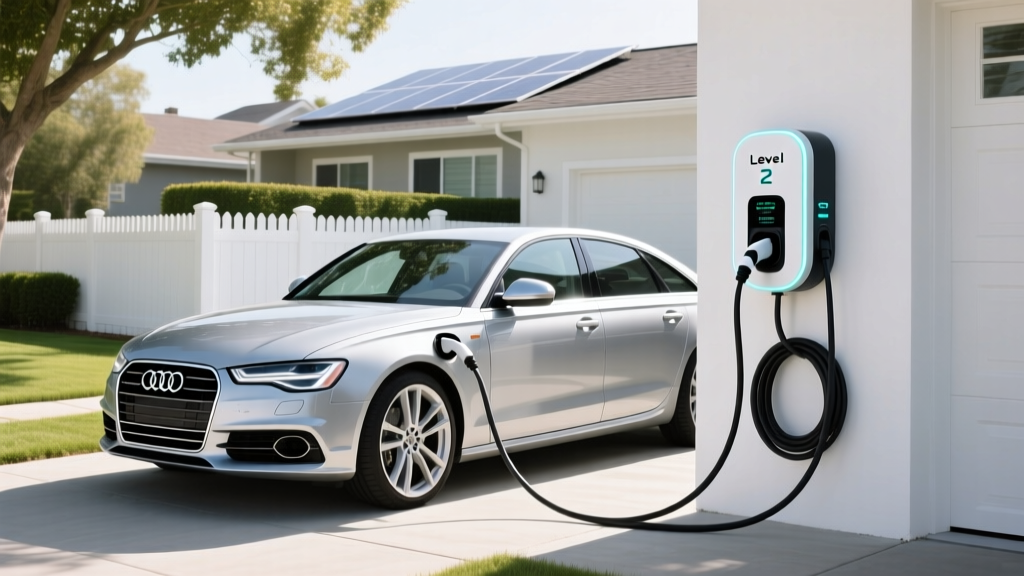
The biggest barrier to home charging isn't the charger itself—it's the electrical work. Here's what a typical Level 2 installation involves:
Electrical Requirements
A 48-amp hardwired Level 2 charger requires a dedicated 60-amp circuit on a 240V line. If you opt for a 40-amp charger (like the Tesla Wall Connector on a 50-amp breaker), you need a 50-amp dedicated circuit. The EVSE (Electric Vehicle Supply Equipment) must draw no more than 80% of the circuit's rated capacity per the National Electrical Code (NEC Article 625).
Panel Upgrade Reality
If your home has a 100-amp main panel—common in houses built before 1990—you may not have enough spare capacity for a 60-amp EV circuit. A panel upgrade to 200 amps typically costs $1,500–$3,500. Some homeowners opt for a smart load-management device (like the Emporia VUE or Span panel) to avoid a full upgrade, but these add $500–$1,500 to the project.
| Component | Low End | High End | Notes |
|---|---|---|---|
| Level 2 Charger (hardware) | $350 | $700 | 40A–48A smart chargers |
| Electrician labor | $500 | $2,000 | Depends on run length from panel to garage |
| Permit & inspection | $50 | $300 | Varies by municipality |
| Panel upgrade (if needed) | $1,500 | $3,500 | 100A → 200A service |
| Total (no panel upgrade) | $900 | $3,000 | Most homes with 200A panels |
| Total (with panel upgrade) | $2,400 | $6,500 | Older homes with 100A service |
Check with your local utility—many offer rebates of $250–$1,000 for Level 2 installations, and some states offer additional tax credits. The Alternative Fuels Data Center maintains a searchable database of state and utility incentives.
Connector Compatibility: NACS, CCS, and Adapter Needs
As of 2026, the North American Charging Standard (NACS)—originally Tesla's proprietary connector—has become the dominant standard. Ford, GM, Rivian, Hyundai, Kia, BMW, and most other automakers now ship EVs with native NACS ports or provide CCS-to-NACS adapters for Supercharger access.
| Connector | Native Vehicles | Adapter Available? | Network Access |
|---|---|---|---|
| NACS (Tesla) | Tesla (all), Ford, GM, Rivian, Hyundai, Kia, BMW | CCS-to-NACS adapters from Tesla, Lectron, A2Z | Tesla Supercharger, Electrify America (select), growing third-party NACS stations |
| CCS1 | Older VW ID.4, some legacy models | NACS-to-CCS adapters available | Electrify America, EVgo, ChargePoint, Ionity (EU) |
| CHAdeMO | Nissan Leaf (legacy) | Limited adapters | Declining network; most new stations omit CHAdeMO |
If you're buying a 2026 EV, you almost certainly want a NACS-equipped vehicle or one with a reliable CCS-to-NACS adapter. Tesla's Supercharger network remains the most reliable DC fast-charging infrastructure in the U.S., with over 30,000 stalls nationwide.
Cost Per Mile: Supercharging Credits vs. Home Electricity
This is where the trade-in offer's real value becomes clear—or underwhelming. Let's model three scenarios for a Tesla Model Y (approximately 3.5 miles per kWh efficiency):
| Scenario | $/kWh | Cost per Mile | Annual Cost (12,000 mi) |
|---|---|---|---|
| Home Level 2 (off-peak utility rate) | $0.12–$0.16 | $0.034–$0.046 | $410–$550 |
| Tesla Supercharger (average U.S.) | $0.30–$0.40 | $0.086–$0.114 | $1,030–$1,370 |
| Public DC Fast (non-Tesla, peak) | $0.40–$0.60 | $0.114–$0.171 | $1,370–$2,050 |
| Gasoline car (27 MPG, $3.40/gal) | — | $0.126 | $1,510 |
Home charging at off-peak rates costs roughly one-third of Supercharging. A Tesla trade-in offer providing 10,000 free Supercharging miles saves you approximately $860–$1,140 compared to paying out-of-pocket at Superchargers—but compared to home charging, those same 10,000 miles would have cost only $340–$460 anyway. The net savings versus a home-charged lifestyle is $340–$680 over the credit period.
Recommended Home Chargers for 2026
If you decide to invest in home charging (which pays for itself within 1–3 years versus exclusive public charging), here are the top options:
Tesla Wall Connector (Gen 3)
- Power output: Up to 48 amps / 11.5 kW (on a 60A circuit)
- Connector: NACS (native Tesla)
- Cable length: 24 feet
- Smart features: Wi-Fi, load sharing (pair two units on one circuit), power adjustment, OTA updates
- Price: ~$475
- Best for: Tesla owners; clean integration with Tesla app
ChargePoint Home Flex
- Power output: Configurable 16–50 amps / up to 12 kW (on a 60A circuit); adjustable to match your panel capacity
- Connector: NACS (2026 model) or J1772 with adapter
- Cable length: 23 feet
- Smart features: Wi-Fi, app scheduling, Alexa integration, detailed energy reports
- Price: ~$550
- Best for: Multi-EV households, panel-constrained homes (can dial down amperage)
Emporia Level 2 EV Charger
- Power output: 40 amps / 9.6 kW (on a 50A circuit) or 48A variant
- Connector: J1772 (NACS adapter included or sold separately)
- Cable length: 24 feet
- Smart features: Integration with Emporia VUE energy monitor, solar-aware charging, time-of-use scheduling
- Price: ~$400
- Best for: Budget-conscious buyers, solar-panel homes
Safety, Code, and Installation Best Practices
EV charging draws sustained high current for hours—unlike most household loads. This makes code compliance non-negotiable:
- Dedicated circuit: Your Level 2 charger must be on its own dedicated breaker. No shared circuits with dryers, ovens, or HVAC.
- GFCI protection: NEC 2023 (and carried into 2026 local adoptions) requires GFCI protection for outdoor receptacles. Hardwired units often bypass this requirement, which is one reason electricians prefer hardwiring over plug-in NEMA 14-50 installations.
- Outdoor rating: If your charger is mounted outside, it must be rated NEMA 4 (weatherproof). All three chargers recommended above carry outdoor ratings.
- Wire gauge: A 60-amp circuit requires 6 AWG copper wire (or 4 AWG aluminum). Your electrician will size this based on run length and local code.
- Permit and inspection: Most jurisdictions require an electrical permit for new 240V circuits. Skipping this can void your homeowner's insurance in the event of a fire.
Frequently Asked Questions
How much does it cost to install a home EV charger?
Expect $900–$3,000 for a standard Level 2 installation in a home with an adequate electrical panel. If your home needs a 200-amp panel upgrade (common in pre-1990 houses), total cost rises to $2,400–$6,500. Utility rebates can offset $250–$1,000 of this.
How fast will each charging level add range?
Level 1 (120V) adds 3–5 miles per hour. Level 2 (240V, 48A) adds 35–45 miles per hour for most EVs. DC fast charging (150–350 kW) can add 150–300+ miles in a 20–30 minute session, but the charge curve tapers above 80% SoC.
Which connector/charger is compatible with my EV?
In 2026, NACS is the dominant standard. All new Teslas use NACS natively. Ford, GM, Rivian, Hyundai, and Kia now ship with NACS ports or include CCS-to-NACS adapters. If your EV has a CCS1 port, you'll need a CCS-to-NACS adapter ($150–$250) for Supercharger access.
How much does charging cost per mile vs gas?
Home Level 2 charging costs $0.03–$0.05 per mile for most EVs. Supercharging costs $0.09–$0.11 per mile. A comparable gasoline car at 27 MPG and $3.40/gallon costs about $0.13 per mile. Home charging saves 60–75% versus gasoline.
What electrical upgrades might I need?
If your home has a 200-amp electrical panel with spare breaker slots and capacity, you likely need only a new 60-amp dedicated circuit. Homes with 100-amp panels or heavily loaded 200-amp panels may require a panel upgrade ($1,500–$3,500) or a smart load-management system to avoid one.
Is the Tesla trade-in Supercharging offer worth more than installing a home charger?
For most drivers, no. A typical trade-in offer provides 10,000 free Supercharging miles (worth ~$860–$1,140 at public rates). But a home Level 2 installation pays for itself within 1–3 years through lower per-mile electricity costs ($0.03–$0.05/mi vs. $0.09–$0.11/mi at Superchargers). The ideal strategy: take the free credits for road trips AND install a home charger for daily driving.
Always verify current Tesla trade-in promotions directly on Tesla's trade-in page, as offers change by quarter and region. For electrical work, consult a licensed electrician familiar with NEC Article 625 (EV charging systems). Federal and state incentive rules can be reviewed via the Alternative Fuels Data Center.