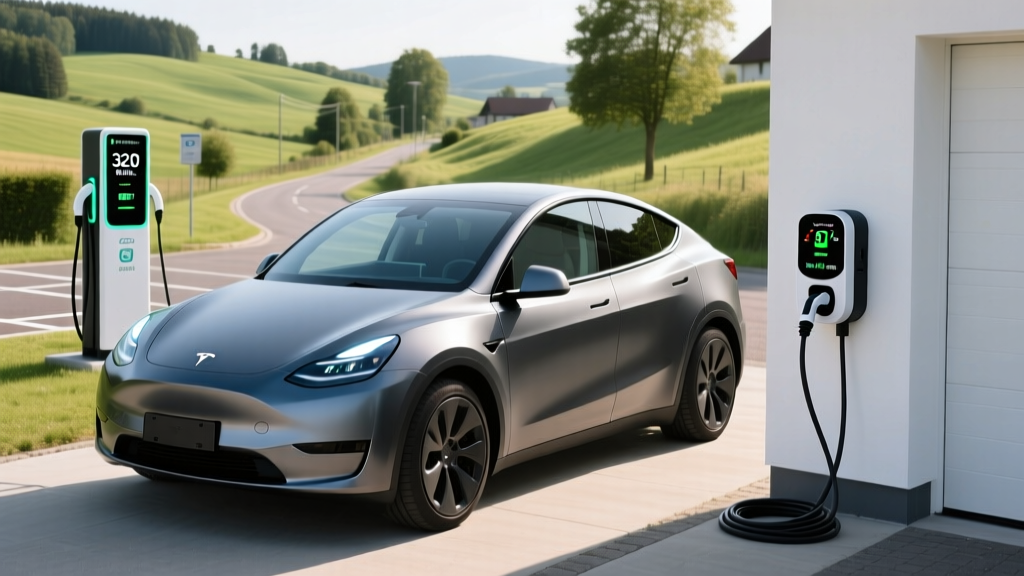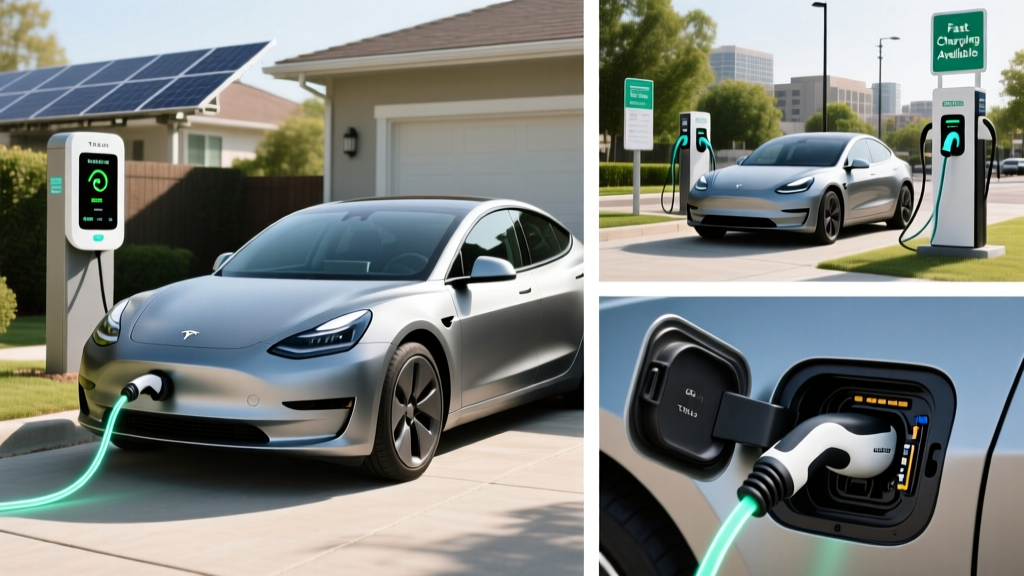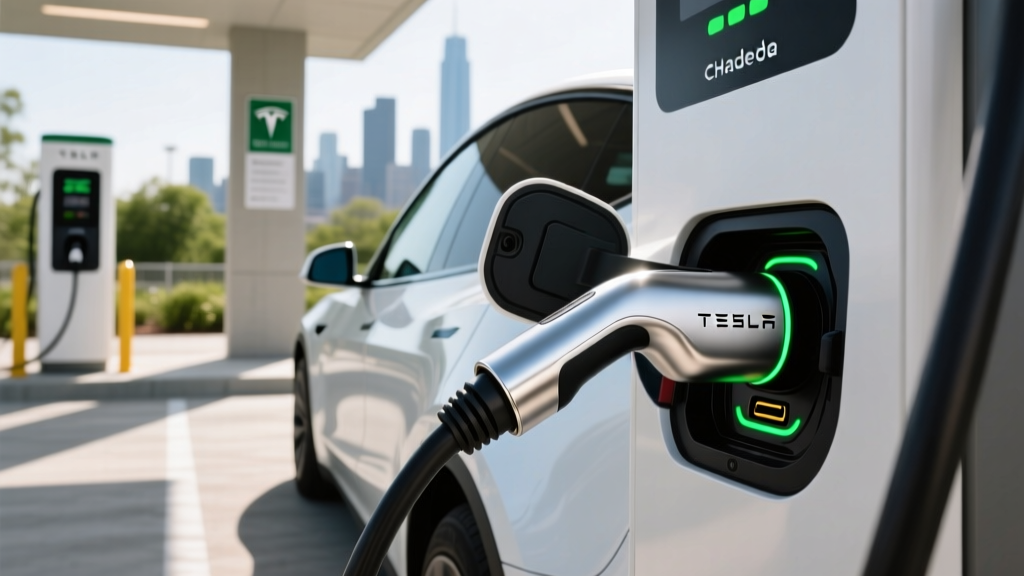
If you drive a Tesla and rely on DC fast charging beyond the Supercharger network, you have likely encountered a CHAdeMO station and wondered whether a Tesla to CHAdeMO adapter exists. The short answer: a direct, consumer-available Tesla-to-CHAdeMO adapter does not exist in the US market as of 2026. But that does not leave you stranded. This guide explains exactly what adapters Tesla owners can use, how the three major DC fast-charging connector standards interact, and what you need to know about charging levels, costs, and home installation to keep your Tesla powered wherever you drive.
Why Tesla Owners Ask About CHAdeMO Adapters
CHAdeMO (Charge de Move) is a DC fast-charging connector standard developed primarily by Japanese automakers — Nissan, Mitsubishi, and Subaru. In the US, CHAdeMO infrastructure has been shrinking since 2022 as Electrify America, EVgo, and other networks standardized on CCS1 (Combined Charging System) and, increasingly, NACS (North American Charging Standard, originally Tesla's proprietary connector). According to the Alternative Fuels Data Center, CHAdeMO stations now represent fewer than 15% of public DC fast-charging ports in the US.
Tesla vehicles use the NACS connector for both AC Level 2 and DC fast charging. Since late 2023, Ford, Rivian, GM, Volvo, and most other major automakers have adopted NACS, and Tesla has opened its Supercharger network to non-Tesla EVs via the Magic Dock adapter. This means the Tesla charging ecosystem has expanded outward, while CHAdeMO has contracted. For Tesla owners, the practical concern is less about reaching CHAdeMO stations and more about understanding which non-Supercharger DC fast chargers they can use with the adapters Tesla does provide.
| Connector Standard | Native Tesla Support? | Adapter Available? | Typical Peak Power | US Network Presence |
|---|---|---|---|---|
| NACS (Tesla) | Yes — all models | Not needed | 170–250 kW (V3/V4 Superchargers) | Largest DC fast network in US |
| CCS1 | No (post-2025 Cybertruck excepted) | Yes — Tesla CCS Combo 1 Adapter (~$175) | Up to 250 kW (station-dependent) | Electrify America, EVgo, Ionity |
| CHAdeMO | No | No consumer adapter available | 50–100 kW (most US stations 50 kW) | Declining; some EVgo legacy stations |
Charging Levels Explained: Speeds, Power, and Range Added
Before evaluating adapters, you need to understand the three charging levels and how power (measured in kW, kilowatts) translates to energy delivered to your battery (measured in kWh, kilowatt-hours). This is the single most important distinction in EV charging: kW is the rate of energy flow (like water pressure from a hose), while kWh is the total energy stored (like gallons in a tank). Never use them interchangeably.
| Level | Voltage / Phase | Max Power (kW) | Miles of Range Added per Hour | Typical Use Case |
|---|---|---|---|---|
| Level 1 | 120V AC / Single-phase | 1.0–1.4 kW | 3–5 miles | Overnight trickle; emergency top-up from standard outlet |
| Level 2 | 240V AC / Single-phase | 7.2–19.2 kW | 20–75 miles | Home wall connector; workplace; destination charging |
| DC Fast Charging | 400–800V DC (bypasses onboard charger) | 50–350 kW | 150–1,000+ miles (equivalent rate) | Road trips; rapid top-up; 10–80% in 15–40 minutes |
For context, a Tesla Model Y Long Range (2026) has a usable battery capacity of approximately 75 kWh and an EPA range of 330 miles. Charging from 10% to 80% (adding ~52.5 kWh) on a 250 kW V3 Supercharger takes roughly 25–28 minutes under ideal thermal conditions. On a Level 2 home charger at 11.5 kW (48A), that same 10–80% session takes about 4.5 hours — which is why overnight home charging is the backbone of practical EV ownership.
The Adapter Reality: What Tesla Owners Can Actually Use
Tesla provides or sells several adapters, but a Tesla to CHAdeMO adapter is not among them. Here is what is available:
- Tesla Mobile Connector (included): Comes with NEMA 5-15 (120V) and NEMA 14-50 (240V) plugs for Level 1 and Level 2 AC charging from household outlets. Delivers up to ~7.6 kW on a 14-50 outlet (32A).
- Tesla Wall Connector (~$425): Hardwired Level 2 home charger delivering up to 11.5 kW (48A) on a 60A circuit. NACS connector native.
- Tesla CCS Combo 1 Adapter (~$175): Allows Tesla vehicles to charge at CCS1-equipped DC fast-charging stations (Electrify America, EVgo CCS stalls, and many others). Supports up to 250 kW depending on the station and vehicle. This is the adapter that meaningfully expands your non-Supercharger DC fast-charging options.
- Tesla J1772 Adapter (included with most models): Allows AC Level 2 charging from J1772-equipped public stations (hotels, shopping centers, workplaces). Limited to the vehicle's onboard charger capacity — 11.5 kW for Model 3/Y, 16.5 kW for Model S/X.
The absence of a CHAdeMO adapter is not an oversight. CHAdeMO uses a fundamentally different communication protocol and physical connector design that would require a complex, heavy, and expensive adapter. With CHAdeMO infrastructure declining and CCS1/NACS dominating, Tesla has no commercial incentive to develop one. If you encounter a CHAdeMO-only station, your practical option is to locate the nearest Supercharger or CCS1 station using your vehicle's navigation or apps like PlugShare.
Home Charger Installation: Electrical Requirements and Costs
The single most impactful charging decision you will make is installing a Level 2 home charger. Here is what the installation actually involves and what it costs.
Electrical Requirements for a Tesla Wall Connector
The Tesla Wall Connector requires a dedicated 240V circuit. For maximum 11.5 kW output, you need a 60-amp breaker, which means the circuit must be rated for 60A continuous (the National Electrical Code requires circuits to be rated at 125% of continuous load, so a 48A continuous draw requires a 60A breaker). If your electrical panel has spare capacity and is located near your garage or parking spot, installation is straightforward. If your panel is at capacity — common in homes built before 2000 with 100A or 150A service — you may need a panel upgrade to 200A, which is the most expensive variable in the installation.
Permitting and Code Requirements
Virtually all jurisdictions require an electrical permit for a hardwired EV charger installation. Your licensed electrician will pull the permit, and a local inspector will verify the work meets NEC Article 625 (Electric Vehicle Charging System Equipment) requirements, including:
- Dedicated circuit (no shared loads)
- GFCI protection (required for outdoor installations; recommended for indoor garage installations per 2023 NEC updates)
- Proper wire gauge (6 AWG copper for 60A circuits; 4 AWG for longer runs to minimize voltage drop)
- Outdoor-rated enclosure and NEMA 4 rating if installed outside
| Component | Low Estimate | High Estimate | Notes |
|---|---|---|---|
| EVSE Equipment (Tesla Wall Connector or equivalent) | $400 | $700 | Tesla Wall Connector ~$425; ChargePoint Home Flex ~$550–$700 |
| Electrician Labor (standard install, panel nearby) | $500 | $1,500 | Varies by region, conduit run length, wall material |
| Electrical Permit | $50 | $300 | Depends on municipality |
| Panel Upgrade (if needed: 100A/150A → 200A) | $1,500 | $4,000 | Major cost driver for older homes; not always required |
| Additional Conduit/Wiring (long runs >50 ft) | $200 | $800 | Longer wire runs increase material and labor |
| Total (no panel upgrade) | $950 | $2,500 | Typical scenario for newer homes with 200A service |
| Total (with panel upgrade) | $2,450 | $6,500 | Older homes or homes with high existing electrical load |
The IRS Residential Clean Energy Credit (§25D) covers 30% of the cost of home EV charger equipment and installation through 2032, capped at $1,000 per year. This can offset $300–$750 of a standard installation. Always verify current-year eligibility with a tax professional, as income and property-type restrictions apply.
Charging Cost Per Mile: Home vs. Public vs. Gas
One of the most compelling arguments for EV ownership is the per-mile energy cost, but the numbers vary dramatically depending on where and when you charge. Here is a realistic breakdown for a 2026 Tesla Model Y Long Range (330 miles EPA, ~28 kWh/100 mi combined efficiency).
| Charging/Fueling Scenario | Rate | Cost per kWh or Gallon | Cost per Mile |
|---|---|---|---|
| Home charging (off-peak utility rate) | $0.08–$0.14/kWh | $0.11/kWh (avg) | $0.031 |
| Home charging (standard/peak rate) | $0.15–$0.28/kWh | $0.20/kWh (avg) | $0.056 |
| Tesla Supercharger (V3/V4) | $0.25–$0.40/kWh | $0.32/kWh (avg) | $0.090 |
| Electrify America / public DC fast | $0.30–$0.55/kWh | $0.43/kWh (avg) | $0.120 |
| Gas vehicle (28 MPG combined, $3.40/gal) | — | $3.40/gal | $0.121 |
At home off-peak rates, charging a Model Y costs roughly one-quarter what a comparable gas vehicle costs per mile. Even at public DC fast-charging rates, you are paying roughly the same per mile as gasoline — and significantly less if your utility offers time-of-use (TOU) rates that let you charge overnight at $0.08–$0.12/kWh. The economic case for an EV is strongest when you can charge at home. According to fueleconomy.gov, the 2026 Model Y Long Range achieves 122 MPGe combined, making it one of the most efficient vehicles in its class.
Real-World Charging Times: What to Expect
Manufacturer-advertised peak charging speeds (e.g., "up to 250 kW") represent the maximum instantaneous rate at the beginning of a session under ideal thermal conditions. In practice, DC fast charging follows a charge curve: the rate is highest between roughly 10–30% state of charge (SoC) and tapers significantly above 80% to protect battery longevity. This is why you will see charging times quoted as "10–80%" rather than 0–100%.
Tesla Model Y Long Range (75 kWh usable, NMC chemistry)
- V3 Supercharger (250 kW peak): 10–80% in ~25–28 minutes. Peak rate sustained to ~40% SoC, then tapers to ~100 kW by 60%, ~50 kW by 75%.
- CCS1 station at 150 kW (with Tesla CCS adapter): 10–80% in ~32–38 minutes.
- 50 kW CHAdeMO station: Not accessible without a non-existent adapter. Hypothetical 10–80% time would be ~75–85 minutes.
- Level 2 at 11.5 kW (Tesla Wall Connector, 48A): 10–80% in ~4.5 hours; full 0–100% in ~7 hours.
- Level 1 at 1.2 kW (120V outlet): 10–80% in ~44 hours. Emergency use only.
Tesla Model 3 Performance (60 kWh usable, LFP chemistry on RWD; NMC on Performance)
- V3 Supercharger (250 kW peak): 10–80% in ~22–25 minutes (Performance/NMC). Model 3 RWD with LFP battery peaks at ~170 kW; 10–80% in ~28–32 minutes.
- Level 2 at 11.5 kW: 10–80% in ~3.6 hours (Performance); ~3.0 hours (RWD/LFP).
Cold-weather caveat: Battery temperatures below 50°F (10°C) significantly slow DC fast charging. If you arrive at a charger without preconditioning the battery (navigating to a Supercharger in the Tesla nav triggers automatic preconditioning), expect 10–80% times to increase by 30–50% in freezing conditions. Always navigate to the charger rather than entering the address manually to ensure preconditioning activates.
Recommended Home Charging Equipment
While the Tesla Wall Connector is the obvious default for Tesla owners, several third-party Level 2 chargers offer compelling features. Here are specific recommendations with power output, connector type, cable length, and smart features.
Tesla Wall Connector (Best for Tesla Owners)
- Power Output: Up to 11.5 kW (48A) on a 60A circuit
- Connector: NACS (native Tesla)
- Cable Length: 24 feet
- Smart Features: Wi-Fi for OTA updates, power sharing between two Wall Connectors on one circuit, load management, access control
- Price: ~$425
- Best For: Tesla-only households wanting seamless integration and maximum power on a NACS connector
ChargePoint Home Flex (Best Universal Option)
- Power Output: Up to 12 kW (50A) on a 60A circuit; configurable down to 16A for lower-capacity panels
- Connector: J1772 (use included Tesla J1772 adapter) or NACS version available
- Cable Length: 23 feet
- Smart Features: Alexa integration, ChargePoint app scheduling, energy tracking, flexible amperage settings
- Price: ~$550–$700 depending on configuration
- Best For: Multi-EV households (one Tesla, one non-Tesla) or renters who may move and want a portable unit
Emporia Vue Level 2 Charger (Best Budget Smart Charger)
- Power Output: Up to 11.5 kW (48A) on a 60A circuit
- Connector: J1772 (use Tesla adapter) or NACS version
- Cable Length: 24 feet
- Smart Features: Integration with Emporia energy monitoring system, solar-aware charging, time-of-use scheduling, detailed energy reporting
- Price: ~$399–$499
- Best For: Solar-panel owners who want to charge exclusively from excess solar production
Safety, Code, and Installation Best Practices
EV charging draws significant continuous current — often for 6–10 hours at a time. This is fundamentally different from intermittent loads like an oven or dryer. Proper installation is not optional; it protects your home, your vehicle, and your insurance coverage.
- Always use a licensed electrician. DIY EV charger wiring voids most homeowner insurance policies and violates electrical code in virtually every US jurisdiction.
- Dedicated circuit is mandatory. Do not share the EV charger circuit with other appliances. A 60A circuit for the charger means 60A reserved exclusively for the charger.
- GFCI protection. The 2023 NEC (adopted in most states by 2026) requires GFCI protection for all outdoor EVSE installations and recommends it for indoor installations. The Tesla Wall Connector has built-in GFCI protection; some hardwired installations may require a GFCI breaker at the panel.
- Outdoor rating. If installing outside, ensure the EVSE is rated NEMA 4 (weatherproof) and that all conduit fittings are rated for wet locations. The Tesla Wall Connector is NEMA 4 rated.
- Cable management. Use a wall-mounted cable organizer or retractable reel to prevent tripping hazards and cable damage. Never run a charging cable across a driveway where vehicles will drive over it — repeated compression damages internal conductors.
- Panel capacity check. Before installation, have your electrician perform a load calculation per NEC Article 220. If your existing loads (HVAC, electric range, dryer, water heater) plus the EV charger exceed 80% of your panel's rated capacity, a panel upgrade is required — not optional.
Frequently Asked Questions
Does a Tesla to CHAdeMO adapter exist?
No. As of 2026, no manufacturer produces a consumer-available Tesla-to-CHAdeMO DC fast-charging adapter. The CHAdeMO protocol and connector design are fundamentally incompatible with Tesla's NACS system without complex active electronics that would be prohibitively expensive and heavy. Tesla owners should use the CCS Combo 1 Adapter (~$175) to access Electrify America, EVgo, and other CCS1-equipped networks, or use Tesla Superchargers directly.
How much does it cost to install a home EV charger?
A standard Level 2 home charger installation (Tesla Wall Connector or equivalent on an existing 200A panel) typically costs $950–$2,500 including equipment, electrician labor, and permit. If your home requires a panel upgrade from 100A or 150A to 200A service, add $1,500–$4,000, bringing the total to $2,450–$6,500. The IRS §25D Residential Clean Energy Credit covers 30% of equipment and installation costs, capped at $1,000.
How fast will each charging level add range to my Tesla?
Level 1 (120V, 1.2 kW) adds 3–5 miles of range per hour. Level 2 (240V, 11.5 kW) adds approximately 37–44 miles per hour for a Model Y. DC fast charging at 250 kW (V3 Supercharger) adds approximately 200 miles in 15 minutes under ideal conditions. Actual rates depend on battery state of charge, temperature, and the charging curve taper above 80% SoC.
Which connector and charger is compatible with my Tesla?
All Tesla vehicles use the NACS connector natively. For home Level 2 charging, the Tesla Wall Connector is the optimal choice. For public AC Level 2 stations with J1772 connectors, use the included J1772 adapter. For non-Tesla DC fast-charging stations with CCS1 connectors, use the Tesla CCS Combo 1 Adapter ($175). CHAdeMO stations are not accessible to Tesla vehicles.
How much does charging cost per mile compared to gas?
Charging a 2026 Tesla Model Y at home off-peak rates (~$0.11/kWh) costs approximately $0.031 per mile — about 75% less than a comparable 28 MPG gas vehicle at $3.40/gallon ($0.121/mile). Even at public DC fast-charging rates (~$0.43/kWh), the per-mile cost ($0.120) is roughly equivalent to gasoline. Home charging is where the economic advantage is greatest.
What electrical upgrades might I need for a home charger?
The most common upgrade is a panel capacity increase from 100A or 150A to 200A service, required if your existing electrical load plus the EV charger exceeds 80% of panel capacity. Other potential upgrades include running new conduit from the panel to the garage, upgrading wire gauge for long runs (over 50 feet), or installing a GFCI breaker for code compliance. A licensed electrician will perform a load calculation to determine exactly what is needed before work begins.
Can I use a Supercharger without an adapter?
Yes. All Tesla vehicles connect directly to Tesla Superchargers via the native NACS connector — no adapter required. As of 2026, Tesla has also opened many Supercharger locations to non-Tesla EVs equipped with NACS ports or using Tesla's Magic Dock built-in adapter at selected stations. For Tesla owners, Superchargers remain the most seamless and reliable DC fast-charging option.