Tesla Supercharging for Non-Tesla EVs: The 2026 Reality
If you drive a Ford Mustang Mach-E, Hyundai Ioniq 5, Rivian R1T, or nearly any new EV sold in the US today, the Tesla Supercharger network is no longer off-limits. What began as a closed ecosystem has become the backbone of American DC fast charging — and the transition accelerated after major automakers adopted the North American Charging Standard (NACS) for their 2025 and 2026 model-year vehicles.
But access isn't uniform. Depending on your vehicle's model year, charge port, and onboard software, you might plug directly into a V3 or V4 Supercharger stall, need a manufacturer-supplied adapter, or rely on Tesla's built-in Magic Dock at select locations. Pricing, peak power delivery, and station availability also vary. This guide maps exactly how Tesla Supercharging for non-Tesla EVs works in 2026, what you'll pay, and how it compares to Electrify America, EVgo, and ChargePoint.
Charging Levels Explained: Speeds in kW and Miles Per Hour
Before evaluating Supercharger access, it helps to understand the three charging tiers available to every EV owner. Each level serves a distinct use case — overnight replenishment, destination topping, or highway road-trip speed.
| Level | Voltage / Phase | Typical Power (kW) | Miles of Range Added Per Hour | Best Use Case |
|---|---|---|---|---|
| Level 1 | 120V AC, single-phase | 1.0–1.9 kW | 3–5 miles | Emergency / trickle top-up |
| Level 2 | 240V AC, single-phase | 3.3–19.2 kW | 12–75 miles | Home overnight, workplace, destinations |
| DC Fast Charging | 200–500V+ DC | 50–350 kW | 150–1,000+ miles (peak) | Highway road trips, rapid replenishment |
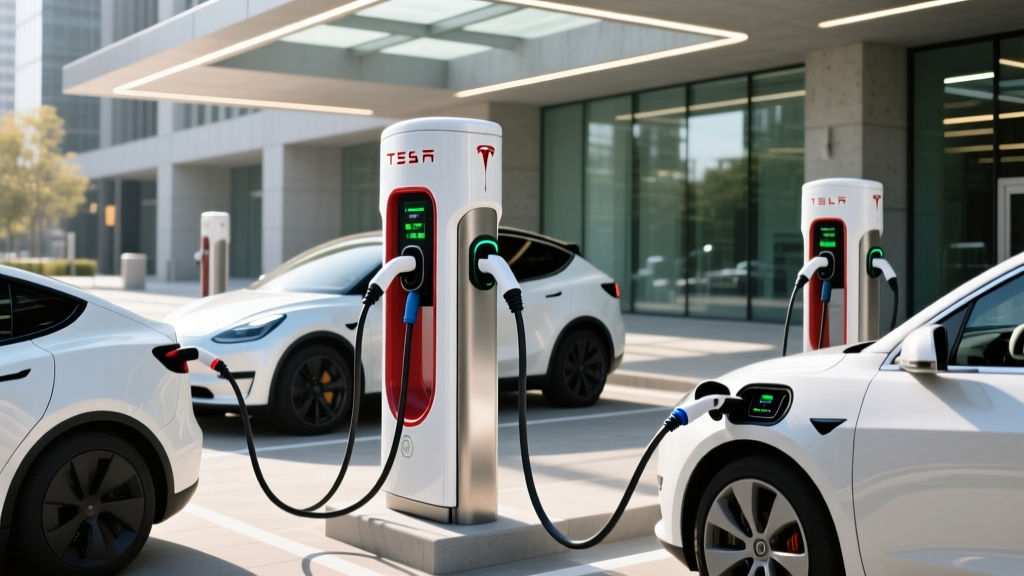
A Tesla V3 Supercharger delivers up to 250 kW peak; V4 stalls deployed through 2025–2026 can reach 350 kW for compatible vehicles. For context, charging a 77 kWh battery (Ford Mach-E Extended Range) from 10% to 80% on a V3 Supercharger takes approximately 25–32 minutes depending on battery temperature and preconditioning. That same session on a 50 kW CHAdeMO station would take well over an hour.
Which Non-Tesla EVs Can Use Superchargers in 2026?
The answer depends on your vehicle's charge port standard and the adapter ecosystem:
| Vehicle Charge Port | Example Models (2025–2026) | Supercharger Access Method | Adapter Required? |
|---|---|---|---|
| NACS (native) | Ford F-150 Lightning, Mustang Mach-E (2025+), GM Ultium models (2025+), Rivian R1T/R1S (2025+), Tesla (all) | Direct plug-in at NACS-equipped Superchargers | No |
| CCS1 | Hyundai Ioniq 5/6 (pre-2026), Kia EV6/EV9 (pre-2026), VW ID.4 (pre-2026), BMW iX | Tesla-provided CCS-to-NACS adapter or Magic Dock stations | Yes — manufacturer or Tesla adapter |
| CHAdeMO | Nissan Leaf (legacy) | No direct Supercharger access; third-party CHAdeMO-to-NACS adapters are rare and not officially supported | Not practically available |
Magic Dock is Tesla's built-in CCS adapter integrated into select Supercharger stalls. It allows CCS-equipped vehicles to plug in without a separate dongle. As of early 2026, Magic Dock is available at roughly 15–20% of US Supercharger locations, concentrated along major corridors. You can identify Magic Dock-enabled stations in the Tesla app or on Tesla's Supercharger map.
Manufacturer adapters — Ford, GM, Rivian, and others ship or sell a CCS-to-NACS adapter (typically $150–$250 if not included free) that lets CCS-port vehicles access NACS Supercharger stalls. These adapters are rated for up to 250 kW DC fast charging and are UL-listed for safety. Always use the adapter specified by your automaker; third-party adapters may void warranty or lack proper thermal management.
How Fast Will Non-Tesla EVs Charge on Superchargers?
Peak charge rate depends on the Supercharger generation, your vehicle's maximum DC charge acceptance, and battery conditions. Here's what real-world 10–80% sessions look like across common battery sizes:
| Vehicle (Battery kWh) | Max DC Acceptance | Supercharger Gen | Est. 10–80% Time | Notes |
|---|---|---|---|---|
| Ford F-150 Lightning Ext. Range (131 kWh, NMC) | ~150 kW sustained | V3 (250 kW peak) | ~42–48 min | Large battery limits C-rate; tapers above 70% |
| Hyundai Ioniq 5 (77.4 kWh, NMC) | ~240 kW peak | V3 (250 kW peak) | ~18–22 min | 800V architecture sustains high power; needs CCS adapter |
| Chevrolet Equinox EV (85 kWh, NMC) | ~150 kW sustained | V3 (250 kW peak) | ~30–35 min | Native NACS on 2025+ models |
| BMW i4 eDrive40 (81.5 kWh, NMC) | ~200 kW peak | V3 (250 kW peak) | ~28–33 min | CCS adapter required |
Cost to Charge: Supercharger Pricing vs. Gas vs. Home Charging
Tesla's Supercharger pricing for non-Tesla vehicles typically includes a per-kWh rate that is $0.05–$0.15 higher than the rate offered to Tesla owners. In 2026, non-Tesla Supercharger rates range from approximately $0.35 to $0.55 per kWh depending on location, time of day, and local utility rates.
| Charging Scenario | Rate | Vehicle Efficiency | Cost Per Mile |
|---|---|---|---|
| Home Level 2 (off-peak utility rate) | $0.12/kWh | 3.0 mi/kWh (100 MPGe class) | $0.040/mile |
| Home Level 2 (standard residential) | $0.18/kWh | 3.0 mi/kWh | $0.060/mile |
| Tesla Supercharger (Tesla owner rate) | $0.32/kWh | 3.0 mi/kWh | $0.107/mile |
| Tesla Supercharger (non-Tesla rate) | $0.45/kWh | 3.0 mi/kWh | $0.150/mile |
| Electrify America (guest rate) | $0.48/kWh | 3.0 mi/kWh | $0.160/mile |
| Gasoline vehicle (25 MPG combined) | $3.40/gallon | 25 MPG | $0.136/mile |
The math is clear: home charging at off-peak rates delivers the lowest per-mile cost by a wide margin. Supercharging at non-Tesla rates can actually exceed the per-mile fuel cost of an efficient gasoline vehicle — particularly in high-cost states like California, where rates can reach $0.55/kWh at peak hours. Road-trippers should budget accordingly and prioritize overnight home or destination Level 2 charging whenever possible.
How Much Does It Cost to Install a Home EV Charger?
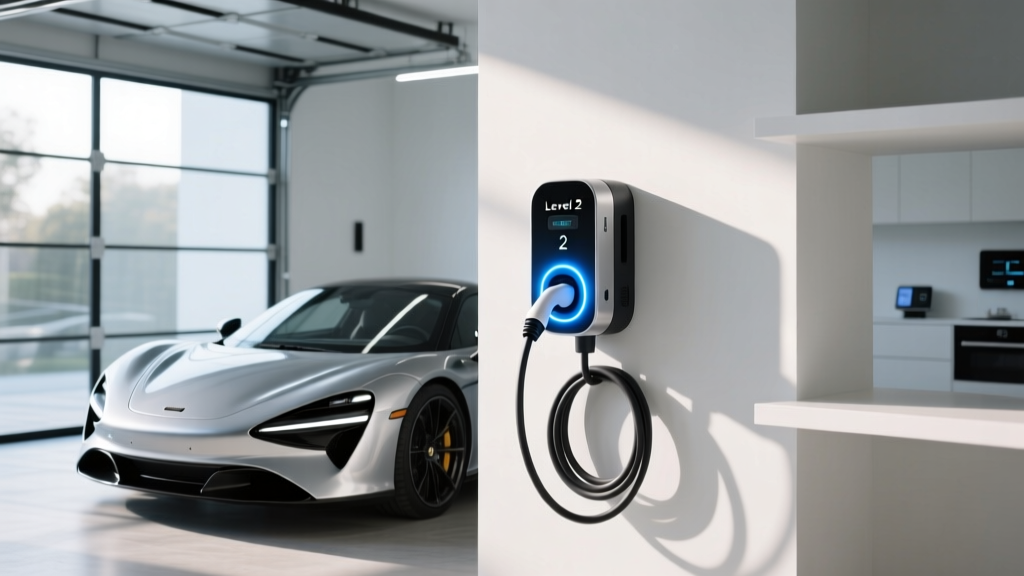
A dedicated Level 2 home charger is the single most impactful upgrade an EV owner can make. It eliminates public-charging dependence, delivers full batteries every morning, and costs a fraction of DC fast charging per mile. Here's what a professional installation actually costs in 2026:
| Cost Component | Typical Range | Notes |
|---|---|---|
| Level 2 charger hardware (smart, Wi-Fi-enabled, 40–48A) | $400–$750 | ChargePoint Home Flex, Emporia Level 2, Tesla Wall Connector |
| Electrician labor (240V circuit run, 40–50 ft) | $600–$2,000 | Varies by distance from panel, wall type, conduit routing |
| Electrical permit and inspection | $50–$250 | Required by most jurisdictions; ensures code compliance |
| Panel upgrade (if needed: 100A → 200A service) | $1,500–$4,000 | Homes built before 1990 with 100A panels often need this |
| Total (no panel upgrade) | $1,050–$3,000 | Most homes with 200A service fall in this range |
| Total (with panel upgrade) | $2,550–$7,000 | Older homes or those adding multiple high-draw circuits |
What Electrical Upgrades Might I Need?
A Level 2 charger drawing 40 amps continuous requires a dedicated 50-amp circuit (NEC rules mandate that continuous loads use no more than 80% of a breaker's rated capacity — so 40A continuous needs a 50A breaker). Key electrical requirements include:
- 240V dedicated circuit — a double-pole breaker in your main panel, not shared with other appliances
- Panel capacity — your panel must have at least two open slots and sufficient amperage headroom. A 200A panel powering a 50A EV circuit, HVAC, electric dryer, and range is typically fine; a 100A panel is not
- GFCI protection — NEC 2020 and later require ground-fault circuit interrupter protection for EV charging outlets in garages; hardwired installations may use a GFCI breaker
- Outdoor rating — if your charger is installed outdoors (carport, driveway), the unit must carry a NEMA 3R or NEMA 4 enclosure rating for weather resistance
- Wire gauge — 6 AWG copper for a 50A circuit; 4 AWG aluminum as an alternative where local code permits
Always hire a licensed electrician and pull a permit. Unpermitted EV charger installations can void home insurance claims and create fire hazards. The National Electrical Contractors Association maintains a directory of qualified installers.
Recommended Home Chargers for Non-Tesla and NACS-Equipped EVs
With the industry converging on NACS, charger selection in 2026 means choosing a unit with either a native NACS connector or a J1772 connector paired with a NACS adapter (most NACS vehicles ship with a J1772-to-NACS adapter).
Tesla Wall Connector (NACS)
- Power output: Up to 11.5 kW (48A) on a 60A circuit
- Connector: Native NACS — ideal for Tesla, Ford, GM, Rivian, and other NACS-port vehicles
- Cable length: 24 feet
- Smart features: Wi-Fi, OTA firmware updates, power-sharing (link up to 6 units on one circuit), access control via Tesla app
- Price: ~$450 (hardware only)
- Best for: NACS-native EV owners who want seamless Tesla ecosystem integration
ChargePoint Home Flex (J1772)
- Power output: Up to 12 kW (50A) on a 60A circuit; configurable down to 16A for lower-capacity panels
- Connector: J1772 — use included adapter for NACS vehicles, or plug directly into CCS/J1772 ports
- Cable length: 23 feet
- Smart features: Wi-Fi, ChargePoint app scheduling, Alexa integration, energy reporting
- Price: ~$550–$650
- Best for: Multi-EV households with mixed connector types; flexible amperage settings
Emporia Level 2 EV Charger (J1772)
- Power output: Up to 11.5 kW (48A) on a 60A circuit
- Connector: J1772 — compatible with NACS via adapter
- Cable length: 24 feet
- Smart features: Wi-Fi, Emporia energy monitoring integration, solar-aware scheduling, load management
- Price: ~$400
- Best for: Budget-conscious buyers with home solar or Emporia Vue energy monitors
Safety and Code Considerations for Home Charging
EV charging draws sustained high current for hours — a load profile unlike most household circuits. Proper installation isn't optional; it's a fire-safety requirement.
- Dedicated circuit only: Never share an EV charger circuit with a dryer, oven, or HVAC unit. Overloaded circuits are the leading cause of EV-charging-related electrical fires
- NEMA 14-50 vs. hardwired: A NEMA 14-50 outlet offers portability (take your charger when you move) but requires GFCI breaker protection under current NEC. Hardwired installations eliminate the outlet, may bypass GFCI breaker requirements in some jurisdictions, and reduce connection-failure risk
- Outdoor installations: Use a charger rated NEMA 4 (dust-tight and splash-proof) or higher. Ensure the conduit and junction box are also rated for wet locations
- Cable management: Use a wall-mounted holster or retractable reel to prevent tripping hazards and cable damage. Never run charging cables across walkways or driveways where vehicles can drive over them
- Utility notification: Some utilities require notification before installing a Level 2 charger, especially if you're on a time-of-use rate plan or need a service upgrade
Frequently Asked Questions
How much does it cost to install a home EV charger?
A typical Level 2 home charger installation with a 240V/50A dedicated circuit costs between $1,050 and $3,000 when no panel upgrade is needed. If your home has an older 100A electrical panel, a service upgrade to 200A adds $1,500–$4,000, bringing the total to $2,550–$7,000. Equipment (the charger itself) accounts for $400–$750 of that total.
How fast will each charging level add range?
Level 1 (120V) adds roughly 3–5 miles of range per hour. Level 2 (240V, 40–48A) adds 25–40 miles per hour for most EVs. DC fast charging at a Tesla V3 Supercharger (250 kW peak) can add 150–200 miles in 15 minutes for efficient vehicles like the Ioniq 5, though real-world rates depend on battery size, chemistry, temperature, and state of charge.
Which connector or charger is compatible with my EV?
Check your vehicle's charge port. If it's NACS (standard on 2025+ Ford, GM, Rivian, and Tesla vehicles), you can plug directly into NACS Superchargers and use a NACS home charger. If it's CCS1 (most Hyundai, Kia, VW, BMW models through 2025), you'll need a CCS-to-NACS adapter for Supercharger access and a J1772 home charger with a J1772-to-NACS adapter, or a native CCS home charger. CHAdeMO vehicles (Nissan Leaf) have no practical Supercharger access path.
How much does charging cost per mile vs. gas?
Home Level 2 charging at $0.12–$0.18/kWh costs $0.04–$0.06 per mile for an average EV — roughly one-third to one-half the cost of gasoline at $3.40/gallon and 25 MPG ($0.136/mile). However, public DC fast charging at non-Tesla Supercharger rates ($0.40–$0.55/kWh) costs $0.13–$0.18 per mile, which can equal or exceed gasoline costs. Home charging is where the economic advantage lives.
What electrical upgrades might I need for a home charger?
The most common upgrade is a panel service increase from 100A to 200A, required when your existing panel lacks the amperage headroom for a 50A dedicated EV circuit alongside other major appliances. You'll also need two open breaker slots, proper wire gauge (6 AWG copper for 50A), and a GFCI-protected circuit if using a NEMA 14-50 outlet. A licensed electrician can perform a load calculation to determine if your panel is sufficient.
Do non-Tesla vehicles charge slower on Superchargers?
Not inherently. The charge speed is determined by your vehicle's onboard DC charge acceptance rate and the Supercharger stall's peak output. A Hyundai Ioniq 5 with 240 kW peak acceptance will charge at roughly the same rate on a V3 Supercharger as it would on an Electrify America 350 kW stall. However, the CCS-to-NACS adapter introduces a small amount of additional connection resistance, and some non-Tesla vehicles may not precondition their batteries as aggressively when navigating to a Supercharger via the Tesla app, which can slightly reduce initial charge rates in cold weather.
Can I use Tesla Superchargers if my car has a CCS port?
Yes, provided the Supercharger station has Magic Dock (Tesla's built-in CCS adapter) or you carry a manufacturer-approved CCS-to-NACS adapter. Ford, GM, Rivian, and several aftermarket suppliers offer UL-listed adapters rated for up to 250 kW. Always verify adapter compatibility with your specific model year before purchasing.
Sources: fueleconomy.gov (EPA range and efficiency data), Tesla Supercharger network, National Fire Protection Association — NEC standards. Pricing and availability reflect 2026 model-year data and may vary by region. Always confirm current rates and adapter compatibility with your vehicle manufacturer.