Recent Tesla Supercharging iOS updates have reshaped how owners interact with the Supercharger network — from enhanced trip planning to real-time stall availability and integrated payment flows. But whether you drive a Tesla or a newly NACS-equipped rival from Ford, GM, or Rivian, understanding the full charging ecosystem remains essential. This guide breaks down every charging level, home installation realities, connector compatibility, and true cost-per-mile math you need to make informed decisions in 2026.
What the Latest Tesla Supercharging iOS Update Actually Changes
Tesla's app and in-car software updates throughout 2025 and into 2026 have incrementally improved the Supercharging experience. The most impactful changes tied to recent iOS and vehicle firmware updates include:
- Live stall status: The app now shows real-time occupancy and max kW output per stall before you arrive, reducing the gamble of pulling into a crowded corridor charger.
- Improved trip energy modeling: Navigation now factors in elevation, wind, and battery preconditioning state more accurately, tightening arrival State of Charge (SoC) predictions.
- Non-Tesla EV routing: With the Supercharger network open to NACS-equipped vehicles from other automakers, the app surfaces compatible stalls (those with the integrated CCS-to-NACS adapter or Magic Dock) and filters out stalls with short cables that can't reach non-Tesla charge ports.
- Charging history and cost tracking: Detailed per-session cost, kWh delivered, and average kW data are now exported cleanly for expense tracking or fleet management.
These software-side improvements matter, but they don't change the physics of charging. To plan ownership properly, you need to understand what happens at the hardware level — from your garage outlet to a 350 kW DC fast charger.
Charging Levels Explained: Speeds, Power, and Range Added
EV charging is categorized into three levels. The critical distinction: kW (kilowatts) measures power — how fast energy flows. kWh (kilowatt-hours) measures energy — how much the battery holds. A 10 kW charger delivers 10 kWh in one hour. Here's what each level delivers in practice:
| Level | Voltage / Amps | Power (kW) | Miles of Range Added Per Hour | Typical Use Case |
|---|---|---|---|---|
| Level 1 | 120V / 12–16A | 1.4–1.9 kW | 3–5 miles | Overnight top-up, PHEVs, emergencies |
| Level 2 | 240V / 16–80A | 3.8–19.2 kW | 12–60 miles | Home daily charging, workplace, destinations |
| DC Fast (Level 3) | 400–800V DC | 50–350 kW | 150–1,000+ miles/hr (peak) | Road trips, corridor travel, rapid top-ups |
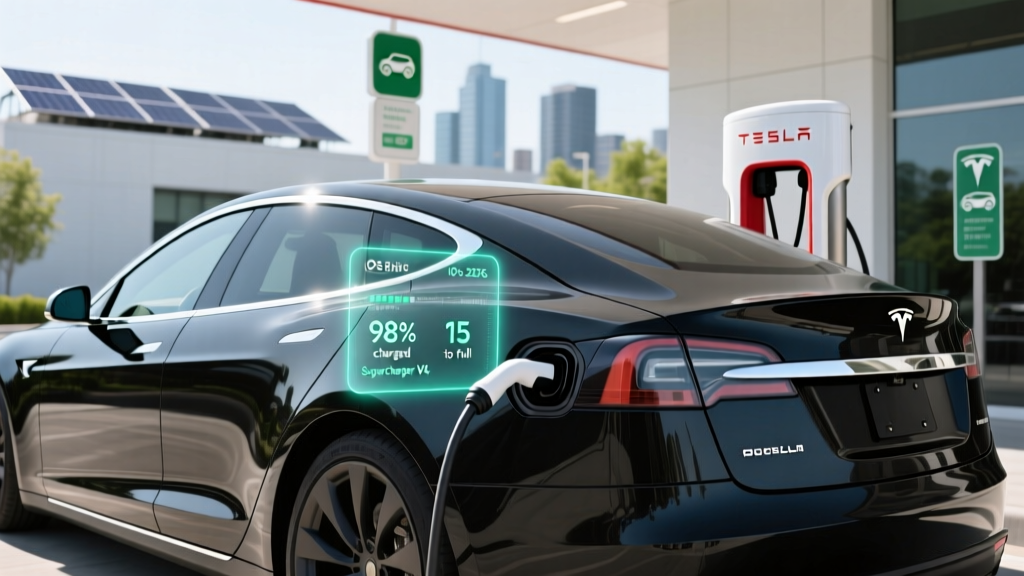
Real-world note on DC fast charging: Peak kW is not sustained kW. A vehicle rated for 250 kW peak may only hold that rate for the first 5–10 minutes before the charge curve tapers to protect the battery. A realistic 10–80% session on a 250 kW-capable vehicle with an 82 kWh battery (like the Tesla Model Y Long Range) takes approximately 25–30 minutes at a V3/V4 Supercharger, averaging around 120–140 kW over the session.
Home Charger Installation: Electrical Requirements, Costs, and Gotchas
Most EV owners do 80–90% of their charging at home on Level 2. A proper home setup requires a dedicated 240V circuit, a hardwired or NEMA 14-50 outlet-connected charger, and compliance with local electrical code (NEC Article 625 in the US).
Electrical Requirements
- Circuit: A 60A breaker feeding a 48A continuous-load charger is the current sweet spot for most EVs. The charger must be rated at 80% of the breaker capacity (NEC continuous load rule).
- Wire gauge: 6 AWG copper for 60A circuits; 4 AWG for longer runs over 100 feet to minimize voltage drop.
- Panel capacity: Your main service panel must have spare capacity. A 200A panel with high existing loads (electric heat, dryer, oven) may require a load management device or a full panel upgrade to 325A or 400A.
- GFCI protection: NEC 2020 and later require GFCI protection for EV outlets; hardwired chargers typically bypass this requirement, which is one reason hardwiring is often preferred.
- Permit: Most jurisdictions require an electrical permit ($50–$250) and a post-install inspection.
Installation Cost Breakdown
| Component | Simple Install (Panel Adjacent) | Moderate Install (50–100 ft Run) | Complex Install (Panel Upgrade Needed) |
|---|---|---|---|
| Level 2 Charger (Equipment) | $400–$700 | $400–$700 | $400–$700 |
| Electrician Labor | $300–$600 | $600–$1,500 | $1,500–$3,000 |
| Materials (Wire, Conduit, Breaker) | $100–$250 | $250–$600 | $400–$800 |
| Panel Upgrade (if needed) | N/A | N/A | $2,000–$4,500 |
| Permit & Inspection | $50–$150 | $50–$250 | $100–$300 |
| Total Estimated Cost | $850–$1,700 | $1,300–$3,050 | $4,400–$9,300 |
Panel upgrade reality check: Homes built before 2000 with 100A or 150A service are common candidates for panel upgrades when adding a 60A EV circuit. The federal Residential Clean Energy Credit (IRC §25D) covers 30% of qualified EV charger equipment and installation costs (up to $1,000 for the charger itself), which partially offsets the expense. Always consult a licensed electrician for a site-specific assessment.
Connector Compatibility: NACS, CCS1, CHAdeMO, and Adapter Needs
The North American connector landscape has consolidated rapidly. As of 2026, the Tesla-designed NACS (North American Charging Standard, SAE J3400) is the dominant connector, adopted by Ford, GM, Rivian, Volvo, Polestar, and most major automakers. CCS1 remains on legacy vehicles and some public chargers, while CHAdeMO is effectively orphaned.
| Connector | Native Vehicles | Tesla Supercharger Access | Notes |
|---|---|---|---|
| NACS (J3400) | Tesla (all), Ford F-150 Lightning/Mustang Mach-E (2025+), GM Ultium models (2025+), Rivian R1T/R1S (2025+), Volvo EX90, Polestar 3 | Native — no adapter needed | Industry standard going forward |
| CCS1 | Hyundai Ioniq 5/6, Kia EV6/EV9, BMW iX/i4, VW ID.4, older Ford/GM models | Requires NACS-to-CCS adapter ($150–$250) or Magic Dock-equipped Superchargers | Still widely supported at Electrify America, EVgo |
| CHAdeMO | Nissan Leaf (legacy), Mitsubishi Outlander PHEV (older) | No access | Effectively discontinued; chargers increasingly rare |
Adapter note for non-Tesla EVs: Ford, GM, and Rivian provide NACS adapters with new vehicle purchases or via dealer retrofit. Third-party adapters (such as the Lectron or A2Z NACS-to-CCS adapters) work for DC fast charging but verify the adapter's kW rating — some are limited to 150 kW, which will bottleneck vehicles capable of 250+ kW.
Charging Cost: Per-Mile Math vs. Gasoline
Electricity pricing varies enormously by location, time of day, and charger type. Here's a realistic cost comparison using a mid-efficiency EV consuming 3.0 miles per kWh (approximately 33 kWh/100 miles, similar to a Tesla Model Y or Hyundai Ioniq 5):
| Scenario | Cost per kWh | Cost per Mile (at 3 mi/kWh) | Equivalent Gas MPG at $3.50/gal |
|---|---|---|---|
| Home Level 2 — Off-Peak (national avg) | $0.12–$0.16 | $0.04–$0.05 | 70–88 MPG |
| Home Level 2 — Peak / Standard Rate | $0.18–$0.28 | $0.06–$0.09 | 39–58 MPG |
| Public Level 2 (ChargePoint, etc.) | $0.25–$0.49 | $0.08–$0.16 | 22–44 MPG |
| DC Fast — Tesla Supercharger (avg) | $0.28–$0.36 | $0.09–$0.12 | 29–39 MPG |
| DC Fast — Electrify America / EVgo | $0.36–$0.56 | $0.12–$0.19 | 18–29 MPG |
| Gasoline Baseline (25 MPG avg sedan) | $3.50/gal | $0.14 | 25 MPG |
The takeaway: Home off-peak charging is dramatically cheaper than gasoline — often 1/3 the per-mile cost. DC fast charging on road trips narrows the gap considerably and, on some networks during peak pricing, can approach or exceed gasoline costs per mile. This is why home charging access remains the single biggest predictor of EV ownership satisfaction.
Equipment Picks: Recommended Home Level 2 Chargers
Not all Level 2 chargers are equal. Key variables include max power output (amps), cable length, smart features (Wi-Fi, scheduling, load sharing), and connector type. Here are proven picks for 2026:
Tesla Wall Connector (Gen 4)
- Power: Up to 11.5 kW (48A on a 60A circuit)
- Connector: Native NACS
- Cable Length: 24 feet
- Smart Features: Wi-Fi updates, power sharing between two units, access control, scheduled charging via Tesla app
- Price: ~$475
- Best For: Tesla owners, NACS-equipped Ford/GM/Rivian vehicles
ChargePoint Home Flex
- Power: Up to 12 kW (50A on a 65A circuit); configurable down to 16A
- Connector: NACS (J3400) or CCS1 — select at purchase
- Cable Length: 23 feet
- Smart Features: Wi-Fi, Alexa integration, detailed energy tracking, flexible amperage for older panels
- Price: ~$600–$650
- Best For: Multi-EV households, panels with limited capacity (dial down amps)
Emporia Level 2 EV Charger
- Power: Up to 11.5 kW (48A)
- Connector: NACS or J1772 (legacy)
- Cable Length: 24 feet
- Smart Features: Wi-Fi, energy monitoring, solar integration with Emporia Vue panel monitor, Time-of-Use scheduling
- Price: ~$400–$500
- Best For: Solar-home owners, budget-conscious buyers wanting smart features
Charging Time Examples: What to Expect for Common Battery Sizes
Charging time depends on battery capacity (kWh), charger power (kW), the vehicle's onboard charger limit (for Level 2), and the DC fast-charge curve. Here are representative examples:
| Vehicle | Battery (kWh usable) | Level 2 at 11.5 kW | DC Fast (Peak kW) | DC Fast 10–80% Time |
|---|---|---|---|---|
| Tesla Model Y Long Range | ~75 kWh | ~4.5 hours | 250 kW (V3 Supercharger) | ~25–28 min |
| Hyundai Ioniq 5 (Long Range) | ~77.4 kWh | ~4.5–7 hrs (depends on onboard charger) | 240 kW (800V architecture) | ~18–20 min |
| Ford F-150 Lightning (Extended) | ~131 kWh | ~8–9 hours at 11.5 kW | 150 kW | ~45–55 min |
| Chevrolet Equinox EV | ~85 kWh | ~5 hours | 150 kW | ~35–40 min |
| BMW iX xDrive50 | ~111.5 kWh | ~7 hours at 11 kW | 200 kW | ~35 min |
Charge curve reality: The Hyundai Ioniq 5's 800V architecture allows it to sustain high charge rates longer than 400V vehicles, which is why its 10–80% time is exceptionally quick despite a similar battery size to the Model Y. Conversely, the F-150 Lightning's massive 131 kWh battery means even "fast" charging takes nearly an hour for a 10–80% fill — plan road trip stops accordingly.
Safety, Code, and Installation Best Practices
EV charging draws sustained high current for hours — a duty profile unlike most household appliances. Proper installation isn't optional:
- Dedicated circuit: Your EV charger must have its own dedicated breaker. Sharing a circuit with other appliances risks overloading and tripping.
- Outdoor rating: If installed outside, the charger must carry a NEMA 4 (or IP65+) rating. All connections must be in weatherproof enclosures.
- GFCI: NEC 2020+ requires GFCI protection for receptacle-based EV charging (NEMA 14-50 outlets). Hardwired installations are exempt from GFCI in most jurisdictions and are generally recommended for reliability.
- Cable management: Avoid letting the charge cable drag on the ground where it can be damaged, tripped over, or exposed to standing water. Wall-mounted cable organizers are a $20–$40 investment that prevents costly cable replacement.
- Load management: In homes with limited panel capacity, devices like the Emporia Vue or Sense energy monitor paired with a smart charger can dynamically throttle charge rate to stay within panel limits — avoiding an expensive panel upgrade.
Frequently Asked Questions
How much does it cost to install a home EV charger?
A straightforward Level 2 installation with the electrical panel nearby typically costs $850–$1,700 including equipment, labor, and permit. Longer wire runs push costs to $1,300–$3,050. If your home needs a panel upgrade (common in pre-2000 homes with 100A–150A service), total costs can reach $4,400–$9,300. The federal Residential Clean Energy Credit covers 30% of equipment costs up to $1,000.
How fast will each charging level add range?
Level 1 (120V standard outlet) adds 3–5 miles of range per hour — adequate for plug-in hybrids with small batteries but impractical as a primary strategy for BEVs with 70+ kWh batteries. Level 2 (240V) adds 12–60 miles per hour depending on amperage; a 48A/11.5 kW charger adds roughly 35–40 miles per hour for an efficient midsize SUV. DC fast charging adds 150–1,000+ miles per hour at peak, but sessions are typically measured in minutes (10–80% in 18–55 minutes depending on vehicle and charger).
Which connector/charger is compatible with my EV?
If you drive a Tesla, any 2025+ Ford, GM Ultium, Rivian, Volvo EX90, or Polestar 3, your vehicle uses the NACS connector natively. If you drive a Hyundai, Kia, BMW, VW, or an older Ford/GM EV, your vehicle uses CCS1 and will need a NACS-to-CCS adapter ($150–$250) to access Tesla Superchargers. CHAdeMO vehicles (Nissan Leaf, older Mitsubishi PHEVs) cannot access Superchargers and rely on the shrinking CHAdeMO public network. Check your vehicle's charge port or owner's manual to confirm.
How much does charging cost per mile vs gas?
At home on off-peak rates ($0.12–$0.16/kWh), an efficient EV costs $0.04–$0.05 per mile — roughly equivalent to a 70–88 MPG gas car. On DC fast chargers at $0.28–$0.56/kWh, costs rise to $0.09–$0.19 per mile, comparable to a 18–39 MPG gas vehicle. For most owners who charge primarily at home, EV fuel costs are 50–70% lower than gasoline per EPA data.
What electrical upgrades might I need?
The most common upgrade is a panel capacity increase. If your main panel is 100A or 150A and already serves electric heat, a dryer, and an oven, adding a 60A EV circuit may exceed capacity. A panel upgrade to 200A–400A costs $2,000–$4,500. Alternatives include installing a lower-amperage charger (32A/7.7 kW instead of 48A/11.5 kW), using a load-sharing device that throttles EV charging when other appliances draw power, or installing a dedicated sub-panel. A licensed electrician can perform a load calculation to determine your options.
Does the Tesla Supercharging iOS update affect non-Tesla EVs?
Yes, indirectly. Tesla's app and network updates now support non-Tesla NACS vehicles accessing Superchargers. The app identifies which stalls have the Magic Dock (integrated CCS adapter) or longer cables that can reach non-Tesla charge port locations. If you drive a Ford F-150 Lightning or GM Equinox EV with NACS, you'll use the Tesla app or your vehicle's native navigation to route to compatible Superchargers — the iOS update improves stall-level detail for all users.