The Real Cost to Charge a Tesla at a Supercharger in 2026
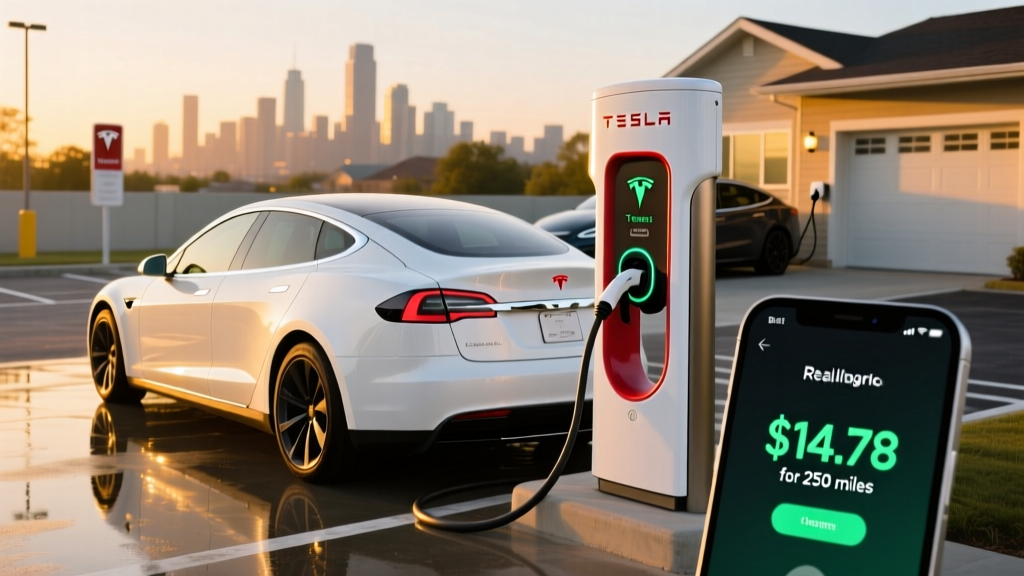
If you own a Tesla or are about to buy one, you've almost certainly typed "how much is it to charge a tesla at supercharger" into a search bar. The short answer: Supercharger pricing in 2026 averages between $0.28 and $0.48 per kWh depending on your state, time of day, and whether you're on a V2 (150 kW) or V4 (up to 350 kW) station. For a Tesla Model Y Long Range with its ~75 kWh usable battery, a 10–80% session (about 52.5 kWh) costs roughly $15 to $25.
But Supercharger costs are only part of the picture. Most Tesla owners do 80–90% of their charging at home on Level 2 equipment, where electricity rates are dramatically cheaper. This guide breaks down every charging scenario — Supercharger, home Level 2, and trickle Level 1 — with exact costs per kWh, per mile, and per full charge, plus what you'll spend to set up home charging.
Charging Levels Explained: Speed, Power, and Range Added Per Hour
Every Tesla owner interacts with three charging tiers. Here's what each delivers in real-world terms for a 2026 Model Y Long Range (EPA efficiency ~3.6 mi/kWh):
| Level | Voltage / Amperage | Max Power (kW) | Miles of Range Added Per Hour | 10–80% Time (75 kWh Battery) |
|---|---|---|---|---|
| Level 1 (120V household outlet) | 120V / 12A | ~1.4 kW | 3–5 mi/hr | ~37+ hours (impractical) |
| Level 2 (240V home/public) | 240V / 48A | ~11.5 kW | 30–44 mi/hr | ~5–6 hours |
| DC Fast Charge (Supercharger V3/V4) | 400V+ DC | 250 kW (V3) / 350 kW (V4) | ~170–200+ mi in 15 min | ~15–25 minutes |
A few real-world caveats: DC fast charging never sustains its peak rate for the full session. A Model Y on a V3 Supercharger will peak near 250 kW up to roughly 40% State of Charge (SoC), then taper progressively — dropping to ~100 kW by 60% and ~40 kW by 80%. This charge-curve taper is why the 10–80% time matters more than the peak kW number. In cold weather (below 32°F), expect 10–80% times to stretch 20–30% longer unless you precondition the battery via the Tesla app or in-car navigation routing to the Supercharger.
How Much Does Supercharger Charging Actually Cost?
Tesla Supercharger rates are not uniform. They vary by location, local utility rates, and time-of-use tiers. Here's what Tesla owners report paying in 2026 across major U.S. markets:
| Scenario | Rate ($/kWh) | Cost for 10–80% (52.5 kWh) | Cost Per Mile (at 3.6 mi/kWh) |
|---|---|---|---|
| Home charging (national avg. residential) | $0.16 | $8.40 | $0.044 |
| Home charging (off-peak utility rate) | $0.09 | $4.73 | $0.025 |
| Supercharger (low-cost states: TX, WA, OK) | $0.28 | $14.70 | $0.078 |
| Supercharger (avg. national rate) | $0.36 | $18.90 | $0.100 |
| Supercharger (high-cost: CA, NY urban) | $0.48 | $25.20 | $0.133 |
| Third-party DC fast (Electrify America, EVgo) | $0.43–$0.56 | $22.58–$29.40 | $0.119–$0.156 |
Cost per mile vs. gas: A comparable gas-powered compact SUV averaging 28 MPG combined at $3.40/gallon costs about $0.121 per mile in fuel. Home-charged Tesla driving at $0.16/kWh costs $0.044 per mile — roughly one-third the fuel cost. Even at peak Supercharger rates in California ($0.48/kWh), you're paying $0.133/mile, which is roughly equivalent to gas, not cheaper. The savings story is overwhelmingly a home-charging story.
Tesla also offers membership pricing in some regions for non-Tesla EVs using Superchargers via the Magic Dock adapter, but Tesla-owners already receive the standard rate. Idle fees of $0.50–$1.00/minute apply if your car remains plugged in after reaching its charge limit at a busy station.
How Much Does It Cost to Install a Home EV Charger?
Home charging is where Tesla ownership economics shine — but the upfront installation cost varies wildly depending on your home's electrical panel, the distance from panel to charger location, and local permit fees.
Electrical Requirements for Tesla Home Charging
For meaningful Level 2 charging speed, you need a 240V dedicated circuit. The most common configurations:
- NEMA 14-50 outlet (240V / 50A): Supports up to 40A continuous charging (~9.6 kW). This is the most popular and versatile option — it works with the Tesla Mobile Connector and most third-party EVSE units.
- Hardwired wall connector (240V / 60A circuit): Supports up to 48A continuous charging (~11.5 kW). Requires a dedicated 60A breaker. Delivers the fastest Level 2 speed for Tesla vehicles.
- NEMA 6-20 outlet (240V / 20A): A fallback option delivering ~3.8 kW (~14 mi/hr). Useful if your panel lacks capacity for a 50A circuit.
Installation Cost Breakdown
| Cost Component | Simple Install (panel nearby, no upgrade) | Complex Install (long wire run, subpanel) | Full Panel Upgrade Scenario |
|---|---|---|---|
| EVSE equipment (Tesla Wall Connector or equivalent) | $400–$475 | $400–$475 | $400–$475 |
| Electrician labor (licensed) | $300–$600 | $800–$2,000 | $1,500–$3,000 |
| Materials (wire, conduit, breaker) | $50–$150 | $200–$500 | $300–$600 |
| Permit & inspection | $50–$150 | $100–$300 | $100–$300 |
| Electrical panel upgrade (100A → 200A) | N/A | N/A | $1,500–$3,500 |
| Total estimated cost | $800–$1,400 | $1,500–$3,300 | $3,800–$7,900 |
The panel-upgrade gotcha: Homes built before 1990 often have 100-amp electrical panels that are already near capacity running HVAC, electric dryers, and ranges. Adding a 50A or 60A EV circuit may require upgrading to a 200A panel — a $1,500–$3,500 job on its own. Always get a load calculation from a licensed electrician before assuming you can simply add a circuit. Some utilities and states offer rebates of $200–$1,000 for panel upgrades tied to EV adoption; check with your local provider.
The federal Residential Clean Energy Credit does not currently cover EV charger equipment directly under §30D (that credit applies to vehicle purchases), but the separate §30C Alternative Fuel Vehicle Refueling Property Credit can cover up to 30% of home charger installation costs (max $1,000) if you live in an eligible census tract. Consult a tax professional for your specific situation.
Which Connector and Charger Is Compatible with Tesla?
Tesla uses the North American Charging Standard (NACS) connector — the same proprietary plug now being adopted industry-wide. In 2026, Tesla vehicles charge natively at all Superchargers without adapters. The landscape for non-Tesla charging compatibility:
| Connector Type | Used By | Tesla Compatibility | Adapter Needed? |
|---|---|---|---|
| NACS (Tesla) | Tesla (all models); Ford, GM, Rivian, Volvo, others (2025+) | Native — direct plug | None for Superchargers |
| CCS1 (Combo) | Most legacy non-Tesla EVs (Hyundai, VW, BMW, etc.) | Works with Tesla CCS adapter | Tesla CCS Adapter (~$175) |
| CHAdeMO | Nissan Leaf (legacy) | Not supported | Not available from Tesla |
| J1772 (Level 2 public) | All non-Tesla EVs for Level 2 AC charging | Works with included J1772 adapter | Tesla includes J1772 adapter |
Starting in 2025, Tesla opened Supercharger access to non-Tesla EVs equipped with NACS ports or using the built-in Magic Dock CCS adapter at select stations. For Tesla owners, the practical takeaway: your NACS plug works everywhere in the Tesla network natively, and the included J1772 adapter handles public Level 2 stations from ChargePoint, EVgo, and others.
Best Home Charging Equipment for Tesla Owners
Here are the top-rated home chargers compatible with Tesla vehicles in 2026, selected for reliability, power output, and smart features:
Tesla Wall Connector (Gen 3)
- Power Output: Up to 11.5 kW (48A on a 60A circuit)
- Connector: NACS native — no adapter needed
- Cable Length: 24 ft
- Smart Features: Wi-Fi for OTA updates, load sharing with multiple units, Tesla app integration, power-sharing across two Wall Connectors on one circuit
- Price: ~$475
- Best For: Tesla-only households wanting maximum Level 2 speed and seamless integration
ChargePoint Home Flex (NACS version)
- Power Output: Up to 12 kW (50A adjustable on a 60A circuit)
- Connector: NACS (2025+ version) or J1772 with adapter
- Cable Length: 23 ft
- Smart Features: Wi-Fi, Alexa integration, scheduling via ChargePoint app, detailed energy tracking, works with utility demand-response programs
- Price: ~$549
- Best For: Multi-EV households (Tesla + non-Tesla) wanting app-based energy management
Tesla Mobile Connector Bundle
- Power Output: Up to 7.6 kW (32A on NEMA 14-50); ~1.4 kW on 120V
- Connector: NACS with interchangeable adapter heads
- Cable Length: 20 ft
- Smart Features: Basic — no Wi-Fi or scheduling; relies on vehicle-side scheduling
- Price: ~$300
- Best For: Budget installs, renters, or as a backup/portable solution
For most Tesla owners with a garage, the Tesla Wall Connector is the default recommendation: native NACS plug, highest Level 2 power for Tesla vehicles, and no adapter friction. If you have a non-Tesla EV in the household or want richer energy-reporting features, the ChargePoint Home Flex is an excellent alternative.
Safety, Electrical Code, and Installation Best Practices
EV charging draws sustained high current for hours — this is not the same as plugging in a dryer for 45 minutes. Follow these code and safety requirements:
- Dedicated circuit: Your EV charger must be on its own dedicated breaker — never shared with other appliances. A 50A circuit for NEMA 14-50 or a 60A circuit for hardwired installations.
- GFCI protection: NEC 2020 and later require GFCI (Ground Fault Circuit Interrupter) protection for all EVSE outlets in garages and outdoor locations. Hardwired Wall Connectors have built-in ground-fault protection.
- Outdoor rating: If installing outdoors, ensure the EVSE is NEMA 4 rated (weatherproof). The Tesla Wall Connector is rated for indoor and outdoor use.
- Wire gauge: A 50A circuit requires minimum 6 AWG copper wire; a 60A circuit requires 4 AWG copper. Longer wire runs may need thicker gauge to prevent voltage drop.
- Permit and inspection: Most jurisdictions require an electrical permit for EVSE installation. Skipping the permit can void homeowner's insurance coverage for electrical fires and may cause issues during home resale.
Always hire a Tesla-certified or licensed electrician familiar with EV charging loads. Get at least two quotes and confirm the electrician will pull permits and schedule inspection.
Tesla Supercharger vs. Home Charging: Which Saves You More?
Let's model a realistic annual scenario for a 2026 Tesla Model Y Long Range driven 12,000 miles per year at 3.6 mi/kWh efficiency (consuming ~3,333 kWh annually):
| Charging Mix | Annual kWh Cost | Annual Fuel Cost | 5-Year Fuel Cost |
|---|---|---|---|
| 100% home (avg. $0.16/kWh) | 3,333 kWh | $533 | $2,665 |
| 80% home / 20% Supercharger (avg. blended $0.20/kWh) | 3,333 kWh | $667 | $3,335 |
| 50% home / 50% Supercharger (blended $0.26/kWh) | 3,333 kWh | $867 | $4,335 |
| 100% Supercharger (avg. $0.36/kWh) | 3,333 kWh | $1,200 | $6,000 |
| Gas SUV (28 MPG, $3.40/gal) | 429 gallons | $1,457 | $7,286 |
Even a Tesla charged exclusively at Superchargers costs less per year in energy than a 28 MPG gas SUV. But the dramatic savings — $900+ per year — come from home charging dominance. If your apartment, condo, or street-parking situation prevents home charging, factor the higher Supercharger costs into your total cost of ownership calculation before purchasing.
Frequently Asked Questions
Is it free to charge at Tesla Superchargers?
No. Tesla discontinued free unlimited Supercharging for new vehicle purchases in 2019. Some older Model S and Model X vehicles retain legacy free Supercharging, but all current Model 3, Model Y, Model S, and Model X vehicles pay per kWh. Tesla occasionally offers promotional Supercharging credits with referrals or new deliveries, but these are limited-time and limited-kWh offers.
How long does it take to charge a Tesla Model Y from 10% to 80% at a Supercharger?
On a V3 Supercharger (250 kW peak), a 2026 Model Y Long Range charges from 10–80% in approximately 22–27 minutes with a preconditioned battery. On the newer V4 Supercharger cabinets (up to 350 kW capable), the Model Y is limited by its onboard architecture to roughly 250 kW peak, so times are similar. Cold batteries or high SoC starting points will extend these times significantly.
Can I use a regular 120V outlet to charge my Tesla?
Yes, but it's extremely slow. A standard 120V/12A outlet delivers roughly 1.4 kW — adding about 3–5 miles of range per hour. Fully charging a 75 kWh battery from empty would take over 50 hours. Level 1 is viable only for overnight top-ups if your daily driving is under 30 miles and you have no access to 240V charging.
Does frequent Supercharging damage the Tesla battery?
DC fast charging generates more heat than Level 2 charging, which accelerates battery degradation marginally over time. Tesla's battery management system (BMS) actively manages cell temperature and limits charge rates to protect longevity. Real-world data from high-mileage Teslas shows that exclusive Supercharging may result in 2–5% additional degradation over 150,000 miles compared to primarily Level 2 charging. For daily use, charge at home; use Superchargers for road trips without concern. Tesla's battery warranty covers degradation below 70% capacity retention for 8 years or 120,000 miles (100,000 miles for Standard Range models), per Tesla's warranty documentation.
What happens if my home electrical panel can't support an EV charger?
If your panel lacks capacity, you have three options: (1) upgrade to a 200A panel ($1,500–$3,500); (2) install a lower-amperage circuit like a NEMA 6-20 (240V/20A, ~3.8 kW) that fits within existing capacity; or (3) use a smart load-management device like the Tesla Wall Connector with load-sharing or a third-party panel monitor that dynamically reduces EV charging current when other household loads spike. This last option avoids a panel upgrade entirely in many cases.
How does Supercharger pricing compare to Electrify America or EVgo?
Tesla Supercharger rates ($0.28–$0.48/kWh) are generally lower than Electrify America ($0.43–$0.56/kWh) and comparable to EVgo's membership rates. Tesla also benefits from superior station reliability — Tesla Superchargers consistently report 99%+ uptime, while third-party networks average 85–92% uptime in J.D. Power EV charging satisfaction studies.