Vermont's Supercharger Network in 2026: What EV Owners Need to Know
If you searched for tesla supercharger stations in vermont 2023 and landed here, you're likely planning a trip through the Green Mountain State or considering an EV purchase and wondering about charging infrastructure. Vermont's Supercharger network has expanded considerably since 2023, and the broader charging landscape has shifted even more dramatically: Tesla opened its Supercharger network to non-Tesla EVs via the NACS (North American Charging Standard) connector, and nearly every major automaker has adopted NACS for 2025 and 2026 model-year vehicles.
This guide covers Vermont's current Supercharger footprint, then walks through everything you need to set up home charging — the single most impactful upgrade for EV ownership. Whether you drive a Tesla Model Y, a Ford F-150 Lightning, or a Hyundai Ioniq 5, the physics and economics of charging remain the same.
Tesla Supercharger Locations Across Vermont
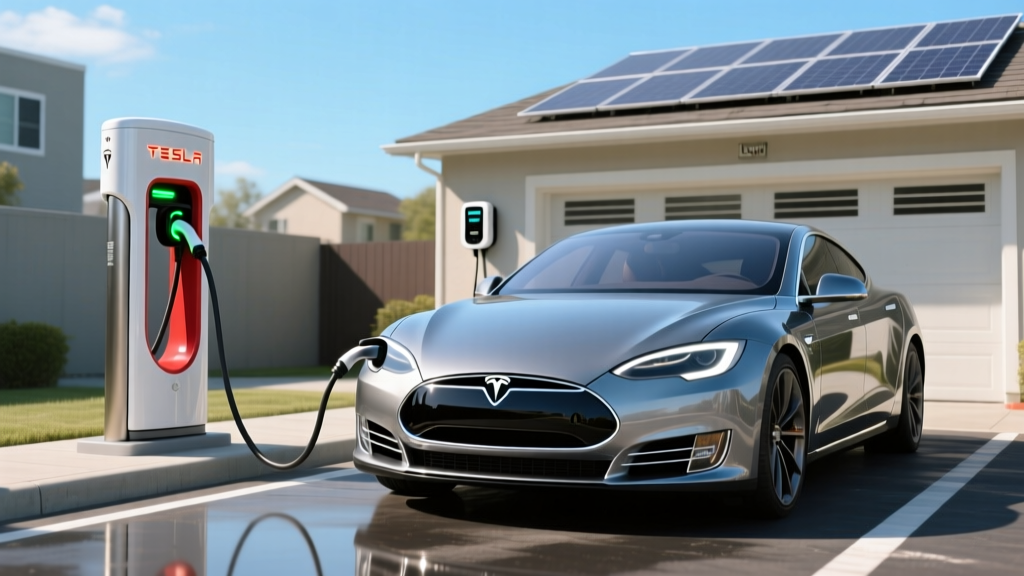
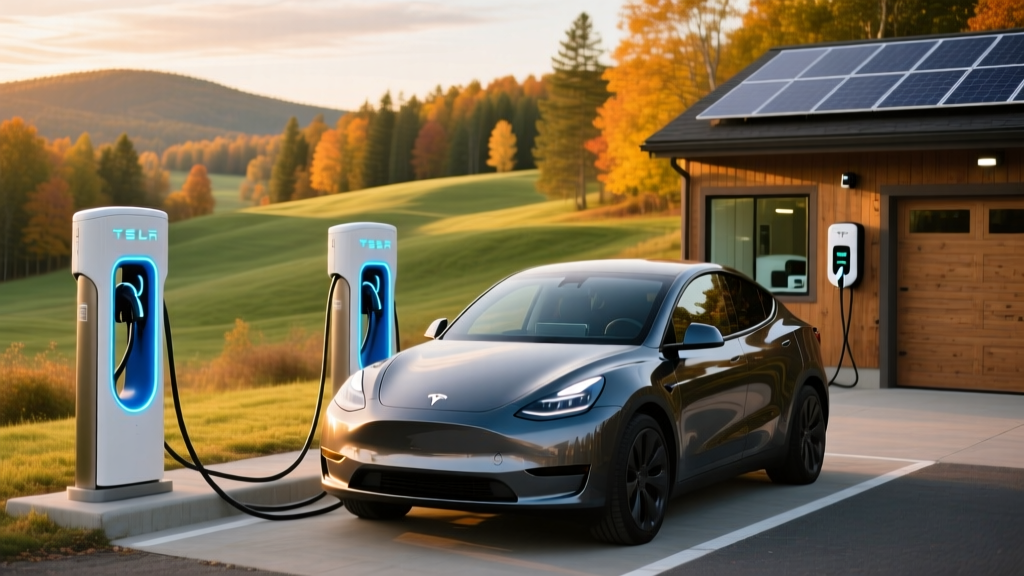
As of early 2026, Vermont hosts roughly a dozen Supercharger stations strategically placed along major travel corridors. Key locations include:
- Burlington / South Burlington — Multiple stalls near I-89, convenient for the state's largest metro area
- Montpelier / Berlin — Central Vermont coverage along Route 2 and I-89
- St. Johnsbury — Critical stop for I-91 travelers heading toward the Northeast Kingdom or New Hampshire
- Brattleboro — Southern Vermont access near I-91 and the Massachusetts border
- Rutland — Western Vermont coverage along US-4
- Manchester — Serves the Route 7 corridor and southern Green Mountains
- Stowe / Waterbury — Seasonal traffic near ski areas, with V3 (250 kW) stalls
- White River Junction — I-89 and I-91 interchange, a key crossroads
Most Vermont Supercharger sites now feature V3 or V4 architecture, delivering up to 250 kW peak power to capable vehicles. For context, a Tesla Model Y Long Range (75 kWh usable battery, NMC chemistry) can add roughly 160 miles of range in 15 minutes at a V3 stall when starting from a low state of charge. Non-Tesla vehicles with NACS ports — such as the 2025+ Ford F-150 Lightning and 2026 Hyundai Ioniq 5 — can access these same stalls using the built-in NACS connector or a CCS-to-NACS adapter.
For the most current station status, stall counts, and real-time availability, check Tesla's Find Us map or the in-vehicle navigation system, which routes through Superchargers automatically and preconditions the battery for optimal charging speed on arrival.
Charging Levels Explained: Speeds, Times, and Real-World Expectations
Every EV owner uses three tiers of charging. Understanding the speed difference between them is essential for trip planning and home setup decisions.
| Level | Voltage | Power (kW) | Miles of Range Added per Hour | Typical Use Case |
|---|---|---|---|---|
| Level 1 | 120V AC | 1.0–1.4 kW | 3–5 mi/hr | Emergency / overnight trickle (PHEVs, low-mileage drivers) |
| Level 2 | 240V AC | 7.2–19.2 kW | 25–70 mi/hr | Home daily charging, workplace, hotels, shopping centers |
| DC Fast Charging | 400–800V DC | 50–350 kW | 150–1,000+ mi/hr (peak) | Road trips, highway corridors, quick top-ups |
Real-World Charging Time Examples
Charging times depend on battery size, state of charge (SoC), battery temperature, and the charger's maximum output. Here are representative 10–80% times for common battery sizes:
- Tesla Model Y Long Range (75 kWh, NMC) at a 250 kW V3 Supercharger: ~22–25 minutes (10–80%). Peak rate hits ~250 kW around 15–25% SoC, then tapers to ~100 kW above 60% and ~50 kW above 80%.
- Ford F-150 Lightning Extended Range (131 kWh, NMC) at a 150 kW DC fast charger: ~45–55 minutes (10–80%). Larger batteries take longer even at high power.
- Hyundai Ioniq 5 (77.4 kWh, NMC) at a 350 kW charger (800V architecture): ~18 minutes (10–80%). The Ioniq 5's 800V system sustains higher power longer than 400V vehicles.
- Level 2 home charging (48A / 11.5 kW) for a 75 kWh battery: ~6.5 hours from 10–80%. This is the overnight sweet spot — plug in at 10 PM, full by morning.
Home EV Charger Installation: Costs, Electrical Requirements, and Gotchas
Home Level 2 charging is where 80%+ of EV charging happens for owners with garage or driveway access. It's also where upfront costs can surprise you. Here's what a proper installation involves.
Electrical Requirements
A Level 2 home charger requires a 240-volt dedicated circuit, similar to what powers an electric dryer or oven. Common configurations:
- 40-amp circuit / 32A continuous charging — Delivers 7.7 kW. Adequate for most daily driving (adds ~25–30 miles per hour of charging). Requires 6-gauge copper wire.
- 50-amp circuit / 40A continuous — Delivers 9.6 kW. The most popular home setup. Adds ~35 miles per hour. Requires 6-gauge wire.
- 60-amp circuit / 48A continuous — Delivers 11.5 kW. Ideal for larger batteries (F-150 Lightning, Rivian R1T). Adds ~40–45 miles per hour. Requires 4-gauge wire.
The National Electrical Code (NEC) requires that continuous loads (like EV charging, which runs for 3+ hours) not exceed 80% of the circuit breaker rating. So a 50A breaker supports 40A continuous draw — not 50A.
Do You Need a Panel Upgrade?
This is the question that can double your installation cost. Most homes built after the 1990s have a 200-amp electrical panel, which usually has enough headroom for a 50A EV circuit. However, older homes with 100-amp service, or homes already running multiple large loads (electric heat, electric water heater, electric dryer, hot tub), may need a panel upgrade to 200A or even a service upgrade from the utility.
A licensed electrician will perform a load calculation (per NEC Article 220) to determine if your panel can handle the additional circuit. If it can't, a panel upgrade typically costs $1,500–$3,500 before the charger circuit itself.
Installation Cost Breakdown
| Component | Low Estimate | High Estimate | Notes |
|---|---|---|---|
| Level 2 Charger (Equipment) | $350 | $750 | Hardwired or NEMA 14-50 plug; 32A–48A models |
| Electrician Labor (circuit run + install) | $500 | $2,000 | Depends on distance from panel, wall material, conduit needs |
| Electrical Permit | $50 | $250 | Varies by municipality; required in most jurisdictions |
| Panel Upgrade (if needed) | $1,500 | $3,500 | Only if load calculation fails; 100A→200A typical |
| Total (no panel upgrade) | $900 | $3,000 | Most homeowners fall in the $1,200–$2,000 range |
| Total (with panel upgrade) | $2,400 | $6,500 | Older homes or high-load households |
Vermont-specific note: Green Mountain Power and other Vermont utilities occasionally offer rebates for Level 2 charger installations. Check with your utility before scheduling work. Additionally, the federal Alternative Fuel Vehicle Refueling Property Credit (IRS Form 8911) may cover up to 30% of home charging equipment and installation costs (capped at $1,000), subject to census-tract eligibility and current-year tax rules. Consult a tax professional to confirm your eligibility.
Connector Compatibility: NACS, CCS, and CHAdeMO in 2026
The connector landscape has consolidated dramatically since 2023, when Tesla's Supercharger network was Tesla-only and most other EVs used CCS1. Today, NACS is the dominant standard in North America.
| Connector | Brands Using It (Native) | Access to Tesla Superchargers? | Adapter Needed? |
|---|---|---|---|
| NACS (Tesla) | Tesla (all years), Ford (2025+), GM (2025+), Hyundai/Kia (2026+), Rivian (2025+), Volvo/Polestar (2025+) | Yes — native access | None for Superchargers; CCS-to-NACS adapter for older CCS stations |
| CCS1 | Legacy models: 2021–2024 Hyundai/Kia, older VW ID.4, BMW i4, some Stellantis models | Yes, with Tesla's CCS-to-NACS adapter (or Magic Dock at select Superchargers) | CCS-to-NACS adapter (~$200–$250) for Supercharger access |
| CHAdeMO | Nissan Leaf (discontinued), Mitsubishi Outlander PHEV (older models) | No — CHAdeMO is not supported at Superchargers | No practical adapter; use Electrify America, EVgo, or ChargePoint CHAdeMO stalls |
If you're buying a 2025 or 2026 EV, it almost certainly has a NACS port natively. If you own a 2022–2024 model with CCS1, purchase the manufacturer-approved CCS-to-NACS adapter to unlock Tesla Supercharger access — a significant advantage for road trips, especially in rural states like Vermont where Superchargers often fill gaps in third-party DC fast charging coverage.
Cost to Charge: Home vs. Public vs. Gas — Real Numbers
The economic case for EV charging hinges on where and when you charge. Here's a realistic breakdown for Vermont drivers.
| Scenario | Rate ($/kWh) | Cost for 60 kWh (~250 mi) | Cost per Mile |
|---|---|---|---|
| Home (Vermont residential avg, off-peak) | $0.17–$0.20 | $10.20–$12.00 | $0.041–$0.048 |
| Home (time-of-use, overnight valley rate) | $0.12–$0.15 | $7.20–$9.00 | $0.029–$0.036 |
| Tesla Supercharger (Vermont, 2026) | $0.28–$0.36 | $16.80–$21.60 | $0.067–$0.086 |
| Electrify America / EVgo (DC fast) | $0.35–$0.48 | $21.00–$28.80 | $0.084–$0.115 |
| Gasoline (Vermont avg $3.40/gal, 28 MPG combined) | — | $30.36 (for 250 mi) | $0.121 |
Even at public DC fast charging rates, EVs typically cost less per mile than a 28 MPG gas car at Vermont fuel prices. But the real savings come from home charging: at $0.15/kWh overnight, you're paying roughly 3–4 cents per mile — about one-quarter the cost of gasoline. Over 12,000 miles per year, that's roughly $960 in electricity vs. $1,450 in gas — a $490 annual savings before factoring in reduced maintenance (no oil changes, fewer brake replacements due to regenerative braking).
Vermont's electricity rates are moderate by Northeast standards. Green Mountain Power's standard residential rate hovers around $0.18–$0.20/kWh in 2026. If your utility offers a time-of-use (TOU) plan, shifting charging to overnight hours (typically 11 PM–6 AM) can drop your rate to $0.12–$0.15/kWh. Most Level 2 chargers have built-in scheduling to automate this.
Recommended Home Level 2 Chargers for 2026
After testing dozens of units across multiple EVs and home electrical setups, here are the Level 2 chargers we recommend for Vermont EV owners. All models below support NACS natively or via included adapter, and all are UL-listed for safety.
Tesla Wall Connector (Gen 3)
- Power Output: Up to 11.5 kW (48A on a 60A circuit)
- Connector: NACS native; includes J1772 adapter for non-Tesla EVs
- Cable Length: 24 feet
- Smart Features: Wi-Fi enabled, OTA firmware updates, load sharing (pair two units on one circuit), access control via app
- Price: ~$475
- Best For: Tesla owners and households with NACS-equipped vehicles. Excellent build quality and the fastest Level 2 charging available for most homes.
ChargePoint Home Flex (2nd Gen)
- Power Output: Up to 12 kW (50A on a 60A circuit); configurable via DIP switches for lower-amperage circuits
- Connector: Available in NACS or J1772; NACS version works with all 2025+ EVs
- Cable Length: 23 feet
- Smart Features: Wi-Fi, Alexa integration, detailed energy tracking via app, flexible amperage settings
- Price: ~$550–$650
- Best For: Multi-EV households or buyers who want granular app control and flexible amperage configuration for older electrical panels.
Emporia Level 2 EV Charger
- Power Output: Up to 11.5 kW (48A on a 60A circuit)
- Connector: J1772 (NACS adapter available separately)
- Cable Length: 24 feet
- Smart Features: Wi-Fi, solar integration (pairs with Emporia Vue energy monitor), scheduling, load management
- Price: ~$350–$400
- Best For: Budget-conscious buyers and homes with solar panels. The best value-per-kW charger on the market, though the J1772 connector means NACS EVs will need an adapter.
Safety, Electrical Code, and Installation Best Practices
EV charging draws sustained high current for hours — more like running an electric furnace than plugging in a phone charger. Proper installation isn't optional; it's a fire-safety requirement.
- Dedicated circuit: Your Level 2 charger must be on its own dedicated breaker — not shared with other outlets or appliances. This prevents overloads and nuisance tripping.
- GFCI protection: The 2023 NEC (adopted by Vermont) requires GFCI protection for all EV charging outlets. Hardwired installations are exempt from the GFCI requirement because the charger itself contains ground-fault protection. This is why many electricians recommend hardwiring over a NEMA 14-50 receptacle — it's safer, avoids a common failure point, and eliminates the $80–$150 GFCI breaker cost.
- Outdoor rating: If your charger is installed outdoors (common in Vermont where garages are small or detached), ensure the unit is rated for outdoor use (NEMA 4 or IP65). All three chargers recommended above carry outdoor ratings, but cable management and connector holsters should be positioned to prevent water pooling.
- Cold-weather considerations: Vermont winters regularly dip below 0°F. Lithium-ion batteries charge slower when cold, and your EV's thermal management system will use energy to warm the battery before and during charging. Expect Level 2 charging to take 10–20% longer in deep cold. DC fast charging can be even more affected — precondition your battery by navigating to a Supercharger in the car's nav system, which triggers active battery heating.
- Permit and inspection: Most Vermont municipalities require an electrical permit for a new 240V circuit. The inspection ensures proper wire gauge, breaker sizing, grounding, and code compliance. Don't skip this — it protects you and is required for insurance claims if an electrical fire occurs.
Frequently Asked Questions
How much does it cost to install a home EV charger in Vermont?
A typical Level 2 home charger installation in Vermont costs $1,200–$2,500 when no panel upgrade is needed. This includes the charger ($350–$650), electrician labor ($500–$1,500), and permit ($50–$200). If your home needs a 200A panel upgrade, add $1,500–$3,500. Always get at least two quotes from licensed electricians and verify they have EV charger installation experience.
How fast will each charging level add range to my EV?
Level 1 (120V) adds 3–5 miles per hour — fine for plug-in hybrids with small batteries but impractical for full EVs. Level 2 (240V, 40–48A) adds 25–45 miles per hour, fully replenishing most EVs overnight. DC fast charging (150–350 kW) adds 150–1,000+ miles per hour at peak, but sessions are typically limited to 10–80% in 18–45 minutes due to charge-curve tapering above 80%.
Which connector is compatible with my EV?
If you own a 2025 or newer Ford, GM, Rivian, Hyundai, Kia, or Volvo EV, your vehicle has a native NACS connector and can plug directly into Tesla Superchargers. If you own a 2022–2024 EV with a CCS1 port (older Hyundai, Kia, VW, BMW), you'll need a CCS-to-NACS adapter (~$200–$250) for Supercharger access. CHAdeMO vehicles (Nissan Leaf) cannot use Superchargers and must rely on Electrify America, EVgo, or ChargePoint stations with CHAdeMO connectors.
How much does EV charging cost per mile compared to gasoline in Vermont?
Home charging in Vermont costs roughly $0.03–$0.05 per mile (at $0.15–$0.20/kWh and 3–4 mi/kWh efficiency). Gasoline at $3.40/gallon in a 28 MPG vehicle costs about $0.12 per mile. Even public DC fast charging at $0.35/kWh works out to roughly $0.09–$0.10 per mile — still cheaper than gas. Over 12,000 annual miles, home charging saves $500–$900 per year vs. gasoline.
What electrical upgrades might I need for a Level 2 charger?
If your home has a 200-amp panel with available capacity, you likely need only a new dedicated 50A or 60A breaker and a wire run to your garage or parking spot. If your panel is 100A, already near capacity, or you have multiple large electric loads (heat pump, electric range, hot tub), an electrician's load calculation may require a panel upgrade to 200A ($1,500–$3,500) or a service upgrade from your utility. Older homes with knob-and-tube or aluminum wiring may need additional remediation.
Can non-Tesla EVs use Superchargers in Vermont?
Yes. As of 2026, most Tesla Supercharger stations in Vermont are open to non-Tesla EVs equipped with a NACS connector. Vehicles with CCS1 ports can access select Supercharger locations equipped with Tesla's Magic Dock adapter or use a purchased CCS-to-NACS adapter. Check the Tesla app or in-vehicle navigation for station-specific access details.
Does cold weather affect EV charging speed in Vermont?
Yes, significantly. Below freezing, lithium-ion batteries accept charge more slowly until the thermal management system warms them. Expect Level 2 charging to take 10–20% longer in sub-zero conditions. DC fast charging is more affected — a cold-soaked battery may initially accept only 30–50 kW before ramping up. Always use your EV's navigation to route to a charger; this triggers battery preconditioning, which can cut cold-weather DC fast charging times by 30–50%. For more on battery performance in cold climates, see the DOE's EV technology overview.