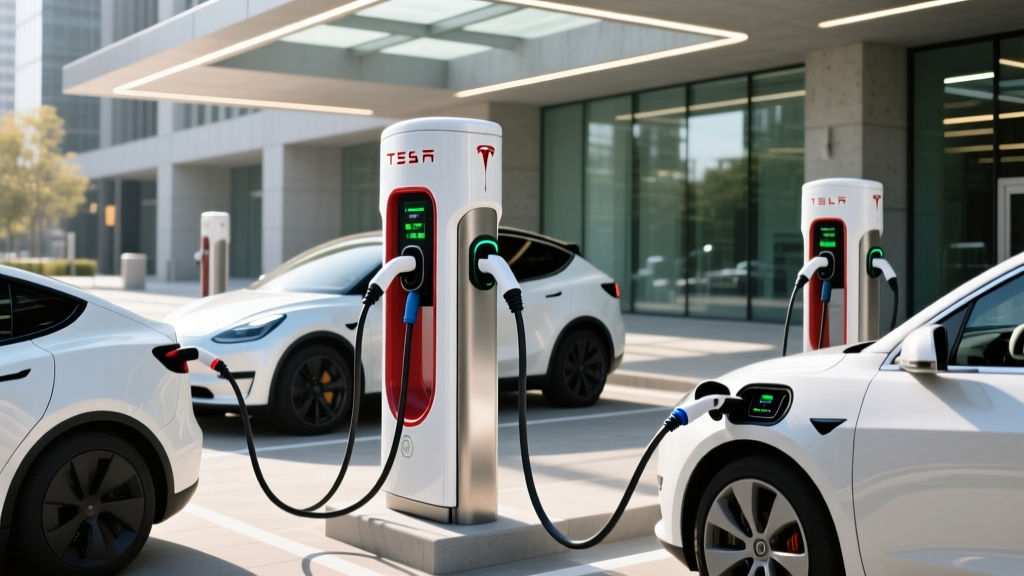
If you've pulled up to a newer Tesla Supercharger station in late 2025 or 2026, you've likely noticed something different: sleeker pedestals, longer cables, and a small badge reading "V4." The Tesla Supercharger V4 represents the latest evolution in DC fast-charging infrastructure — but what does it actually mean for your charging experience, whether you drive a Tesla, a Ford F-150 Lightning, or a Hyundai Ioniq 5?
This guide breaks down exactly what Supercharger V4 delivers, how it fits into the broader charging ecosystem, and what you need to know about pairing public fast-charging with a reliable home Level 2 setup. We'll cover speeds, connector compatibility, real-world costs, and the electrical work required to charge at home — with exact numbers, not marketing fluff.
What Is Tesla Supercharger V4 and How Fast Does It Charge?
The Supercharger V4 cabinet is a modular power architecture that Tesla began deploying in volume through 2024 and 2025. Unlike the V3 system, which paired each cabinet with a fixed set of four stalls, V4 separates the power cabinet from the charge post, allowing more flexible site layouts and future power upgrades without replacing the entire station.
As of early 2026, most V4 stalls in North America deliver a peak rate of 250 kW to NACS-equipped vehicles — the same peak as V3. The key difference is infrastructure scalability: V4 cabinets are designed to support higher power delivery (potentially up to 350 kW or more) as future vehicles and battery packs can accept it. Some European V4 deployments already support CCS2 vehicles natively at up to 250 kW without an adapter.
For current Tesla models and NACS-equipped non-Tesla EVs, expect these real-world charge times at a V4 stall:
- Tesla Model Y (75 kWh usable, NMC): 10–80% in approximately 25–28 minutes
- Tesla Model 3 Long Range (79 kWh usable, NMC): 10–80% in approximately 24–27 minutes
- Ford F-150 Lightning Extended Range (131 kWh usable, NMC): 10–80% in approximately 38–42 minutes (peak ~155 kW on NACS adapter)
- Hyundai Ioniq 5 (77.4 kWh usable, NMC): 10–80% in approximately 18–22 minutes when using a NACS adapter on a V4 stall capable of 250 kW
Important caveat: Peak kW is not sustained kW. All lithium-ion batteries follow a charge curve — power ramps up to a peak, then tapers as the battery's state of charge (SoC) rises. A vehicle that peaks at 250 kW at 15% SoC may drop to 100 kW by 60% and under 50 kW above 85%. This is why 10–80% times are the industry standard metric, not "0–100%."
Charging Levels Explained: Level 1, Level 2, and DC Fast Charging
Before we go deeper on V4, it's essential to understand the three charging tiers available to EV owners. The distinction between kW (kilowatts — the rate of power delivery) and kWh (kilowatt-hours — the amount of energy stored in your battery) is critical. Think of kW as the width of a hose and kWh as the size of the bucket.
| Level | Voltage | Power (kW) | Miles of Range Added per Hour | Typical Use Case |
|---|---|---|---|---|
| Level 1 | 120V AC | 1.0–1.4 kW | 3–5 miles | Overnight top-up, emergencies |
| Level 2 | 240V AC | 3.3–19.2 kW | 12–75 miles | Home daily charging, workplace |
| DC Fast (incl. V4) | 400–800V DC | 50–350 kW | 150–1,000+ miles (peak) | Road trips, quick top-ups |
Level 1 uses a standard 120V household outlet. It comes with most EVs and requires no installation, but at ~1.2 kW, it adds only about 4 miles of range per hour — adequate for PHEVs with small batteries (e.g., Toyota RAV4 Prime's 42-mile electric range) but painfully slow for a 75+ kWh BEV.
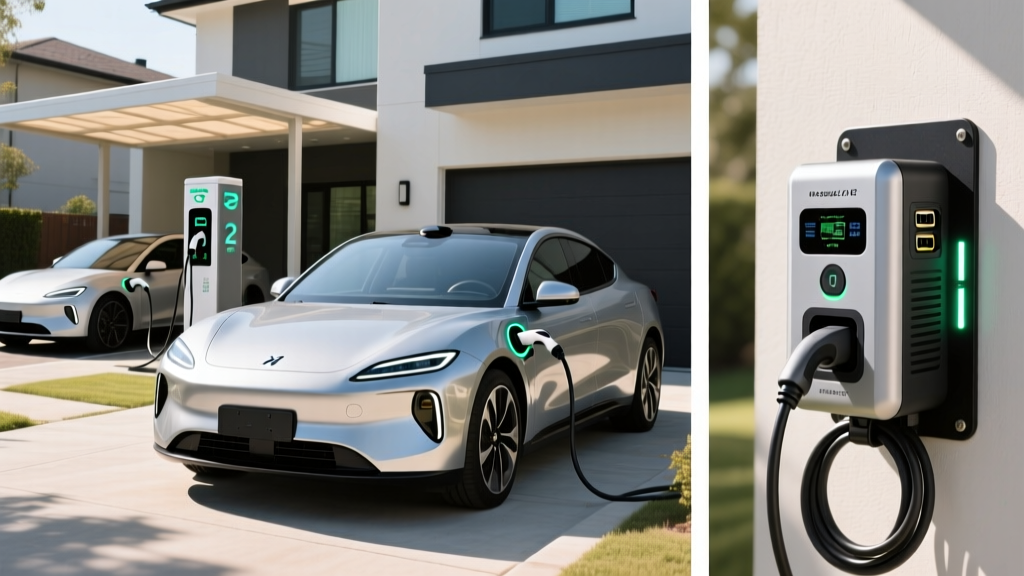
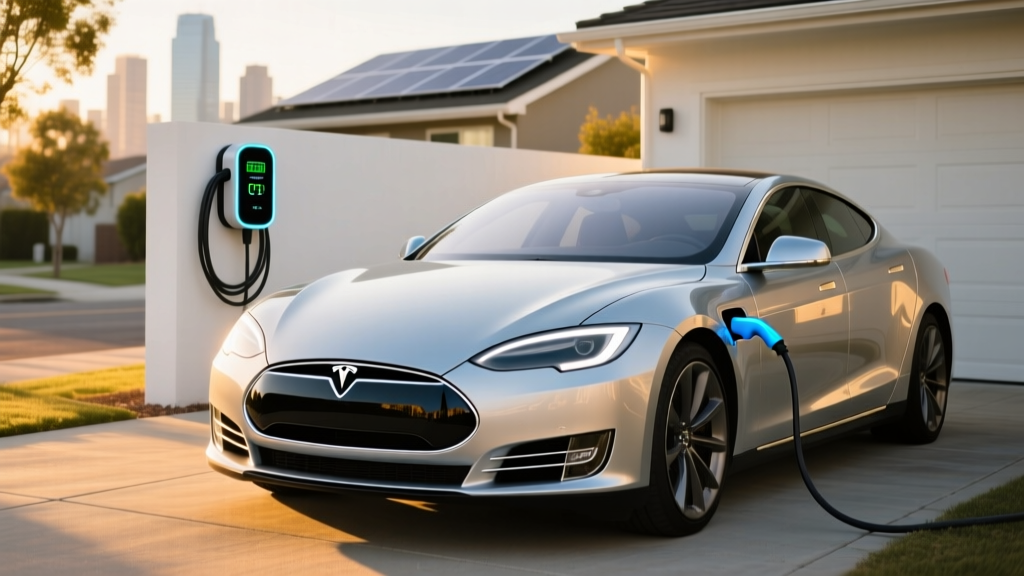
Level 2 is the backbone of home EV ownership. A 240V circuit (the same voltage as your electric dryer) at 40 amps delivers roughly 9.6 kW, adding about 30–35 miles of range per hour to most EVs. An overnight charge of 8–10 hours easily replenishes 200+ miles. This is what the vast majority of EV owners install at home.
DC Fast Charging — which includes Tesla's Supercharger V4, Electrify America's 350 kW stations, and EVgo's network — bypasses the vehicle's onboard charger and sends DC power directly to the battery. This enables the rapid 10–80% charges measured in minutes, not hours. But DC fast charging is not meant for daily use; frequent exclusive reliance on it can accelerate battery degradation over time.
Supercharger V4 Connector Compatibility: NACS, CCS, and Adapters
The connector landscape in North America has shifted dramatically. Tesla's North American Charging Standard (NACS) — now formally SAE J3400 — has been adopted by Ford, GM, Rivian, Hyundai/Kia, Volvo, BMW, and most other major automakers starting in the 2025–2026 model years. This means a growing number of non-Tesla EVs can plug directly into Supercharger V4 stalls.
| Connector | Standard On | Supercharger V4 Compatible? | Adapter Needed? |
|---|---|---|---|
| NACS (J3400) | Tesla (all), Ford 2025+, GM 2025+, Rivian, Hyundai/Kia 2026+ | Yes — native | No |
| CCS1 | Most 2022–2024 non-Tesla EVs (VW ID.4, older Ioniq 5, BMW iX) | Yes, with adapter | Tesla CCS adapter or Magic Dock (at equipped stalls) |
| CHAdeMO | Nissan Leaf (discontinued 2025), Mitsubishi Outlander PHEV (older) | No | No adapter available — use other networks |
If your EV has a CCS1 port (common on 2022–2024 model-year vehicles), Tesla offers a CCS-to-NACS adapter (approximately $175–$250) that allows access to Superchargers, including V4 stations. Some V4 stalls are also equipped with Tesla's Magic Dock, a built-in adapter that lets CCS vehicles plug in without carrying their own adapter — but Magic Dock availability is not universal, so check the Tesla app or your vehicle's navigation before relying on it.
For CHAdeMO-equipped vehicles, Supercharger access is not available. These owners should rely on Electrify America, EVgo, or other networks with CHAdeMO connectors, though CHAdeMO infrastructure is shrinking in North America.
How Much Does It Cost to Install a Home Level 2 EV Charger?
Home charging is where 80%+ of EV charging happens for most owners, according to fueleconomy.gov. A Level 2 home charger is the single most impactful upgrade for EV ownership convenience. Here's what it actually costs — and what can drive that cost higher.
| Component | Typical Cost Range | Notes |
|---|---|---|
| Level 2 EVSE (charger hardware) | $300–$700 | 32A–48A smart chargers; hardwired units cost more than plug-in |
| Electrician labor | $500–$2,000 | Depends on run length, wall type, conduit needs |
| Electrical permit | $50–$200 | Required in most jurisdictions; varies by municipality |
| Panel upgrade (if needed) | $1,500–$4,000 | Older homes with 100A service may need upgrade to 200A |
| Total (no panel upgrade) | $850–$2,900 | Most common scenario for homes with 200A service |
| Total (with panel upgrade) | $2,350–$6,900 | Common for pre-1990 homes or those with high existing loads |
Electrical requirements for a standard Level 2 install: A dedicated 240V circuit at 40 amps (for a 32A charger) or 60 amps (for a 48A charger) is standard. The circuit must be dedicated — no sharing with other appliances. The National Electrical Code (NEC) requires that continuous loads (like EV charging, which runs for 3+ hours) use only 80% of the circuit's rated capacity. So a 40A breaker supports a 32A charger; a 60A breaker supports a 48A charger.
Panel upgrade reality check: If your home has a 100-amp electrical panel — common in homes built before 1990 — adding a 40A or 60A dedicated circuit may exceed your panel's capacity. A licensed electrician will perform a load calculation. If an upgrade to 200A is needed, expect $1,500–$4,000 for the panel replacement alone, plus the standard installation costs. Some utilities offer rebates for panel upgrades paired with EV charger installation — check with your local provider.
Safety and code considerations:
- The circuit must be dedicated to the EVSE (no shared outlets on the same breaker)
- GFCI protection is required for outdoor installations and in garages per NEC 2023/2026 updates
- Outdoor-rated chargers must carry a NEMA 4 or NEMA 4X rating for weather resistance
- Hardwired installations (no plug) are generally more reliable and avoid the NEMA 14-50 receptacle overheating issues reported with some cheap outlets — if using a receptacle, specify a commercial-grade Hubbell or Bryant outlet
- All work should be permitted and inspected — unpermitted electrical work can void home insurance and create fire risk
Recommended Home Level 2 Chargers for 2026
Here are three proven Level 2 chargers suited to different needs, all compatible with NACS-equipped vehicles (or CCS vehicles with appropriate adapter cables):
Tesla Wall Connector (Gen 4)
- Power Output: Up to 11.5 kW (48A on 60A circuit)
- Connector: NACS native; CCS adapter cable available separately
- Cable Length: 24 feet
- Smart Features: Wi-Fi, OTA updates, power sharing between multiple units, access control
- Price: ~$425 (hardwired)
- Best For: Tesla owners and NACS-native vehicles wanting seamless integration
ChargePoint Home Flex
- Power Output: Up to 12 kW (50A on 60A circuit); configurable down to 16A
- Connector: NACS or J1772 (configurable at purchase)
- Cable Length: 23 feet
- Smart Features: Wi-Fi, Alexa integration, scheduling, energy tracking, flexible amperage
- Price: ~$550–$650
- Best For: Multi-EV households, panel-limited homes (can dial down amperage)
Emporia Vue Level 2 Charger
- Power Output: Up to 11.5 kW (48A on 60A circuit)
- Connector: NACS or J1772
- Cable Length: 24 feet
- Smart Features: Wi-Fi, solar integration, real-time energy monitoring, load management
- Price: ~$399
- Best For: Budget-conscious buyers, solar-panel households wanting energy visibility
For homes with a 200A panel and capacity for a 60A circuit, the ChargePoint Home Flex or Tesla Wall Connector at 48A offers the fastest home charging. For 100A panels or homes where a panel upgrade isn't feasible, dialing down to a 32A charger on a 40A circuit (7.7 kW) is a practical compromise that still delivers ~25 miles of range per hour — more than enough for overnight replenishment.
Charging Cost Per Mile: Home vs. Public DC Fast vs. Gas
One of the strongest economic arguments for EVs is lower per-mile fueling cost — but the gap narrows significantly when you rely on public DC fast charging. Here's a data-driven comparison:
| Scenario | Rate | Vehicle Efficiency | Cost Per Mile |
|---|---|---|---|
| Home Level 2 (off-peak utility rate) | $0.10/kWh | 3.5 mi/kWh (e.g., Tesla Model Y) | $0.029 |
| Home Level 2 (national avg. residential) | $0.17/kWh | 3.5 mi/kWh | $0.049 |
| Supercharger V4 (avg. $0.35/kWh) | $0.35/kWh | 3.5 mi/kWh | $0.100 |
| Electrify America (avg. $0.48/kWh) | $0.48/kWh | 3.5 mi/kWh | $0.137 |
| Gasoline vehicle (28 MPG combined) | $3.30/gal | 28 MPG | $0.118 |
| Gasoline vehicle (22 MPG combined, truck) | $3.30/gal | 22 MPG | $0.150 |
Key takeaway: Home charging at off-peak rates delivers fuel costs roughly 75% lower than a comparable gas vehicle. But exclusive reliance on public DC fast charging — especially at premium networks — can bring your per-mile cost close to or even above that of a fuel-efficient gas car. The economics of EV ownership strongly favor home or workplace charging.
For a Tesla Model Y driven 12,000 miles per year:
- Home charging (national avg.): ~$588/year
- Exclusive Supercharger use: ~$1,200/year
- Gas equivalent (28 MPG): ~$1,414/year
According to the IRS §30D clean vehicle credit, qualifying new EV purchases can receive up to $7,500 in federal tax credits (subject to MSRP caps, buyer income limits, and battery sourcing requirements), which can offset higher electricity costs during the ownership period. Always consult a tax professional to confirm eligibility.
Supercharger V4 vs. Other DC Fast Networks: What's Different?
Tesla's Supercharger network — including V4 — consistently ranks highest in reliability among DC fast-charging networks. Here's how V4 compares to other major networks:
- Reliability: Supercharger uptime historically exceeds 99%, compared to ~80–90% for some competitors (per J.D. Power and user surveys). V4's modular cabinet design means a single post failure doesn't take down adjacent stalls.
- Plug-and-charge: Tesla vehicles (and NACS-equipped non-Teslas with linked accounts) authenticate automatically on plug-in — no app, no RFID card, no payment screen. This remains a significant UX advantage.
- Stall availability: As of early 2026, Tesla operates over 7,000 Supercharger stations and 70,000+ individual stalls globally, with V4 deployments expanding rapidly.
- Power delivery: While Electrify America and some Ionity stations offer 350 kW peak, the real-world advantage is limited because most current EVs cannot sustain charge rates above 250–270 kW. The Hyundai Ioniq 5 and Kia EV6 (with 800V architecture) can peak around 240 kW, making V4's 250 kW delivery well-matched.
For non-Tesla NACS adopters, the Supercharger network's reliability and plug-and-charge simplicity are the primary draws. The trade-off is that some V4 stations have shorter cable lengths optimized for Tesla's rear-quarter charge port location — vehicles with front or side charge ports may need to park at an angle or use specific stalls.
Frequently Asked Questions
How much does it cost to install a home EV charger?
Expect $850–$2,900 for a standard Level 2 installation in a home with an existing 200A electrical panel. If a panel upgrade to 200A is needed (common in pre-1990 homes), total costs can reach $2,350–$6,900. Always get a load calculation from a licensed electrician before committing.
How fast will each charging level add range?
Level 1 (120V) adds 3–5 miles per hour. Level 2 (240V, 40A circuit) adds approximately 30–35 miles per hour for most EVs. DC fast charging at a Supercharger V4 (250 kW peak) can add 150–200 miles in 15–20 minutes during the peak portion of the charge curve, though this tapers significantly above 60% SoC.
Which connector/charger is compatible with my EV?
If your EV has a NACS port (all Teslas, most 2025+ Ford/GM/Rivian, 2026+ Hyundai/Kia), you can use Supercharger V4 natively. If your EV has CCS1 (most 2022–2024 non-Tesla EVs), you'll need a Tesla CCS adapter (~$175–$250) or a Supercharger stall with Magic Dock. CHAdeMO vehicles cannot use Superchargers. For home Level 2 charging, match the charger connector to your vehicle's port — or buy a universal J1772 charger with a J1772-to-NACS adapter.
How much does charging cost per mile vs gas?
Home charging at off-peak rates costs roughly $0.03/mile — about 75% less than a 28 MPG gas car at $3.30/gallon ($0.12/mile). Public DC fast charging at $0.35–$0.48/kWh costs $0.10–$0.14/mile, which is comparable to a fuel-efficient gas vehicle. The cost advantage of EVs is maximized with home or workplace charging.
What electrical upgrades might I need?
A dedicated 240V circuit at 40A or 60A is standard for Level 2 charging. Homes with 100A service panels may need an upgrade to 200A ($1,500–$4,000). Your electrician will perform a load calculation per NEC requirements. Other potential needs include GFCI breakers (required for garage/outdoor installs per NEC 2023+), conduit runs for long distances, and commercial-grade NEMA 14-50 receptacles if using a plug-in charger rather than hardwired.
Can I charge a non-Tesla at a Supercharger V4?
Yes, if your vehicle has a NACS port or you carry a CCS-to-NACS adapter (for CCS1-equipped vehicles). Tesla's "Open Supercharger" program in North America has expanded access to most non-Tesla EVs. Check the Tesla app for station-specific compatibility, as not all stalls at every location support non-Tesla vehicles. Per NHTSA and DOT guidelines, always verify connector compatibility before relying on a specific station for a road trip.
Is daily DC fast charging bad for my battery?
Exclusive reliance on DC fast charging can accelerate battery degradation compared to Level 2 home charging. Most manufacturers recommend keeping daily charging to Level 2 and using DC fast charging for road trips or when necessary. Battery degradation from fast charging is driven by heat — vehicles with active liquid-cooled battery thermal management (Tesla, Hyundai E-GMP, GM Ultium) handle frequent fast charging better than passively cooled packs. For long-term battery health, charge to 80% daily on NMC batteries and 100% only when needed for trips (LFP batteries, like those in Tesla Model 3 RWD, can be charged to 100% regularly without degradation concerns).