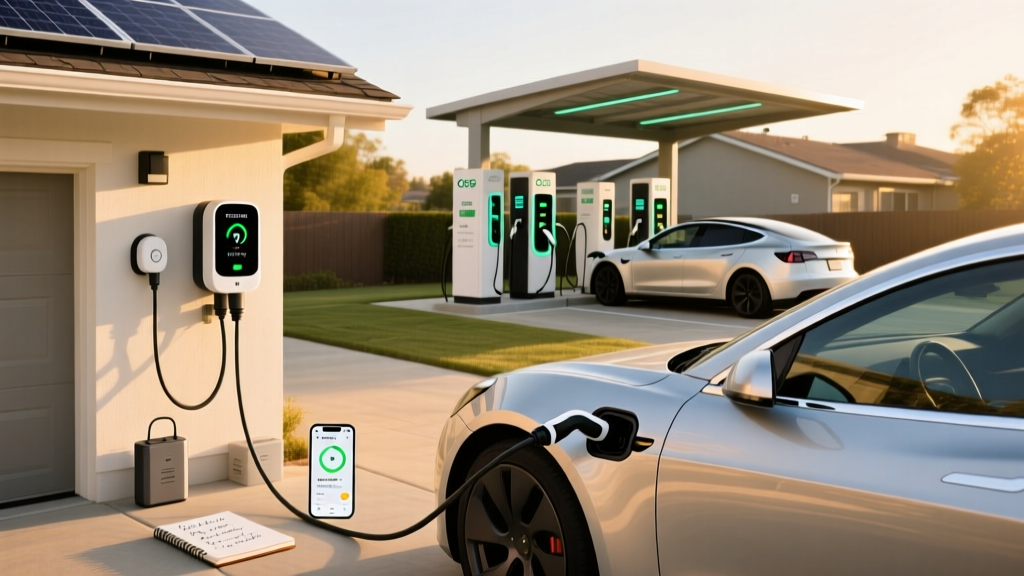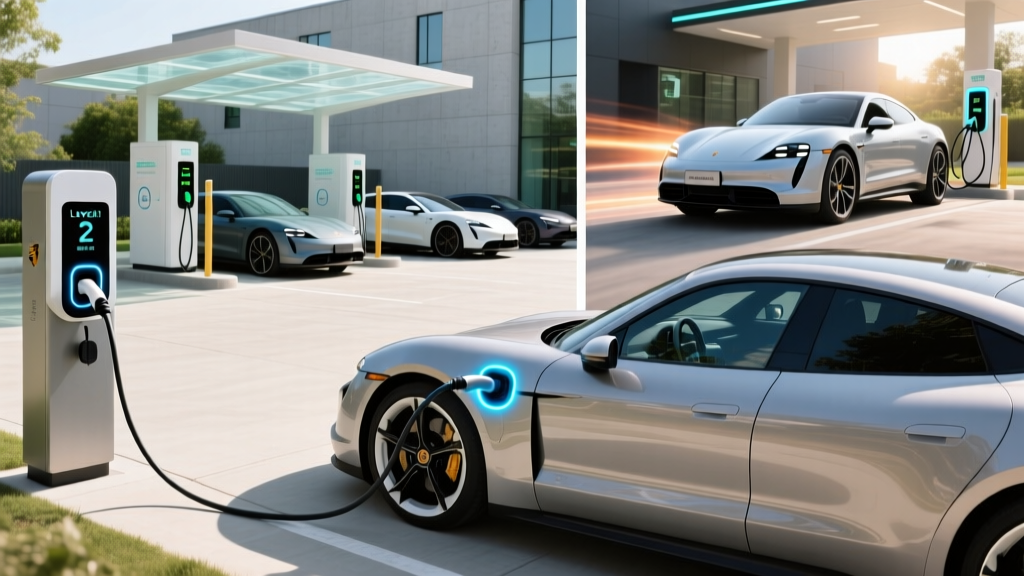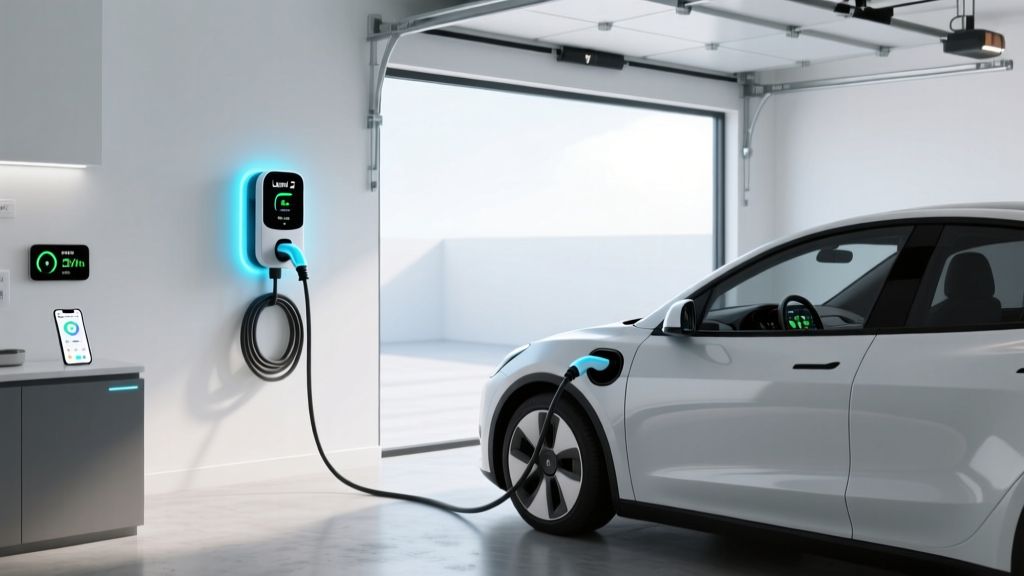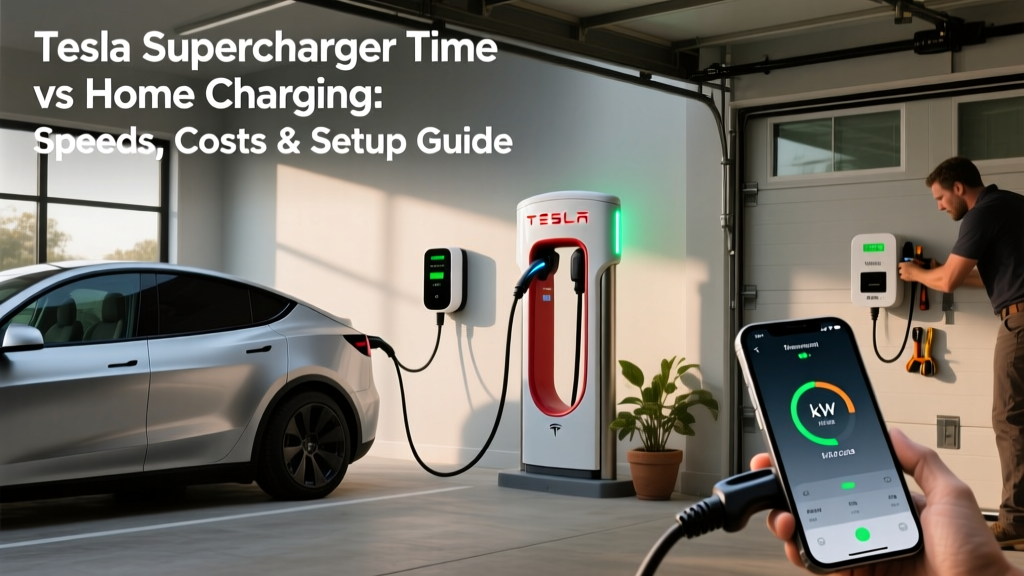
If you own a Tesla—or any EV with a NACS port—chances are you've searched for "Tesla Supercharger time" before a road trip. The answer depends on which generation of Supercharger you pull up to, your battery's state of charge (SoC), ambient temperature, and whether you preconditioned. But Superchargers are only half the story. For most owners, the real charging strategy is a mix of DC fast charging on the road and Level 2 charging at home. This guide breaks down both with exact numbers.
How Fast Is a Tesla Supercharger in 2026?
Tesla's current Supercharger network spans three tiers. Understanding the difference matters because "Supercharger" doesn't mean one fixed speed.
| Tier | Peak Power | 10–80% Time* | Miles Added in 15 Min |
|---|---|---|---|
| V2 Supercharger | 150 kW | ~30–35 min | ~130–150 mi |
| V3 Supercharger | 250 kW | ~18–22 min | ~175–200 mi |
| V4 Supercharger | 350 kW (cabinet) | ~15–18 min (capable vehicles) | ~200–250 mi |
*Times based on a Model Y Long Range (~75 kWh usable, NMC). Actual times vary with SoC, battery temperature, and pack size. Model 3 Performance with LFP may see slightly longer curves due to chemistry.
The critical nuance: peak kW is not sustained kW. A V3 Supercharger delivers 250 kW only between roughly 10–30% SoC. Above 50%, the charge curve tapers significantly. By 80%, you're often pulling under 60 kW. This is why Tesla's onboard navigation recommends charging to 80% on road trips—pushing to 100% can double your total stop time for just 20% more range.
Charging Levels Explained: kW, Miles Per Hour, and What They Mean
Before comparing home versus Supercharger, let's lock down the terminology. kW (kilowatts) measures power—the rate of energy delivery, like water pressure from a hose. kWh (kilowatt-hours) measures energy—the total amount stored in your battery, like gallons in a tank. A 75 kWh battery charged at 11.5 kW takes roughly 6.5 hours from empty to full. Charge that same battery at 250 kW and you're talking minutes, not hours.
| Level | Voltage | Power (kW) | Miles of Range Per Hour | Best For |
|---|---|---|---|---|
| Level 1 | 120V AC | 1.0–1.4 kW | 3–5 mi/hr | Overnight top-up, PHEVs, emergency |
| Level 2 (Home) | 240V AC | 7.2–11.5 kW | 25–44 mi/hr | Daily home charging, primary strategy |
| Level 2 (Public) | 240V AC | 6.6–19.2 kW | 22–70 mi/hr | Workplace, shopping, destination |
| DC Fast (CCS/NACS) | 400–800V DC | 50–350 kW | 150–1,000+ mi/hr (peak) | Road trips, rapid top-up |
For context, a Tesla Model Y Long Range driven at 300 Wh/mi (a realistic highway figure) needs about 22.5 kWh to recover 75 miles of range. At Level 2 (11.5 kW), that's roughly 2 hours. At a V3 Supercharger (averaging ~130 kW sustained over the session), it's about 10 minutes.
Home Level 2 Installation: Requirements, Costs, and Panel Gotchas
Most EV owners install a 240V Level 2 charger at home. It's the single biggest quality-of-life upgrade in EV ownership—wake up every morning with a full battery and never visit a gas station for daily driving. But installation costs vary dramatically depending on your electrical panel.
Electrical Requirements
A typical home Level 2 setup requires:
- 240V dedicated circuit (like a dryer or oven outlet)
- 40A to 60A breaker, depending on charger amperage (EVSE rated at 48A needs a 60A breaker per NEC 80% continuous-load rule)
- Panel capacity: Your main panel must have spare amperage. A 200A panel is standard for modern homes; older 100A panels may need an upgrade
- NEMA 14-50 outlet (for mobile connector) or hardwired connection (for wall-mounted units—often required for 48A+ chargers)
| Item | Low End | Typical | High End |
|---|---|---|---|
| Level 2 EVSE Equipment (240V, 32–48A) | $350 | $550 | $750 |
| Electrician Labor (simple install, <20 ft run) | $400 | $800 | $1,200 |
| Permit & Inspection | $50 | $150 | $350 |
| Panel Upgrade (100A → 200A, if needed) | $1,500 | $2,500 | $4,000 |
| Total (no panel upgrade) | $800 | $1,500 | $2,300 |
| Total (with panel upgrade) | $2,300 | $4,000 | $6,300 |
When You'll Need a Panel Upgrade
Homes built before 1990 often have 100A or even 60A main panels. If your panel is already near capacity (running electric heat, an electric oven, a dryer, and AC), adding a 48A EV circuit may push you over. A licensed electrician will perform a load calculation (per NEC Article 220) to determine if your panel can handle the additional draw. If not, a panel upgrade to 200A is a $1,500–$4,000 job that takes 1–2 days.
Cost-offset tip: The federal Residential Clean Energy Credit does not cover EV chargers for most taxpayers after 2022. However, many utilities offer rebates of $250–$750 for Level 2 equipment and installation. Check your local utility's EV program before scheduling work.
Connector Compatibility: NACS, CCS1, and Adapters in 2026
The connector landscape has consolidated significantly. As of 2025–2026, nearly all major automakers have adopted the North American Charging Standard (NACS)—originally Tesla's proprietary connector, now opened as SAE J3400. Here's where things stand:
| Connector | Vehicles Using It (Native) | Tesla Supercharger Access |
|---|---|---|
| NACS (J3400) | Tesla (all), Ford F-150 Lightning/Mach-E (2025+), GM Ultium vehicles (2025+), Rivian (2025+), Volvo/Polestar (2025+) | Direct plug-in |
| CCS1 | Hyundai/Kia (Ioniq 5/6, EV6/9), BMW iX/i4, VW ID.4, older Ford/GM/Rivian | Via NACS adapter (included or ~$200–$250) |
| CHAdeMO | Nissan Leaf (legacy), Mitsubishi Outlander PHEV | Not compatible; use CCS/EA networks |
For non-Tesla EVs accessing Superchargers: Ford, GM, Rivian, and Volvo owners with NACS adapters can use Tesla Superchargers equipped with "Magic Dock" (built-in CCS adapter) or via their vehicle's NACS adapter. Tesla's Supercharger network now lists compatibility in the vehicle's navigation or the Tesla app. Expect peak speeds of 150–250 kW for adapter-connected non-Tesla vehicles, depending on the vehicle's onboard charge acceptance.
Cost to Charge: Home vs. Supercharger vs. Gas
The economics of EV charging depend heavily on where and when you plug in. Here's a realistic breakdown using a Tesla Model Y Long Range (averaging 3.5 miles/kWh or ~285 Wh/mi) and a comparable gas SUV at 25 MPG combined.
| Scenario | Rate | Cost Per Mile | Annual Cost (12,000 mi) |
|---|---|---|---|
| Home Level 2 (national avg. electricity, 2026) | $0.16/kWh | $0.046 | $552 |
| Home Level 2 (off-peak TOU rate) | $0.09/kWh | $0.026 | $312 |
| Home Level 2 (high-cost state, e.g., CA avg.) | $0.30/kWh | $0.086 | $1,032 |
| Tesla Supercharger (avg. 2026) | $0.32/kWh | $0.091 | $1,092 |
| Tesla Supercharger (peak pricing, urban) | $0.48/kWh | $0.137 | $1,644 |
| Public DC Fast (Electrify America, EVgo) | $0.38/kWh | $0.109 | $1,308 |
| Gas SUV (25 MPG, $3.50/gal) | $3.50/gal | $0.140 | $1,680 |
The takeaway: Home charging on an off-peak rate saves roughly $1,300/year versus gas. Exclusive Supercharger use costs about $600/year less than gas but more than double what home charging costs. If you can charge at home 80%+ of the time and use Superchargers only for road trips, your blended cost lands around $0.05–$0.06/mile—less than half the cost of gas.
Equipment Picks: Best Home Level 2 Chargers for Tesla & NACS Vehicles (2026)
Here are three chargers we recommend based on power output, build quality, smart features, and real-world reliability. All are NACS-native or available with NACS connectors.
Tesla Wall Connector (Gen 4)
- Power: 48A / 11.5 kW (on 60A circuit)
- Connector: NACS native
- Cable: 24 ft
- Smart Features: Wi-Fi, OTA updates, Power Sharing (link up to 6 units on one circuit), load management, access control via app
- Price: ~$475
- Best For: Tesla owners who want seamless integration and the fastest home charge on a NACS vehicle
ChargePoint Home Flex (NACS version)
- Power: Up to 50A / 12 kW (on 60A circuit); adjustable 16–50A via DIP switches
- Connector: NACS (2025+ models) or J1772 with adapter
- Cable: 23 ft
- Smart Features: Wi-Fi, app scheduling, Alexa integration, utility TOU integration, energy tracking
- Price: ~$599
- Best For: Multi-EV households or buyers who want adjustable amperage for older panels
Emporia Level 2 EV Charger
- Power: 48A / 11.5 kW (on 60A circuit)
- Connector: NACS or J1772 options
- Cable: 24 ft
- Smart Features: Wi-Fi, app control, solar integration (pairs with Emporia Vue energy monitor), TOU scheduling
- Price: ~$399
- Best For: Budget-conscious buyers with solar panels who want energy monitoring
Safety, Code, and Installation Best Practices
EV charging is a continuous high-draw load—your charger may run at full power for 6–8 hours straight. This makes proper installation non-negotiable.
- Dedicated circuit: Your EVSE must be on its own breaker, never shared with other appliances. NEC 625.41 requires this for all EV charging equipment.
- GFCI protection: NEC 2020 and later require GFCI protection for all 240V receptacles used for EV charging in garages and outdoors. Hardwired installations may be exempt in some jurisdictions—confirm with your inspector.
- Outdoor rating: If your charger is mounted outside, ensure the EVSE carries a NEMA 4 or NEMA 4X rating for weather resistance. The Tesla Wall Connector and ChargePoint Home Flex are both rated for outdoor use.
- Cable management: Use a holster or cable organizer to keep the connector off the ground and prevent tripping hazards. Many localities require this for outdoor installations.
- Permit and inspection: Most jurisdictions require an electrical permit for a new 240V circuit. Your electrician should pull this—it typically costs $50–$350 and ensures the work is inspected for safety. Skipping the permit risks insurance claim denials if a fire occurs.
Tesla Supercharger Time vs. Home Charging: Which Strategy Wins?
There's no single answer—it depends on your driving pattern.
- You drive under 60 miles/day and can charge overnight
- You have access to a garage, driveway, or dedicated parking spot with 240V
- You want the lowest cost per mile ($0.03–$0.05)
- You value convenience—plug in when you get home, wake up full
- You're on a road trip and need 150+ miles in 15–20 minutes
- You live in an apartment without charging access and rely on public infrastructure
- You need a quick top-up before a long drive and didn't charge overnight
Frequently Asked Questions
How much does it cost to install a home EV charger?
A straightforward Level 2 installation (240V, 48A, short wire run, no panel upgrade) typically costs $800–$2,300 including equipment, electrician labor, and permit. If your home needs a panel upgrade from 100A to 200A, add $1,500–$4,000. Always get 2–3 quotes from licensed electricians and confirm they include permit costs.
How fast will each charging level add range?
Level 1 (120V) adds 3–5 miles per hour—suitable only for PHEVs or emergency top-ups. Level 2 (240V, 48A) adds roughly 35–44 miles per hour on a Tesla Model Y. DC fast charging at 250 kW adds up to 200 miles in 15 minutes at peak, but the charge curve tapers significantly above 50–60% SoC.
Which connector/charger is compatible with my EV?
If you drive a 2025+ Tesla, Ford, GM, Rivian, or Volvo EV, your vehicle has a NACS port and plugs directly into Tesla Wall Connectors and Superchargers. If you drive a Hyundai, Kia, BMW, or VW EV, you have CCS1 and will need a NACS adapter ($200–$250, sometimes included by the manufacturer) to access Tesla Superchargers. CHAdeMO vehicles (Nissan Leaf) cannot use Superchargers.
How much does charging cost per mile vs gas?
Home charging at the national average electricity rate ($0.16/kWh) costs about $0.046 per mile in a Model Y. Gas at $3.50/gallon in a 25 MPG SUV costs $0.14 per mile. Even exclusive Supercharger use ($0.32/kWh) at $0.091/mile is still 35% cheaper than gas. The savings are largest when you charge at home on off-peak utility rates.
What electrical upgrades might I need?
The most common upgrade is a panel capacity increase from 100A to 200A, which costs $1,500–$4,000. Other potential upgrades include adding a sub-panel if your main panel is full, upgrading service entrance wiring in very old homes, or installing a smart load-management device (like the Emporia Smart Load Center) that allows EV charging without a panel upgrade by dynamically shedding load from other circuits.
Does frequent Supercharging degrade my Tesla battery faster?
DC fast charging generates more heat than Level 2, and heat accelerates battery degradation. Tesla's battery management system actively manages thermal load during Supercharging, which mitigates most of the risk. Data from fleet studies suggests that vehicles charged primarily via Supercharger show approximately 2–4% more degradation over 100,000 miles compared to Level 2–charged vehicles. For daily charging, Level 2 at home remains the gentler and cheaper option. Tesla's battery warranty covers 8 years/120,000 miles (Long Range) or 8 years/100,000 miles (RWD/LFP) with a minimum 70% capacity retention threshold, per Tesla's warranty documentation.
Can I use a Tesla Supercharger with a non-Tesla EV?
Yes, as of 2026. Tesla has opened select Supercharger stalls to non-Tesla EVs via the built-in "Magic Dock" CCS adapter or through the Tesla app. Ford, GM, Rivian, and Volvo/Polestar EVs with NACS adapters can access most Superchargers. Hyundai/Kia and other CCS1 vehicles can use Magic Dock–equipped stalls. Availability varies by station—check the Tesla app or your vehicle's navigation for compatible locations.
For the latest EPA range and efficiency data referenced in this guide, see fueleconomy.gov. For federal tax credit and clean energy credit rules, consult IRS.gov.