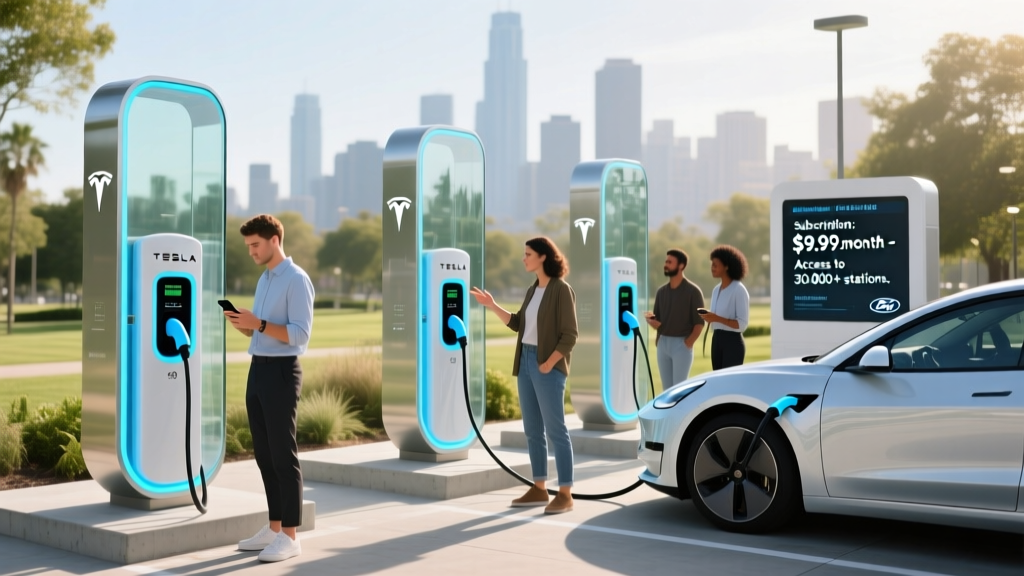
For years, the Tesla Supercharger network was a walled garden. Today, it's the backbone of DC fast charging for nearly every EV brand on the road — but how you access it, what you pay, and whether you need a subscription depends entirely on what you drive. The Tesla Supercharger subscription (formally part of Tesla's membership pricing structure) allows non-Tesla EV owners to access select Supercharger stalls at a discounted per-kWh rate, while Tesla owners pay the standard rate by default. This guide cuts through the confusion with exact pricing tiers, connector compatibility, real-world charging speeds, and what the math looks like against gasoline.
What Is the Tesla Supercharger Subscription (Membership)?
Tesla offers two pricing tiers at Supercharger stations that are open to non-Tesla vehicles:
- Member pricing: Available to Tesla account holders who pay a monthly subscription fee (typically $12.99/month as of early 2026). Members receive a discounted per-kWh rate comparable to what Tesla vehicle owners pay.
- Non-member pricing: No subscription required. Any EV with a compatible connector can plug in and pay a higher per-kWh rate — often 25–40% more than the member rate.
This structure was introduced when Tesla opened its North American Supercharger network to non-Tesla EVs under the NACS (North American Charging Standard) connector. The subscription is managed entirely through the Tesla app — no physical card or RFID fob required.
Charging Levels Explained: Speeds in kW and Miles Per Hour
Before evaluating Supercharger costs, it's essential to understand the three charging levels available to EV owners. Power is measured in kW (kilowatts — the rate of energy flow), while battery capacity is measured in kWh (kilowatt-hours — the total energy stored). Confusing these two is the single most common EV mistake.
| Level | Voltage / Amps | Power (kW) | Miles of Range Per Hour | Typical Use Case |
|---|---|---|---|---|
| Level 1 | 120V / 12A | 1.4 kW | 3–5 mi/hr | Overnight trickle; PHEVs and low-mileage drivers |
| Level 2 | 240V / 32–48A | 7.7–11.5 kW | 25–44 mi/hr | Home daily charging; workplace; destination |
| DC Fast (Supercharger V3) | 400–800V DC | Up to 250 kW | ~1,000 mi/hr (peak) | Road trips; 10–80% in 15–25 min |
| DC Fast (Supercharger V4) | Up to 900V DC | Up to 350 kW (theoretical) | ~1,200+ mi/hr (peak) | Next-gen stalls; 800V architectures |
Real-world caveat: Peak kW rates are never sustained for the full session. A vehicle rated for 250 kW peak charging will typically see that rate only between ~10–40% State of Charge (SoC). Above 50%, the charge curve tapers significantly, and above 80%, speeds drop to 40–60 kW to protect battery health. A "10–80% in 18 minutes" claim assumes optimal battery preconditioning and moderate ambient temperatures.
Connector Compatibility: NACS, CCS, and Adapters
As of 2026, nearly every major automaker has adopted the NACS (North American Charging Standard) connector — originally Tesla's proprietary plug, now standardized under SAE J3400. However, millions of EVs on the road still have CCS1 ports, and adapter requirements vary by brand and model year.
| Connector | Brands (2025–2026 Models) | Supercharger Access | Adapter Needed? |
|---|---|---|---|
| NACS (native) | Tesla (all), Ford (2025+), GM (2025+), Rivian (2025+), Hyundai/Kia (2026+), BMW, Mercedes | Direct plug-in at all open stalls | No |
| CCS1 + NACS adapter | Ford (2023–2024), GM (2024), Rivian (2022–2024), Hyundai/Kia (2023–2025), VW, BMW (2024) | Via OEM-provided or aftermarket adapter | Yes — OEM adapter (often free from dealer) |
| CHAdeMO | Nissan Leaf (legacy), Mitsubishi Outlander PHEV (older) | Not compatible with Superchargers | No viable adapter exists |
Adapter note: Ford, GM, and Rivian provided complimentary NACS adapters to early adopters. As of 2026, most OEM adapters retail for $150–$250 if purchased separately. Tesla also sells an official CCS-to-NACS adapter for $175. Third-party adapters (e.g., A2Z, Lectron) exist at lower price points, but always verify UL/ETL certification before purchasing — a non-certified adapter at 250 kW is a serious fire risk.
Supercharger Pricing: Members vs. Non-Members vs. Gas
Pricing at Tesla Superchargers varies by location, time of day, and membership status. Below is a representative breakdown based on 2026 pricing across major U.S. metro areas:
| Scenario | Rate ($/kWh) | Cost for 60 kWh Session | Cost Per Mile (at 3 mi/kWh) |
|---|---|---|---|
| Tesla owner (standard rate) | $0.28–$0.36 | $16.80–$21.60 | $0.09–$0.12 |
| Non-Tesla member ($12.99/mo subscription) | $0.28–$0.36 | $16.80–$21.60 + $12.99/mo | $0.09–$0.12 + subscription |
| Non-Tesla non-member (no subscription) | $0.39–$0.48 | $23.40–$28.80 | $0.13–$0.16 |
| Home charging (off-peak utility rate) | $0.08–$0.14 | $4.80–$8.40 | $0.03–$0.05 |
| Gasoline equivalent (30 MPG, $3.40/gal) | — | — | $0.11 |
The math: If you road-trip twice a month and consume ~120 kWh on Superchargers, the $12.99 membership saves roughly $13–$16 per month at the member rate — essentially paying for itself in one trip. For frequent travelers (200+ kWh/month on DC fast chargers), the subscription is a clear win. For occasional users, paying the non-member rate may be simpler.
Compared to gasoline at $3.40/gallon and 30 MPG combined, Supercharger member pricing is roughly equivalent per mile — but home charging at off-peak rates undercuts gas by 60–70%.
Real-World Charging Times: 10–80% by Vehicle
Supercharger speed depends on the vehicle's maximum charge acceptance rate (in kW), battery preconditioning, and ambient temperature. Here are real-world 10–80% times for common EVs at a V3 Supercharger (250 kW max):
- Tesla Model 3 Long Range (75 kWh, NMC): ~22 minutes (peak 250 kW, sustained ~170 kW average)
- Ford Mustang Mach-E Extended Range (91 kWh, NMC): ~28 minutes (peak 150 kW via adapter, tapering above 60%)
- Hyundai Ioniq 5 (77.4 kWh, NMC, 800V): ~18 minutes at native 350 kW chargers; ~25 min at V3 Supercharger (limited by 400V adapter throughput)
- BMW iX xDrive50 (111.5 kWh, NMC): ~31 minutes (peak 195 kW)
- Chevrolet Equinox EV (85 kWh, NMC): ~27 minutes (peak 190 kW)
Home Charging Setup: Installation Costs and Electrical Requirements
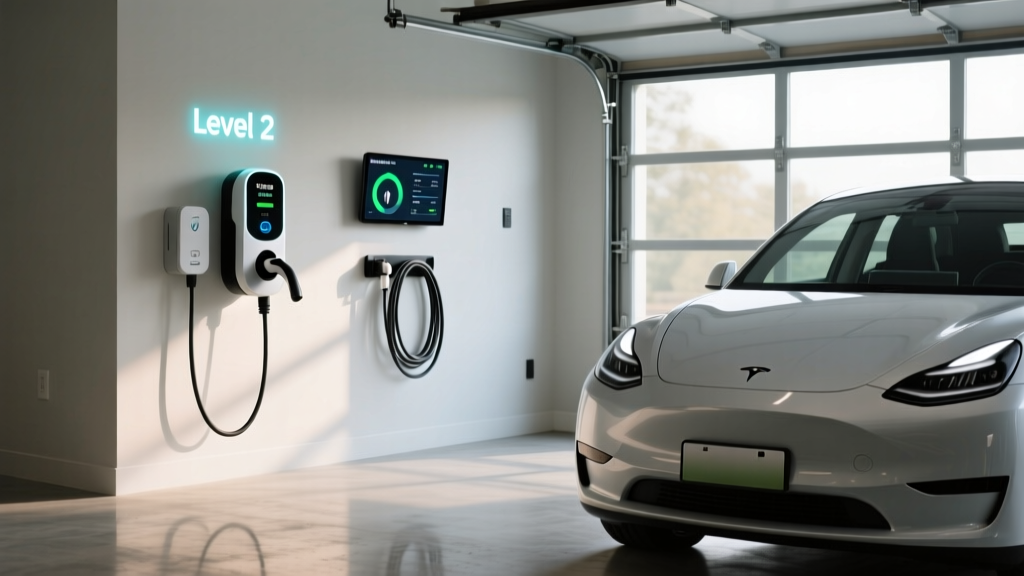
Most EV owners do the majority of their charging at home on Level 2. The Tesla Supercharger network is for road trips — home is where the real savings happen. Here's what a Level 2 home installation involves:
Electrical requirements: A Level 2 charger typically requires a dedicated 240V circuit at 40–60 amps. The most common setup is a NEMA 14-50 outlet (50A circuit, 40A continuous draw) or a hardwired connection at 48A. Your home's electrical panel must have sufficient capacity — typically 2–4 open slots and at least 100A of unused capacity on a 200A panel.
| Component | Cost Range | Notes |
|---|---|---|
| Level 2 charger equipment | $350–$700 | 40A–48A Wi-Fi-enabled unit |
| Electrician labor (standard install) | $500–$1,500 | Run from panel to garage/carport; 10–40 ft |
| Permit and inspection | $50–$200 | Required in most jurisdictions; varies by city |
| Electrical panel upgrade (if needed) | $1,500–$3,500 | 100A → 200A service upgrade for older homes |
| Total (no panel upgrade) | $900–$2,400 | Typical for homes with 200A panels |
| Total (with panel upgrade) | $2,400–$5,900 | Older homes with 100A or 60A service |
Panel upgrade reality check: Homes built before 1990 frequently have 100A or even 60A electrical service. Adding a 50A EV circuit to a maxed-out 100A panel is a code violation and fire hazard. Budget for a panel upgrade if your electrician flags insufficient capacity — this is the single biggest surprise cost for new EV owners. Per the National Electrical Code (NEC), EV circuits must be dedicated (not shared with other appliances) and must have GFCI protection for outdoor installations.
Recommended Home Chargers for 2026
Below are three proven Level 2 home chargers that work with both NACS and CCS vehicles (with appropriate cable/connector):
ChargePoint Home Flex
- Power: Up to 12 kW (50A) on a 60A circuit; adjustable down to 16A
- Connector: J1772 (CCS-compatible); NACS adapter available separately
- Cable length: 23 feet
- Smart features: Wi-Fi, app scheduling, utility integration, Alexa
- Price: ~$549 (unit only)
- Best for: Flexible amperage adjustment for homes with limited panel capacity
Tesla Wall Connector (Gen 3)
- Power: Up to 11.5 kW (48A) on a 60A circuit
- Connector: NACS native; includes J1772 adapter for non-Tesla EVs
- Cable length: 24 feet
- Smart features: Wi-Fi, OTA updates, power sharing (link up to 6 units on one circuit), Tesla app integration
- Price: ~$475 (unit only)
- Best for: Tesla owners or households with mixed Tesla + NACS-equipped vehicles
Emporia Level 2 EV Charger
- Power: Up to 11.5 kW (48A) on a 60A circuit
- Connector: J1772 (CCS-compatible); NACS adapter sold separately
- Cable length: 24 feet
- Smart features: Wi-Fi, energy monitoring via Emporia Vue panel integration, solar-aware scheduling
- Price: ~$399 (unit only)
- Best for: Budget-conscious buyers who want detailed energy tracking
All three units are UL-listed, rated for indoor and outdoor installation (NEMA 4 enclosure), and eligible for the federal Residential Clean Energy Credit (30% of equipment + installation cost, up to $1,000, under current IRS §25E rules — check irs.gov for 2026 eligibility details).
Safety, Code, and Installation Best Practices
EV charging involves sustained high-current draw — far more demanding than a dryer or oven. Cutting corners on installation creates fire risk and voids homeowner's insurance coverage.
- Dedicated circuit: NEC Article 625 requires EV chargers to have a dedicated circuit not shared with other loads. A "split" circuit with a washer or water heater is a code violation.
- GFCI protection: Required for all outdoor receptacles. Hardwired indoor installations may not require GFCI depending on local code — your electrician will know your jurisdiction's requirements.
- Wire gauge: A 50A circuit requires 6 AWG copper wire; a 60A circuit requires 4 AWG. Do not allow an electrician to undersize wire to save cost.
- Outdoor rating: If your charger is mounted outside (carport, driveway wall), ensure it carries a NEMA 4 or NEMA 4X rating for weather resistance.
- Permit and inspection: Most municipalities require an electrical permit and post-installation inspection. Skipping this may void insurance claims related to electrical fires.
- Load management: If your panel is near capacity but you want to avoid a full upgrade, consider a smart load-management system (e.g., Emporia, Wallbox Power Sharing) that dynamically reduces charger amperage when other appliances are running.
Frequently Asked Questions
How much does it cost to install a home EV charger?
A standard Level 2 installation (48A hardwired or NEMA 14-50 outlet) costs $900–$2,400 including equipment, electrician labor, and permit — assuming your electrical panel has sufficient capacity. If a panel upgrade from 100A to 200A is needed, add $1,500–$3,500. Always get 2–3 quotes from licensed electricians who have specific EV charger installation experience.
How fast will each charging level add range?
Level 1 (120V) adds 3–5 miles per hour — adequate for PHEVs with small batteries but impractical for full-size EVs. Level 2 (240V, 48A) adds 30–40 miles per hour, easily replenishing a daily commute overnight. DC fast charging at a Supercharger V3 adds up to ~175 miles in 15 minutes at peak rate, though real-world sessions average 10–80% in 18–30 minutes depending on the vehicle.
Which connector and charger is compatible with my EV?
If your EV is a 2025+ model from Ford, GM, Rivian, Hyundai, Kia, or BMW, it likely has a native NACS port and plugs directly into any Supercharger. If your EV is a 2022–2024 model with a CCS1 port (Ford Mach-E, GM Ultium vehicles, Ioniq 5, etc.), you'll need an OEM-provided or aftermarket NACS-to-CCS adapter. CHAdeMO-equipped vehicles (older Nissan Leaf, Mitsubishi) cannot use Superchargers — no adapter exists.
How much does charging cost per mile compared to gas?
At Supercharger member rates ($0.28–$0.36/kWh) and an efficiency of 3 miles per kWh, you'll pay $0.09–$0.12 per mile — roughly comparable to a 30 MPG gas car at $3.40/gallon ($0.11/mile). Home charging at off-peak utility rates ($0.08–$0.14/kWh) drops to $0.03–$0.05 per mile, a 60–70% savings over gasoline.
What electrical upgrades might I need for home charging?
The most common upgrade is a panel capacity increase from 100A to 200A service, required in older homes where the existing panel is near its load limit. Your electrician will perform a load calculation per NEC Article 220. Other potential upgrades include replacing a Federal Pacific or Zinsco panel (known fire hazards, commonly found in 1960s–1980s homes), adding a sub-panel in the garage, or upgrading the utility service drop if your home's incoming supply is insufficient.
Is the Tesla Supercharger subscription worth it for non-Tesla owners?
If you use Superchargers more than once or twice per month, the $12.99/month membership typically pays for itself through the lower per-kWh rate. For a driver consuming 150 kWh/month on Superchargers, the savings average $15–$20/month after the subscription fee. If you only road-trip a few times per year, skip the subscription and pay the non-member rate — the math doesn't justify the recurring cost.