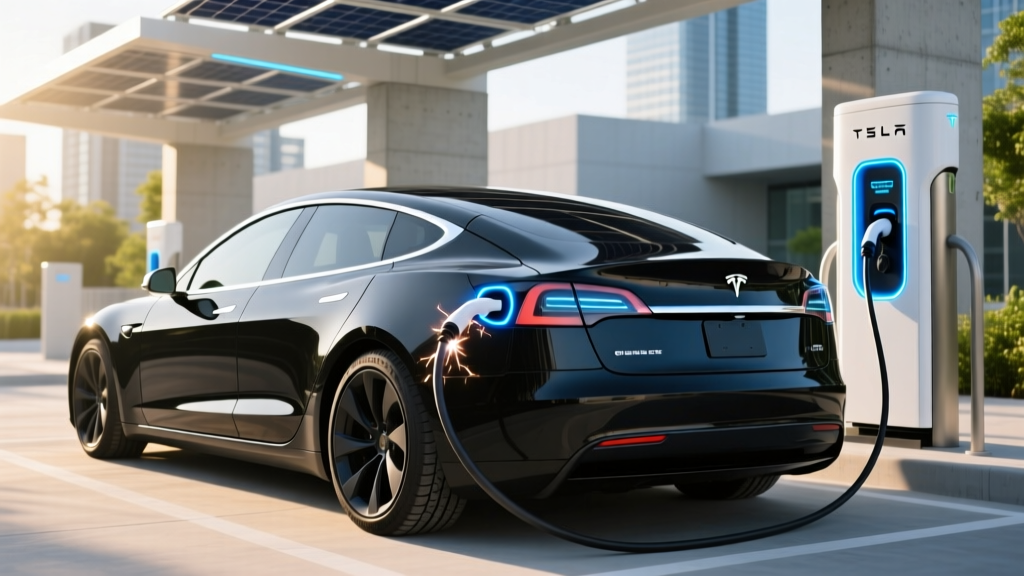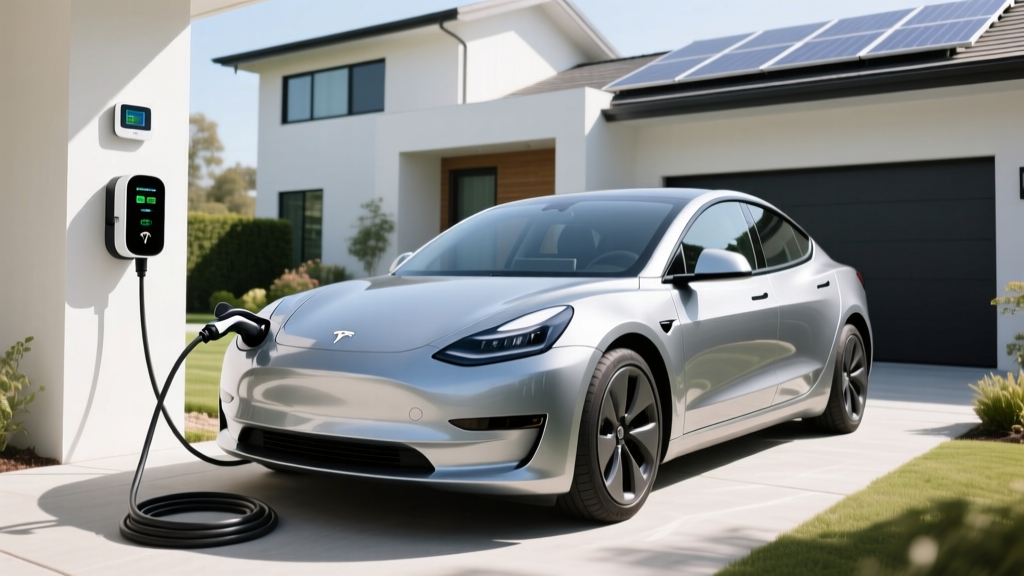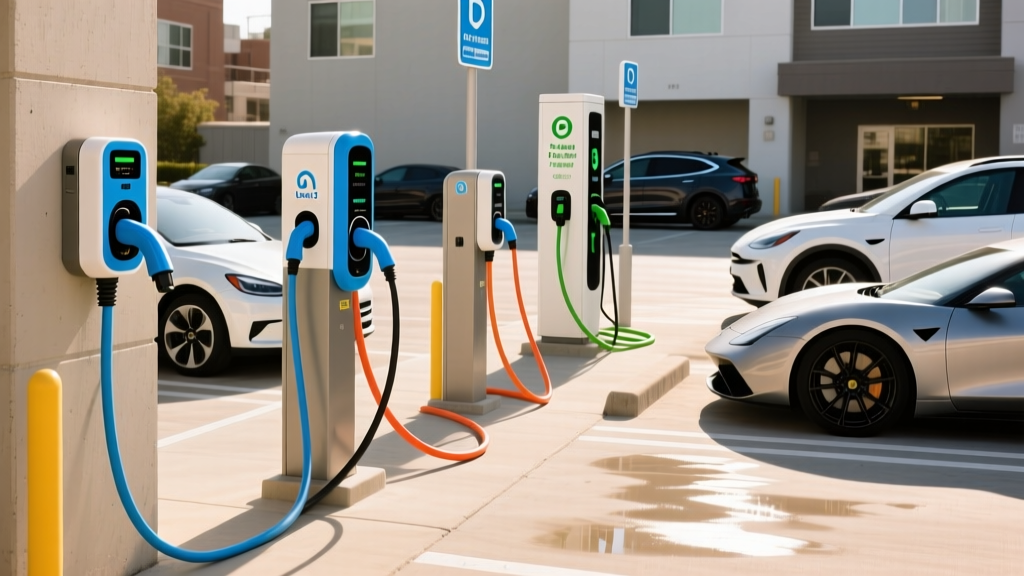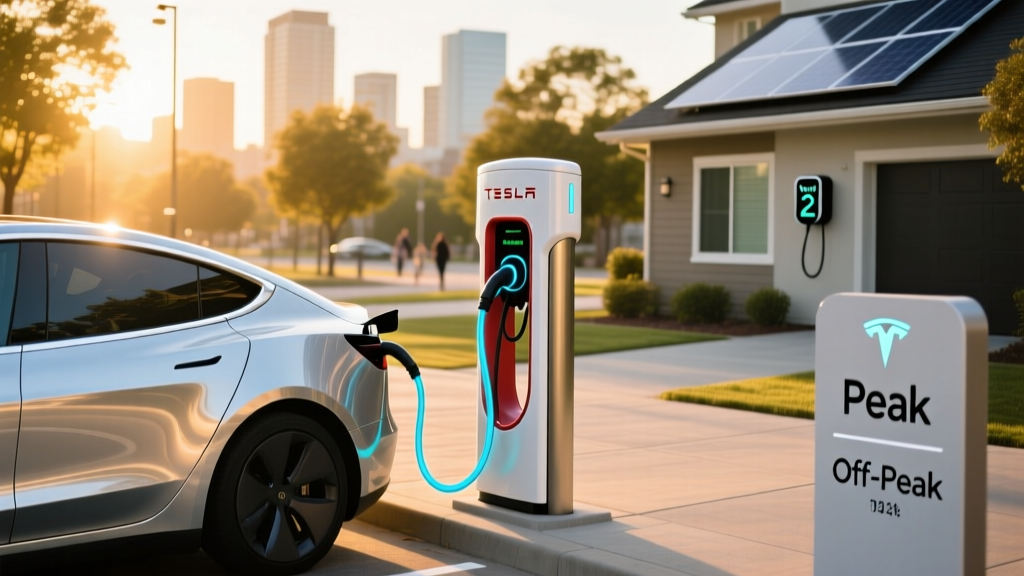
If you own or are considering a Tesla—or any EV with a NACS charge port—one of the first questions that surfaces is what you'll actually pay to keep the battery full. Public fast charging costs have become a moving target, with networks rolling out demand-based pricing that can swing a session's cost by 30% or more depending on when you plug in. Understanding Tesla Supercharger rates by time of day is now as essential to trip planning as checking the battery's state of charge before you leave the driveway.
This guide breaks down the time-of-use pricing structure you'll encounter at Tesla Superchargers in 2026, compares those rates to home Level 2 charging and third-party DC fast networks, and walks through the real math on cost per mile versus gasoline. We also cover what it takes—and costs—to set up a dedicated home charger so you can shift the majority of your charging to the cheapest hours.
How Tesla Supercharger Time-of-Use Pricing Works
Tesla has progressively moved its Supercharger network to time-of-use (TOU) pricing in many markets, meaning the $/kWh rate changes depending on local grid demand. The structure typically splits into two or three tiers:
- Off-Peak (cheapest): Usually overnight and mid-morning on weekdays, and sometimes all day on weekends. Rates often fall between $0.25–$0.32/kWh.
- Mid-Peak: Daytime hours outside of the evening rush. Rates commonly range from $0.33–$0.42/kWh.
- On-Peak (most expensive): Late afternoon through early evening (roughly 4 PM–9 PM local time), when grid demand spikes. Rates can hit $0.45–$0.58/kWh or higher in high-cost states like California and New York.
Exact rates are location-specific and displayed in the Tesla app before you navigate to a station. A Supercharger in rural Nevada might charge a flat $0.28/kWh around the clock, while a downtown Los Angeles station could peak at $0.56/kWh at 6 PM on a Tuesday. Tesla also applies idle fees—typically $0.50–$1.00 per minute—if your car remains plugged in after reaching its charge limit and the station is at least 50% occupied.
Charging Levels Explained: Speed, Power, and Range Added
Before comparing costs, it's critical to distinguish between kW (kilowatts, the rate of power delivery—think of it as the speed of water flowing through a hose) and kWh (kilowatt-hours, the total energy stored or delivered—the size of the bucket). Your car's battery capacity is measured in kWh; the charger's output is measured in kW.
| Level | Voltage | Power (kW) | Miles of Range Added per Hour | Typical Use Case |
|---|---|---|---|---|
| Level 1 | 120V AC | 1.0–1.4 kW | 3–5 miles | Emergency/top-up; overnight for PHEVs |
| Level 2 (Home/Public) | 240V AC | 7.2–19.2 kW | 25–75 miles | Daily home charging; workplace; destinations |
| DC Fast Charging | 400–800V DC | 50–350 kW | 150–1,000+ miles (equivalent rate) | Road trips; rapid top-ups; 10–80% in 15–40 min |
For context, a Tesla Model 3 or Model Y on a V3 Supercharger (250 kW peak) can add roughly 200 miles of range in 15 minutes under ideal conditions—though the charge curve tapers significantly above 60% state of charge. A 10%–80% session on a V3 typically takes 25–30 minutes. On a V4 Supercharger cabinet (which supports up to 350 kW for compatible vehicles), that same session can drop to approximately 18–22 minutes for vehicles with 800V architectures.
Charging Cost Per Mile: EV vs Gasoline in 2026
The financial argument for an EV hinges on cost per mile, and that number shifts dramatically depending on where and when you charge. Below is a comparison using a Tesla Model Y Long Range (averaging 3.5 miles/kWh or roughly 28.5 kWh/100 miles on the EPA cycle) against a comparable gasoline crossover achieving 28 MPG combined, with gas at $3.65/gallon.
| Charging Scenario | Rate ($/kWh or $/gal) | Cost per 100 Miles | Cost per Mile |
|---|---|---|---|
| Home Level 2 (national avg electricity, ~$0.16/kWh) | $0.16 | $4.56 | $0.046 |
| Home Level 2 (off-peak TOU rate, ~$0.09/kWh) | $0.09 | $2.57 | $0.026 |
| Tesla Supercharger (off-peak, ~$0.28/kWh) | $0.28 | $7.98 | $0.080 |
| Tesla Supercharger (on-peak, ~$0.48/kWh) | $0.48 | $13.72 | $0.137 |
| Third-party DC fast (EA/EVgo, avg ~$0.40/kWh) | $0.40 | $11.43 | $0.114 |
| Gasoline (28 MPG, $3.65/gal) | $3.65 | $13.04 | $0.130 |
The takeaway: home charging on an off-peak rate is roughly one-fifth the cost of gasoline per mile. Even on-peak Supercharging is competitive with gas in most states. But if you rely exclusively on on-peak public DC fast charging, your per-mile cost can actually exceed that of an efficient gasoline car.
How Much Does a Home Level 2 Charger Installation Cost?
Installing a dedicated 240V Level 2 home charger is the single highest-impact move an EV owner can make for long-term cost savings and convenience. But the total price varies widely depending on your home's electrical infrastructure.
| Component | Simple Install (panel nearby, capacity available) | Complex Install (long run, panel upgrade needed) |
|---|---|---|
| Level 2 Charger (hardware) | $400–$700 | $400–$700 |
| Electrician labor (240V circuit, 40–60A) | $600–$1,200 | $1,500–$3,500 |
| Permit & inspection | $50–$200 | $100–$350 |
| Electrical panel upgrade (100A → 200A, if needed) | $0 | $1,500–$3,000 |
| Total Estimated Cost | $1,050–$2,100 | $3,500–$7,550 |
Homes built after 2000 with a 200-amp electrical panel and a garage or carport close to the panel often fall in the simpler, less expensive range. Older homes with 100-amp service, or situations where the charger location is 80+ feet from the panel (requiring heavier-gauge wire and conduit), will push costs higher.
Electrical Requirements for a Home Level 2 Charger
Most home Level 2 chargers require a dedicated 240V circuit. The amperage determines your charging speed:
- 40A circuit → 32A continuous charge (7.7 kW): Adds ~28–30 miles/hour for a Model Y. Sufficient for overnight charging on most battery sizes.
- 50A circuit → 40A continuous (9.6 kW): Adds ~35–40 miles/hour. The sweet spot for most EV owners.
- 60A circuit → 48A continuous (11.5 kW): Adds ~44 miles/hour. Ideal for large-battery vehicles (F-150 Lightning, Rivian R1S, 100+ kWh packs).
NEC code requires the circuit breaker to be rated at 125% of the continuous load, which is why a 48A charger needs a 60A breaker. Your electrician will also install a GFCI breaker or ensure the charger has integrated ground-fault protection, particularly for outdoor installations. Outdoor-rated chargers should carry a NEMA 4 or IP65 rating.
Connector Compatibility: NACS, CCS1, CHAdeMO, and Adapters
As of 2026, the North American Charging Standard (NACS)—originally Tesla's proprietary connector—has become the dominant standard. Ford, GM, Rivian, Volvo, BMW, and most other major automakers have adopted NACS on new vehicles, with many 2025–2026 models shipping with native NACS ports. Legacy CCS1 vehicles can access the Tesla Supercharger network using a Tesla-approved NACS DC adapter (approximately $175–$250).
| Connector Type | Native Vehicles | Tesla Supercharger Access | Third-Party DC Fast Access |
|---|---|---|---|
| NACS (Tesla) | Tesla (all), Ford (2025+), GM (2025+), Rivian (2025+), Volvo, BMW, others | Yes — native | Yes — via CCS adapter (where station supports) |
| CCS1 | Hyundai/Kia (some 2025), VW ID.4 (pre-2026), legacy models | Yes — via NACS adapter | Yes — native |
| CHAdeMO | Nissan Leaf (discontinued in US after 2025) | No | Limited — shrinking network |
If you drive a CCS1-equipped vehicle and plan to use Tesla Superchargers, budget for the adapter and confirm your vehicle's firmware supports the Tesla handshake protocol—most 2024+ CCS vehicles do after an OTA update, but older models may not.
Recommended Home Level 2 Chargers for 2026
The home charger market has matured significantly. Here are three proven options across price tiers, all compatible with NACS-equipped vehicles (or CCS via the vehicle's port):
Tesla Wall Connector (Gen 4)
- Power Output: 11.5 kW (48A) on a 60A circuit
- Connector: Native NACS
- Cable Length: 24 feet
- Smart Features: Wi-Fi connectivity, OTA updates, power-sharing for multi-unit installs, integrated cable management
- Price: ~$420 (hardware only)
- Best For: Tesla owners wanting seamless integration and maximum Level 2 speed
ChargePoint Home Flex (NACS)
- Power Output: Up to 12 kW (50A) on a 60A circuit; adjustable down to 16A
- Connector: NACS (2025+ model); older CCS version also available
- Cable Length: 23 feet
- Smart Features: App-based scheduling for TOU optimization, Alexa integration, energy reporting, UL-listed
- Price: ~$550–$650
- Best For: Multi-EV households or owners wanting granular scheduling to hit off-peak rates
Emporia Level 2 EV Charger
- Power Output: 11.5 kW (48A) on a 60A circuit
- Connector: NACS (2025+ model) or J1772 with adapter
- Cable Length: 24 feet
- Smart Features: Integrates with Emporia Vue home energy monitor, solar-aware charging, TOU scheduling
- Price: ~$350–$400
- Best For: Budget-conscious buyers, solar-panel owners wanting to charge on excess production
Safety, Permits, and Code Considerations
Every hardwired Level 2 installation requires a permit and inspection in virtually all US jurisdictions. This isn't bureaucratic red tape—it ensures the circuit, wire gauge, breaker, and grounding meet National Electrical Code (NEC) standards and protects your home from fire risk.
- Dedicated circuit: Your EV charger must be on its own breaker—never shared with other appliances.
- GFCI protection: Required for outdoor installations and increasingly mandated indoors. Either a GFCI breaker or a charger with built-in ground-fault detection satisfies code.
- Outdoor rating: If your charger is exposed to weather, it must carry at minimum a NEMA 4 (splash-resistant) or NEMA 4X (corrosion-resistant) rating.
- Wire gauge: A 60A circuit typically requires 6 AWG copper wire (THHN in conduit) or 4 AWG for longer runs to minimize voltage drop. Your electrician will calculate this based on distance.
- Utility notification: Some utilities require you to notify them before adding an EV load, particularly if you're on a TOU rate plan. This is also how you access utility rebates.
Frequently Asked Questions
How much does it cost to install a home EV charger?
A straightforward installation with an adequate electrical panel typically costs $1,050–$2,100 total (charger hardware, electrician labor, and permit). If your home needs a 200A panel upgrade or a long conduit run, expect $3,500–$7,550. Get at least two quotes from licensed electricians and ask for a NEC Article 220 load calculation.
How fast will each charging level add range?
Level 1 (120V) adds 3–5 miles per hour—adequate for plug-in hybrids with small batteries but impractical for full EVs. Level 2 (240V, 40A–60A) adds 25–45 miles per hour and fully recharges most EVs overnight. DC fast charging at 150–250 kW can add 150–200 miles in 15–20 minutes, though the charge curve tapers sharply above 80% state of charge.
Which connector/charger is compatible with my EV?
If you drive a 2025+ Tesla, Ford, GM, Rivian, Volvo, or BMW electric vehicle, you likely have a native NACS port and can use any NACS charger directly. Older CCS1 vehicles can access Tesla Superchargers with a $175–$250 NACS adapter. CHAdeMO vehicles (primarily older Nissan Leafs) cannot use Tesla Superchargers and face a shrinking public network.
How much does charging cost per mile vs gas?
Home Level 2 charging on an off-peak rate (~$0.09/kWh) costs roughly $0.026/mile for a Tesla Model Y—about one-fifth the cost of gasoline at $3.65/gallon and 28 MPG ($0.13/mile). On-peak Supercharger rates ($0.48/kWh) push EV cost to ~$0.137/mile, slightly above gas. The savings case for EVs depends heavily on consistent access to home or off-peak charging.
What electrical upgrades might I need?
Homes with 100-amp electrical service often need a panel upgrade to 200 amps ($1,500–$3,000) before adding a 40A–60A EV circuit. Older wiring, full panels with no spare breaker slots, or long distances between the panel and charger location can also drive costs up. A licensed electrician's load calculation will determine whether your current panel has headroom. Some utilities offer rebates for panel upgrades tied to EV adoption—check with your provider before committing.
How can I find the exact Supercharger rate at a specific station?
Open the Tesla app or your vehicle's navigation screen, select the Supercharger station, and the current rate and time-of-use schedule will be displayed before you navigate there. Third-party apps like PlugShare and A Better Routeplanner also increasingly list time-of-use pricing for both Tesla and non-Tesla DC fast stations.