If you've searched "how much does a Tesla Supercharger cost to install," you're likely conflating two very different things — and you're not alone. A Tesla Supercharger is a commercial DC fast-charging station delivering up to 250 kW (V3) or 325 kW (V4). These are multi-stall installations that cost between $70,000 and $150,000+ per site for businesses and fleet operators. They are not residential products, and Tesla does not sell them to homeowners.
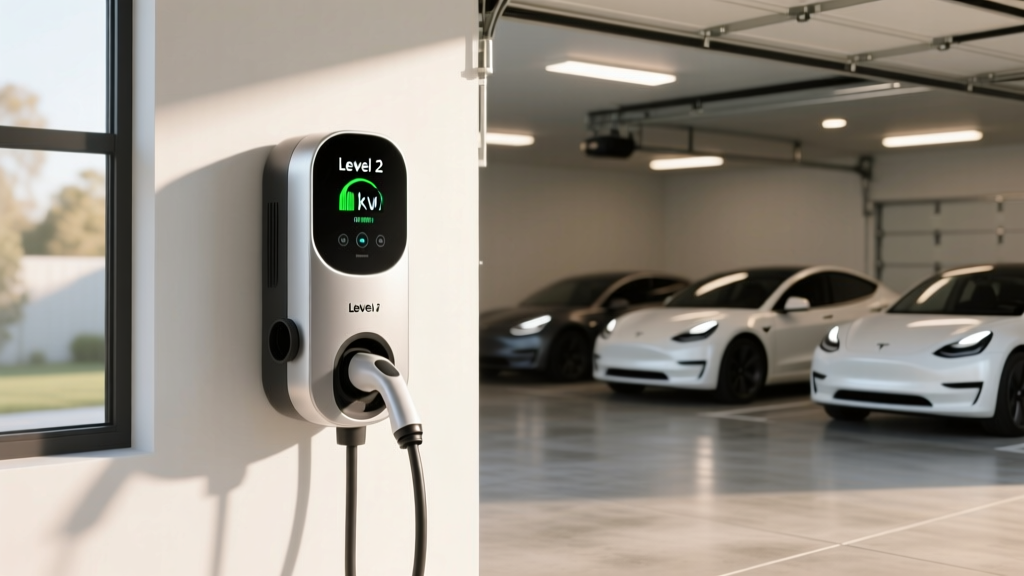
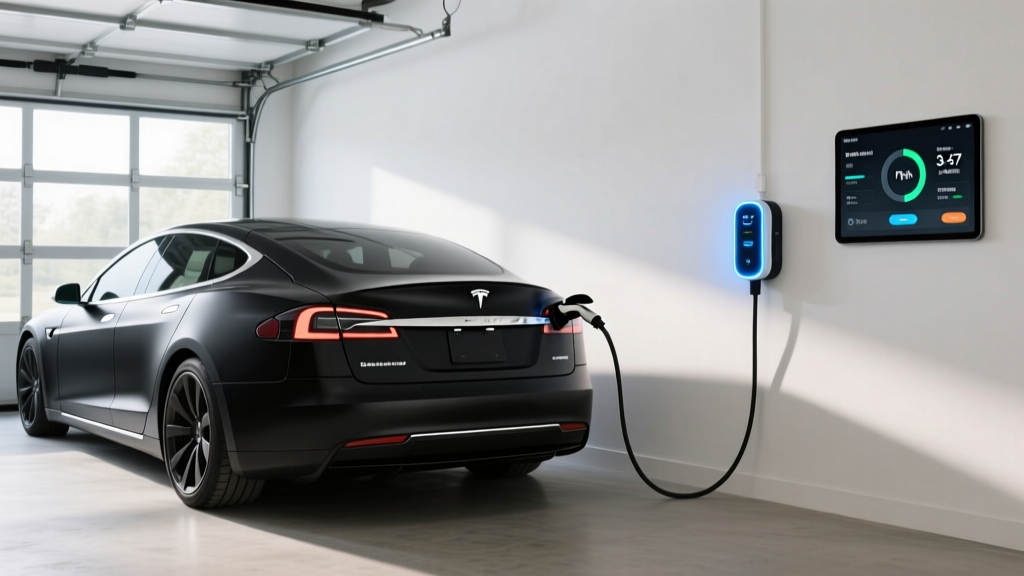
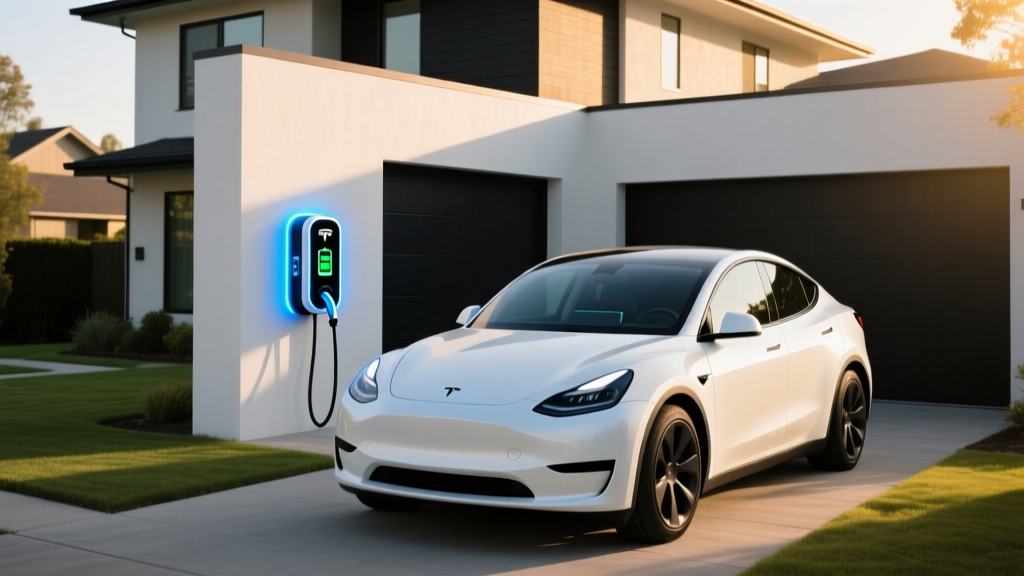
What most buyers actually want is a home Level 2 charger — specifically, the Tesla Wall Connector or a comparable unit — that delivers 11.5 kW of power on a 240V circuit and adds roughly 44 miles of range per hour. Installed, that typically runs $500 to $2,500 depending on your electrical panel.
This guide breaks down the real costs, electrical requirements, and equipment options for home EV charging in 2026, whether you drive a Tesla, a NACS-equipped Ford, or a CCS1 vehicle from Hyundai.
Charging Levels: What Speeds Are Actually Possible at Home?
Before quoting install prices, you need to understand the three charging levels available to EV owners. The distinction between kW (kilowatts — the rate of power delivery) and kWh (kilowatt-hours — the energy stored in your battery) is critical. Think of kW as how fast water flows from a hose; kWh is how much water fills the bucket.
| Level | Voltage | Power (kW) | Miles of Range Added/Hour | Typical Use Case |
|---|---|---|---|---|
| Level 1 | 120V AC | 1.2–1.9 kW | 3–5 mi/hr | Overnight trickle; PHEVs or low-mileage drivers |
| Level 2 | 240V AC | 3.3–19.2 kW | 12–75 mi/hr | Primary home charging; workplace; public destinations |
| DC Fast Charging | 400–800V DC | 50–350 kW | 150–1,000+ mi/hr (peak) | Road trips; commercial stations (Supercharger, Electrify America) |
Level 1 uses a standard household outlet. It's fine for plug-in hybrids with small batteries (e.g., the Toyota RAV4 Prime's 18.1 kWh pack tops up overnight), but inadequate for a 75 kWh Tesla Model Y Long Range — that would take 40+ hours.
Level 2 is the standard for daily home charging. Most EVs charge at 11.5 kW (48A on a 60A circuit), which fully replenishes a 75 kWh battery in roughly 7–8 hours. Some vehicles, like the Ford F-150 Lightning with its optional 80A Charge Station Pro, can accept up to 19.2 kW.
DC Fast Charging (what Superchargers actually provide) bypasses the vehicle's onboard charger and feeds DC current directly to the battery. A Tesla V3 Supercharger at 250 kW can take a Model 3 Long Range (75 kWh battery, NMC chemistry) from 10% to 80% in approximately 25–28 minutes. However, charge speed tapers significantly above 80% to protect battery health — the final 20% can take as long as the first 80%.
How Much Does a Home Level 2 Charger Cost to Install?
The total cost to install a home Level 2 charger depends on four factors: the charger hardware, electrician labor, electrical panel capacity, and local permitting. Here's a realistic 2026 breakdown:
| Component | Simple Install (Panel Adjacent) | Moderate Install (50-80 ft run) | Complex Install (Panel Upgrade Needed) |
|---|---|---|---|
| Charger hardware (Level 2, 40-48A) | $400–$650 | $400–$650 | $400–$650 |
| Electrician labor (2-6 hrs @ $100-$150/hr) | $200–$400 | $500–$1,200 | $800–$1,500 |
| Electrical materials (conduit, wire, breaker) | $50–$150 | $200–$500 | $300–$600 |
| Permit & inspection | $50–$200 | $50–$200 | $50–$200 |
| Panel upgrade (100A → 200A service) | N/A | N/A | $1,500–$3,500 |
| Total | $700–$1,400 | $1,150–$2,550 | $3,050–$6,450 |
Federal Tax Credit for Home Charging Equipment
The IRS residential clean energy credit (Section 25C) covers 30% of the cost of home EV charging equipment and installation, up to $1,000 per year. This means a $1,200 install could yield a $360 federal tax credit. Eligibility requires the equipment be installed at your primary U.S. residence. State and utility rebates can stack on top — check AFDC's incentive database for your zip code. Consult a tax professional for personal eligibility.
Electrical Requirements: What Your Panel Needs to Support
A standard Level 2 home charger installation requires a dedicated 240V circuit. Here are the specifics electricians follow under the National Electrical Code (NEC):
- Circuit amperage: A 48A charger requires a 60A breaker (NEC mandates circuits be rated at 125% of continuous load). A 40A charger needs a 50A breaker.
- Wire gauge: 6 AWG copper for 60A circuits; 8 AWG for 50A circuits, run through conduit.
- GFCI protection: The 2020 NEC requires GFCI protection for EV charging outlets. Hardwired units (like the Tesla Wall Connector) often bypass this requirement since they have built-in ground-fault protection.
- Outdoor rating: If mounting outside, the charger must carry a NEMA 4 (weather-resistant) rating. The Tesla Wall Connector and ChargePoint Home Flex both meet this standard.
- Permitting: Most jurisdictions require an electrical permit and post-installation inspection. Skipping this risks insurance claim denials if a fire originates from unpermitted work.
Load calculation matters. An electrician will perform a NEC Article 220 load calculation to verify your panel can handle the EV circuit alongside existing loads (HVAC, electric range, dryer). If your panel is near capacity, you have options: a panel upgrade, a smart panel device like the Span Drive that dynamically manages loads, or simply installing a lower-amperage charger (e.g., 32A instead of 48A).
Connector Compatibility: NACS, CCS1, and CHAdeMO
The North American charging landscape has consolidated significantly. As of 2026, the NACS (North American Charging Standard) connector — originally Tesla's proprietary plug — has been adopted by Ford, GM, Rivian, Volvo, Hyundai, and most major automakers. Here's what that means for your charger purchase:
| Connector | Brands Using It (Native) | Home Charger Options | Adapter Needed? |
|---|---|---|---|
| NACS (Tesla) | Tesla, Ford, GM, Rivian, Volvo, Polestar, Hyundai (2025+) | Tesla Wall Connector, Emporia Level 2, Autel MaxiCharger | No (for NACS vehicles) |
| CCS1 | VW, BMW, older Hyundai/Kia (pre-2025), legacy models | ChargePoint Home Flex, Grizzl-E Smart | CCS-to-NACS adapter (~$200) if using Tesla charger |
| CHAdeMO | Nissan Leaf (legacy only; discontinued in US) | Limited home options; mostly public DC stations | Not practical for new home installs |
If you drive a Tesla or a 2025+ Ford/GM with a native NACS port, the Tesla Wall Connector is the most cost-effective home option. If you drive a CCS1 vehicle (like a 2024 Hyundai Ioniq 5 built before the NACS switch), the ChargePoint Home Flex with its J1772 connector is a strong choice — and you can use a J1772-to-NACS adapter at Tesla Superchargers as automakers have opened the network.
Level 2 Charger Equipment Recommendations
Based on power output, build quality, smart features, and price, here are the top home chargers for 2026:
Tesla Wall Connector (Gen 3)
- Power: 11.5 kW (48A) max
- Connector: NACS (native)
- Cable length: 24 ft
- Smart features: Wi-Fi, OTA updates, Tesla app integration, power sharing (link multiple units on one circuit)
- Price: ~$420
- Best for: Tesla owners, NACS-equipped Ford/GM/Rivian drivers
ChargePoint Home Flex
- Power: Up to 12 kW (50A) — configurable from 16A to 50A
- Connector: J1772 (CCS1 vehicles); NACS adapter available
- Cable length: 23 ft
- Smart features: Wi-Fi, ChargePoint app, Alexa, scheduling, energy tracking
- Price: ~$550
- Best for: CCS1 vehicles, multi-EV households with mixed connectors
Emporia Vue Level 2 EV Charger
- Power: 11.5 kW (48A) max
- Connector: J1772 (NACS adapter included in 2026 model)
- Cable length: 24 ft
- Smart features: Integration with Emporia energy monitoring, solar-aware charging, time-of-use scheduling
- Price: ~$400
- Best for: Solar-panel owners, budget-conscious buyers
How Much Does Charging Cost Per Mile vs. Gasoline?
The cost advantage of electric charging depends heavily on where and when you charge. Here's a realistic 2026 comparison using the national average electricity rate of $0.17/kWh and gasoline at $3.40/gallon:
| Scenario | Rate | Vehicle Efficiency | Cost Per Mile |
|---|---|---|---|
| Home charging (off-peak TOU rate) | $0.09/kWh | 3.5 mi/kWh (Tesla Model Y) | $0.026/mi |
| Home charging (standard rate) | $0.17/kWh | 3.5 mi/kWh (Tesla Model Y) | $0.049/mi |
| Public Level 2 (workplace/retail) | $0.25/kWh | 3.5 mi/kWh | $0.071/mi |
| Tesla Supercharger (V3, 250 kW) | $0.32/kWh avg | 3.5 mi/kWh | $0.091/mi |
| Electrify America DC fast | $0.43/kWh avg | 3.5 mi/kWh | $0.123/mi |
| Gasoline (28 MPG combined sedan) | $3.40/gal | 28 mi/gal | $0.121/mi |
| Gasoline (22 MPG combined SUV/truck) | $3.40/gal | 22 mi/gal | $0.155/mi |
The takeaway: Home charging on off-peak rates saves 75–80% per mile versus gasoline. Even at public DC fast-charger rates, EVs match or beat gasoline per-mile costs. But if you only use expensive public DC fast charging, the savings narrow to roughly 20–25%. This is why home charger installation pays for itself — typically within 8,000 to 15,000 miles of driving.
Charging Time Examples for Common Battery Sizes
Here's how long it takes to charge from 10% to 80% across common scenarios:
- Tesla Model Y Long Range (75 kWh, NMC): ~7 hours on an 11.5 kW Level 2 home charger; ~25 minutes at a 250 kW V3 Supercharger
- Ford F-150 Lightning Extended Range (131 kWh, NMC): ~11.5 hours on 11.5 kW Level 2; ~6.5 hours on 19.2 kW (80A) home charger; ~41 minutes at 150 kW DC fast charger
- Hyundai Ioniq 5 (77.4 kWh, NMC, 800V architecture): ~7 hours on 11.5 kW Level 2; ~18 minutes at a 350 kW Electrify America station (10–80%)
- Chevrolet Equinox EV (85 kWh, NMC): ~7.5 hours on 11.5 kW Level 2; ~30 minutes at a 150 kW DC fast charger
Frequently Asked Questions
Can I install a Tesla Supercharger at my house?
No. Tesla Superchargers are commercial DC fast-charging stations costing $70,000–$150,000+ per site, requiring 480V three-phase power, utility coordination, and commercial permitting. They are sold only to businesses, fleet operators, and destination partners. For home use, the Tesla Wall Connector ($420 hardware, $700–$2,500 installed) provides Level 2 charging at 11.5 kW — sufficient for overnight replenishment.
How fast will a home Level 2 charger add range?
A typical 11.5 kW (48A) Level 2 charger adds approximately 44 miles of range per hour to a Tesla Model Y, or roughly 38 miles per hour for an F-150 Lightning. Over an 8-hour overnight session, that's 300+ miles — more than enough for virtually any daily driving need.
Do I need to upgrade my electrical panel for an EV charger?
Possibly. Homes with 100A service or panels already near capacity (running electric HVAC, range, and dryer) may need an upgrade to 200A service, which costs $1,500–$3,500. A licensed electrician can perform a load calculation to determine this. Alternatives include installing a lower-amperage charger (32A instead of 48A) or using a smart load-management device.
Is a hardwired charger better than a plug-in (NEMA 14-50 outlet)?
Hardwired installations (like the Tesla Wall Connector hardwired option) eliminate the need for a 14-50 receptacle, avoid GFCI breaker requirements, and allow the full 48A draw. A NEMA 14-50 outlet limits you to 40A continuous (per NEC 80% rule) but offers portability — you can unplug and take the charger when you move. Both are safe when properly installed by a licensed electrician.
What's the cheapest way to charge my EV at home?
Enroll in your utility's time-of-use (TOU) plan and schedule charging during off-peak hours (typically 10 PM – 6 AM), when rates drop to $0.06–$0.10/kWh. At $0.08/kWh, fully charging a 75 kWh Tesla Model Y costs just $6.00 — the equivalent of 1.8 gallons of gas for 300+ miles of range. Most smart chargers (Tesla Wall Connector, ChargePoint, Emporia) have built-in scheduling features to automate this.