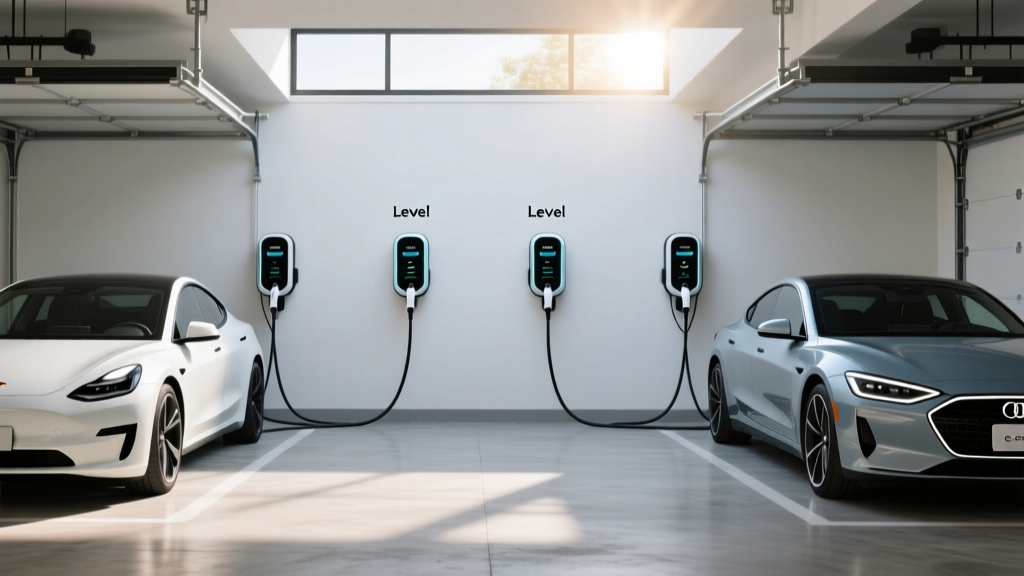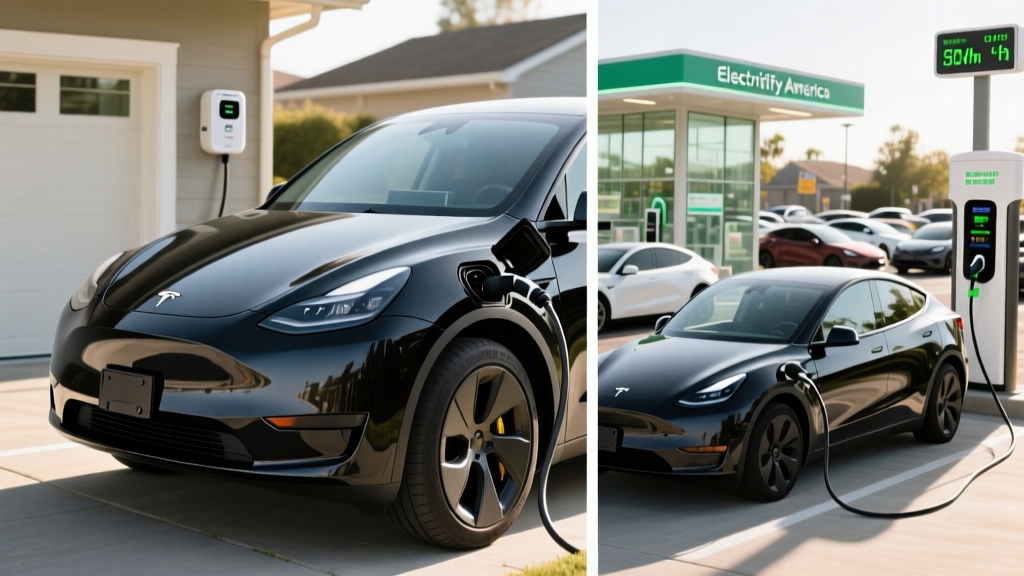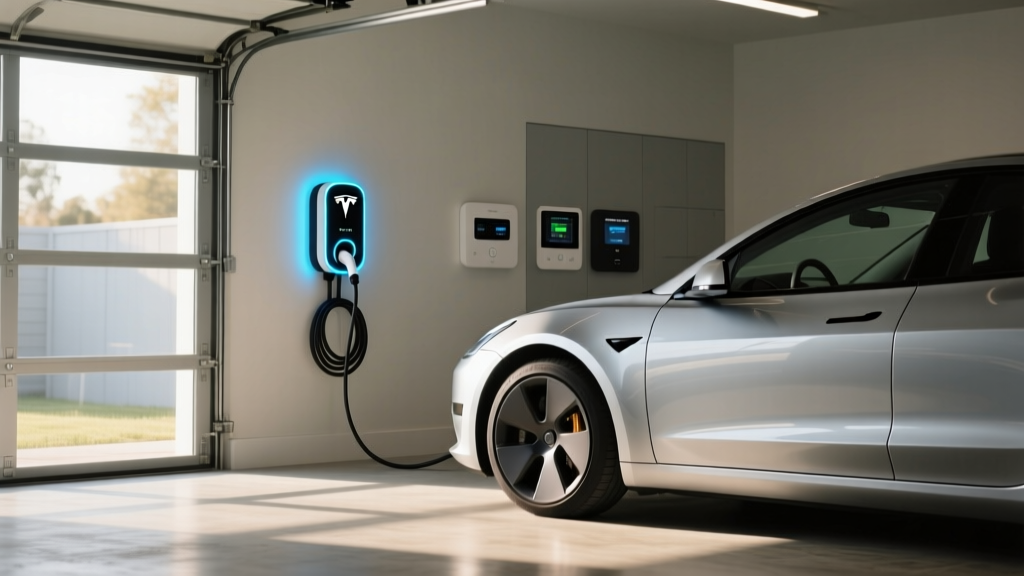
Search for "Tesla Supercharger installation cost" and you'll find a tangled mix of information about public Supercharger stations and home charging equipment. Let's clear up the confusion immediately: Tesla does not sell or install residential Superchargers. Superchargers are DC fast-charging stations (150–350 kW) deployed at commercial sites along highways. What most buyers actually want is the cost to install a Tesla Wall Connector at home — a Level 2 charger that delivers up to 11.5 kW (48 amps) on a 240V circuit.
This guide breaks down the real costs of home EV charger installation in 2026, whether you drive a Tesla Model Y, a Ford F-150 Lightning with NACS access, or any other EV using the North American Charging Standard. We'll cover electrical requirements, panel upgrades, permit costs, equipment picks, and the per-mile economics that make home charging the cheapest way to fuel an electric vehicle.
The Truth About Tesla Superchargers vs. Home Charging
A Tesla Supercharger V4 stall delivers up to 350 kW of DC power — enough to add roughly 200 miles of range in 15 minutes to a compatible vehicle like the Cybertruck or refreshed Model 3 Long Range. These stations require dedicated utility-grade transformers, concrete pads, commercial permitting, and grid interconnection agreements. The installation cost for a single Supercharger stall runs well into six figures, and Tesla does not offer them for residential purchase.
For home use, the relevant Tesla product is the Wall Connector, a hardwired Level 2 AC charger priced at approximately $475. It's the fastest practical home-charging solution for Tesla and NACS-equipped vehicles, and it's what most people mean when they search for home Tesla charger costs. Below, we detail what it takes to get one (or a comparable unit) installed on your wall.
Charging Levels Explained: Speeds, Power, and Range Added
Before calculating installation costs, you need to understand the three charging levels and what each delivers. The critical distinction: kW (kilowatts) measures power — how fast energy flows into your battery. kWh (kilowatt-hours) measures energy — the total capacity of your battery. Think of kW as the width of a pipe and kWh as the size of the tank.
| Level | Voltage | Max Power (kW) | Miles of Range/Hour | Typical Use |
|---|---|---|---|---|
| Level 1 | 120V AC | 1.4–1.9 kW | 3–5 mi/hr | Overnight trickle; PHEVs; emergency |
| Level 2 | 240V AC | 7.2–19.2 kW | 20–60+ mi/hr | Home daily charging; workplace |
| DC Fast Charge | 400–800V DC | 50–350 kW | 150–1,000+ mi/hr | Road trips; public stations |
For a typical EV with a 75–85 kWh battery (like the Tesla Model Y Long Range or Hyundai Ioniq 5), a Level 2 home charger at 11.5 kW will replenish from 10% to 80% State of Charge in roughly 5–6 hours. That's ideal for overnight charging: plug in when you get home, wake up to a full battery. A Level 1 outlet, by contrast, would take 40+ hours for the same charge — adequate only for plug-in hybrids with smaller batteries or drivers who travel fewer than 30 miles per day.
How Much Does Home EV Charger Installation Cost?
The total installed cost of a Level 2 home charger depends on your home's electrical panel capacity, the distance from panel to charger location, and local permit fees. Here's a realistic breakdown based on 2026 national averages for a 48-amp (11.5 kW) hardwired installation:
| Component | Simple Install | Complex Install |
|---|---|---|
| Level 2 Charger (Equipment) | $400–$650 | $400–$650 |
| Electrician Labor (2–6 hours) | $300–$600 | $800–$2,000 |
| Electrical Permit | $50–$150 | $50–$250 |
| Wiring / Conduit (materials) | $50–$150 | $200–$800 |
| Panel Upgrade (if needed) | $0 | $1,500–$3,500 |
| Total Range | $800–$1,550 | $2,950–$7,200 |
A "simple install" means your panel has a spare 60-amp breaker slot, the charger mounts within 10–15 feet of the panel (e.g., garage wall), and no structural drilling or trenching is required. A "complex install" involves long wire runs (40+ feet through walls or attic), conduit on exterior walls, or — the biggest variable — an electrical panel upgrade from 100-amp to 200-amp service.
Panel upgrade reality check: Homes built before 1990 frequently have 100-amp panels that are already near capacity with modern appliances, HVAC, and electronics. Adding a 48-amp continuous EV load (which the National Electrical Code requires sizing at 125%, meaning a 60-amp breaker) may exceed available headroom. If your electrician recommends a panel upgrade, budget $1,500–$3,500 for that work alone. Some utilities offer rebates of $200–$500 for panel upgrades tied to EV adoption — check with your provider.
Federal Tax Credit for Home Charger Installation
The IRS §30C Alternative Fuel Vehicle Refueling Property Credit covers 30% of home EV charger equipment and installation costs, up to a maximum of $1,000 per year. To qualify, the charger must be installed at your primary residence and placed in service during the tax year. This credit is non-refundable, meaning it can reduce your tax liability to zero but won't generate a refund beyond that. Consult a tax professional to confirm eligibility — rules are subject to change and interact with other energy credits.
Electrical Requirements: What Your Home Needs for a Level 2 Charger
A 48-amp Level 2 charger — the sweet spot for most EVs — requires a dedicated 60-amp, 240-volt circuit using 6 AWG copper wire (or 4 AWG aluminum). The National Electrical Code (NEC) mandates that continuous loads (defined as running 3+ hours, which EV charging does) be sized at 80% of the breaker rating. So a 60-amp breaker supports a 48-amp continuous charger.
Key electrical and safety requirements:
- Dedicated circuit: The charger must have its own breaker — not shared with a dryer, oven, or HVAC system. Shared circuits risk tripping and fire hazard.
- Hardwired vs. plug-in: Hardwired installations (no plug, wires connect directly inside the unit) are preferred for 48-amp chargers because NEMA 14-50 receptacles are rated for intermittent use, not the daily 8-hour continuous loads of EV charging. If you opt for a NEMA 14-50 outlet (for portability), use an industrial-grade receptacle (Hubbell or Bryant) — residential-grade outlets have been linked to melting under continuous EV loads.
- GFCI protection: The 2023 NEC requires GFCI (Ground Fault Circuit Interrupter) protection for all EV charging receptacles. Hardwired units with built-in ground-fault protection may satisfy this without a separate GFCI breaker — confirm with your electrician and local inspector.
- Outdoor rating: If mounting outside, ensure the charger carries a NEMA 4 or IP65 weatherproof rating. The Tesla Wall Connector and ChargePoint Home Flex both qualify.
- Wi-Fi connectivity: Smart chargers require a 2.4 GHz Wi-Fi signal at the install location for scheduling, firmware updates, and utility demand-response programs. Check signal strength before finalizing the mount location.
Connector Compatibility: NACS, CCS, and Adapters
The connector landscape shifted dramatically in 2024–2025 when Ford, GM, Rivian, Volvo, and most major automakers adopted Tesla's North American Charging Standard (NACS) as their native charging port. As of 2026, most new EVs sold in the U.S. ship with NACS ports. Here's how compatibility breaks down:
| Connector | Brands Using It (Native) | Home Charger Support | Adapter Options |
|---|---|---|---|
| NACS (Tesla) | Tesla, Ford, GM, Rivian, Volvo, Polestar, Mercedes, BMW, Hyundai, Kia (2025+) | Tesla Wall Connector, ChargePoint Home Flex (NACS), Emporia Vue | CCS-to-NACS adapters available ($150–$300) |
| CCS1 | Older VW ID.4, Hyundai Ioniq 5 (pre-2025), Kia EV6 (pre-2025), BMW i4 (pre-2025) | ChargePoint Home Flex (CCS), JuiceBox, Wallbox Pulsar Plus | NACS-to-CCS adapters (Tesla mobile adapter, Lectron) |
| CHAdeMO | Nissan Leaf (legacy), Mitsubishi Outlander PHEV | Limited home options; mostly public DC | No practical home adapter to NACS/CCS |
What to buy in 2026: If you own or plan to own a NACS-equipped vehicle, purchase a NACS-connector home charger. If you currently drive a CCS vehicle but plan to switch to NACS in the next few years, buy a charger with a swappable connector or invest in a quality adapter. The Tesla Wall Connector only has a NACS plug — it will not charge a CCS vehicle without an adapter. The ChargePoint Home Flex ships with either connector depending on your selection at purchase.
Charging Cost Per Mile: Home Electricity vs. Gas vs. Public DC
Home charging remains the cheapest way to fuel an EV — often dramatically cheaper than gasoline or public DC fast charging. The exact cost depends on your utility rate, time-of-use plan, and vehicle efficiency. Here's a realistic comparison using a midsize EV averaging 3.5 miles per kWh (roughly 100 MPGe combined, similar to a Tesla Model Y or Hyundai Ioniq 6):
| Scenario | Rate / Price | Cost Per Mile | Annual Cost (12,000 mi) |
|---|---|---|---|
| Home off-peak (TOU plan) | $0.09/kWh | $0.026 | $312 |
| Home standard rate | $0.16/kWh | $0.046 | $552 |
| Public Level 2 (workplace/mall) | $0.25/kWh | $0.071 | $852 |
| DC Fast (Electrify America/Tesla) | $0.40/kWh | $0.114 | $1,368 |
| Gasoline (28 MPG combined) | $3.40/gallon | $0.121 | $1,452 |
The math is clear: home off-peak charging costs roughly 80% less per mile than gasoline, and even standard-rate home charging saves 60%+ versus gas. Public DC fast charging is the most expensive electric option — sometimes approaching gas-car costs — which is why relying on home Level 2 charging is the economic foundation of EV ownership.
Time-of-use tip: Many utilities offer EV-specific TOU plans that drop rates to $0.07–$0.10/kWh between 11 PM and 6 AM. If you charge overnight (as most owners do), this is the rate that matters. Check with your utility about EV rate plans — some require a separate meter, others apply automatically.
Best Home EV Chargers for 2026: Equipment Recommendations
We evaluated chargers on power output, connector options, cable length, smart features, build quality, and price. Here are the top picks for different buyer profiles:
Tesla Wall Connector (Gen 4)
- Power: 11.5 kW (48A) on 60A circuit; configurable down to 16A
- Connector: NACS only
- Cable: 24 feet
- Smart features: Wi-Fi, OTA updates, Tesla app scheduling, Power-Share (load sharing between two units on one circuit)
- Price: ~$475
- Best for: Tesla owners and NACS-equipped EV drivers who want the fastest Level 2 charge at a competitive price
ChargePoint Home Flex
- Power: Up to 12 kW (50A) on 60A circuit; adjustable via DIP switches
- Connector: Available in NACS or CCS1/J1772
- Cable: 23 feet
- Smart features: Wi-Fi, ChargePoint app, Alexa integration, utility demand-response compatible, detailed energy reporting
- Price: ~$550–$650
- Best for: Multi-EV households with mixed connectors, or buyers who want robust app features and utility program participation
Emporia Level 2 EV Charger
- Power: 11.5 kW (48A) on 60A circuit
- Connector: NACS (J1772 adapter included)
- Cable: 24 feet
- Smart features: Wi-Fi, Emporia app, integrates with Emporia Vue whole-home energy monitor, solar-aware charging, V2H-ready
- Price: ~$400
- Best for: Budget-conscious buyers and solar-panel owners who want to charge exclusively from excess solar production
Wallbox Pulsar Plus (48A)
- Power: 11.5 kW (48A) on 60A circuit
- Connector: J1772 (CCS combo); NACS adapter required for Tesla
- Cable: 25 feet
- Smart features: Wi-Fi + Bluetooth, Wallbox app, Power Sharing, Eco-Smart solar integration
- Price: ~$550
- Best for: Drivers who want a compact unit with solar integration and don't mind an adapter for NACS vehicles
Charging Time Examples: What to Expect With a 48A Level 2 Charger
Charging speed depends on your vehicle's onboard charger capacity — the AC-to-DC converter inside the car that limits how much power it can accept from a Level 2 source. Most EVs accept 7.2–11.5 kW on Level 2; some (like the Hummer EV or certain Lucid configurations) accept up to 19.2 kW.
Real-world 10%–80% charging times on an 11.5 kW Level 2 charger:
- Tesla Model Y Long Range (75 kWh usable, 11.5 kW onboard): ~4.5 hours
- Ford F-150 Lightning Extended Range (131 kWh usable, 19.2 kW onboard): ~5.7 hours at 11.5 kW (faster on a 19.2 kW charger)
- Hyundai Ioniq 5 (77.4 kWh usable, 10.9 kW onboard): ~4.7 hours
- Chevrolet Equinox EV (85 kWh usable, 11.5 kW onboard): ~5.1 hours
- Toyota RAV4 Prime PHEV (18.1 kWh usable, 6.6 kW onboard): ~1.8 hours (limited by 6.6 kW onboard charger)
For DC fast charging on road trips, these same vehicles accept 150–250 kW at public Superchargers or Electrify America stations, reaching 10–80% in 18–25 minutes (with charge-curve taper above 80% SoC — charging slows significantly to protect the battery).
Frequently Asked Questions
How much does it cost to install a home EV charger?
A straightforward Level 2 charger installation (Tesla Wall Connector or equivalent) typically costs $800–$1,550 total when your electrical panel has capacity and the charger mounts near the panel. If you need a panel upgrade from 100A to 200A service, long wire runs, or exterior conduit, expect $2,950–$7,200. The §30C federal tax credit covers 30% of equipment and installation up to $1,000.
Can I install a Tesla Supercharger at my house?
No. Tesla Superchargers are 150–350 kW DC fast chargers designed for commercial sites with utility-grade electrical infrastructure. They are not available for residential purchase or installation. The fastest home option is the Tesla Wall Connector at 11.5 kW (Level 2), which fully charges most EVs overnight.
How fast will each charging level add range?
Level 1 (120V) adds 3–5 miles per hour. Level 2 (240V, 48A) adds 35–45 miles per hour for a typical midsize EV. DC fast charging (150–350 kW) adds 150–1,000+ miles per hour at peak rate, though real-world sessions are limited by charge-curve taper above 80% SoC.
Which connector and charger is compatible with my EV?
If your EV has a NACS port (all Teslas, plus 2025+ Ford, GM, Rivian, Volvo, Hyundai, and Kia models), buy a NACS-connector charger like the Tesla Wall Connector. If your EV has a CCS1/J1772 port (older VW, Hyundai, Kia models), buy a J1772 charger or use a CCS-to-NACS adapter. CHAdeMO vehicles (Nissan Leaf) have limited home charger options and are being phased out.
How much does charging cost per mile compared to gas?
Home off-peak charging averages $0.026/mile — about 80% less than gasoline at $3.40/gallon in a 28 MPG vehicle ($0.121/mile). Standard-rate home charging runs $0.046/mile. Public DC fast charging at $0.40/kWh costs $0.114/mile, approaching gas prices. For maximum savings, charge at home on a time-of-use plan.
What electrical upgrades might I need for a home charger?
The most common upgrade is a 100A-to-200A panel replacement ($1,500–$3,500) if your existing panel lacks capacity for a dedicated 60A breaker. Other potential upgrades include: adding a sub-panel near the garage ($400–$800), running new conduit for long wire runs ($10–$25 per foot), or upgrading utility service from the transformer (utility-dependent, sometimes free, sometimes $2,000+). Have a licensed electrician perform a load calculation before purchasing equipment.
Is a hardwired charger better than a NEMA 14-50 plug?
For 48-amp chargers, yes. Hardwired connections avoid the thermal stress that continuous 8-hour loads place on plug-in receptacles. Residential-grade NEMA 14-50 outlets have been documented melting under sustained EV charging loads. If you need plug-in flexibility (for portability or rental situations), invest in an industrial-grade Hubbell or Bryant 14-50 receptacle ($80–$120) and have your electrician verify the installation meets NEC continuous-load requirements.