If you're a Tesla owner—or soon will be—the idea of charging at home at Supercharger-like speeds is irresistible. But the phrase "Supercharger installation cost" covers a wide range of realities, from a straightforward $1,200 Level 2 wall connector setup to a $25,000+ commercial-grade DC fast charger installation. This guide breaks down exactly what each option costs, what your electrical panel can actually support, and which home charging setup delivers the best value per mile in 2026.
Understanding Charging Levels: What "Supercharger" Actually Means at Home
First, a crucial distinction. A Tesla Supercharger is a DC fast charger (Level 3) delivering 150–350 kW of power directly to your battery. Replicating that at home is technically possible but financially extreme. Most Tesla owners install a Level 2 home charger—specifically the Tesla Wall Connector—which delivers 11.5 kW to 19.2 kW depending on your electrical service. That's fast enough for overnight charging and vastly more practical.
Here's how each level translates to real charging speed:
| Level | Voltage | Power (kW) | Miles Added/Hour | Typical Use Case |
|---|---|---|---|---|
| Level 1 | 120V | 1.0–1.4 kW | 3–5 mi/hr | Emergency/trickle; PHEVs |
| Level 2 | 240V | 7.2–19.2 kW | 25–70 mi/hr | Home daily charging |
| DC Fast (Supercharger) | 400–800V DC | 50–350 kW | 200–1,000+ mi/hr | Road trips; commercial |
For context, a Tesla Model Y Long Range with its 75 kWh (usable) battery needs roughly 10–12 hours on Level 1, 5–8 hours on a standard 48A Level 2, and just 25–30 minutes from 10–80% at a 250 kW V3 Supercharger. The charge curve tapers significantly above 80%, which is why DC fast chargers quote 10–80% times rather than 0–100%.
Tesla Wall Connector Installation Cost: The Breakdown
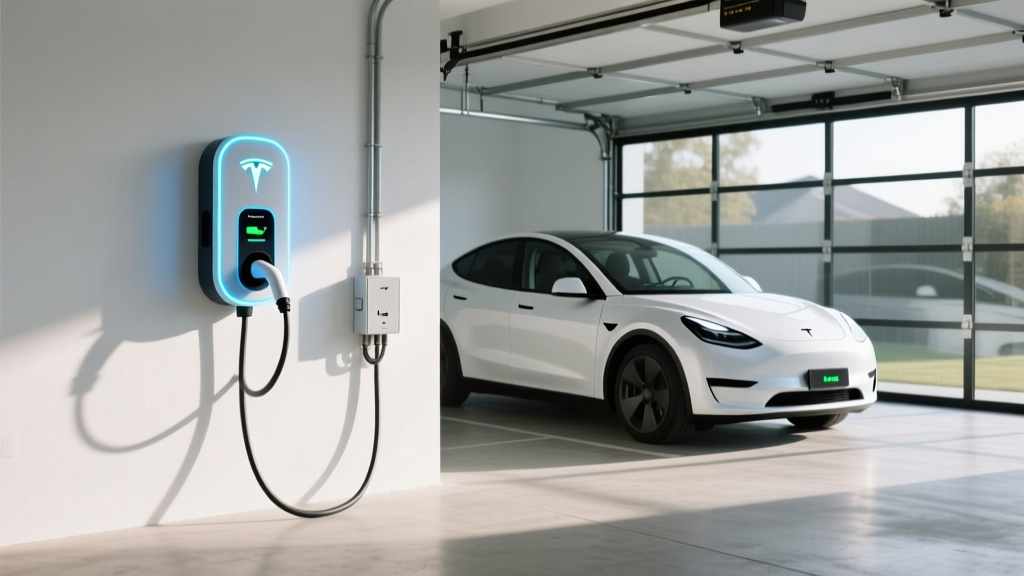
The Tesla Wall Connector (Gen 4) is the standard home charging solution. It's a Level 2 charger delivering up to 11.5 kW on a 48-amp circuit or up to 19.2 kW on an 80-amp circuit. Here's what a typical installation costs:
| Item | Cost Range | Notes |
|---|---|---|
| Tesla Wall Connector (hardware) | $420–$475 | Gen 4, 24ft cable, NACS connector built-in |
| Electrician labor (standard install) | $600–$1,500 | Short run from panel to garage; conduit, wiring, mounting |
| Electrical permit | $50–$200 | Varies by municipality; required by code |
| 60A breaker + wiring (48A charger) | $100–$300 | 6 AWG copper THHN; breaker matched to circuit |
| Panel upgrade (if needed) | $1,500–$4,000 | Upgrading from 100A to 200A service |
| Trenching (long outdoor runs) | $500–$2,500 | Detached garage or driveway pedestal |
| Total (no panel upgrade) | $1,170–$2,475 | Most common scenario |
| Total (with panel upgrade) | $2,670–$6,475 | Older homes with 100A service |
Do You Need a Panel Upgrade?
This is the single biggest variable in your Supercharger installation cost at home. A Tesla Wall Connector on a 48-amp circuit requires a 60-amp dedicated breaker. By NEC code, continuous loads (like EV charging) can only use 80% of a circuit's capacity—so a 60A breaker supports 48A continuous draw.
Your electrician will perform a load calculation on your existing panel. If you have a 200-amp panel with spare capacity, you're likely fine. If you have a 100-amp panel in an older home, you'll almost certainly need an upgrade to 200A, adding $1,500–$4,000 to the project. Some utilities offer rebates for panel upgrades tied to EV adoption—check with your local provider.
Can You Install an Actual Tesla Supercharger at Home?
Technically, yes. Practically, almost nobody should. Tesla does sell DC fast charging equipment to commercial partners, but a home DC fast charger installation involves:
- Equipment cost: $25,000–$75,000+ for a 50–150 kW DC unit
- Electrical service: 480V three-phase power, requiring a utility transformer upgrade ($10,000–$50,000)
- Permitting: Commercial-grade permits, utility interconnection agreements, potential demand charges
- Ongoing costs: Demand charges from your utility can add $200–$1,000+/month
For 99% of EV owners, a Level 2 Wall Connector at 11.5 kW replenishes the battery fully overnight—which is exactly what you need. A 75 kWh battery charges from 10–80% in about 5 hours at 11.5 kW, meaning you plug in at 10 PM and wake up to a full car at 6 AM.
Connector Compatibility: NACS, CCS, and Adapters
The connector landscape has shifted dramatically. Tesla's North American Charging Standard (NACS) has been adopted by Ford, GM, Rivian, Volvo, Hyundai, and most major automakers for 2025–2026 models. Here's where things stand:
| Connector | Brands Using It | Home Charger Options | Adapter Needed? |
|---|---|---|---|
| NACS (Tesla) | Tesla, Ford, GM, Rivian, Hyundai, Volvo, others | Tesla Wall Connector, ChargePoint Home Flex (NACS), Emporia Level 2 | No (native on new EVs) |
| CCS1 | Older VW, BMW, Stellantis, some 2024–2025 models | ChargePoint Home Flex, EnelX JuiceBox, Grizzl-E | CCS-to-NACS adapter for Superchargers (~$100–$250) |
| CHAdeMO | Nissan Leaf (legacy) | Limited home options; mostly public DC | No home adapter available |
If you own a non-Tesla EV with a CCS port but want to use Tesla Superchargers on road trips, Tesla sells a CCS-to-NACS adapter. For home charging, the Tesla Wall Connector has a built-in NACS plug—non-Tesla vehicles with CCS ports will need the adapter or a CCS-native home charger like the ChargePoint Home Flex.
Cost to Charge: Home vs. Public vs. Gas
The financial case for home charging is overwhelming once you see the per-mile math. Here's a comparison using a Tesla Model Y Long Range (averaging 3.5 miles per kWh or 117 MPGe combined per fueleconomy.gov):
| Scenario | Rate | Cost per kWh | Cost per Mile | Annual Cost (12,000 mi) |
|---|---|---|---|---|
| Home (off-peak utility rate) | $0.12/kWh | $0.12 | $0.034 | $411 |
| Home (average US rate) | $0.17/kWh | $0.17 | $0.049 | $583 |
| Tesla Supercharger (average) | $0.30/kWh | $0.30 | $0.086 | $1,029 |
| Electrify America / EVgo DC | $0.40/kWh | $0.40 | $0.114 | $1,371 |
| Gas car (30 MPG, $3.50/gal) | — | — | $0.117 | $1,400 |
Home off-peak charging costs roughly 70–80% less per mile than gasoline. Even exclusive Supercharger use is still cheaper than gas for most drivers. The key to maximum savings is a time-of-use (TOU) utility plan that offers off-peak rates between 10 PM and 6 AM—the Tesla Wall Connector can be scheduled to charge during these windows via the Tesla app.
Recommended Home Chargers for Tesla and Non-Tesla EVs
Tesla Wall Connector (Gen 4)
- Power Output: Up to 11.5 kW (48A / 240V) or 19.2 kW (80A on compatible panels)
- Connector: NACS (native Tesla plug)
- Cable Length: 24 feet
- Smart Features: Wi-Fi, OTA updates, Tesla app scheduling, power sharing between multiple units, vehicle authentication
- Price: ~$420–$475
- Best For: Tesla owners; non-Tesla NACS-equipped vehicles
ChargePoint Home Flex
- Power Output: Up to 12 kW (50A / 240V); adjustable amperage via DIP switches
- Connector: Available in NACS or CCS1 configurations
- Cable Length: 23 feet
- Smart Features: Wi-Fi, ChargePoint app, Alexa integration, scheduling, energy tracking
- Price: ~$550–$650
- Best For: Multi-EV households with mixed connectors
Emporia Level 2 EV Charger
- Power Output: Up to 11.5 kW (48A / 240V)
- Connector: NACS or J1772 (with adapter)
- Cable Length: 24 feet
- Smart Features: Wi-Fi, Emporia app, solar integration, real-time energy monitoring, load management
- Price: ~$350–$400
- Best For: Budget-conscious buyers; solar-panel households
One practical note: if you have a 200-amp panel with limited spare capacity, the Emporia charger's load-management feature can dynamically reduce charging power to avoid tripping your main breaker—a valuable safeguard that the Tesla Wall Connector also supports via its Power Sharing feature when paired with a second unit.
Safety, Electrical Code, and Permit Requirements
EV charger installation is regulated by the National Electrical Code (NEC) and your local building authority. Key requirements include:
- Dedicated circuit: Your charger must have its own breaker—no sharing with other appliances. A 48A charger needs a 60A breaker; a 32A charger needs a 40A breaker.
- GFCI protection: NEC 2020 and later require ground-fault circuit interrupter protection for all EV charging outlets. Hardwired units (like the Wall Connector) typically have built-in GFCI. If you install a NEMA 14-50 receptacle instead, you'll need a GFCI breaker (~$50–$100 extra).
- Outdoor rating: If mounting outside, the charger must be NEMA 4-rated for weather resistance. The Tesla Wall Connector is NEMA 4-rated and suitable for outdoor installation.
- Permit and inspection: Most jurisdictions require an electrical permit ($50–$200) and a post-installation inspection. Skipping the permit can void your homeowner's insurance coverage for electrical fires.
- Wire gauge: 48A continuous draw requires 6 AWG copper wire. 80A requires 3 AWG or 2 AWG depending on wire type and run length. Your electrician will spec this to NEC Table 310.16.
Hire a licensed electrician—preferably one with EV charger installation experience. Tesla maintains a certified installer network on their website. Get at least two quotes, and ensure the quote includes the permit, inspection coordination, and any necessary conduit or trenching.
Federal Tax Credit for Home Charger Installation
The IRS §30C Alternative Fuel Vehicle Refueling Property Credit covers 30% of home EV charger equipment and installation costs, up to a maximum of $1,000 per year. This applies to the Tesla Wall Connector and its installation labor.
- Credit amount: 30% of equipment + installation, capped at $1,000
- Eligibility: Must be installed at your primary residence in the US
- Income limits: None for the §30C credit (unlike the §30D vehicle credit)
- Claiming: File IRS Form 8911 with your tax return; consult a tax professional for current-year rules
Note: This is separate from the §30D new EV purchase credit (up to $7,500), which has its own MSRP caps, buyer income limits, and battery-sourcing requirements. The §30C charger credit is simpler and more broadly available.
Frequently Asked Questions
How much does it cost to install a Tesla home charger?
Expect $1,170–$2,475 for a standard Tesla Wall Connector installation without a panel upgrade. This includes the $420–$475 charger unit, $600–$1,500 in electrician labor, $50–$200 for the permit, and $100–$300 for the breaker and wiring. If your home needs a panel upgrade from 100A to 200A service, add $1,500–$4,000.
How fast will a Level 2 home charger add range to my Tesla?
A Tesla Wall Connector at 11.5 kW (48A) adds roughly 40–44 miles of range per hour for a Model Y or Model 3. At the full 19.2 kW (80A), that increases to approximately 65–70 miles per hour. An overnight 8-hour charge at 11.5 kW restores about 320–350 miles—more than enough for a full battery on most Tesla models.
Can I use a regular outlet to charge my Tesla?
Yes, but slowly. A standard 120V household outlet (Level 1) delivers about 1.0–1.4 kW, adding 3–5 miles of range per hour. This works for plug-in hybrids with small batteries or as a backup for BEVs, but it's impractical as a primary charging solution—a full charge for a 75 kWh battery would take 50+ hours.
Do I need a Tesla Wall Connector, or can I use a third-party charger?
You can use any Level 2 charger with a NACS connector (or a J1772 charger with a J1772-to-NACS adapter, which Tesla includes with most vehicles). However, the Tesla Wall Connector offers the best integration—automatic vehicle authentication, OTA updates, and power sharing—making it the default choice for Tesla-only households.
How much does charging cost per mile compared to gas?
Home charging at the US average rate of $0.17/kWh costs about $0.049 per mile in a Model Y. Gasoline at $3.50/gallon in a 30 MPG vehicle costs $0.117 per mile. That's a 58% savings per mile with home EV charging, or roughly $817 saved annually at 12,000 miles per year.
What electrical upgrades might I need for a home charger?
The most common upgrade is a panel capacity increase from 100A to 200A service ($1,500–$4,000). You may also need a new dedicated circuit with appropriate wire gauge, a GFCI breaker if using a receptacle, or trenching for a detached-garage installation. Your electrician's load calculation will determine exactly what's required.
Is it safe to charge an EV in the rain or outdoors?
Yes. EV chargers rated NEMA 4 (like the Tesla Wall Connector) are designed for outdoor use in rain, snow, and dust. The connector and vehicle inlet are engineered to be weather-sealed when mated. The NEC requires GFCI protection for all EV charging circuits as an additional safety measure.