Tesla's rollout of a Supercharger dynamic pricing pilot marks a significant shift in how EV owners pay for public fast charging. Rather than a flat per-kilowatt-hour rate, participating stations now adjust prices based on time of day, local grid demand, and station utilization. For Tesla owners — and the growing number of non-Tesla EVs accessing Superchargers via the NACS standard — understanding this new pricing model is essential for managing your fuel budget.
This guide breaks down exactly how dynamic pricing works, what it costs compared to home Level 2 charging, and how to build a charging strategy that keeps your per-mile cost as low as possible. We'll also cover the home charging setup that remains the single biggest cost-saver in EV ownership.
What Is Tesla's Supercharger Dynamic Pricing Pilot?
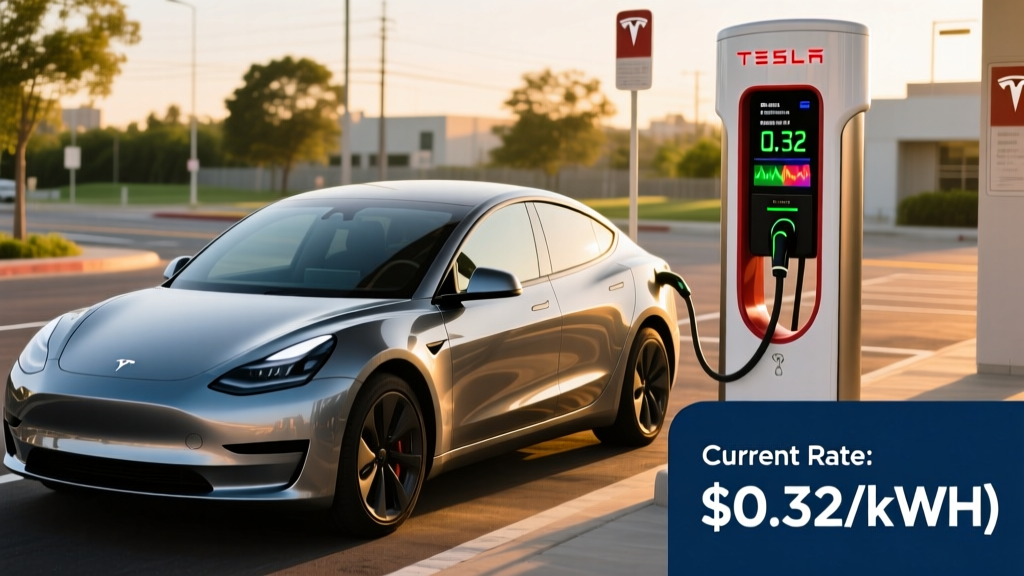
Under the Tesla Supercharger dynamic pricing pilot, rates at select stations fluctuate similarly to how utility time-of-use (TOU) plans work — but applied to DC fast charging. Prices can swing based on:
- Time of day: Off-peak overnight rates may drop to $0.25–$0.30/kWh, while peak afternoon/evening rates can climb to $0.45–$0.55/kWh or higher at congested urban stations.
- Station utilization: Stalls operating near capacity during road-trip holiday weekends may see surcharges.
- Local electricity demand: Grid stress events (e.g., summer heat waves in California or Texas) push wholesale energy costs higher, which Tesla passes through.
The result: a charging session that cost $12 at 11 PM might cost $22 for the same energy at 5 PM at the same station. For a 75 kWh battery charging from 10% to 80% (roughly 52.5 kWh delivered), the difference between $0.28/kWh and $0.52/kWh is $12.60 vs. $27.30 — more than double.
Charging Levels Explained: Speed, Power, and What You Get
Before comparing costs, you need to understand the three charging levels available to EV owners. The critical distinction: kW (kilowatts) measures power — how fast energy flows into your battery. kWh (kilowatt-hours) measures energy — the total amount stored. Think of kW as the flow rate of a hose and kWh as the size of the bucket.
| Level | Voltage | Power (kW) | Miles of Range Added/Hour | Best For |
|---|---|---|---|---|
| Level 1 | 120V AC | 1.0–1.4 kW | 3–5 miles/hr | Overnight top-ups, PHEVs, low-mileage drivers |
| Level 2 | 240V AC | 3.3–19.2 kW | 12–75 miles/hr | Daily home charging, workplace charging |
| DC Fast Charging | 400–800V DC | 50–350 kW | 150–1,000+ miles/hr (peak) | Road trips, rapid replenishment |
For context, a Tesla Model Y Long Range with a ~75 kWh usable battery charging at home on a 48A Level 2 circuit (11.5 kW) will add roughly 44 miles of range per hour and go from 10% to 80% in about 4.5 hours. At a 250 kW V3 Supercharger, that same 10–80% session takes roughly 22–28 minutes, though peak rates only sustain up to ~30–40% State of Charge (SoC) before tapering.
How Much Does Charging Cost Per Mile vs. Gas?
The economics of EV charging depend heavily on where and when you charge. Here's a comparison using a Tesla Model Y Long Range AWD (EPA-rated 310 miles, ~75 kWh usable battery, ~27 kWh/100mi efficiency) versus a comparable gas crossover averaging 28 MPG combined.
| Scenario | Rate | Cost Per Mile | Full 310-mi "Tank" Cost |
|---|---|---|---|
| Home Level 2 (off-peak utility rate) | $0.12/kWh | $0.032 | $10.00 |
| Home Level 2 (avg. U.S. residential) | $0.17/kWh | $0.046 | $14.25 |
| Supercharger dynamic pilot (off-peak) | $0.28/kWh | $0.076 | $23.40 |
| Supercharger dynamic pilot (peak) | $0.52/kWh | $0.140 | $43.50 |
| Gas vehicle (28 MPG, $3.40/gal) | — | $0.121 | $37.60 |
The takeaway: home charging at off-peak rates is roughly 3.8× cheaper than gas per mile. Even the average U.S. residential rate beats gas by a factor of 2.6×. But peak Supercharger dynamic pricing can actually exceed the per-mile cost of gasoline — a critical reason to plan road-trip stops around off-peak windows when possible.
According to fueleconomy.gov, the 2025 Tesla Model Y Long Range achieves 127 MPGe combined, translating to roughly $0.04/mile at the U.S. average electricity rate. Your actual cost varies with driving style, terrain, and climate — highway driving at 75+ mph and cold-weather operation both increase energy consumption by 15–30%.
Home Charger Installation: Costs, Requirements, and Upgrades
Home Level 2 charging is the backbone of affordable EV ownership. A proper installation requires a dedicated 240V circuit, typically 40A to 60A, wired by a licensed electrician with a permit. Here's what to budget:
| Component | Cost Range | Notes |
|---|---|---|
| Level 2 charger (hardware) | $350–$750 | 40A–48A Wi-Fi-enabled units from reputable brands |
| Electrical panel capacity check | $0–$200 | Many electricians include this in the quote |
| Wiring and conduit (50 ft run) | $400–$1,200 | Varies by distance from panel to garage/parking spot |
| Electrician labor | $500–$1,500 | Depends on local rates and job complexity |
| Permit and inspection | $50–$300 | Required by most jurisdictions; varies by municipality |
| Panel upgrade (if needed) | $1,500–$4,000 | Older homes with 100A service may need 200A upgrade |
| Total (no panel upgrade) | $1,300–$3,950 | Most homes with 200A service fall in $1,500–$2,500 |
| Total (with panel upgrade) | $2,800–$7,950 | Common in homes built before 1990 |
Electrical Requirements and Safety
Your Level 2 installation must meet National Electrical Code (NEC) requirements:
- Dedicated circuit: The charger needs its own breaker — no sharing with other appliances.
- Continuous load derating: NEC requires EV chargers (classified as continuous loads) to use only 80% of a circuit's rated capacity. A 50A breaker supports a 40A charger; a 60A breaker supports 48A.
- GFCI protection: NEC 2020 and later require GFCI breakers for EV charging circuits in garages and outdoor locations.
- Outdoor rating: If your charger mounts outside, it must carry a NEMA 4 or NEMA 4X weather-resistance rating.
- Permit and inspection: Skipping the permit risks insurance claim denials and code violations. Most jurisdictions require inspection before the circuit is energized.
Connector Compatibility: NACS, CCS, and CHAdeMO
As of 2025–2026, the North American Charging Standard (NACS) — originally Tesla's proprietary connector — has become the dominant standard. Most major automakers (Ford, GM, Rivian, Hyundai, Kia, BMW, and others) have adopted NACS on new vehicles or provide adapters for CCS-equipped models to access Tesla Superchargers.
| Connector | Brands Using It (Native) | Adapter Needed for Superchargers? |
|---|---|---|
| NACS (Tesla) | Tesla (all models), Ford (2025+), GM (2025+), Rivian (2025+), Hyundai (2026 Ioniq refresh) | No — native plug at Superchargers |
| CCS1 | Hyundai/Kia (2024 and earlier), VW ID.4, BMW i4/iX, Mercedes EQE/EQS, most legacy EVs | Yes — manufacturer-provided or third-party NACS-to-CCS adapter (~$150–$250) |
| CHAdeMO | Nissan Leaf (legacy), Mitsubishi Outlander PHEV | Not compatible with Superchargers; use Electrify America or EVgo CHAdeMO stations |
If you drive a CCS-equipped EV from a brand that has joined the NACS coalition, check with your manufacturer for a complimentary or subsidized adapter. Ford and GM began distributing adapters to existing owners in 2024–2025. Third-party adapters from companies like Lectron and A2Z are available, but verify they are UL-listed before purchasing — non-certified adapters carry fire and equipment-damage risks.
Equipment Recommendations: Best Home Level 2 Chargers
Here are proven Level 2 chargers across price points, all featuring NACS connectors (or available in NACS/CCS configurations) with smart scheduling for utility TOU optimization — critical for minimizing costs under dynamic pricing models.
Tesla Wall Connector (Gen 3)
Power: Up to 11.5 kW (48A, 240V)
Connector: NACS native
Cable: 24 ft
Smart features: Wi-Fi, OTA updates, load sharing (up to 6 units on one circuit), Tesla app integration
Price: ~$475
Best for: Tesla owners wanting seamless integration
ChargePoint Home Flex (2nd Gen)
Power: Up to 12 kW (50A, 240V) — adjustable from 16A–50A
Connector: NACS or J1772 (configurable)
Cable: 23 ft
Smart features: Wi-Fi, Alexa/Google Home, scheduled charging, utility TOU integration, energy tracking
Price: ~$599
Best for: Multi-EV households, non-Tesla NACS adopters
Emporia Level 2 EV Charger
Power: Up to 11.5 kW (48A, 240V)
Connector: J1772 (NACS adapter included)
Cable: 24 ft
Smart features: Wi-Fi, solar integration, energy monitoring via Emporia app, scheduled charging
Price: ~$399
Best for: Budget-conscious buyers, solar-equipped homes
Grizzl-E Smart (United Chargers)
Power: Up to 10 kW (40A, 240V)
Connector: J1772 (NACS adapter available)
Cable: 24 ft
Smart features: Wi-Fi, OCPP compatibility, adjustable amperage, extreme cold rated (-40°F)
Price: ~$549
Best for: Cold-climate owners, outdoor installations
Regardless of brand, choose a charger that supports scheduled charging — this feature lets you set charge windows to align with off-peak utility rates, insulating you from both utility peak pricing and Supercharger dynamic pricing spikes when you're charging at home.
Strategies to Minimize Charging Costs Under Dynamic Pricing
The Tesla Supercharger dynamic pricing pilot rewards planning. Here's how experienced EV owners keep costs low:
- Charge at home whenever possible. Even at average U.S. residential rates ($0.17/kWh), home Level 2 charging costs roughly $0.046/mile — less than half the cost of peak Supercharger sessions.
- Precondition your battery before Supercharging. Tesla's navigation system automatically warms the battery when a Supercharger is set as your destination. A preconditioned battery accepts higher kW rates sooner, shortening your session and reducing the time spent at a high-priced station.
- Time road-trip stops for off-peak hours. If your route allows, schedule Supercharger stops before 10 AM or after 9 PM. The dynamic pricing pilot may show rates 40–50% lower during these windows.
- Use non-Tesla DC fast networks as alternatives. Electrify America, EVgo, and ChargePoint stations often have flat or subscription-based pricing (e.g., EA's Pass+ at $0.31/kWh) that may undercut peak Supercharger rates.
- Check the rate before plugging in. The Tesla app and in-car navigation display the current $/kWh rate. If it's spiking, drive to the next station or wait — rates can shift within hours.
- Charge to 80%, not 100%. Above 80% SoC, charging speed drops dramatically while the per-kWh rate stays the same. You're paying full price for a trickle. Reserve 100% charges for home, where cost and time are less critical.
Frequently Asked Questions
How much does it cost to install a home EV charger?
A typical Level 2 home charger installation costs $1,300–$3,950 including hardware, electrician labor, wiring, and permits — assuming your electrical panel has sufficient capacity. Homes needing a 200A panel upgrade should budget $2,800–$7,950 total. Get at least three quotes from licensed electricians, and confirm they include permit and inspection in their estimate.
How fast will each charging level add range?
Level 1 (120V) adds 3–5 miles of range per hour. Level 2 (240V, 48A) adds roughly 35–44 miles per hour for most EVs. DC fast charging at a 250 kW Supercharger can add 150–200+ miles in 15 minutes at peak charge rates, though the rate tapers significantly above 50–60% SoC. Your exact mileage-per-hour depends on your vehicle's efficiency (kWh/100mi).
Which connector and charger is compatible with my EV?
If you own a Tesla, you have native NACS compatibility at all Superchargers and at home. If you own a 2025+ Ford, GM, or Rivian, your vehicle likely has a native NACS port. Older CCS-equipped vehicles from brands that have adopted NACS (Hyundai, Kia, BMW, Mercedes, Volvo) can access Superchargers using a manufacturer-provided or third-party NACS-to-CCS adapter. CHAdeMO vehicles (Nissan Leaf) cannot use Superchargers and rely on Electrify America or EVgo networks.
How much does charging cost per mile vs. gas?
Home charging at the U.S. average residential rate ($0.17/kWh) costs roughly $0.04–$0.05 per mile for a typical EV. Gasoline at $3.40/gallon in a 28 MPG vehicle costs about $0.12 per mile. However, peak Supercharger dynamic pricing ($0.45–$0.55/kWh) can push EV public-charging costs to $0.12–$0.15 per mile — comparable to or exceeding gas. The economic advantage of EV ownership depends heavily on access to affordable home charging.
What electrical upgrades might I need for a home charger?
Homes with a 200A electrical panel typically have sufficient capacity for a 40A–48A Level 2 charger without upgrades. Homes with 100A panels — common in buildings constructed before 1990 — often require a panel upgrade to 200A, costing $1,500–$4,000. Additionally, if your garage or parking area is far from the panel, expect higher conduit and wiring costs. A licensed electrician will perform a NEC Article 220 load calculation to determine your home's available capacity.
Is the Supercharger dynamic pricing pilot permanent?
As of early 2026, Tesla has framed dynamic pricing as a pilot program at select stations. Whether it expands nationwide depends on pilot results, customer response, and utility partnership structures. Non-Tesla EVs accessing Superchargers via the NACS network are subject to the same dynamic rates. Monitor Tesla's in-app pricing and announcements for updates on station-specific pricing models.