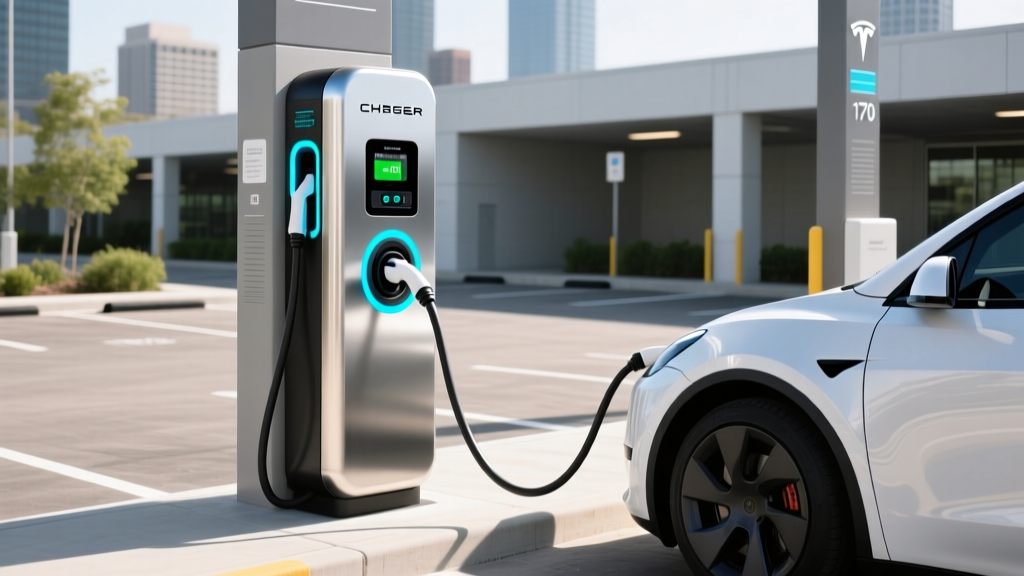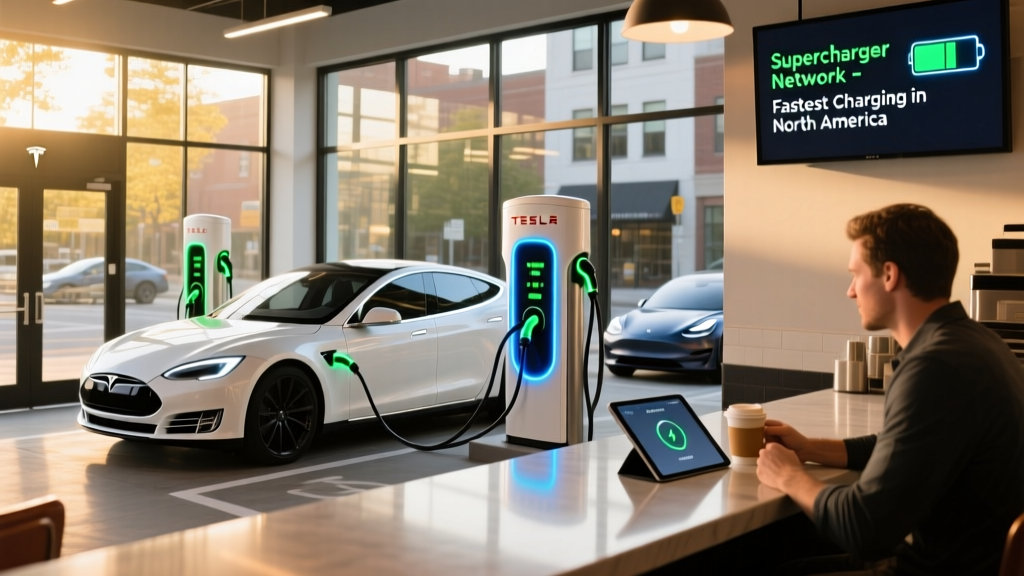
Tesla's Supercharger Diner in Hollywood isn't just a place to grab a meal while your EV tops off — it's a glimpse into what destination charging could become. The 3,500-square-foot restaurant, paired with a canopy of V4 Supercharger stalls, signals a shift from bare-bones parking-lot charging toward experiences designed around the 20–30 minute fast-charge stop. But whether you're pulling into a Supercharger Diner or plugging in at home, understanding charging levels, connectors, and real-world costs is what separates confident EV ownership from frustrating guesswork.
This guide covers everything you need to charge smart: the three charging levels with real speed numbers, what a home installation actually costs (including the panel upgrade nobody warns you about), which connector your car needs, and how EV charging stacks up against gas on a per-mile basis.
Charging Levels Explained: How Fast Does Each Level Add Range?
EV charging falls into three tiers. The distinction that matters most: kW (kilowatts) measures power — how fast energy flows into your car. kWh (kilowatt-hours) measures energy — the total capacity of your battery. Think of kW as the width of a hose and kWh as the size of the bucket.
| Level | Voltage | Typical Power (kW) | Miles of Range Added per Hour | Best For |
|---|---|---|---|---|
| Level 1 | 120V AC | 1.0–1.9 kW | 3–5 mi/hr | Overnight top-ups, PHEVs, low-mileage drivers |
| Level 2 | 240V AC | 7.2–19.2 kW | 20–60 mi/hr | Daily home charging, workplace, destinations |
| DC Fast Charging | 400–800V DC | 50–350 kW | 150–1,000+ mi/hr (peak) | Road trips, rapid top-ups away from home |
A critical reality check: DC fast charging speeds are peak rates, not sustained. A Tesla Model Y charging at a 250 kW V3 Supercharger will peak near 250 kW up to roughly 40% state of charge (SoC), then taper progressively. The 10–80% charge typically takes about 25–28 minutes. Above 80%, the rate drops sharply to protect battery health — that last 20% can take as long as the first 60%. This charge-curve taper is why you'll see experienced EV drivers targeting 80% and moving on rather than waiting for a full fill.
- Tesla Model Y (75 kWh usable, NMC): ~25 min at a 250 kW V3 Supercharger; ~8.5 hrs on a 7.2 kW Level 2 home charger
- Hyundai Ioniq 5 (77.4 kWh usable, NMC): ~18 min at a 350 kW Electrify America station (800V architecture); ~10.5 hrs on 7.2 kW Level 2
- Ford F-150 Lightning (131 kWh extended range, NMC): ~41 min at a 150 kW DC fast charger; ~18 hrs on 7.2 kW Level 2
- Chevrolet Equinox EV (85 kWh usable, NMC): ~32 min at a 150 kW DCFC; ~11.5 hrs on 7.2 kW Level 2
The Supercharger Diner Concept: Destination Charging Evolves
The Tesla Supercharger Diner, located on Santa Monica Boulevard in Hollywood, combines a retro-futuristic drive-in restaurant with a canopy of V4 Supercharger stalls. Tesla filed initial plans for the concept as early as 2018, and the location began taking shape as a proof of concept for turning the 20–30 minute charging window into a genuine amenity rather than dead time spent in a parking lot.
What makes this significant for the broader EV ecosystem:
- V4 Supercharger architecture supports up to 350 kW for CCS-equipped vehicles and native NACS Tesla vehicles, with a separate charge cabinet that allows longer cable runs and more flexible stall placement.
- NACS (North American Charging Standard) access continues to expand. As of 2025–2026, Ford, GM, Rivian, Volvo, and other automakers have adopted NACS ports on new vehicles, gaining access to Tesla's Supercharger network — the most reliable public DC fast-charging network in the U.S. by uptime metrics.
- The destination-charging model addresses one of the biggest complaints in public charging: barren, poorly lit lots with no amenities. Expect more operators to follow with food, restrooms, and Wi-Fi integrated into charging hubs.
For Tesla owners, the Supercharger Diner doesn't change the technical charging experience — a Model 3 or Model Y charges the same at a Hollywood V4 stall as it does at a highway rest stop. But it reframes the ownership experience, especially for apartment dwellers and urban drivers who rely more heavily on public infrastructure.
Home EV Charger Installation: Costs, Electrical Requirements, and Gotchas
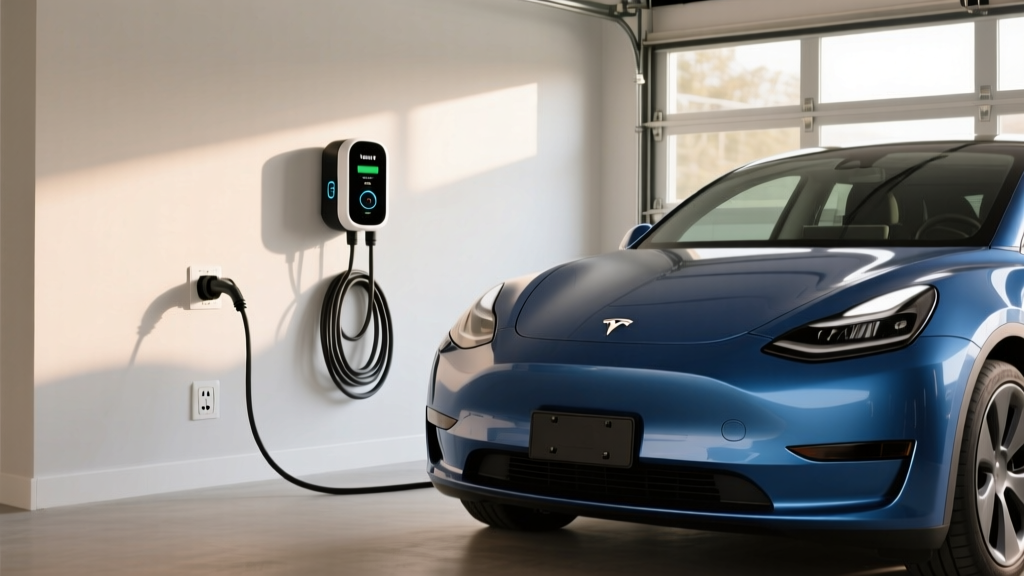
Home Level 2 charging is where most EV owners do 80–90% of their charging. A properly installed 240V Level 2 charger adds 25–45 miles of range per hour of charging, meaning an overnight session (8–10 hours) fully replenishes nearly any EV battery.
Electrical Requirements
A typical home Level 2 installation requires:
- 240V dedicated circuit — the same voltage as your electric dryer or oven
- 40A to 60A breaker — a 48A charger (like the Tesla Wall Connector) requires a 60A breaker per National Electrical Code (NEC) continuous-load rules, which mandate that circuits be rated at 125% of the sustained draw
- NEMA 14-50 outlet or hardwired connection — hardwired is preferred for 48A+ chargers because NEMA 14-50 outlets are rated for 50A maximum, and some jurisdictions now require GFCI breakers on receptacles, which can cause nuisance tripping with EV chargers
- Electrical panel capacity — your panel must have enough spare amperage to support the new circuit. A 200A panel with existing heavy loads (electric heat, dryer, oven, AC) may not have headroom for a 60A EV circuit
The Panel Upgrade Reality
This is the cost surprise that catches many homeowners off guard. If your home has a 100A or older 150A electrical panel, or if your panel is near capacity, you'll likely need a panel upgrade to 200A — or in some cases, a service upgrade from the utility to bring more amperage to the house. Panel upgrades typically cost $1,500–$3,500. A full service upgrade (new meter, utility transformer work) can push costs to $4,000–$8,000+.
An alternative worth exploring: some utilities and jurisdictions now permit automated load management devices (like the Emporia Load Management or Span smart panel) that dynamically reduce charger draw when other circuits are active, potentially avoiding a panel upgrade entirely.
| Cost Component | Typical Range | Notes |
|---|---|---|
| Level 2 Charger (Equipment) | $300–$700 | Varies by brand, power output, and smart features |
| Electrician Labor | $500–$2,000 | Depends on run length from panel to garage/driveway |
| Permit & Inspection | $100–$400 | Required in most jurisdictions; varies by municipality |
| Electrical Panel Upgrade (if needed) | $1,500–$3,500 | 200A upgrade; full service upgrade can exceed $4,000 |
| Conduit, Wiring, & Misc. Materials | $100–$500 | Longer runs from panel to outlet increase cost |
| Total (No Panel Upgrade) | $900–$3,200 | Most common scenario for newer homes |
| Total (With Panel Upgrade) | $2,500–$7,000+ | Common for older homes with 100A service |
Always get a licensed electrician to assess your panel before purchasing equipment. Some utilities offer rebates of $250–$1,000 for Level 2 home charger installations — check with your local provider. The federal Residential Clean Energy Credit (IRC §25C) may cover up to 30% of charger and installation costs (capped at $1,000 for EVSE through 2032), though eligibility depends on specific requirements.
Connector Compatibility: NACS, CCS1, and CHAdeMO
The connector landscape has consolidated dramatically. Here's where things stand for 2026 model-year vehicles:
| Connector | Used By | DC Fast Charging Standard? | Adapter Needed? |
|---|---|---|---|
| NACS (J3400) | Tesla (all models), Ford (2025+), GM (2025+), Rivian (2025+), Volvo, Polestar, Mercedes, BMW (upcoming) | Yes — Tesla Supercharger network | CCS-to-NACS adapters available for non-Tesla vehicles with CCS ports accessing Superchargers; ~$200–$300 |
| CCS1 (Combined Charging System) | Hyundai, Kia, Volkswagen, BMW (current), Stellantis, legacy Ford/GM/Rivian (pre-NACS transition) | Yes — Electrify America, EVgo, ChargePoint, Ionity | NACS-to-CCS adapter needed for CCS vehicles at Tesla Superchargers |
| CHAdeMO | Nissan Leaf (legacy), Mitsubishi Outlander PHEV | Yes — limited and declining network | No adapter available; CHAdeMO infrastructure is being phased out in the U.S. |
Key takeaway: If you're buying a new EV in 2026, NACS is the direction the market is heading. Non-Tesla vehicles with NACS ports can access Tesla Superchargers natively. If your EV has a CCS1 port (common on 2023–2024 models), you'll need an adapter — Ford and GM have provided complimentary adapters to early buyers, but aftermarket options from companies like Lectron and A2Z are available for $200–$300.
For home Level 2 charging, all EVs use the J1772 connector (or NACS, which includes J1772 AC signaling). Tesla provides a J1772-to-NACS adapter in the glovebox of every vehicle. Non-Tesla chargers with J1772 connectors work with Teslas using that same adapter.
Charging Cost Per Mile: EV vs. Gas
The cost advantage of EV charging over gasoline is substantial but varies significantly depending on where and when you charge.
| Charging Scenario | Typical Cost ($/kWh) | Cost per Mile (3.5 mi/kWh EV) | Equivalent Gas Car (28 MPG @ $3.40/gal) |
|---|---|---|---|
| Home — Off-Peak (Time-of-Use) | $0.08–$0.12 | $0.023–$0.034 | $0.121 |
| Home — Standard Rate | $0.13–$0.18 | $0.037–$0.051 | $0.121 |
| Public Level 2 (Workplace, Mall) | $0.20–$0.35 | $0.057–$0.100 | $0.121 |
| DC Fast Charging (Electrify America, EVgo) | $0.35–$0.55 | $0.100–$0.157 | $0.121 |
| Tesla Supercharger (varies by location/time) | $0.25–$0.45 | $0.071–$0.129 | $0.121 |
The bottom line: Home charging on an off-peak rate is the cheapest way to fuel any vehicle — roughly 75–80% less per mile than a comparable gas car. Even public DC fast charging is often comparable to or slightly cheaper than gasoline on a per-mile basis, though the most expensive urban DCFC stations can briefly exceed gas-car fueling costs.
Efficiency matters here. A Tesla Model 3 achieves roughly 4.0 miles per kWh (one of the most efficient EVs sold), bringing its home charging cost down to under $0.03/mile. A heavier, less aerodynamic vehicle like the GMC Hummer EV manages around 1.8–2.0 mi/kWh, nearly doubling the per-mile cost. Check fueleconomy.gov for EPA-rated kWh/100mi figures on any model you're considering.
Recommended Home Level 2 Chargers (2026)
Not all Level 2 chargers are equal. Here are proven picks based on power output, build quality, smart features, and connector compatibility:
Tesla Wall Connector (Gen 3)
- Power Output: Up to 48A / 11.5 kW (requires 60A breaker)
- Connector: NACS native; J1772 adapter included
- Cable Length: 24 ft
- Smart Features: Wi-Fi, OTA updates, power sharing between multiple units, access control
- Price: ~$475
- Best For: Tesla owners and NACS-equipped vehicles; best-in-class power-to-price ratio
Emporia Vue Level 2 Charger
- Power Output: Up to 48A / 11.5 kW (60A breaker) or configurable down to 32A
- Connector: J1772 (works with all EVs; Tesla owners use adapter)
- Cable Length: 24 ft
- Smart Features: Wi-Fi, app scheduling, solar integration with Emporia energy monitor, load management
- Price: ~$400
- Best For: Non-Tesla EVs, solar homes, budget-conscious buyers wanting smart features
ChargePoint Home Flex
- Power Output: Configurable 16A–50A / up to 12 kW (requires up to 60A breaker at 50A setting)
- Connector: J1772 (NACS adapter available separately)
- Cable Length: 23 ft
- Smart Features: Wi-Fi, app scheduling, Alexa integration, flexible amperage settings for panel-constrained homes
- Price: ~$550–$700
- Best For: Homes with limited panel capacity (dial down amperage to match circuit); works with all EVs
Grizzl-E Smart
- Power Output: Up to 40A / 9.6 kW (50A breaker)
- Connector: J1772 (NACS adapter available)
- Cable Length: 24 ft
- Smart Features: Wi-Fi, OCPP-compatible, adjustable amperage (16/24/32/40A)
- Price: ~$400–$500
- Best For: Outdoor installations (IP67 rated, -40°C to +50°C operating range); rugged Canadian-built unit
Safety, Code, and Installation Best Practices
EV chargers draw sustained high current for hours — this is a demanding load that your home's electrical system must handle safely. Key requirements and recommendations:
- Dedicated circuit: Your EV charger must be on its own dedicated breaker — never shared with other appliances. This is NEC code, not optional.
- GFCI considerations: The 2020 NEC requires GFCI protection on receptacles in garages. However, many EV charger manufacturers recommend hardwired installations to avoid nuisance GFCI trips (the charger's internal ground-fault protection is typically sufficient). Discuss this with your electrician.
- Outdoor rating: If your charger is mounted outdoors, it must carry at least an IP54 rating (splash-resistant). Look for IP65 or IP67 for full weather exposure. NEMA 4 enclosure ratings are the North American equivalent.
- Wire gauge: A 60A circuit requires 6 AWG copper wire (or 4 AWG aluminum). Your electrician will size this correctly, but undersized wire on a long run is a fire risk — never cut corners here.
- Permit and inspection: Most jurisdictions require an electrical permit and post-installation inspection for EV charger circuits. This typically costs $100–$400 and protects you from liability and insurance issues. Unpermitted work can void home insurance claims.
- Surge protection: A whole-home surge protector ($150–$300 installed) is strongly recommended to protect your charger and vehicle from voltage spikes, especially in areas with frequent lightning or unstable grid power.
For authoritative guidance on home electrical safety, refer to the National Fire Protection Association's NEC guidelines and your local building department.
Public Charging Networks Beyond the Supercharger Diner
While Tesla's Supercharger network remains the reliability benchmark (consistently above 95% uptime), the broader public charging ecosystem has improved significantly. Here's how the major networks compare for non-Tesla drivers in 2026:
- Electrify America: Largest non-Tesla DCFC network, with many 350 kW stations. Reliability has improved but still trails Tesla. Plug & Charge support on compatible vehicles (Hyundai, Ford, GM) streamlines the experience.
- EVgo: Strong urban coverage, partnerships with automakers for discounted rates. Offers both CCS and NACS connectors at newer stations.
- ChargePoint: Dominant in Level 2 destination charging (workplaces, retail, apartments). DCFC presence is smaller but growing.
- Tesla Supercharger (open to non-Tesla): Select Supercharger stations now welcome CCS-equipped vehicles via the Tesla app. Availability varies by region, and stalls may have shorter cables that don't reach non-Tesla charge ports positioned on different corners of the vehicle.
Apps like PlugShare and A Better Routeplanner (ABRP) remain essential tools for trip planning, showing real-time station status, connector availability, and user-reported reliability data.
Frequently Asked Questions
How much does it cost to install a home EV charger?
A typical Level 2 home charger installation runs $900–$3,200 when no panel upgrade is needed — that covers the charger ($300–$700), electrician labor ($500–$2,000), and permits ($100–$400). If your home needs a 200A panel upgrade, add $1,500–$3,500, bringing the total to $2,500–$7,000+. Always get a panel assessment from a licensed electrician before purchasing equipment.
How fast will each charging level add range?
Level 1 (120V) adds roughly 3–5 miles per hour — adequate for PHEVs with small batteries but impractical for full EVs. Level 2 (240V) at 48A adds 30–45 miles per hour, fully recharging most EVs overnight. DC fast charging at 150–350 kW adds 150–1,000+ miles per hour at peak, but charge-curve taper means real-world 10–80% sessions take 18–45 minutes depending on battery size and station power.
Which connector or charger is compatible with my EV?
For 2026 models: Tesla vehicles use NACS natively. Ford, GM, Rivian, Volvo, and others have transitioned to NACS ports. Hyundai, Kia, VW, and BMW currently use CCS1. All EVs charge at home on J1772 (or NACS, which handles AC charging). For public DCFC, check your vehicle's port type and whether you need a CCS-to-NACS adapter to access Tesla Superchargers. CHAdeMO is effectively legacy-only for the Nissan Leaf.
How much does charging cost per mile compared to gas?
Home charging on off-peak electricity costs roughly $0.02–$0.05 per mile, compared to $0.10–$0.14 per mile for a 28 MPG gas car at $3.40/gallon. Public DC fast charging at $0.35–$0.55/kWh costs $0.10–$0.16 per mile — comparable to or slightly above gas. The biggest savings come from home charging; frequent exclusive reliance on public DCFC narrows the cost gap considerably.
What electrical upgrades might I need?
The most common upgrade is a panel upgrade from 100A to 200A service ($1,500–$3,500), needed when your existing panel lacks spare capacity for a 40–60A dedicated EV circuit. Older homes may also need a full utility service upgrade ($4,000–$8,000+). Alternatives include load-management devices that dynamically share capacity, or installing a lower-amperage charger (32A instead of 48A) that fits within your existing panel headroom.