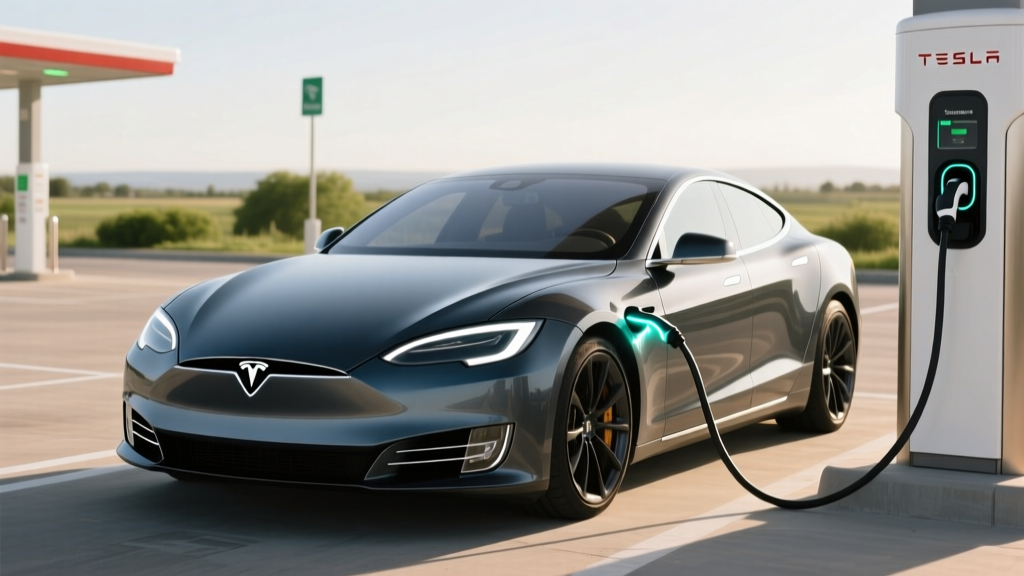
If you've ever searched "how long does a supercharger take to charge a tesla" while staring at a trip planner, you've noticed the answers online are all over the map. "15 minutes" is technically possible in a narrow slice of the charge curve; "45 minutes" is more realistic on a road trip that includes a bathroom break and a coffee. The truth depends on which Tesla you drive, which Supercharger generation you plug into, how full the battery already is, and what the battery temperature is when you arrive.
This guide gives you the exact numbers — peak kW, 10-80% times, real-world curve taper — for every current Tesla model on the 2026 Supercharger network. Then we'll zoom out to Level 2 home charging, installation costs, and the per-mile economics that decide whether Supercharging is actually cheaper than gas.
Supercharger Charging Times by Tesla Model (10–80%)
Tesla's Supercharger network in 2026 spans three relevant generations: V2 (150 kW peak), V3 (250 kW peak), and the newer V4 (up to 350 kW peak at select corridors, currently compatible at full rate only with the Cybertruck's 800V-class architecture). Most drivers will use V3 cabinets, which are now the backbone of highway corridors.
A critical concept: kW is the rate of energy flow (power), while kWh is the amount of energy stored in the battery. A 250 kW peak does not mean you charge at 250 kW the whole session — the rate tapers as the battery fills, especially above ~50% state of charge (SoC). That's why we quote 10-80% times, not "full charge" times.
| Model (2026) | Battery (usable kWh) | Peak DC kW | 10–80% Time | Miles added in 15 min |
|---|---|---|---|---|
| Model 3 Long Range RWD | ~75 kWh (LFP variant ~60) | 250 | ~25 min | ~175 mi |
| Model 3 Performance | ~75 kWh NMC | 250 | ~26 min | ~170 mi |
| Model Y Long Range AWD | ~75 kWh NMC | 250 | ~27 min | ~162 mi |
| Model Y Performance | ~75 kWh NMC | 250 | ~27 min | ~158 mi |
| Model S Long Range | ~95 kWh NMC | 250 | ~33 min | ~200 mi |
| Model S Plaid | ~95 kWh NMC | 250 | ~33 min | ~195 mi |
| Model X Long Range | ~95 kWh NMC | 250 | ~35 min | ~185 mi |
| Cybertruck AWD | ~123 kWh NMC (800V arch) | 350 (V4) | ~28 min | ~185 mi |
Why the Charge Curve Matters More Than Peak kW
Marketing materials love a big peak-kW number, but sustained charge rate is what determines your road-trip downtime. A typical V3 session on a Model Y Long Range looks roughly like this:
- 10–30% SoC: Holds near 250 kW (peak)
- 30–50% SoC: Steps down to ~180-200 kW
- 50–70% SoC: Drops to ~120-140 kW
- 70–80% SoC: Tapers to ~70-90 kW
- Above 80%: Sharply limited to protect battery longevity — charging from 80-100% can take as long as 10-80%
This is why Tesla's trip planner targets 10-80% (or less) on road trips. Charging to 100% at a Supercharger is both slow and unnecessary unless you're about to tackle a long stretch with no chargers — and Tesla discourages it with idle fees at busy stations.
All Three Charging Levels, Compared
Superchargers are only one piece of the picture. Most Tesla miles are actually charged at home, overnight, at far lower cost. Here's how the three levels stack up in 2026.
| Level | Voltage / Power | Typical kW | Miles of range per hour | Best for |
|---|---|---|---|---|
| Level 1 | 120V AC | 1.0–1.4 kW | 3–5 mi/hr | Overnight top-ups, PHEVs, emergency |
| Level 2 | 240V AC | 7.2–19.2 kW | 25–60 mi/hr | Daily home / workplace charging |
| DC Fast (Supercharger V3) | 400V+ DC | 150–250 kW | 600–1,000 mi/hr (peak) | Road trips, quick top-ups |
| DC Fast (Supercharger V4) | 800V DC | up to 350 kW | ~1,200 mi/hr (peak) | Compatible vehicles on select corridors |
For a Model Y Long Range driven 35 miles per day, a 11.5 kW home Level 2 session replenishes that in roughly 3 hours — typically while you sleep. Superchargers exist for the ~5% of miles you can't cover at home.
Home Level 2 Installation: What It Actually Costs
The single biggest variable in home charging cost isn't the charger — it's whether your electrical panel can handle a new 240V circuit. Here's the realistic breakdown for a 2026 Tesla Wall Connector install on a 60A breaker (48A continuous, ~11.5 kW).
| Line item | Typical range | Notes |
|---|---|---|
| Tesla Wall Connector hardware | $420–$475 | 24-ft cable, NACS, Wi-Fi |
| Electrician labor (simple install) | $600–$1,400 | Short run from panel, same wall |
| Electrician labor (long/conduit run) | $1,500–$3,500 | Detached garage, underground conduit |
| Permit & inspection | $100–$350 | Varies by municipality |
| Panel upgrade (if needed) | $2,000–$4,500 | 100A → 200A service, older homes |
| Total (no panel upgrade) | $1,100–$2,200 | Most newer homes with 200A service |
| Total (with panel upgrade) | $3,200–$6,500 | Homes with 100A or near-capacity panels |
Electrical requirements for a 48A continuous charge: NEC code requires the circuit be rated 125% of continuous load, so 48A charging needs a 60A breaker with 6 AWG copper (or 4 AWG aluminum) wire on a dedicated 240V circuit. A NEMA 14-50 receptacle on a 50A breaker (40A continuous, ~9.6 kW) is a cheaper, portable-friendly alternative — but you lose ~2 kW of charge rate.
Safety and code considerations: Any 240V outlet or hardwired EVSE in a garage or outdoor location should be on a GFCI-protected breaker per NEC 2020/2023. Outdoor-rated Wall Connectors (NEMA 4) are required for exposed installations. Skip the permit to save $200 and you risk voiding homeowner's insurance coverage for any electrical fire — not worth it.
Equipment Picks: Home Chargers for Teslas (and NACS-Equipped EVs)
Since Tesla opened the North American Charging Standard (NACS) to the industry, every new EV sold in the U.S. from 2025 onward uses the same connector. That means a Tesla Wall Connector now charges a Ford, Rivian, Hyundai, or GM EV natively — no adapter required. Here are the top picks for 2026:
Tesla Wall Connector (Gen 4)
- Output: up to 11.5 kW (48A / 240V)
- Connector: NACS native, 24-ft cable
- Smart features: Wi-Fi, OTA updates, load sharing, power-sharing between two units
- Price: ~$450
- Best for: Tesla owners who want the cleanest integration
Emporia Level 2 EV Charger
- Output: up to 11.5 kW (48A)
- Connector: NACS or J1772 options
- Smart features: app scheduling, solar integration, energy monitoring
- Price: ~$400
- Best for: Budget-conscious buyers who want energy tracking
ChargePoint Home Flex
- Output: up to 12 kW (50A, adjustable down)
- Connector: NACS (2025+ models) or J1772
- Smart features: Alexa, scheduling, detailed app stats
- Price: ~$600
- Best for: Multi-EV households with non-Tesla cars
Grizzl-E Smart
- Output: up to 9.6 kW (40A)
- Connector: NACS or J1772
- Smart features: OCPP-compatible, works with utility demand-response
- Price: ~$450
- Best for: Cold climates — rated to -40°F, rugged aluminum case
Connector Compatibility: NACS, CCS, and Adapters
As of 2026, NACS is the de facto U.S. standard. Here's what fits what, and where you still need an adapter:
| Brand | Native connector | Supercharger access | Adapter needed? |
|---|---|---|---|
| Tesla (all models) | NACS | Full network | None |
| Ford (F-150 Lightning, Mustang Mach-E 2025+) | NACS | Full network | None |
| GM (Cadillac, Chevy, GMC 2025+) | NACS | Full network | None |
| Rivian (R1T, R1S 2025+) | NACS | Full network | None |
| Hyundai / Kia (2025+) | NACS | Full network | None |
| Older CCS1 EVs (2020–2024) | CCS1 | Via Magic Dock or adapter | Tesla CCS adapter (~$175) or station-side Magic Dock |
| Nissan Leaf (legacy) | CHAdeMO | Limited / none | No reliable Supercharger path |
Per Tesla's support documentation, the Tesla CCS adapter unlocks access to non-Tesla DC fast networks for Tesla vehicles, and Tesla's Magic Dock (built into select Superchargers) lets CCS-equipped non-Tesla EVs use the Supercharger network without their own adapter. For new EV buyers in 2026, just choose a NACS-native vehicle and the problem disappears.
Cost Per Mile: Supercharger vs Home vs Gas
Charging time is only half the equation — charging cost is the other. Electricity prices vary wildly by state and time-of-use, but here are representative 2026 scenarios for a Model Y Long Range (~3.6 mi/kWh, per fueleconomy.gov):
| Scenario | $/kWh | Cost per mile | Annual cost (12,000 mi) |
|---|---|---|---|
| Home Level 2, off-peak utility rate | $0.13 | $0.036 | $432 |
| Home Level 2, blended avg rate | $0.18 | $0.050 | $600 |
| Tesla Supercharger (avg U.S. 2026) | $0.32 | $0.089 | $1,068 |
| Electrify America / third-party DCFC | $0.45 | $0.125 | $1,500 |
| Gas car, 28 MPG combined @ $3.40/gal | — | $0.121 | $1,457 |
| Gas car, 22 MPG combined @ $3.40/gal | — | $0.155 | $1,855 |
The takeaway: home charging is 3–4× cheaper than gas per mile. Exclusive Supercharger use is still cheaper than a 22-MPG gas car, but roughly on par with an efficient 28-MPG hybrid. If your housing situation doesn't allow home Level 2 charging, run the numbers carefully before buying a BEV — public-only charging erodes much of the fuel-cost advantage.
Frequently Asked Questions
How much does it cost to install a home EV charger?
A straightforward Tesla Wall Connector install on an existing 200A panel typically runs $1,100–$2,200 all-in (hardware, electrician, permit). If your home has a 100A panel or is near capacity, a service upgrade to 200A adds $2,000–$4,500. Always get a load calculation from a licensed electrician before committing.
How fast will each charging level add range?
Level 1 (120V) adds about 3–5 miles per hour. Level 2 (240V, 48A) adds roughly 35–45 miles per hour on a Model Y. DC fast charging at a V3 Supercharger peaks near 1,000 miles per hour but averages ~400–600 mi/hr across a 10-80% session due to the charge curve taper.
Which connector is compatible with my EV?
Every new Tesla and most new EVs from 2025 onward use NACS natively. Older CCS1 vehicles (2020–2024 model years) can access Superchargers via Tesla's CCS adapter or stations equipped with Magic Dock. CHAdeMO vehicles (Nissan Leaf) have no practical Supercharger path.
How much does charging cost per mile vs gas?
Home charging averages $0.04–$0.05 per mile; Supercharging averages ~$0.09/mile. A comparable 25-MPG gas car at $3.40/gallon costs ~$0.14/mile. Home charging delivers the biggest savings — typically $1,000–$1,400 per year vs gas at 12,000 miles annually.
What electrical upgrades might I need?
If your panel is 100A or has little spare capacity, expect a 200A service upgrade ($2,000–$4,500). Homes with 200A panels and spare breaker slots typically need only a new 60A breaker and a wire run. A licensed electrician should perform a NEC Article 220 load calculation — don't guess based on panel age alone.
Does charging to 100% at a Supercharger take much longer?
Yes. The 80–100% portion can take as long as the entire 10–80% session because the battery management system limits current to protect cell health. For road trips, plan stops around 10–80% and only charge to 100% when you're parked overnight at home or at a destination charger.
Are there any federal incentives for home charger installation?
The IRS §30C Alternative Fuel Vehicle Refueling Property Credit offers up to $1,000 (30% of cost) for home charger hardware and installation, subject to income limits and census-tract eligibility rules that favor rural and low-income areas. Confirm eligibility with a tax professional before filing.