Why Businesses Are Adding Tesla Supercharger Stations
The Tesla Supercharger network has grown past 65,000 connectors globally, and a significant share of new sites are hosted by commercial properties — hotels, retail centers, restaurants, and office parks. For business owners, the question is no longer whether EV charging draws customers, but how to evaluate the Supercharger for business features Tesla offers and whether hosting a station pencils out financially.
This guide breaks down the charging fundamentals any site host or EV-curious business owner needs: the three charging levels and their real-world speeds, the electrical infrastructure required, connector compatibility across today's EVs, equipment picks, per-mile charging economics, and the safety codes that govern commercial installations. Whether you're evaluating a Tesla Destination Charger, a full Supercharger host agreement, or a third-party DC fast-charging site, the electrical and economic principles are the same.
Charging Levels Explained: Speeds in kW and Miles Per Hour
The most common mistake in EV charging discussions is confusing kW (kilowatts, the rate of power delivery) with kWh (kilowatt-hours, the amount of energy stored in a battery). Think of kW as the speed of water flowing from a hose and kWh as the size of the bucket you're filling. A 72 kWh battery charged at 11.5 kW takes roughly 6.5 hours from empty; that same battery at 150 kW DC fast charging can reach 80% in about 25 minutes.
| Level | Voltage / Phase | Power (kW) | Miles of Range Added Per Hour | Typical Use Case |
|---|---|---|---|---|
| Level 1 | 120V / Single | 1.0 – 1.4 kW | 3 – 5 mi/hr | Overnight trickle; PHEV top-ups |
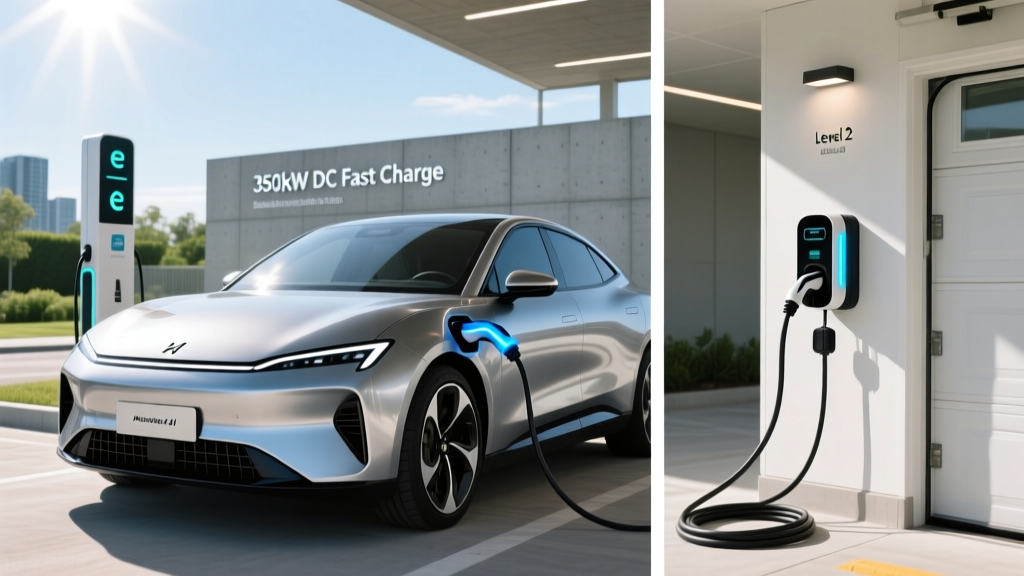
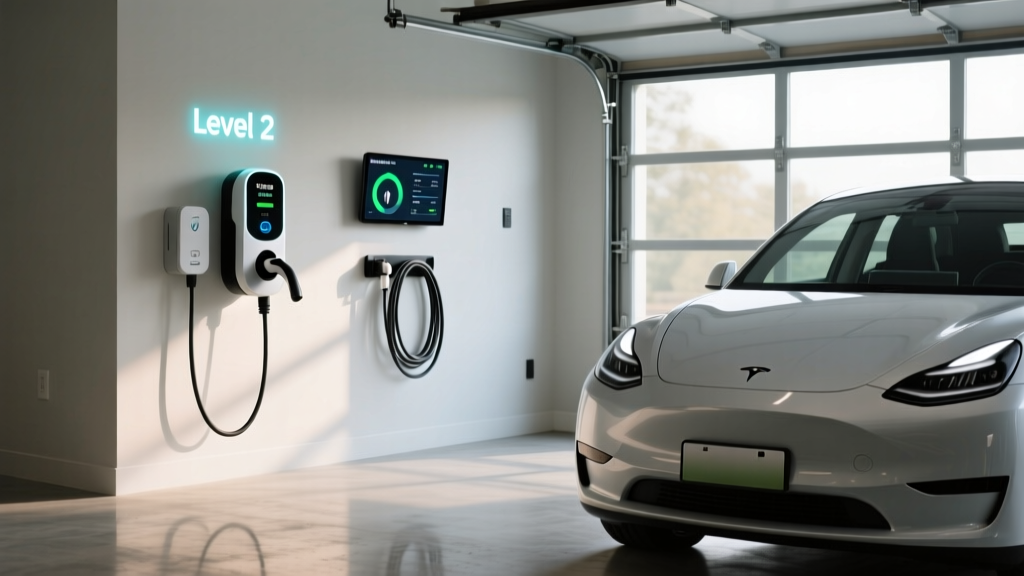
| Level 2 | 240V / Single | 7.2 – 19.2 kW | 25 – 75 mi/hr | Home daily charging; workplace; hotels; Destination Charging |
| DC Fast Charge | 400V–800V / DC | 50 – 350 kW | 150 – 1,000+ mi/hr (peak) | Road-trip stops; Supercharger stations; retail fast-charge hubs |
Real-world caveat: DC fast-charging speeds are peak rates, not sustained. Most EVs taper charge speed significantly above 80% State of Charge (SoC) to protect battery health. A vehicle advertising "250 kW peak" may sustain that rate only between 10–40% SoC, then step down to 100 kW, then 50 kW. This is why manufacturers quote 10–80% charge times rather than 0–100%.
Tesla Supercharger Hosting: What the Business Gets
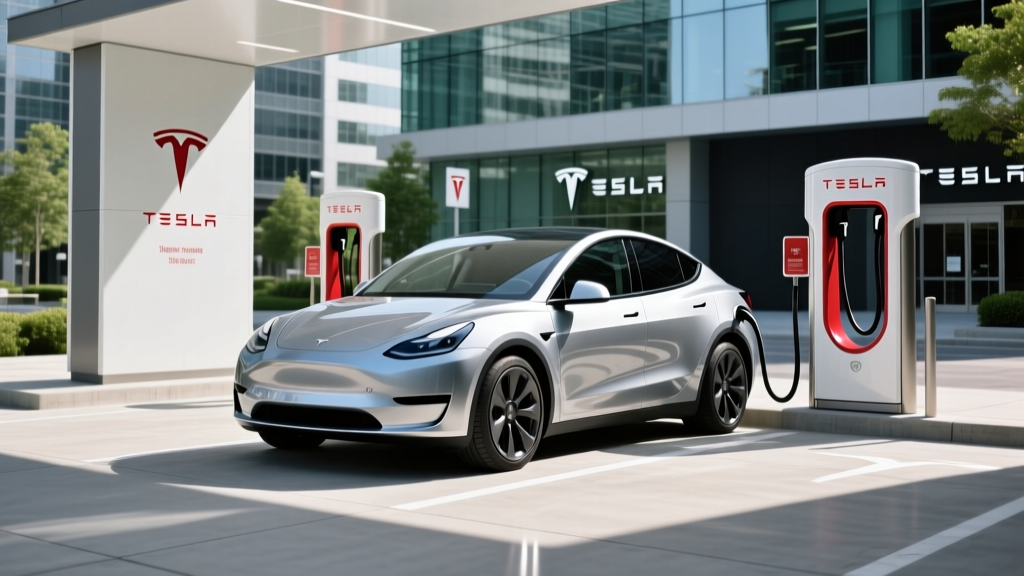
When a business partners with Tesla to host a Supercharger station, Tesla typically owns, installs, and maintains the charging hardware. The business provides the parking spaces, electrical capacity, and site access. In return, the property gains:
- High-visibility EV traffic: Supercharger sites are hard-coded into Tesla navigation and visible to every Tesla driver planning a route.
- Destination Charging integration: Many hosts also install Level 2 Tesla Wall Connectors (up to 11.5 kW / 48A) for overnight guests or longer-stay customers.
- NACS ecosystem access: As of 2025–2026, Ford, GM, Rivian, Volvo, Polestar, and others have adopted the North American Charging Standard (NACS) connector, meaning a Supercharger site now serves most new EVs on the road, not just Teslas.
- Revenue share or lease terms: Specific financial arrangements vary by site and are governed by private agreement with Tesla — hosts should consult legal and tax professionals before signing.
For businesses evaluating alternatives, third-party networks like Electrify America, EVgo, and ChargePoint offer similar host models with CCS1 and NACS connectors. The electrical requirements and cost structures described below apply broadly regardless of network.
Electrical Requirements and Installation Cost Breakdown
A commercial EV charging installation is fundamentally an electrical infrastructure project. The cost and complexity depend on available panel capacity, distance from the utility transformer, and local code requirements.
Typical Electrical Specifications
- Level 2 (single charger): 240V, 40A–80A dedicated circuit; requires 50A–100A breaker depending on continuous-load derating (NEC requires circuits rated at 125% of continuous load).
- DC Fast Charger (single pedestal): 480V three-phase service, 100A–400A; most commercial sites require a dedicated transformer.
- Supercharger V4 site (4–8 stalls): 480V three-phase, 600A–1,200A service; may require utility-side upgrades including new transformer or switchgear.
Panel Upgrade Reality
Older commercial buildings with 200A–400A total service often cannot add DC fast charging without a panel upgrade to 800A–1,200A. This is the single largest variable in installation cost and can add $15,000–$60,000+ to a project. Always have a licensed electrical contractor perform a load calculation before committing to a charger spec.
| Component | Level 2 (per charger) | DC Fast Charger (per pedestal) |
|---|---|---|
| Equipment (charger unit) | $500 – $2,500 | $30,000 – $150,000 |
| Electrical materials (conduit, wire, breaker) | $500 – $2,000 | $5,000 – $25,000 |
| Electrician labor | $1,500 – $5,000 | $10,000 – $40,000 |
| Permit & inspection | $200 – $800 | $1,000 – $5,000 |
| Panel/service upgrade (if needed) | $2,000 – $8,000 | $15,000 – $60,000+ |
| Total range | $4,700 – $18,300 | $61,000 – $280,000 |
Federal incentive note: The IRS §30C Alternative Fuel Infrastructure Tax Credit offers up to 30% of qualified installation costs (capped at $100,000 per item of property for commercial installations) for charging equipment placed in service in eligible census tracts. Eligibility depends on location, prevailing-wage requirements, and specific IRS guidance — consult a tax professional and review current-year IRS publications before budgeting.
Connector Compatibility: NACS, CCS1, and CHAdeMO
The connector landscape shifted dramatically between 2023 and 2026. Tesla's NACS connector has become the dominant North American standard, but CCS1-equipped vehicles remain on the road in large numbers, and legacy CHAdeMO vehicles (notably the Nissan Leaf) still need charging access.
| Connector | Brands Using It (Native) | Adapter Needed for Supercharger? |
|---|---|---|
| NACS (Tesla) | Tesla, Ford, GM, Rivian, Volvo, Polestar, Hyundai/Kia (2025+) | No — native access |
| CCS1 | VW, BMW, Audi, Hyundai/Kia (pre-2025), Honda, Mercedes | Yes — CCS-to-NACS adapter (Magic Dock at some stations) |
| CHAdeMO | Nissan Leaf (legacy), Mitsubishi Outlander PHEV | No direct Supercharger access; use CHAdeMO networks |
For businesses hosting chargers, dual-cable pedestals (NACS + CCS1) maximize the addressable EV population. Tesla's V4 Supercharger cabinets support both connector types, and many Supercharger sites now include built-in "Magic Dock" CCS adapters at select stalls.
Charging Cost Per Mile: EV vs. Gasoline
The per-mile fuel cost advantage of EVs is one of the strongest arguments for commercial charging investment. Here's how the numbers break down across common charging scenarios for a mid-size EV averaging 3.5 miles per kWh (roughly equivalent to a Tesla Model Y or Hyundai Ioniq 5).
| Scenario | $/kWh | Cost Per Mile (EV @ 3.5 mi/kWh) | Equivalent Gas Vehicle (28 MPG @ $3.40/gal) |
|---|---|---|---|
| Home Level 2 (off-peak utility rate) | $0.08 – $0.12 | $0.023 – $0.034 | $0.121 |
| Home Level 2 (standard rate) | $0.14 – $0.18 | $0.040 – $0.051 | $0.121 |
| Public Level 2 (commercial) | $0.20 – $0.35 | $0.057 – $0.100 | $0.121 |
| DC Fast Charge (Supercharger / public) | $0.28 – $0.48 | $0.080 – $0.137 | $0.121 |
Key takeaway: Home-charged EVs cost roughly 70–80% less per mile than gasoline. Even DC fast charging at peak rates approaches or slightly exceeds gasoline cost per mile — which is why home and workplace Level 2 charging remain the economic sweet spot for daily driving, while DC fast charging serves road-trip convenience.
Equipment Recommendations: Level 2 Chargers for Business
For businesses adding Level 2 charging (hotels, workplaces, retail, restaurants), these are widely deployed, code-compliant units available in 2026:
Tesla Wall Connector (Gen 3)
- Power: 11.5 kW (48A) on 60A circuit
- Connector: NACS native; J1772 adapter included
- Cable length: 24 ft
- Smart features: Wi-Fi, OTA updates, power-sharing across up to 6 units on one circuit
- Price: ~$475 per unit
ChargePoint CT4000 (Commercial Dual-Port)
- Power: 7.2 kW (30A) per port / 6.6 kW typical
- Connector: Dual J1772 (adaptable to NACS)
- Cable length: 18–23 ft
- Smart features: Networked, RFID access, usage analytics, revenue management
- Price: ~$4,500 – $6,500 (dual-port unit)
Emporia Vue Link / Emporia Level 2
- Power: 11.5 kW (48A) on 60A circuit
- Connector: J1772 (NACS adapter available)
- Cable length: 24 ft
- Smart features: Energy monitoring, solar integration, load management
- Price: ~$600 – $800
Charging Time Examples: 10–80% for Common Battery Sizes
Below are estimated 10–80% charge times for representative EV battery sizes at different charge rates. These assume optimal battery preconditioning and moderate ambient temperature; cold batteries or high SoC taper will extend times.
- 60 kWh battery (e.g., base Tesla Model 3 RWD): Level 2 @ 11.5 kW → ~3.5 hours; DC fast @ 170 kW peak → ~22 minutes
- 82 kWh battery (e.g., Tesla Model Y Long Range): Level 2 @ 11.5 kW → ~5 hours; DC fast @ 250 kW peak → ~18 minutes
- 100 kWh battery (e.g., Ford F-150 Lightning Extended): Level 2 @ 19.2 kW → ~4 hours; DC fast @ 150 kW peak → ~38 minutes
Charge-curve reality: The 10–80% metric exists because charging speed drops sharply above 80% SoC. A vehicle that charges 10–80% in 18 minutes may need an additional 25–40 minutes to go from 80–100%. For daily use, most EV owners set a charge limit of 80% to preserve long-term battery health (particularly for NMC chemistry batteries).
Safety, Code, and Compliance Considerations
Commercial EV charger installations must comply with the National Electrical Code (NEC), local building codes, and ADA accessibility requirements. Key requirements include:
- Dedicated circuit: Each Level 2 charger requires its own dedicated branch circuit; no shared circuits with other loads.
- GFCI protection: NEC 2023+ requires Ground Fault Circuit Interrupter protection for all EVSE installations, including hardwired units.
- Outdoor rating: Outdoor chargers must carry a NEMA 4 or NEMA 4X enclosure rating for weather resistance.
- ADA compliance: Commercial sites must provide accessible charging spaces meeting ADA requirements for path width, reach range, and signage.
- Load management: Multi-charger installations should use dynamic load-sharing systems to avoid exceeding panel capacity without a service upgrade.
- Permit and inspection: All commercial EVSE installations require an electrical permit and final inspection by the local Authority Having Jurisdiction (AHJ).
Frequently Asked Questions
How much does it cost to install a home or business EV charger?
For a single Level 2 charger in a commercial setting, expect $4,700–$18,300 all-in (equipment, electrician, materials, permit). DC fast chargers range from $61,000–$280,000+ per pedestal, heavily dependent on whether a panel or service upgrade is needed. The §30C federal tax credit may offset up to 30% of qualified costs in eligible census tracts — verify current-year rules with the IRS.
How fast will each charging level add range?
Level 1 (120V) adds 3–5 miles per hour. Level 2 (240V) adds 25–75 miles per hour depending on amperage. DC fast charging adds 150–1,000+ miles per hour at peak, but sustained rates taper significantly above 80% SoC. See the charging-levels table above for exact figures.
Which connector or charger is compatible with my EV?
Check your vehicle's charge port. 2025–2026 Teslas, Fords, GMs, Rivians, and many Hyundai/Kia models use NACS natively. Most VW, BMW, and pre-2025 Hyundai/Kia models use CCS1. The Nissan Leaf uses CHAdeMO. Adapters exist for cross-compatibility, and many Supercharger stations now offer built-in CCS1 adapters (Magic Dock).
How much does charging cost per mile compared to gasoline?
Home Level 2 charging at off-peak rates costs roughly $0.02–$0.05 per mile — about 70–80% less than gasoline at $3.40/gallon in a 28 MPG vehicle. Public DC fast charging at $0.35–$0.48/kWh approaches gasoline parity at $0.08–$0.14 per mile.
What electrical upgrades might I need for a commercial charger?
Older buildings may need a panel upgrade from 200A–400A to 800A–1,200A service, particularly for DC fast charging. A licensed electrical contractor should perform a load calculation. Utility-side upgrades (new transformer, switchgear) may also be required and can add $15,000–$60,000+ to the project.
Sources: fueleconomy.gov (EPA efficiency data); IRS §30C credit guidance; manufacturer specification pages for Tesla, ChargePoint, and Emporia.