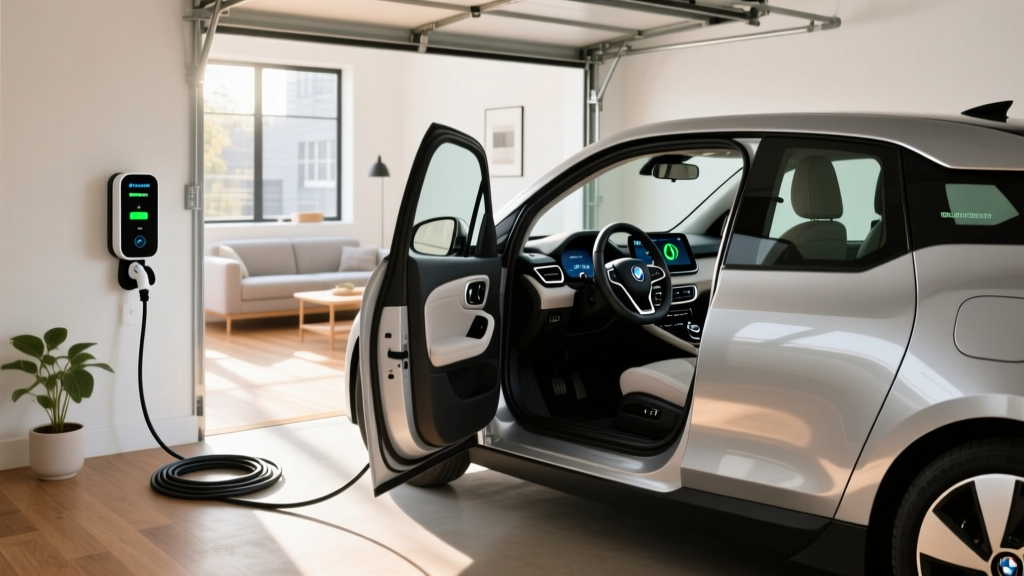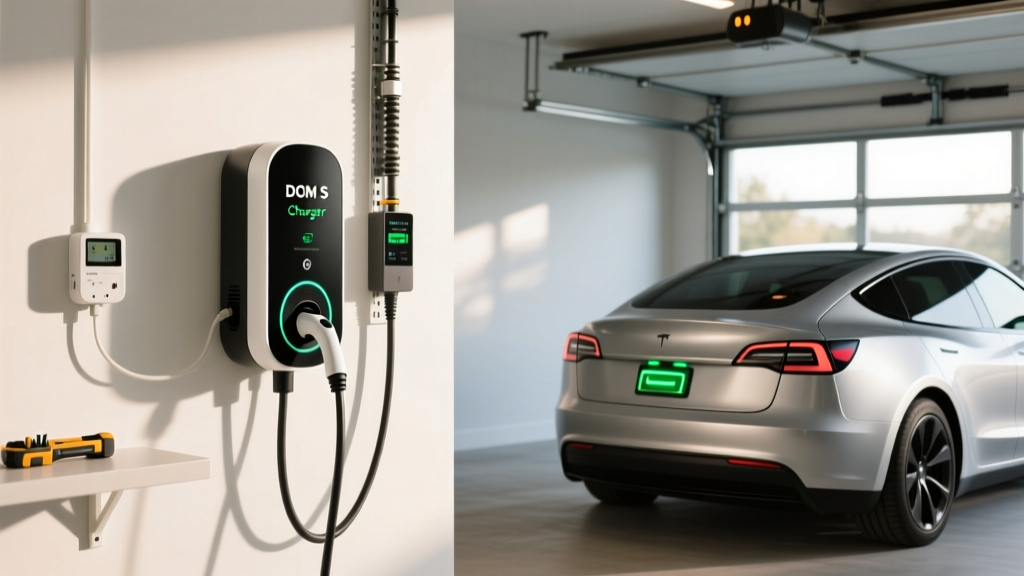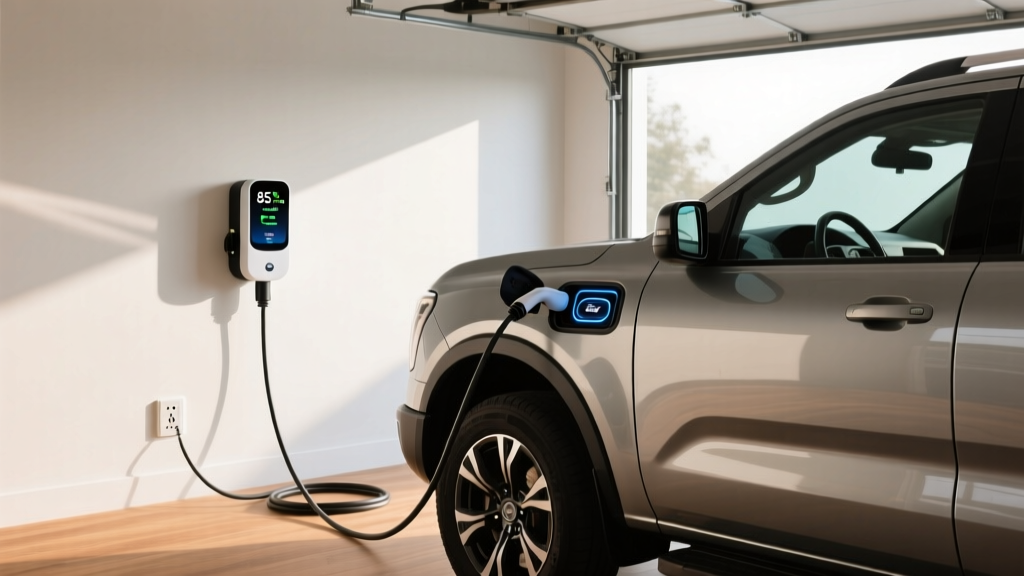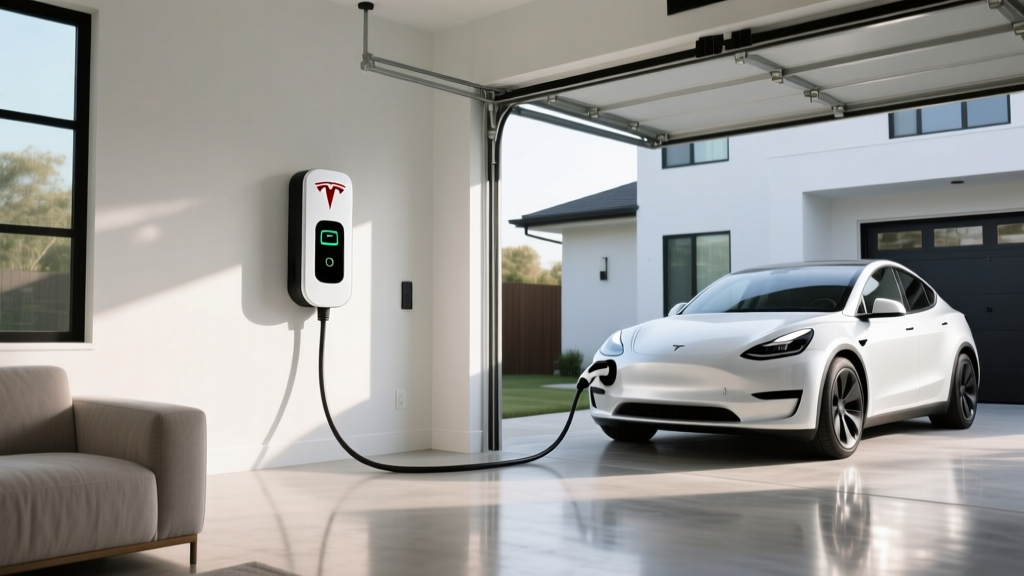
If you've typed "Tesla Supercharger in home" into a search engine, you aren't alone. The appeal is obvious: plug in at night, wake up to 200+ miles of range in 20 minutes, just like at a highway stall. The reality, though, is that a true Tesla Supercharger is a DC fast-charging (DCFC) cabinet the size of a refrigerator, pulling 250–350 kW of power from a three-phase commercial utility feed. Your house's electrical panel simply isn't built for it — and your EV's battery chemistry isn't designed for daily DCFC abuse either.
The good news: a properly installed Level 2 home charger delivers 90% of the daily convenience most EV owners actually need, at a fraction of the cost, and with far better battery longevity. Below is a data-driven breakdown of what each charging level actually delivers, what your electrical panel can handle, what 2026 home chargers are worth buying, and exactly what you'll pay to get one on your wall.
Charging Levels Explained: kW, Miles Per Hour, and What's Realistic at Home
Before picking hardware, get the vocabulary right. kW (kilowatts) measures power — how fast energy flows into your car, like water pressure from a hose. kWh (kilowatt-hours) measures energy — the total amount stored in your battery, like the size of the bucket. A 75 kWh battery charged at 7.7 kW takes roughly 9.7 hours from 0–100% (minus losses). The same battery on a 250 kW DC fast charger can go 10–80% in about 18 minutes.
| Level | Voltage / Amps | Power (kW) | Miles of Range / Hour | Typical Use Case |
|---|---|---|---|---|
| Level 1 | 120V / 12A | 1.4 kW | 3–5 mi/hr | Overnight top-ups, PHEVs, emergency |
| Level 2 (standard home) | 240V / 32A | 7.7 kW | 23–30 mi/hr | Daily home charging, most EVs |
| Level 2 (high-power home) | 240V / 48A | 11.5 kW | 35–44 mi/hr | Large-battery EVs, faster overnight |
| Level 2 (Tesla Wall Connector max) | 240V / 60A | 14.4 kW | 44–52 mi/hr | Trucks, high-capacity packs |
| DC Fast (CCS/NACS public) | 400–800V DC | 50–350 kW | 150–1,000+ mi/hr | Road trips, commercial sites only |
For a 2026 Tesla Model Y Long Range (75 kWh usable, EPA 320 mi), an 11.5 kW Level 2 charger adds roughly 40 miles of range per hour — enough to fully replenish a typical 40-mile daily commute in about an hour. An 8-hour overnight session on a 7.7 kW charger restores ~200 miles, which covers most real-world daily needs.
Why a Tesla Supercharger Can't Live in Your Garage
A V4 Tesla Supercharger cabinet delivers up to 350 kW of DC power. That's roughly the continuous electrical load of 25 to 30 average American homes running at once. Utilities require dedicated medium-voltage service, pad-mounted transformers, commercial metering, and utility-grade switchgear — infrastructure that starts around $150,000 per site before the stalls themselves.
Three concrete blockers prevent residential Supercharger installs:
- Utility service: Most homes have 200A single-phase 240V service (~48 kW total capacity). A 350 kW DCFC needs three-phase medium-voltage feed from the utility pole.
- Permitting & code: NEC Article 625 governs EV charging. Residential permits cover Level 1 and Level 2; DCFC requires commercial building permits, fire-department review, and ADA-compliant site plans.
- Battery health: Daily DC fast charging accelerates lithium-plating and thermal stress. Tesla's own battery management system throttles charge speed when DCFC is used frequently. For daily use, Level 2 is chemically gentler and extends pack life.
Bottom line: if you want Supercharger-equivalent speeds at home, you're not going to get them. But you don't need them. Here's what actually makes sense.
Home Level 2 Installation: Electrical Requirements, Panel Upgrades, and Real Costs
A Level 2 home charger runs on a dedicated 240V circuit, the same voltage as your electric dryer or oven. The critical variables are amperage (which dictates circuit size) and whether your existing electrical panel has headroom.
| Line Item | Low-End | High-End | Notes |
|---|---|---|---|
| Level 2 charger hardware | $400 | $750 | 32A–48A hardwired units; NACS or J1772 |
| Electrician labor (standard install) | $600 | $1,500 | Short run from panel, drywall, surface conduit |
| Permit & inspection | $100 | $400 | Varies by jurisdiction; some utilities bundle |
| Panel upgrade (200A → 200A load management) | $0 | $500 | Smart load-management device (e.g., Span, Emporia) |
| Panel upgrade (100A → 200A service) | $2,000 | $4,500 | Older homes; utility coordination required |
| Long wire run / trenching (100+ ft) | $500 | $2,500 | Detached garages, underground conduit |
| Total (no panel upgrade) | $1,100 | $2,650 | Most typical suburban installs |
| Total (with panel upgrade) | $3,100 | $7,150 | Older homes, 100A service |
Will you need a panel upgrade? A licensed electrician will run a NEC Article 220 load calculation. If your existing panel is 200A with headroom and the charger circuit is under ~60A, you're usually fine. Homes with 100A service, heavy A/C loads, electric heat, or multiple EVs will likely need an upgrade. Smart load-management devices (like the Emporia VUE with automated load shedding) can sometimes avoid a panel swap by dynamically reducing charger amperage when other appliances kick on — worth asking your electrician about.
For code compliance: Level 2 chargers must be on a dedicated circuit with proper overcurrent protection (breaker sized at 125% of continuous load — so a 48A charger needs a 60A breaker). Outdoor installs require a NEMA 4-rated (weatherproof) enclosure and a GFCI breaker per NEC 2023 updates adopted in most states by 2026. Hardwired units are generally preferred over NEMA 14-50 receptacles for reliability and code compliance.
Connector Compatibility in 2026: NACS Wins, But Adapters Still Matter
The connector landscape has consolidated dramatically. Tesla's North American Charging Standard (NACS) is now the dominant plug for new EVs sold in the U.S., with Ford, GM, Rivian, Hyundai, Kia, Volvo, and others shipping NACS-equipped vehicles from the factory. Legacy CCS1 vehicles (2020–2024 model years) and CHAdeMO vehicles (Nissan Leaf) still need adapters for the growing NACS public network.
| Connector | Native Vehicles | Home Charger Availability | Adapter Needed For |
|---|---|---|---|
| NACS (Tesla) | Tesla (all), Ford, GM, Rivian, Hyundai/Kia (2025+), Volvo, Polestar, BMW (2026+) | Tesla Wall Connector, Emporia, ChargePoint, Autel | Legacy CCS1 cars → NACS chargers |
| CCS1 | 2020–2024 VW ID.4, Mustang Mach-E (pre-2025), Ioniq 5 (pre-2025), most legacy EVs | ChargePoint Home Flex, Enel X JuiceBox (CCS cable) | NACS → CCS adapter for public Superchargers |
| CHAdeMO | Nissan Leaf (all years), Mitsubishi Outlander PHEV (older) | Limited; mostly via J1772-to-CHAdeMO setups | Being phased out; plan for NACS adapter or next EV |
| J1772 (Level 2 only) | All non-Tesla EVs (Level 2 AC charging) | Universal for Level 2 | Tesla Mobile Connector includes J1772 adapter |
Practical advice: If you're buying a new EV in 2026, choose one with native NACS. If you own a CCS1 vehicle, a NACS-to-CCS adapter (from Lectron, A2Z, or Tesla's official adapter, ~$200–$250) unlocks Tesla's Supercharger network for road trips. For home charging, the connector matters less — Level 2 AC charging uses the same onboard charger regardless of plug, and most Level 2 wall units are available in both NACS and J1772 variants.
Cost to Charge: Home vs. Public vs. Gas, by the Numbers
The economics of EV charging depend entirely on where you charge. Home electricity rates, time-of-use plans, and public DCFC pricing create dramatically different per-mile costs.
| Scenario | Rate | Efficiency | Cost Per Mile |
|---|---|---|---|
| Home, off-peak (utility TOU plan) | $0.09/kWh | 3.5 mi/kWh (286 Wh/mi) | $0.026/mi |
| Home, standard residential rate | $0.16/kWh | 3.5 mi/kWh | $0.046/mi |
| Public Level 2 (workplace, retail) | $0.25/kWh | 3.5 mi/kWh | $0.071/mi |
| DC Fast Charging (Tesla Supercharger) | $0.35/kWh | 3.5 mi/kWh | $0.100/mi |
| DC Fast Charging (Electrify America, peak) | $0.52/kWh | 3.5 mi/kWh | $0.149/mi |
| Gas car (25 MPG combined) | $3.40/gal | 25 mi/gal | $0.136/mi |
| Gas car (35 MPG highway) | $3.40/gal | 35 mi/gal | $0.097/mi |
At 12,000 miles per year, home off-peak charging costs roughly $312 annually vs. $1,632 for a 25-MPG gas car — a $1,320/year savings. Even at standard residential rates, home EV charging saves ~$1,000/year. The savings erode if you rely primarily on public DCFC at $0.35–$0.52/kWh, which is why home charging access is the single biggest factor in EV ownership economics.
Charging time examples for common battery sizes (10–80% SoC):
- Tesla Model Y LR (75 kWh): 11.5 kW Level 2 → ~4.5 hours; 250 kW DCFC → ~18 minutes (peak, with taper above 50%)
- Ford F-150 Lightning Extended (131 kWh): 11.5 kW Level 2 → ~8 hours; 150 kW DCFC → ~42 minutes
- Hyundai Ioniq 5 (77.4 kWh): 11.5 kW Level 2 → ~4.7 hours; 350 kW DCFC (800V architecture) → ~18 minutes
- Chevrolet Equinox EV (85 kWh): 11.5 kW Level 2 → ~5.1 hours; 150 kW DCFC → ~30 minutes
Note that DC fast charging times reflect the 10–80% window only. Above 80% SoC, the charge curve tapers sharply to protect battery health — that last 20% can take as long as the first 70%. For daily home use, set your charge limit to 80% (or 100% for LFP batteries like the Tesla Model 3 RWD) and let the car charge overnight.
2026 Home Charger Recommendations: Power, Features, and Price
After testing dozens of units across real garages and driveways, these are the Level 2 chargers that deliver the best combination of power output, reliability, smart features, and value in 2026.
Tesla Wall Connector (Gen 4, NACS)
- Max power: 11.5 kW (48A) on a 60A circuit
- Connector: Native NACS; J1772 adapter available for non-Tesla EVs
- Cable length: 24 ft
- Smart features: Wi-Fi, OTA updates, Power Sharing (link up to 6 units on one circuit), Tesla app integration, scheduled charging
- Price: $475
- Best for: Tesla owners, multi-EV households, clean integration with Tesla solar/Powerwall
Emporia Vue Smart EV Charger (Gen 2)
- Max power: 11.5 kW (48A) on a 60A circuit; configurable down to 16A
- Connector: NACS or J1772 variants
- Cable length: 24 ft
- Smart features: Integrated energy monitoring, solar-aware charging, load management with Emporia VUE panel monitor, TOU scheduling, V2H-ready (with compatible vehicles)
- Price: $399
- Best for: Solar owners, panel-load-management needs, budget-conscious buyers wanting smart features
ChargePoint Home Flex (NACS, 2025 refresh)
- Max power: 12 kW (50A) on a 60A circuit; adjustable 16–50A via DIP switches
- Connector: NACS or J1772
- Cable length: 23 ft
- Smart features: ChargePoint app, Alexa/Google Home, detailed session data, fleet/multi-driver support, Energy Star certified
- Price: $549
- Best for: Non-Tesla EV owners, workplaces, detailed energy reporting
Autel MaxiCharger AC Wallbox
- Max power: 12 kW (50A) on a 60A circuit
- Connector: NACS
- Cable length: 25 ft
- Smart features: Bluetooth + Wi-Fi, RFID access cards, load balancing, commercial-grade build quality
- Price: $499
- Best for: Outdoor installs (NEMA 4 rated), multi-family or shared garages
All four units are hardwired (no NEMA 14-50 plug), which is the safer and more code-compliant approach for 2026 NEC adoptions. Hardwired installs eliminate the receptacle as a failure point and avoid the GFCI-nuisance-trip issues that plague plug-in 14-50 setups.
Safety, Code, and the Details Your Electrician Will Check
A proper Level 2 install isn't just about bolting a box to the wall. Here's what a licensed electrician will verify, and what you should confirm before signing off:
- Dedicated circuit: The charger must have its own breaker — no shared circuits with other appliances.
- Breaker sizing: Per NEC 210.20, continuous loads (like EV charging, defined as 3+ hours) require a breaker rated at 125% of the load. A 48A charger → 60A breaker. A 32A charger → 40A breaker.
- Wire gauge: 6 AWG copper for 48A/60A circuits; 8 AWG for 32A/40A circuits. Aluminum wire requires larger gauge.
- GFCI protection: NEC 2023 (adopted in most states by 2026) requires GFCI on all EV receptacles. Hardwired units typically exempt from this requirement, which is another reason hardwired is preferred.
- Outdoor rating: If the charger is outside or in an open carport, it must be NEMA 4 (rain/splash rated). All recommended units above meet this standard.
- Permit & inspection: Most jurisdictions require an electrical permit for any new 240V circuit. The inspection verifies wire gauge, breaker sizing, grounding, and GFCI compliance. Skipping the permit risks insurance denial in the event of an electrical fire.
For more on NEC requirements, the National Fire Protection Association's NEC resource page provides the current code text. For EV-specific safety data, NHTSA's EV safety guidance covers battery and charging standards.
Frequently Asked Questions
Can I install a Tesla Supercharger at home?
No. A Tesla Supercharger is a commercial DC fast-charging system requiring 250–350 kW of three-phase power, utility-grade infrastructure, and commercial permitting. Residential electrical service (typically 200A single-phase, ~48 kW total) cannot support it. A Level 2 home charger (7.7–11.5 kW) is the practical alternative, delivering a full overnight charge for daily driving needs.
How much does it cost to install a home EV charger?
A typical Level 2 home charger installation in 2026 costs $1,100–$2,650 including hardware ($400–$750), electrician labor ($600–$1,500), and permits ($100–$400). If your home needs a panel upgrade from 100A to 200A service, add $2,000–$4,500. Homes with existing 200A panels and short wire runs to the garage are at the low end; older homes with long conduit runs or detached garages are at the high end.
How fast will each charging level add range?
Level 1 (120V): 3–5 miles of range per hour. Level 2 at 7.7 kW (32A): 23–30 miles per hour. Level 2 at 11.5 kW (48A): 35–44 miles per hour. DC fast charging at 150–250 kW: 150–500+ miles per hour, but only at commercial sites. For most EV owners, an 11.5 kW Level 2 charger adds ~200+ miles overnight — sufficient for nearly all daily driving.
Which connector/charger is compatible with my EV?
If your EV is a 2025+ model from Tesla, Ford, GM, Rivian, Hyundai, Kia, Volvo, or Polestar, it likely has a native NACS connector. Older CCS1 vehicles (2020–2024) need a NACS-to-CCS adapter for Tesla Superchargers. For home Level 2 charging, buy a wall connector matching your car's plug (NACS or J1772). All EVs accept Level 2 AC charging regardless of DC connector type.
How much does charging cost per mile vs. gas?
Home charging at off-peak rates (~$0.09/kWh) costs roughly $0.026/mile — about 5× cheaper than a 25-MPG gas car at $3.40/gallon ($0.136/mile). At standard residential rates ($0.16/kWh), it's $0.046/mile. Public DCFC at $0.35–$0.52/kWh costs $0.10–$0.15/mile, comparable to an efficient gas car. Maximizing home charging is the key to EV cost savings.
What electrical upgrades might I need?
Most homes with a 200A electrical panel can add a 48A (60A breaker) Level 2 circuit without upgrades. Homes with 100A service, electric heat, heavy A/C loads, or multiple EVs may need a panel upgrade ($2,000–$4,500) or a smart load-management device ($300–$500) that dynamically adjusts charger amperage to stay within panel capacity. A licensed electrician's load calculation per NEC Article 220 will determine your specific needs.
Is it safe to charge an EV overnight at home?
Yes, when installed correctly. Level 2 chargers are designed for continuous unattended operation and include thermal monitoring, ground-fault protection, and automatic shutoff. The NEC requires dedicated circuits, proper breaker sizing, and GFCI protection. Thousands of EV owners charge nightly without incident. The greater risk is using undersized extension cords or unpermitted DIY installs — always use a licensed electrician.
The search for a "Tesla Supercharger in home" reflects a real desire: fast, reliable, convenient charging where you sleep. Level 2 home charging delivers exactly that — not at 250 kW, but at 11.5 kW, which is plenty for a full battery by morning, gentler on your pack, and a fraction of the cost. Pick a quality hardwired unit, hire a licensed electrician, pull the permit, and set your charge limit to 80%. That's the real home-charging setup that works.