Tesla's rollout of V4 Supercharger cabinets capable of delivering up to 325 kW to a single vehicle has reshaped the DC fast-charging landscape. But how does that headline number translate to real-world charging sessions, and how does it stack up against a properly configured home Level 2 setup? This guide breaks down every charging tier with exact kW figures, miles-per-hour rates, installation costs, and per-mile energy expenses so you can plan your charging strategy with confidence.
Understanding kW vs kWh: The Non-Negotiable Distinction
Before comparing chargers, lock in this vocabulary: kW (kilowatts) measures power — the rate at which electricity flows into your battery, like water pressure from a hose. kWh (kilowatt-hours) measures energy — the total amount stored, like the volume of water in a bucket. A 325 kW Supercharger delivers energy at a rate of 325 kilojoules per second; a 75 kWh battery stores 75 kilowatt-hours of total energy. Confusing these two is the single most common EV literacy error. Every speed claim in this guide specifies kW for charge rate and kWh for battery capacity.
Charging Levels Explained: Speeds in kW and Miles Per Hour
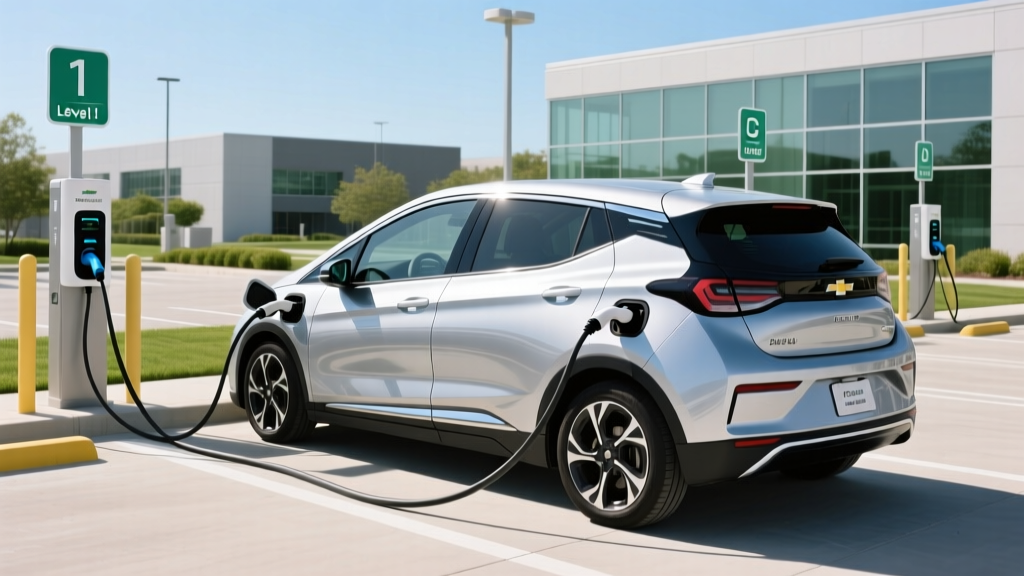
EV charging falls into three tiers. The table below assumes an average efficiency of 3.5 miles per kWh (typical for a mid-size crossover like the Tesla Model Y or Hyundai Ioniq 5).
| Level | Voltage | Power (kW) | Miles of Range Per Hour | Typical Use Case |
|---|---|---|---|---|
| Level 1 | 120V AC | 1.2–1.9 kW | 4–7 mi/hr | Overnight trickle, PHEV top-ups |
| Level 2 | 240V AC | 7.2–19.2 kW | 25–67 mi/hr | Home daily charging, workplace |
| DC Fast (CCS/NACS) | 400–800V DC | 50–325 kW | 175–1,100+ mi/hr (peak) | Road trips, rapid top-ups |
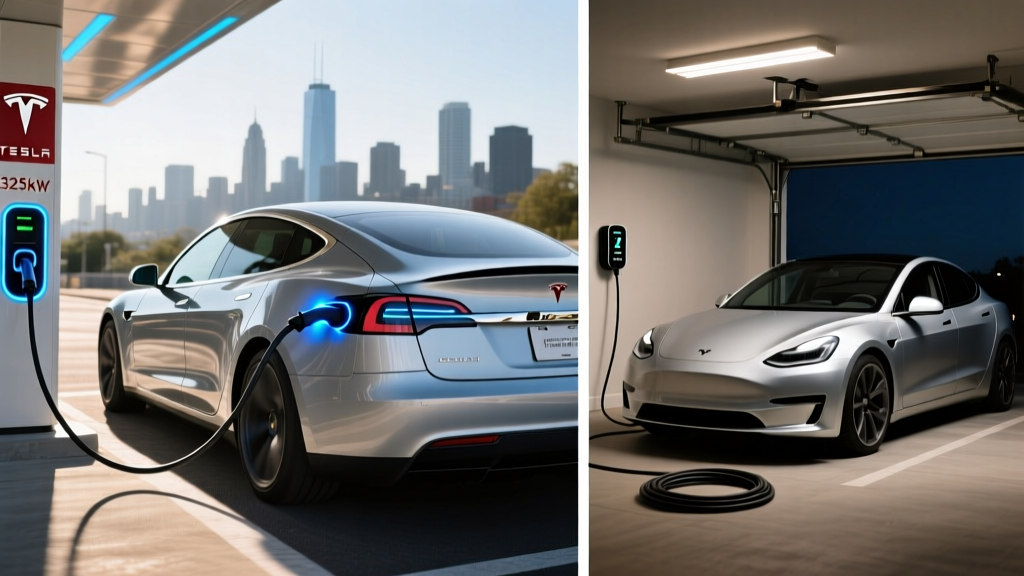
The Tesla Supercharger 325kW figure refers to V4 architecture with the newer charge-post and cabinet design. In practice, only vehicles with 800V-class battery architectures (such as the Hyundai Ioniq 5, Kia EV6, Porsche Taycan, and Lucid Air) can sustain charge rates approaching this ceiling, and even then only within a narrow state-of-charge window — typically 10% to 35% SoC. Tesla's own Cybertruck, with its 800V+ pack, is one of the few Tesla-badged vehicles that can approach the 325 kW peak. Most 400V Tesla models (Model 3, Model Y) will peak around 170–250 kW on V4 hardware, tapering significantly above 60% SoC.
Charging Time Examples: 10–80% Sessions by Battery Size
Here is what 10–80% charging looks like across common battery sizes and charger types. These times assume optimal battery preconditioning and moderate ambient temperatures (65–80°F).
| Battery Size | Level 2 (11.5 kW) | DC Fast 150 kW (400V) | DC Fast 250 kW (400V) | Tesla Supercharger 325kW (800V vehicle) |
|---|---|---|---|---|
| 60 kWh (e.g., base Model 3 RWD) | ~3.6 hours | ~22 min | ~18 min | N/A (400V arch) |
| 75 kWh (e.g., Model Y Long Range) | ~4.6 hours | ~28 min | ~22 min | N/A (400V arch) |
| 77.4 kWh (e.g., Ioniq 5) | ~4.7 hours | ~18 min | ~18 min | ~14 min |
| 100 kWh (e.g., Model S, Lucid Air) | ~6.1 hours | ~37 min | ~28 min | ~20 min |
| 123 kWh (e.g., Cybertruck) | ~7.5 hours | ~45 min | ~35 min | ~22 min |
The Tesla Supercharger 325kW advantage is most pronounced on 800V vehicles with large packs. For a 77.4 kWh Ioniq 5, the difference between a 150 kW stall and a 325 kW V4 post is roughly 4 minutes on a 10–80% session — meaningful on a road trip, but not transformative for daily driving.
Home Level 2 Installation: Electrical Requirements and Costs
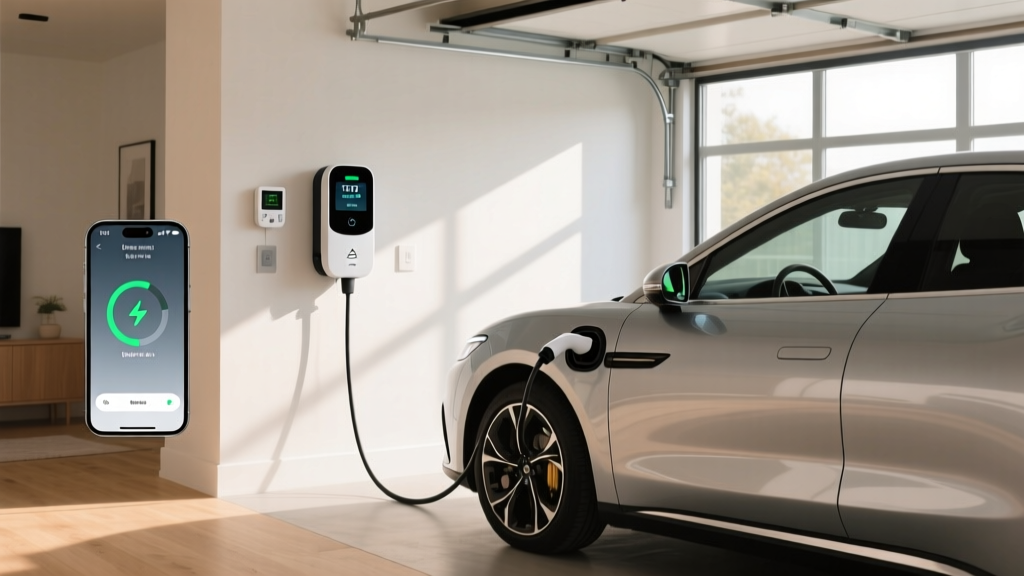
A home Level 2 charger is the backbone of practical EV ownership. Most EV owners do 80–90% of their charging at home, waking to a full battery every morning. Here is what a proper installation entails.
Electrical Requirements
A Level 2 charger requires a dedicated 240V circuit. Common configurations:
- 40A circuit / 32A continuous: Delivers 7.7 kW. Suitable for most EVs and smaller electrical panels. Uses a NEMA 14-50 outlet or hardwired connection.
- 50A circuit / 40A continuous: Delivers 9.6 kW. The sweet spot for most homes. NEMA 14-50 or hardwired.
- 60A circuit / 48A continuous: Delivers 11.5 kW. Requires a 200A+ service panel and 6 AWG copper wire. Hardwired only (NEC does not permit 60A NEMA outlets for EVSE).
- 80A circuit / 64A continuous: Delivers 15.4 kW. Requires robust panel capacity and 4 AWG wire. Overkill for most EVs, as onboard chargers cap at 11.5–19.2 kW.
Panel Upgrade Considerations
Homes with 100A service panels — common in pre-1990 construction — often lack the spare capacity for a 50A or 60A EV circuit. A panel upgrade to 200A service typically costs $1,500–$3,500. In some cases, a smart load-management device (such as the Emporia Smart Load Center or Span panel integration) can avoid a full upgrade by dynamically sharing capacity between the EVSE and other high-draw appliances.
| Cost Component | Low-End Estimate | High-End Estimate | Notes |
|---|---|---|---|
| Level 2 Charger Equipment | $350 | $750 | Varies by brand, power output, smart features |
| Electrician Labor (240V run, ~30 ft) | $600 | $1,800 | Depends on wire run length, wall/ceiling routing, conduit |
| Permit & Inspection | $50 | $300 | Municipal requirements vary; some jurisdictions waive for simple installs |
| Panel Upgrade (if needed) | $1,500 | $3,500 | 100A → 200A service upgrade |
| Total (no panel upgrade) | $1,000 | $2,850 | Most homes with 200A panels fall in this range |
| Total (with panel upgrade) | $2,500 | $6,350 | Older homes with 100A service |
The IRS §30D tax credit does not cover home charger equipment directly, but the separate Residential Clean Energy Credit (§25D) and the now-expired-but-potentially-renewed Alternative Fuel Vehicle Refueling Property Credit (§30C) have historically offered up to $1,000 for home charging equipment. Check current IRS guidance for 2026 eligibility, as these provisions are subject to legislative change and have income and census-tract requirements.
Connector Compatibility: NACS, CCS, and CHAdeMO
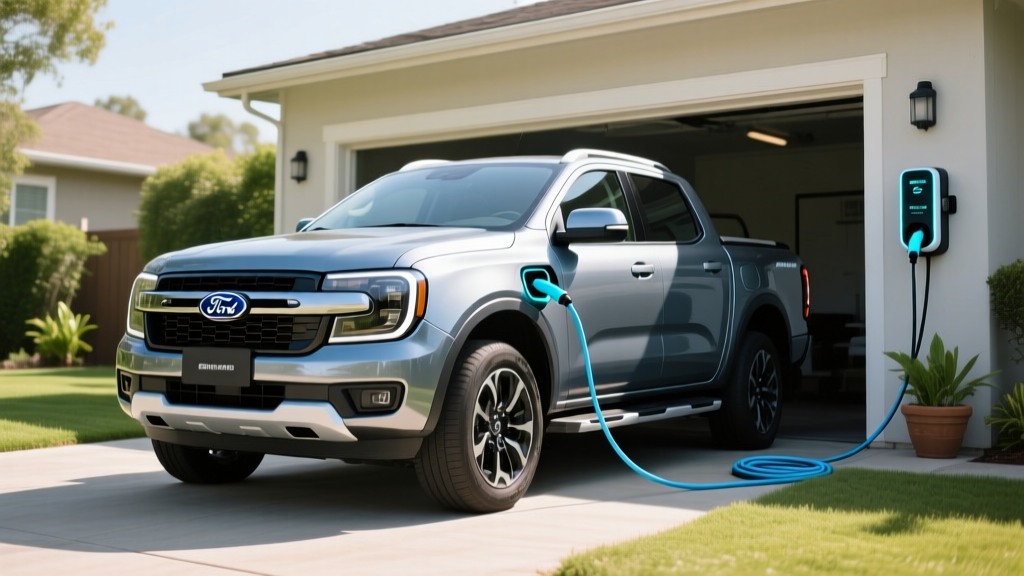
The North American Charging Standard (NACS), originally developed by Tesla, is now the dominant connector for new EVs sold in North America. By the 2026 model year, virtually all major automakers — Ford, GM, Hyundai, Kia, Rivian, BMW, Mercedes-Benz, Volvo — have adopted NACS as their native charge port. CCS1 remains on some legacy models and older vehicles still on the road, while CHAdeMO is effectively discontinued except for the Nissan Leaf, which itself is winding down production.
| Connector | Brands Using It (2026 Models) | DC Fast Max kW | Adapter Availability |
|---|---|---|---|
| NACS (Tesla) | Tesla (all), Ford, GM, Hyundai, Kia, Rivian, BMW, Volvo, Mercedes, Polestar | Up to 325 kW (V4) | N/A — native port on most new EVs |
| CCS1 | Legacy models (pre-2025 VW ID.4, older Bolt, etc.), some commercial vehicles | Up to 350 kW (Electrify America) | Tesla provides CCS-to-NACS adapter ($175); Magic Dock at some Superchargers |
| CHAdeMO | Nissan Leaf (discontinued/phase-out) | Up to 100 kW | Limited adapter options; network declining |
For Tesla Supercharger access: Tesla opened its Supercharger network to non-Tesla NACS-equipped vehicles starting in 2024, with broad access by 2025. If your EV has a native NACS port, you can plug directly into any Supercharger stall, including V4 325 kW posts. If your EV still has CCS1, you will need Tesla's CCS-to-NACS adapter or use a Supercharger station equipped with Tesla's Magic Dock (an integrated adapter built into the cable), though Magic Dock availability remains limited to select locations.
Cost to Charge: Per-Mile Breakdown vs Gasoline
The economic case for EV charging hinges on where and when you charge. Below is a cost comparison assuming an EV efficiency of 3.5 mi/kWh and a gasoline vehicle achieving 28 MPG combined at $3.40/gallon.
| Charging Scenario | Rate ($/kWh) | Cost Per Mile | Savings vs Gas (per 1,000 mi) |
|---|---|---|---|
| Home, off-peak utility rate | $0.09 | $0.026 | $95 |
| Home, average utility rate | $0.16 | $0.046 | $75 |
| Home, peak/TOU rate | $0.28 | $0.080 | $41 |
| Public Level 2 (ChargePoint, etc.) | $0.25–$0.39 | $0.071–$0.111 | $10–$50 |
| Tesla Supercharger (member rate) | $0.28–$0.36 | $0.080–$0.103 | $18–$41 |
| Tesla Supercharger (non-Tesla / peak) | $0.35–$0.48 | $0.100–$0.137 | -$16 to $21 |
| Electrify America / Ionity DC Fast | $0.38–$0.56 | $0.109–$0.160 | -$39 to $12 |
| Gasoline (28 MPG, $3.40/gal) | N/A | $0.121 | Baseline |
Home off-peak charging is the clear economic winner, delivering fuel costs roughly one-fifth that of gasoline. Public DC fast charging, particularly at peak-rate non-Tesla networks, can exceed the cost of gasoline on a per-mile basis. The Tesla Supercharger 325kW V4 stalls generally maintain competitive pricing for Tesla owners (typically $0.28–$0.36/kWh), but non-Tesla vehicles often face a surcharge unless the owner has a Tesla account with membership pricing.
Recommended Home Level 2 Equipment
Below are three proven Level 2 chargers suited to different needs. All are UL-listed and support NACS or configurable connectors.
Tesla Wall Connector (Gen 3)
- Power Output: Up to 11.5 kW (48A on 60A circuit)
- Connector: NACS native
- Cable Length: 24 ft
- Smart Features: Wi-Fi, OTA updates, load sharing between units, Powerwall integration
- Price: ~$475
- Best For: Tesla owners and NACS-equipped EVs; simplest setup with Tesla vehicles
Emporia Level 2 EV Charger
- Power Output: Up to 11.5 kW (48A on 60A circuit)
- Connector: J1772 (with NACS adapter included or available)
- Cable Length: 24 ft
- Smart Features: Energy dashboard integration, solar-aware scheduling, time-of-use optimization, load management
- Price: ~$399
- Best For: Solar owners and energy-conscious users wanting detailed consumption data
ChargePoint Home Flex
- Power Output: Up to 12 kW (50A on 60A circuit); configurable from 16A–50A
- Connector: J1772 (NACS adapter available) or NACS pigtail option
- Cable Length: 23 ft
- Smart Features: Alexa integration, ChargePoint app scheduling, flexible amperage dial
- Price: ~$699
- Best For: Multi-EV households needing flexible amperage settings and broad compatibility
Safety, Code, and Installation Best Practices
EV charging draws sustained high current for hours — a duty profile unlike most household appliances. Proper installation is non-negotiable:
- Dedicated circuit: The EVSE must be on its own breaker, never shared with other appliances. Continuous loads (defined as running 3+ hours) require the circuit to be rated at 125% of the charger's max draw — hence a 48A charger needs a 60A breaker.
- GFCI protection: NEC 2020 and later require GFCI protection for all 240V EVSE outlets (NEMA 14-50). Hardwired installations may be exempt in some jurisdictions, but GFCI breakers add a valuable safety layer.
- Outdoor rating: If your charger is mounted outside or in an unconditioned garage, ensure the unit carries a NEMA 4 or IP65 rating. The Tesla Wall Connector and ChargePoint Home Flex both meet outdoor-use standards.
- Wire gauge: 6 AWG copper for 60A circuits; 4 AWG for 80A. Aluminum wire requires upsizing. Never undersize wire — this is a fire hazard.
- Permit and inspection: Most municipalities require an electrical permit for EVSE installation. Skipping inspection may void homeowner's insurance coverage for electrical fires.
Frequently Asked Questions
How much does it cost to install a home EV charger?
Expect $1,000–$2,850 for a standard Level 2 installation in a home with an adequate 200A electrical panel. This includes the charger ($350–$750), electrician labor ($600–$1,800), and permits ($50–$300). If your home has a 100A panel and needs a service upgrade, add $1,500–$3,500, bringing the total to $2,500–$6,350.
How fast will each charging level add range?
Level 1 (120V) adds roughly 4–7 miles of range per hour. Level 2 (240V, 11.5 kW) adds approximately 40 miles per hour for an average EV. DC fast charging at a Tesla Supercharger 325kW V4 post can add up to 200+ miles in 10 minutes on an 800V vehicle, though sustained rates taper as the battery fills.
Which connector or charger is compatible with my EV?
If you purchased a 2025 or newer EV from a major automaker, it almost certainly has a NACS port and is directly compatible with Tesla Superchargers and all NACS-equipped home chargers. Older CCS1 vehicles (pre-2025) require a CCS-to-NACS adapter ($175 from Tesla or aftermarket) for Supercharger access. CHAdeMO vehicles (Nissan Leaf) have declining public charging support.
How much does charging cost per mile compared to gas?
Home charging at off-peak rates (~$0.09/kWh) costs roughly $0.026 per mile — about one-fifth the cost of gasoline at $3.40/gallon and 28 MPG ($0.121/mile). Public DC fast charging at $0.35–$0.48/kWh costs $0.10–$0.14 per mile, which can approach or exceed gasoline costs depending on your vehicle's efficiency.
What electrical upgrades might I need for a home charger?
If your home has a 100A service panel, you will likely need a panel upgrade to 200A ($1,500–$3,500) to safely support a 40A–60A EV circuit. Homes with 200A panels typically have sufficient spare capacity, though older panels with many existing high-draw circuits (electric range, dryer, HVAC) may require a load calculation by a licensed electrician. Smart load-management devices can sometimes avoid a full panel upgrade.
Can non-Tesla vehicles use the Tesla Supercharger 325kW V4 stalls?
Yes. As of 2025, Tesla has opened most Supercharger stations to non-Tesla NACS-equipped vehicles. Vehicles from Ford, GM, Hyundai, Kia, Rivian, and others with native NACS ports can plug in directly. Non-Tesla owners should create a Tesla account and enable the "Charge Your Non-Tesla" feature in the app. Pricing for non-Tesla vehicles may include a surcharge unless a membership plan is active.
Does the 325 kW peak rate apply to all vehicles at a V4 Supercharger?
No. The Tesla Supercharger 325kW peak is achievable only by vehicles with 800V-class battery architectures and compatible charge-request protocols. Most 400V vehicles (including current Model 3 and Model Y variants) will peak between 170–250 kW on V4 hardware. The charge rate also depends on battery temperature, state of charge, and ambient conditions. Always precondition your battery before a fast-charging session.
For the most current data on vehicle efficiency and range, consult fueleconomy.gov, the EPA's official source for MPGe and kWh/100mi ratings. For Supercharger station locations and real-time pricing, the Tesla app and in-vehicle navigation remain the authoritative sources. For electrical code specifics, consult a licensed electrician in your jurisdiction — local amendments to the NEC can affect permit requirements, GFCI rules, and allowable wire types.