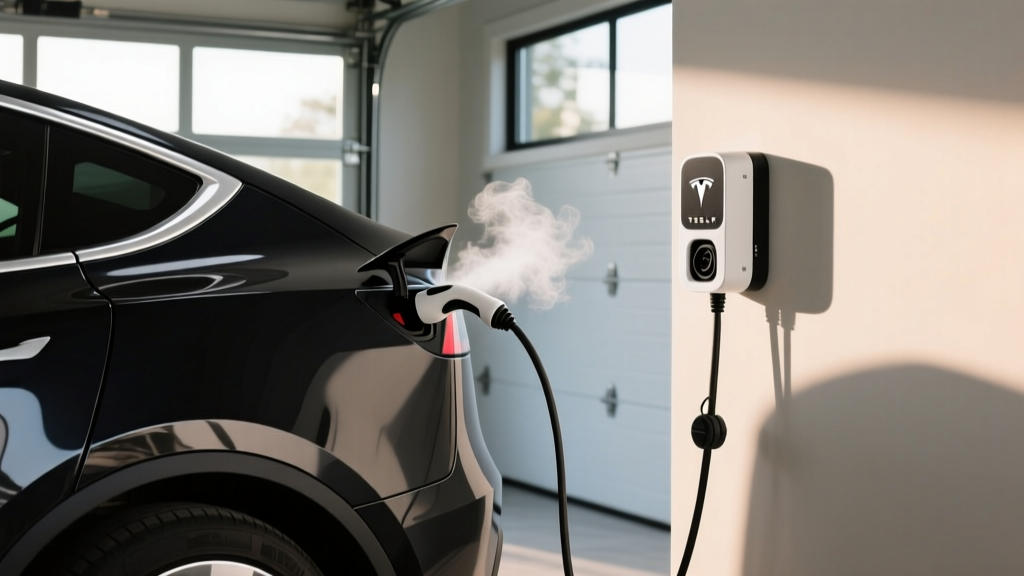
If you've walked out to your Tesla during a fast-charge session or a hot-weather Level 2 top-up and noticed wisps of vapor rising from the front hood or undercarriage, you're not alone. "Tesla steaming while charging" is one of the most searched owner concerns — and in most cases, it's the thermal management system doing exactly what it was designed to do. But not all vapor is benign, and understanding the difference between normal battery preconditioning and a genuine coolant issue can save you a costly service visit.
This guide breaks down why Teslas (and other EVs) emit steam during charging, when you should be concerned, and how to set up a reliable home charging system that minimizes thermal stress on your battery pack — including exact costs, electrical requirements, and equipment picks for 2026.
Why Your Tesla Steams While Charging
Modern Teslas — including the Model 3, Model Y, Model S, and Model X — use an active liquid thermal management system to keep the high-voltage battery pack within an optimal temperature window (roughly 68°F–95°F / 20°C–35°C). During charging, especially DC fast charging at rates up to 250 kW (V3 Supercharger) or 325 kW (V4 Supercharger), the battery generates substantial heat. The cooling system circulates a glycol-water coolant mixture through cold plates bonded to the battery cells.
Here's where the "steam" comes from:
- Condensation evaporation: When the cold plates chill below the ambient dew point, moisture condenses on the undercarriage and battery enclosure. As the system heats up during charging, that moisture evaporates as visible vapor — especially on cool, humid mornings or evenings.
- Coolant loop heat rejection: The radiator and front-end heat exchangers reject battery heat into the ambient air. On hot days or during sustained high-power charging, the thermal system works aggressively, and water that has collected on the radiator fins can flash to steam.
- HVAC compressor operation: Teslas run the A/C compressor to cool the battery during Supercharging. The compressor and associated lines can produce condensation that vaporizes as components warm.
How Charging Level Affects Battery Heat (and Steam)
The harder you push electrons into the battery, the more heat is generated. Understanding the three charging levels helps explain why steaming is most common during DC fast charging.
| Level | Voltage / Amperage | Power (kW) | Miles of Range Added per Hour | Typical Heat Output |
|---|---|---|---|---|
| Level 1 (120V) | 120V / 12A | ~1.4 kW | 3–5 mi/hr | Minimal — rarely causes visible vapor |
| Level 2 (240V) | 240V / 32–48A | 7.7–11.5 kW | 25–44 mi/hr | Low to moderate — occasional condensation |
| DC Fast Charge | 400–800V DC | 50–325 kW | 150–1,000+ mi/hr | High — thermal system runs aggressively; steaming common |
Key distinction: kW (kilowatts) measures the rate of energy transfer — think of it as the speed of water flowing through a hose. kWh (kilowatt-hours) measures the total energy stored or delivered — the volume of water in the bucket. A 75 kWh battery charged at 11.5 kW (Level 2) from 10% to 80% takes roughly 4.5 hours. That same 10–80% session at a 250 kW Supercharger takes approximately 25–30 minutes, but generates exponentially more heat in the battery cells.
Charging Time Examples for Common Tesla Battery Sizes
Real-world charging times depend on battery chemistry, state of charge, ambient temperature, and the charging curve — peak kW rates are never sustained through the full session. Here's what to expect for current 2026 Tesla models:
- Model 3 Rear-Wheel Drive (57.5 kWh, LFP battery): 10–80% at a 250 kW Supercharger in ~25 minutes. LFP chemistry tolerates higher charge rates at elevated SoC, but peak rate is limited to ~170 kW. Level 2 (11.5 kW): ~5.5 hours from 0–100%.
- Model Y Long Range AWD (78.1 kWh, NMC battery): 10–80% at a 250 kW Supercharger in ~27 minutes. Peak rate ~210 kW tapering sharply above 60% SoC. Level 2 (11.5 kW): ~7 hours from 0–100%.
- Model S Plaid (95 kWh, NMC): 10–80% at a 250 kW Supercharger in ~30 minutes. Level 2 (11.5 kW): ~8.5 hours from 0–100%.
According to fueleconomy.gov, the 2026 Model Y Long Range achieves 122 MPGe combined (28 kWh/100 mi), while the Model 3 RWD achieves 132 MPGe combined (26 kWh/100 mi). Lower efficiency means more kWh consumed per mile — and more heat generated when replenishing those kWh at high speed.
Home Charger Installation: Electrical Requirements and Costs
If you're steaming your Tesla mostly at Superchargers and want to minimize thermal stress (and public-charging costs), a properly installed home Level 2 charger is the single best upgrade you can make. Here's what's involved electrically and financially.
Electrical Requirements
A Level 2 home charger requires a dedicated 240V circuit — the same voltage as your electric dryer or oven. Common configurations:
- NEMA 14-50 outlet: 50A breaker, delivers up to 40A continuous (9.6 kW). Most common residential setup. Suitable for Tesla Mobile Connector or Wall Connector configured to 40A.
- Hardwired 60A circuit: 60A breaker, delivers up to 48A continuous (11.5 kW). Required for maximum Tesla Wall Connector output. No outlet — wire runs directly from the breaker panel to the charger.
- Hardwired 100A circuit: For high-power chargers like the ChargePoint Home Flex (up to 80A / 19.2 kW) or future-proofing. Requires a 100A breaker and heavier gauge wire (typically 2 AWG copper).
Panel Upgrade Considerations
Most modern homes with a 200A electrical panel can accommodate a 50A or 60A EV circuit without a panel upgrade. However, if your home has a 100A panel (common in pre-1990 construction), or if your existing loads (electric range, dryer, HVAC, water heater) are already consuming most of your panel's capacity, you may need a service upgrade to 200A. This is one of the most overlooked costs in EV ownership.
A licensed electrician will perform a load calculation per NEC Article 220 to determine if your panel can handle the additional draw. If an upgrade is needed, expect:
| Component | Typical Cost Range | Notes |
|---|---|---|
| Level 2 charger equipment | $350 – $750 | Tesla Wall Connector, ChargePoint Home Flex, Emporia Level 2 |
| Electrician labor (standard install) | $500 – $1,500 | Depends on run length from panel to garage/driveway |
| Permit and inspection | $100 – $400 | Varies by municipality; some jurisdictions waive for EV |
| Electrical panel upgrade (if needed) | $1,500 – $4,000 | 100A → 200A service upgrade; includes utility coordination |
| Total (no panel upgrade) | $950 – $2,650 | |
| Total (with panel upgrade) | $2,450 – $6,650 |
The IRS §30D tax credit does not cover home charger equipment in 2026 (the residential alternative fuel infrastructure credit under §30C expired for most taxpayers), but some state and utility programs offer rebates of $250–$1,000 for Level 2 installations. Check your local utility's EV program page before purchasing.
Connector Compatibility: NACS, CCS, and Adapters
As of 2026, the North American Charging Standard (NACS) — originally Tesla's proprietary connector — has become the dominant charging connector. Most new EVs from Ford, GM, Rivian, Hyundai, Kia, and others now ship with NACS ports. CCS1 (Combined Charging System) remains on many 2023–2025 models, and CHAdeMO is effectively discontinued for new vehicles.
| Connector | Native Vehicles | Adapter Needed? |
|---|---|---|
| NACS (Tesla) | Tesla (all), Ford (2025+), GM (2025+), Rivian (2025+), Hyundai/Kia (2026+), Volvo/Polestar | No — native on most new EVs |
| CCS1 | VW ID.4 (2021–2025), older Hyundai Ioniq 5/Kia EV6, BMW i4/iX, Mercedes EQS | CCS-to-NACS adapter (~$200) needed for Supercharger access |
| CHAdeMO | Nissan Leaf (all years), Mitsubishi Outlander PHEV (older) | No widely available adapter; network declining |
For Tesla owners, the native NACS port means seamless access to the Supercharger network — over 60,000 stalls in North America as of early 2026 — without adapters. If you own a CCS-equipped EV and want Supercharger access, Tesla sells a CCS-to-NACS adapter for approximately $200 through the Tesla Shop, and third-party options from Lectron and A2Z are also available.
Cost to Charge: Home vs. Public vs. Gas
One of the strongest arguments for home Level 2 charging is cost. Here's how common scenarios compare on a per-mile basis, using the 2026 Model Y Long Range's efficiency of 28 kWh/100 miles (or 0.28 kWh/mile) as a baseline:
| Scenario | Rate ($/kWh) | Cost per Mile | Annual Cost (12,000 mi) |
|---|---|---|---|
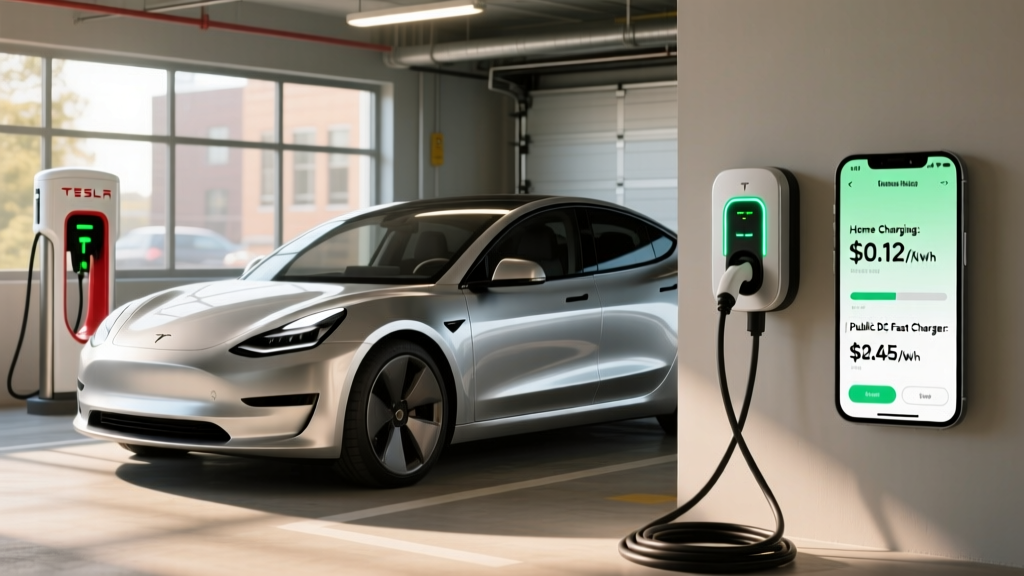
| Home off-peak (utility TOU rate) | $0.08 – $0.12 | $0.022 – $0.034 | $264 – $408 |
| Home standard rate | $0.14 – $0.18 | $0.039 – $0.050 | $468 – $600 |
| Public Level 2 (ChargePoint, EVgo) | $0.25 – $0.49 | $0.070 – $0.137 | $840 – $1,644 |
| Tesla Supercharger (V3/V4) | $0.28 – $0.42 | $0.078 – $0.118 | $936 – $1,416 |
| Gasoline (25 MPG avg, $3.50/gal) | — | $0.140 | $1,680 |
Home charging on an off-peak utility rate saves roughly $1,200–$1,400 annually versus gasoline and $500–$1,000 versus exclusive Supercharger use. Over five years, that's $6,000–$7,000 in fuel savings — more than enough to offset the cost of a home Level 2 installation even with a panel upgrade.
Recommended Home Chargers for Tesla and NACS-Equipped EVs
Here are three proven Level 2 chargers for 2026, selected for build quality, smart features, and value:
Tesla Wall Connector (Gen 4)
- Power: Up to 11.5 kW (48A hardwired)
- Connector: Native NACS, 24 ft cable
- Smart features: Wi-Fi, OTA updates, power-sharing with second unit, access control
- Price: ~$450
- Best for: Tesla-only households; cleanest integration
ChargePoint Home Flex (NACS)
- Power: Up to 19.2 kW (80A) configurable; 12 kW on 60A circuit
- Connector: NACS (2025+ model), 23 ft cable
- Smart features: Wi-Fi, Alexa, scheduling, detailed energy tracking app
- Price: ~$650
- Best for: Multi-EV households; highest power flexibility
Emporia Vue Level 2 Charger
- Power: Up to 11.5 kW (48A) on NEMA 14-50 or hardwired
- Connector: NACS or J1772, 24 ft cable
- Smart features: Wi-Fi, solar integration with Emporia Vue energy monitor, scheduling
- Price: ~$399
- Best for: Budget-conscious buyers; solar-home integration
Safety, Electrical Code, and Best Practices
EV charging places a sustained high-amperage load on your home's electrical system — unlike a dryer that cycles on and off, a Level 2 charger can draw maximum current for 6–8 hours straight. Safety and code compliance are non-negotiable:
- Dedicated circuit: NEC 625.41 requires a dedicated branch circuit for EV charging equipment. Do not share the circuit with other appliances.
- GFCI protection: NEC 2023 and later require GFCI (Ground Fault Circuit Interrupter) protection for all outdoor receptacles used for EV charging. Hardwired installations may be exempt depending on jurisdiction — confirm with your local inspector.
- Outdoor rating: If your charger is installed outdoors, it must carry a NEMA 4 or NEMA 4X rating for weather resistance. The Tesla Wall Connector and ChargePoint Home Flex are both rated for indoor/outdoor use.
- Wire gauge: A 60A circuit requires 6 AWG copper wire (THHN in conduit or NM-B Romex rated for 60°C). Undersized wire creates a fire hazard under sustained load.
- Permit and inspection: Nearly all jurisdictions require an electrical permit for EV charger installation. The inspection ensures proper grounding, breaker sizing, wire gauge, and GFCI compliance. Skipping the permit risks insurance claim denial in the event of an electrical fire.
Frequently Asked Questions
Is it normal for my Tesla to steam or emit vapor while Supercharging?
Yes. Thin, white, odorless vapor during or after a Supercharger session is almost always condensation evaporating from the battery cooling system's heat exchangers. The thermal management system works hardest during DC fast charging, and visible vapor is especially common on humid days or when ambient temperatures are cool. It typically dissipates within minutes of driving away.
When should I be concerned about steam from my Tesla?
Contact Tesla Service immediately if you notice: a sweet, syrupy odor (indicating glycol coolant leak); colored fluid pooling under the vehicle; persistent thick vapor that doesn't dissipate; or a "Coolant Level Low" alert in the Tesla app or on the touchscreen. Coolant leaks in the battery loop can lead to thermal runaway risk if left unaddressed.
How much does it cost to install a home EV charger?
A standard Level 2 installation (50A or 60A circuit, no panel upgrade) typically costs $950–$2,650 including equipment, electrician labor, and permit. If your home requires a 100A-to-200A panel upgrade, add $1,500–$4,000. Always get a load calculation from a licensed electrician before committing.
How fast will each charging level add range to my Tesla?
Level 1 (120V) adds approximately 3–5 miles of range per hour. Level 2 (240V, 48A) adds 30–44 miles per hour depending on the model. DC fast charging at a V3 Supercharger (250 kW) can add up to 200 miles in 15 minutes during the peak of the charging curve, though the rate tapers significantly above 60% state of charge.
Which connector is compatible with my Tesla?
All Tesla vehicles use the native NACS connector. The Tesla Wall Connector, Mobile Connector, and all Superchargers use NACS natively. If you need to charge at a CCS-only public station, Tesla sells a NACS-to-CCS adapter (~$250) through the Tesla Shop, though CCS-only stations are increasingly rare in 2026.
Does home charging reduce battery steaming compared to Supercharging?
Significantly. Level 2 charging at 7.7–11.5 kW generates far less heat in the battery cells than DC fast charging at 150–250 kW. The thermal management system runs at much lower capacity, and visible vapor is rare during home charging unless ambient humidity is very high. Overnight charging in cooler temperatures further reduces thermal load.
For official Tesla thermal management system documentation and service guidance, refer to your vehicle's Owner's Manual or the Tesla Owner's Manual portal. For electrical code requirements, consult the National Fire Protection Association's NEC resources and always hire a licensed electrician for installation.