Seeing smoke, steam, or vapor coming from your Tesla while it's plugged in is alarming — and it should be. While the most common explanation is harmless condensation evaporating off a warm charging cable or battery pack, actual smoke can signal an electrical fault, a damaged connector, or an overheating component that requires immediate attention. This guide walks through exactly what to do, how to diagnose the cause, and how to set up a safe, code-compliant home charging system that prevents these issues in the first place.
Is It Smoke or Steam? How to Tell the Difference
Before panicking, determine what you're actually seeing. Teslas — especially those with large 75–100 kWh battery packs — generate significant heat during DC fast charging. The thermal management system works hard to keep the battery in its optimal 20–40°C window, and that heat has to go somewhere.
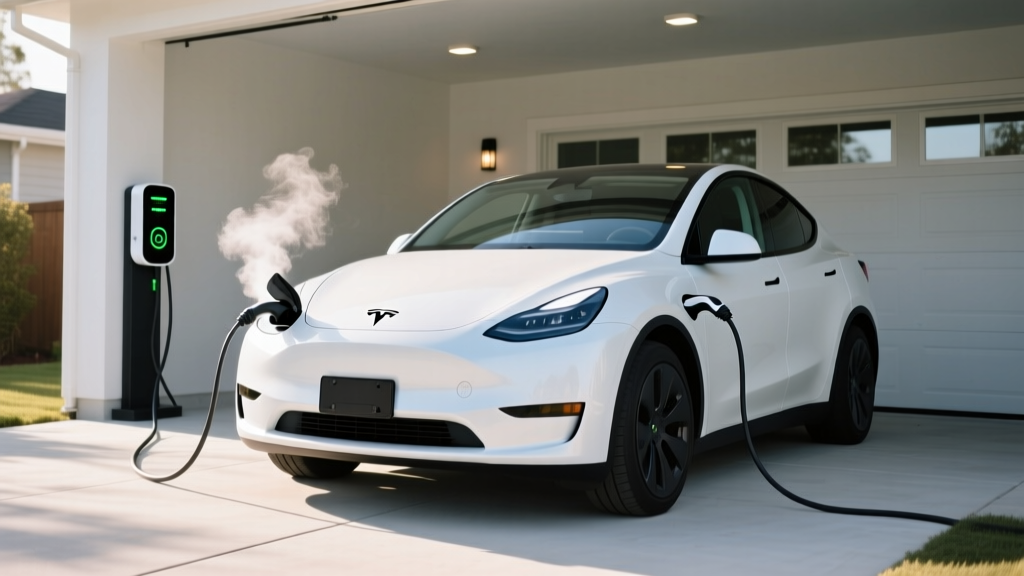
Steam (usually harmless): Thin, white, wispy vapor that dissipates quickly. Common in cold or humid weather when the battery's cooling loop warms the underside of the car. You may also see it rising from the charge port area after a high-power DC fast charge session. It smells like nothing — just water vapor.
Smoke (stop charging immediately): Thicker, gray or blue-tinged, lingers in the air, and often carries a sharp acrid or burning-plastic smell. This indicates overheating wiring, a melting connector, or an electrical arc. Unplug if safe to do so and contact Tesla Roadside Assistance or a qualified electrician.
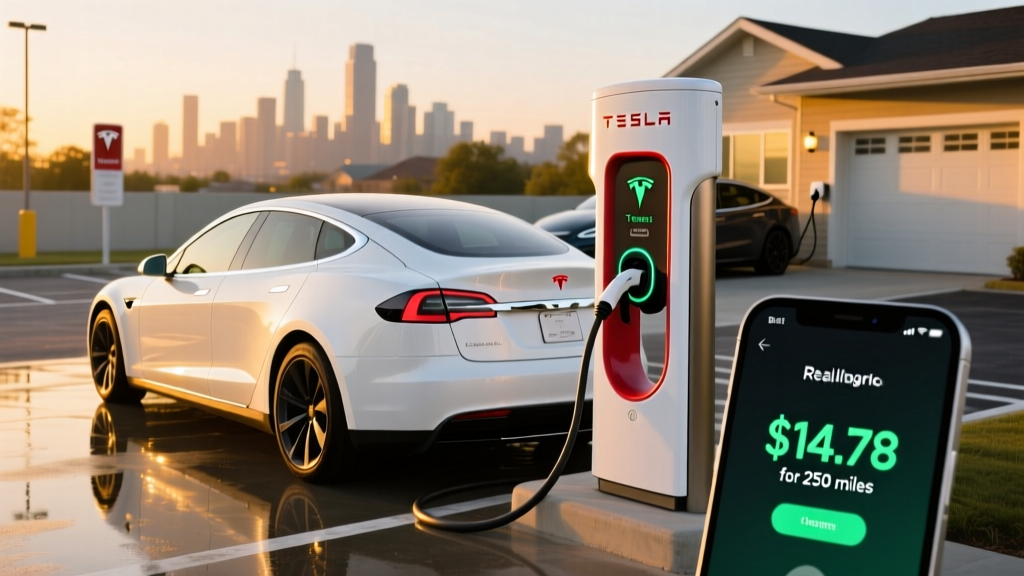
If you're DC fast charging at a Tesla Supercharger (which can deliver up to 250 kW on V3 stalls or 350 kW on newer V4 stalls), the charge port and cable can become noticeably warm. Tesla's engineering accounts for this — the liquid-cooled Supercharger cable manages heat at the connector — but ambient temperature above 95°F, a damaged cable, or debris in the charge port can push temperatures higher than expected.
Common Causes of Actual Smoke While Charging
When it is genuine smoke, these are the most likely culprits:
- Damaged or corroded charge port: Moisture intrusion, road salt, or physical damage to the NACS (North American Charging Standard) port can cause resistance heating at the pins. Inspect for discoloration, melting, or green corrosion on the contacts.
- Faulty or undersized home charging equipment: A Level 2 wall connector on a circuit that's too small, loose terminal connections at the breaker panel, or a worn-out mobile connector adapter can overheat under sustained 32–48A loads.
- Extension cord misuse: Never use an extension cord with a Tesla Mobile Connector or any EVSE. Undersized wire gauge causes voltage drop and dangerous heat buildup.
- Debris in the charge port: Leaves, dirt, or insects inside the port can smolder when the connector heats up during a charge session.
- 12V battery venting: A failing 12V lithium-ion auxiliary battery (used in 2021+ Model S/X and 2022+ Model 3/Y) can vent gas if overcharged by a DC-DC converter fault. This produces a sweet chemical smell and whitish vapor near the frunk area.
- Electrical panel or wiring fault: The issue may not be the car at all — a loose neutral, corroded bus bar, or overloaded panel can cause arcing at the EVSE circuit, producing smoke near the wall unit.
Immediate Safety Steps If You See Smoke
- Stop the charge session via the Tesla app or the vehicle's touchscreen.
- Do not touch the cable or connector if you smell burning plastic or see melting. The metal pins can exceed 200°F during a fault.
- Move away from the vehicle if smoke is thick or accompanied by a chemical smell — in rare cases, a traction battery thermal event can escalate.
- Call Tesla Roadside Assistance (1-877-798-3772) or 911 if flames appear.
- Document the incident with photos of the charge port, cable, and any visible damage for warranty or insurance claims.
Understanding EV Charging Levels: Speeds, Power, and Range Added
To prevent charging-related issues, it helps to understand exactly what's flowing into your vehicle at each level. Power is measured in kilowatts (kW) — that's the rate of energy delivery. Energy stored in the battery is measured in kilowatt-hours (kWh) — that's the total capacity. Confusing the two is the most common EV literacy mistake; think of kW as the flow rate of a hose and kWh as the size of the bucket.
| Level | Voltage | Max Power (kW) | Miles of Range Per Hour | Typical Use |
|---|---|---|---|---|
| Level 1 | 120V AC | 1.4–1.9 kW | 3–5 mi/hr | Overnight trickle; emergency top-up |
| Level 2 | 240V AC | 7.2–19.2 kW | 20–60 mi/hr | Daily home and workplace charging |
| DC Fast Charge | 400–800V DC | 50–350 kW | 150–1,000+ mi/hr | Road trips; rapid top-ups |
For a Tesla Model Y Long Range (75 kWh usable battery, EPA 310 miles), a Level 2 home charger at 11.5 kW adds roughly 44 miles of range per hour — a full overnight session easily replenishes a day's driving. On a 250 kW V3 Supercharger, that same vehicle peaks at 250 kW but sustains roughly 150–170 kW on average from 10–80%, reaching 80% in approximately 25–28 minutes. Above 80%, the charge rate tapers sharply to protect the battery cells — this is normal and built into every lithium-ion charge curve.
Home Charger Installation: Electrical Requirements and Costs
A safe, reliable home Level 2 setup starts with proper electrical infrastructure. Most Tesla owners install a 240V dedicated circuit — the same type of outlet your electric dryer uses — but at higher amperage.
| Component | Low End | High End | Notes |
|---|---|---|---|
| EVSE Equipment (Tesla Wall Connector or equivalent) | $400 | $700 | 48A units cost more; Wi-Fi-enabled models at premium |
| Electrician Labor (2–6 hours) | $400 | $1,800 | Varies by run length, conduit needs, wall material |
| Electrical Permit | $50 | $300 | Required in most jurisdictions; inspection included |
| Panel Upgrade (if needed) | $1,500 | $4,000 | 100A→200A service upgrade for older homes |
| Conduit & Wiring Materials | $100 | $500 | Longer runs from panel to garage increase cost |
| Total (no panel upgrade) | $950 | $3,300 | Most homes with 200A service fall in this range |
| Total (with panel upgrade) | $2,450 | $7,300 | Homes built before 1990 often need this |
Electrical Requirements for a Tesla Wall Connector
The Tesla Wall Connector (Gen 3) supports up to 48A continuous draw, which requires a 60A breaker on a dedicated circuit using 6 AWG copper wire (or 4 AWG aluminum). If your panel has limited capacity, you can configure the Wall Connector via its internal dip switches or software to limit draw to 32A (40A breaker, 8 AWG wire) or even 16A (20A breaker, 12 AWG wire) — still adequate for overnight charging.
Panel upgrade reality check: If your home has a 100-amp main panel and you're already running central AC, an electric oven, and a dryer, adding a 60A EV circuit may overload the panel's capacity. A licensed electrician will perform a load calculation per NEC Article 220. If you're over 80% of panel capacity, you'll need an upgrade to 200A service — or you can opt for a smart panel-level device like the SPAN smart panel or a load-management relay that throttles the charger when other circuits are drawing heavily.
Permits and Code Considerations
Most municipalities require an electrical permit for a new 240V circuit. The inspection verifies proper wire gauge, breaker sizing, torque on terminal lugs, GFCI protection (required by NEC 2020 Article 625 for outdoor outlets), and adequate grounding. Skipping the permit risks insurance denial if a fire occurs and can complicate a home sale. A NEMA 14-50 outlet installation (for a Mobile Connector) also requires a permit and should use an industrial-grade outlet (Hubbell or Bryant) — cheaper residential-grade 14-50 receptacles have been linked to overheating under sustained EV loads, as noted in discussions by the National Highway Traffic Safety Administration (NHTSA).
Charging Connectors: What Fits Your EV?
As of 2026, the connector landscape has consolidated significantly around the NACS (North American Charging Standard) — originally Tesla's proprietary connector, now adopted by Ford, GM, Rivian, Hyundai, and most major automakers.
| Connector | Type | Compatible Brands | Adapter Needed? |
|---|---|---|---|
| NACS (J3400) | AC + DC | Tesla, Ford, GM, Rivian, Hyundai, Kia, Volvo, Polestar, Mercedes | No (native on new models); CCS-to-NACS adapter for older CCS vehicles |
| CCS1 | AC + DC | Older VW, BMW, Stellantis models (pre-2025) | NACS-to-CCS adapter for Tesla Supercharger access |
| CHAdeMO | DC only | Nissan Leaf (legacy) | Limited network; no adapter to NACS/CCS widely available |
| J1772 | AC only (Level 1/2) | All non-Tesla EVs (for Level 2 public charging) | Tesla includes J1772 adapter in trunk |
If you own a Tesla, your vehicle uses NACS natively for both AC Level 2 and DC fast charging. You can access the full Tesla Supercharger network (25,000+ stalls in North America) without adapters. For non-Tesla Level 2 public chargers with J1772 connectors, Tesla includes a J1772-to-NACS adapter with every vehicle. If you own a non-Tesla EV that has switched to NACS (e.g., a 2025+ Ford Mustang Mach-E or F-150 Lightning), you can now access Tesla Superchargers using the included NACS charge port — no adapter needed.
Charging Cost: Per-Mile Economics vs. Gasoline
One of the strongest arguments for home charging is the cost advantage. Here's how real-world scenarios break down for a Tesla Model Y Long Range (averaging 3.5 miles per kWh, or roughly 121 MPGe combined per fueleconomy.gov):
| Scenario | Rate | Cost per kWh | Cost per Mile (Model Y) |
|---|---|---|---|
| Home — Off-Peak TOU Rate | $0.08–0.12/kWh | $0.10 avg | $0.029 |
| Home — Standard Residential Rate | $0.13–0.20/kWh | $0.16 avg | $0.046 |
| Public Level 2 (ChargePoint, EVgo) | $0.25–0.49/kWh | $0.35 avg | $0.100 |
| Tesla Supercharger (V3/V4) | $0.25–0.45/kWh | $0.32 avg | $0.091 |
| Gasoline Vehicle (28 MPG combined) | $3.40/gal | — | $0.121 |
At a national average residential rate of $0.16/kWh, charging at home costs roughly $0.046 per mile — about 62% less than fueling a comparable gas-powered crossover at $0.12 per mile. Over 15,000 miles per year, that's a savings of approximately $1,125. Even at public DC fast-charging rates, most EVs still undercut gasoline on a per-mile basis, though the gap narrows considerably in states with high electricity rates (California, Hawaii, parts of the Northeast) or when relying exclusively on premium-priced charging networks.
Time-of-use (TOU) plans offered by most utilities allow you to schedule charging between 10 PM and 6 AM when rates drop to $0.06–0.10/kWh. Tesla's built-in scheduled charging feature handles this automatically.
Recommended Home Charging Equipment for 2026
Here are three Level 2 home chargers we recommend based on reliability, power output, and feature set:
Tesla Wall Connector (Gen 3)
- Power: Up to 11.5 kW (48A at 240V)
- Connector: NACS (native); J1772 version also available
- Cable Length: 24 ft
- Smart Features: Wi-Fi, OTA updates, load sharing between multiple units, power-sharing with solar
- Price: $475
- Best For: Tesla owners who want seamless integration and the cleanest install
ChargePoint Home Flex
- Power: Up to 12 kW (50A at 240V), configurable down to 16A
- Connector: J1772 (NACS adapter included for Teslas)
- Cable Length: 23 ft
- Smart Features: Wi-Fi, Alexa integration, detailed energy reporting, TOU scheduling
- Price: $549
- Best For: Multi-EV households with a mix of NACS and CCS/J1772 vehicles
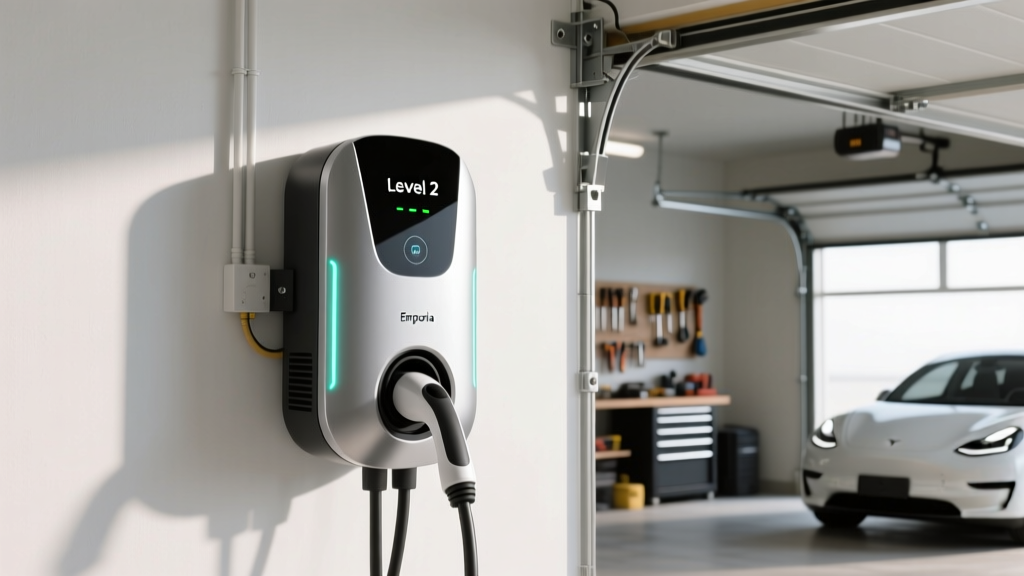
Emporia Level 2 EV Charger
- Power: Up to 11.5 kW (48A at 240V)
- Connector: J1772 (NACS adapter sold separately)
- Cable Length: 24 ft
- Smart Features: Wi-Fi, integration with Emporia home energy monitor, solar-aware charging
- Price: $399
- Best For: Budget-conscious buyers who want energy monitoring and solar integration
Preventing Charging-Related Smoke and Overheating
The vast majority of smoke incidents during charging are preventable. Follow these guidelines:
- Inspect your charge port monthly: Look for corrosion, debris, or discoloration on the pins. Use compressed air to clear dust and leaves.
- Never use extension cords: If your charger cable doesn't reach, hire an electrician to relocate the outlet or install a longer-cable EVSE.
- Use only UL-listed or ETL-certified EVSEs: Cheap, uncertified chargers from online marketplaces often lack proper thermal protection and ground-fault circuitry.
- Check your NEMA 14-50 outlet: If using a Mobile Connector with a 14-50 plug, ensure the outlet is an industrial-grade Hubbell or Bryant unit rated for continuous 40A loads. Residential-grade outlets can loosen over time and arc under sustained draw.
- Enable Tesla's charge-port temperature monitoring: The vehicle already monitors connector temperature and will throttle charge speed if it detects overheating — but if you see repeated throttling warnings on the touchscreen, have the charge port inspected.
- Schedule annual electrical inspections: Have a licensed electrician check the breaker, wiring connections, and EVSE terminal torque every 2–3 years, especially in humid or coastal climates.
Frequently Asked Questions
Is it normal for my Tesla to emit steam from underneath while Supercharging?
Yes. During DC fast charging, the battery thermal management system circulates coolant and can generate condensation on the battery pack's cooling plates. In cold or humid conditions, this moisture evaporates as visible steam. It's odorless, thin, and dissipates within seconds. This is not a cause for concern.
How much does it cost to install a home EV charger?
A typical Level 2 home charger installation costs between $950 and $3,300 when no panel upgrade is needed. This includes the EVSE unit ($400–$700), electrician labor ($400–$1,800), permit ($50–$300), and wiring materials ($100–$500). If your home needs a 100A-to-200A panel upgrade, add $1,500–$4,000 to the total.
How fast will each charging level add range to my Tesla?
Level 1 (120V) adds 3–5 miles per hour — suitable only for overnight trickle charging. Level 2 (240V, 48A) adds 35–44 miles per hour on a Model Y, fully replenishing the battery overnight. DC fast charging at 250 kW adds 200+ miles in 15 minutes, but sustained rates taper above 80% state of charge.
Which connector is compatible with my Tesla?
All Tesla vehicles use the NACS connector natively for both AC Level 2 and DC fast charging. For public Level 2 chargers with J1772 connectors, Tesla includes a J1772-to-NACS adapter with each vehicle. No adapter is needed for Tesla Superchargers.
How much does charging cost per mile compared to gas?
At the US average residential electricity rate of $0.16/kWh, a Tesla Model Y costs about $0.046 per mile to charge at home — roughly 62% less than a 28 MPG gasoline crossover at $3.40/gallon ($0.121/mile). Public DC fast charging at $0.32/kWh works out to $0.091 per mile, still cheaper than gas in most states.
What electrical upgrades might I need for a home charger?
If your home has a 200-amp electrical panel with available capacity, you likely only need a new 60A breaker and a dedicated circuit run to your garage. Homes with 100A panels, older wiring, or heavy existing loads (central AC, electric heat, dual ovens) may require a panel upgrade to 200A or 400A service, costing $1,500–$4,000. A licensed electrician will perform an NEC Article 220 load calculation to determine your exact needs.
Should I be worried about battery fire if I see smoke?
True lithium-ion battery thermal events are extremely rare — NHTSA data shows EV fires occur at a lower rate per 100,000 vehicles than gasoline vehicle fires. Most smoke incidents during charging are caused by connector overheating, debris, or wiring faults, not the battery itself. However, if smoke is thick, persistent, accompanied by a chemical smell, or if you hear popping sounds, move away from the vehicle and call 911. Tesla's battery pack includes firewalls between cell modules and a venting system designed to direct gases away from the cabin.