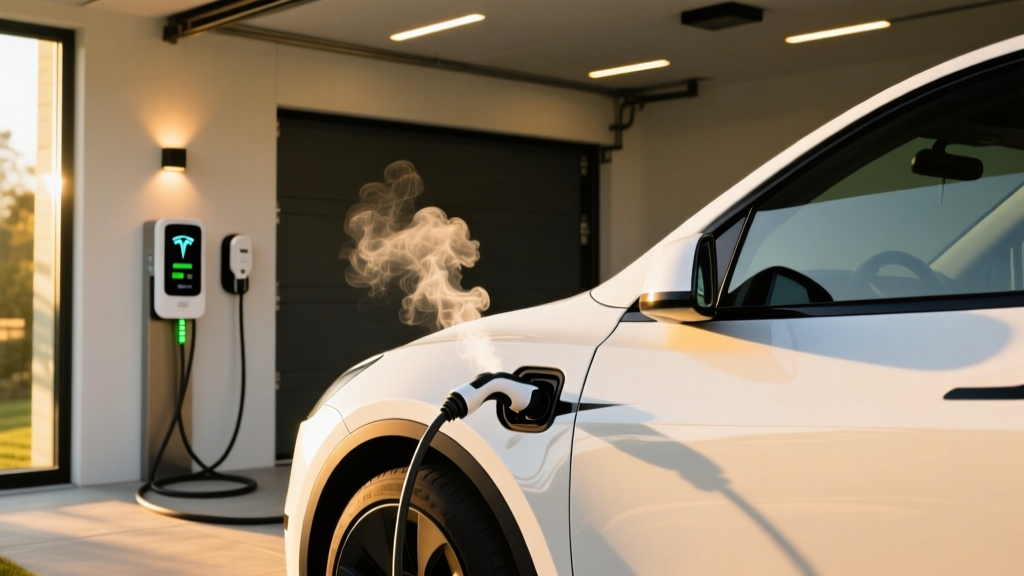
Search forums or Reddit threads for "Tesla smoke while charging" and you'll find dozens of panicked owners describing wisps of white vapor rising from their car's charge port, undercarriage, or even the charging cable itself. In most cases, what looks like smoke is actually harmless condensation or thermal-management exhaust. But in rare instances, it can signal a genuine electrical fault that demands immediate attention.
This guide breaks down exactly what causes visible vapor or smoke during Tesla charging sessions — at home or at Superchargers — and walks you through building a safe, code-compliant home charging setup that minimizes risk. We'll cover charging levels, installation costs, electrical requirements, and the specific equipment that pairs best with Tesla's NACS connector.
Why Your Tesla May Produce "Smoke" While Charging
Before calling the fire department, it's worth understanding the physics at play. Teslas use active thermal management to keep the battery pack within an optimal temperature window (roughly 68–95°F / 20–35°C). During charging — especially DC fast charging at 150–250 kW — the battery generates significant heat, and the car's cooling system works hard to dissipate it.
Harmless Causes (Condensation & Thermal Exhaust)
Battery cooling condensation: When a cold battery pack meets warm, humid ambient air, moisture condenses on the underside of the vehicle. As the thermal management system warms the pack during charging, that moisture evaporates as a thin white vapor. This is most common in early-morning charging sessions, rainy weather, or when the car has been parked in cold conditions. It typically dissipates within 5–10 minutes.
Heat pump and HVAC operation: Teslas route waste heat from the battery and drive unit through a heat pump system. During preconditioning or active charging, the HVAC compressor runs and can produce visible water vapor from the front bumper area or undercarriage drain tubes. This is normal operation.
Supercharger cable cooling: Tesla's V3 and V4 Supercharger cables use liquid cooling to handle sustained 250 kW power delivery. On cold mornings, the temperature differential between the cooled cable and ambient air can produce visible condensation along the cable or near the connector. This is by design and not a safety concern.
Concerning Causes That Require Immediate Action
Electrical arcing at the charge port: If you see smoke accompanied by a burning smell, popping sounds, or visible scorch marks on the NACS connector or charge port, stop charging immediately. Arcing can result from a damaged connector, corroded contacts, or a loose connection. Tesla's charge port includes thermal sensors that should trigger a shutdown, but failures can occur.
Home wiring or EVSE overheating: Smoke originating from your wall connector, junction box, or electrical panel is a serious fire hazard. This typically indicates an undersized circuit, loose terminal connections, degraded wire insulation, or an outlet (like a NEMA 14-50) that wasn't installed to the torque specifications required for sustained high-amperage EV charging. The National Fire Protection Association notes that EV charging circuits draw continuous loads for hours — far longer than typical household appliances — making proper installation critical.
Battery thermal runaway (extremely rare): In the unlikely event of thick, acrid smoke from the vehicle's undercarriage accompanied by rapid temperature warnings on the dashboard, evacuate the area and call 911. Lithium-ion thermal runaway events in Teslas are exceedingly rare — NHTSA data shows EV fire rates per 100,000 vehicles are significantly lower than internal combustion vehicles — but they require professional emergency response.
Charging Levels Explained: Speed, Power & Real-World Range Added
Understanding charging speeds is essential for both safety and planning. The key distinction every EV owner must internalize: kW (kilowatts) measures power — the rate at which energy flows. kWh (kilowatt-hours) measures energy — the total amount stored in your battery. Think of kW as the speed of water flowing through a hose and kWh as the total gallons in the bucket.
| Level | Voltage | Max Power (kW) | Miles of Range/Hour | 10–80% Time (75 kWh Battery) | Typical Use |
|---|---|---|---|---|---|
| Level 1 | 120V AC | 1.4–1.9 kW | 3–5 mi/hr | ~35–45 hours | Emergency / overnight trickle |
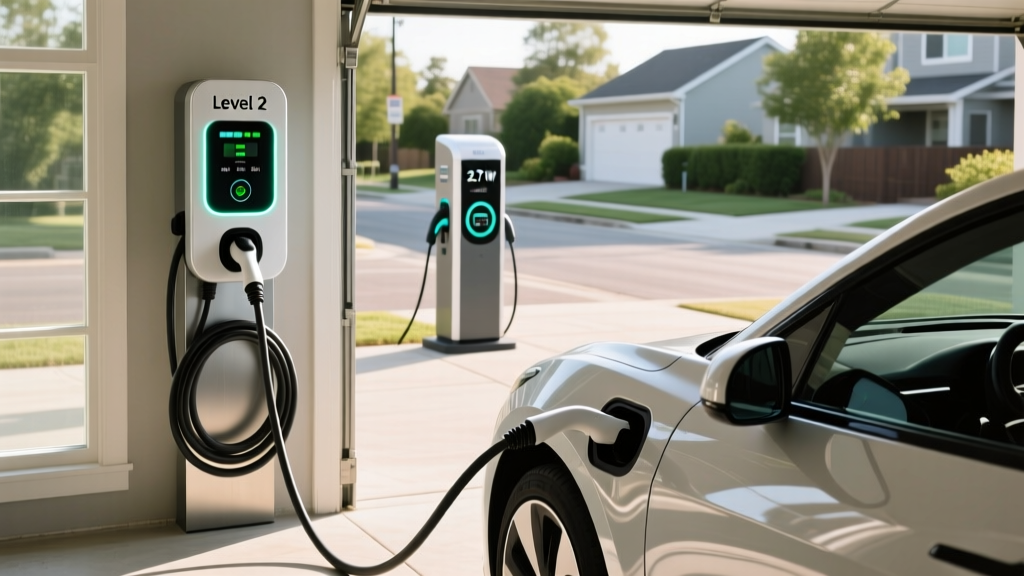
| Level 2 (Home) | 240V AC | 7.2–19.2 kW | 20–60 mi/hr | ~4–10 hours | Daily home charging |
| DC Fast Charging | 400–800V DC | 50–350 kW | 150–1,000+ mi/hr | ~15–35 minutes | Road trips / public stations |
Real-world charging curve note: Peak DC fast-charge rates (e.g., 250 kW at a Tesla V3 Supercharger) are sustained only between roughly 10–30% State of Charge (SoC). Above 50%, the charge rate tapers significantly to protect battery health. A Tesla Model Y Long Range (75 kWh usable, NMC chemistry) charging from 10–80% at a V3 Supercharger typically takes about 25–28 minutes, not the theoretical 18 minutes that peak-rate math would suggest. Always plan road-trip stops around 10–80% windows for the fastest experience.
Home Charger Installation: Electrical Requirements & Full Cost Breakdown
A safe, code-compliant Level 2 home charging station is the single most important investment for any Tesla owner. Here's what's involved electrically and financially.
Electrical Requirements
Most Tesla owners install a 240V dedicated circuit on a 60-amp breaker, which supports continuous charging at 48 amps (the National Electrical Code requires circuits to be rated at 125% of the continuous load, so 48A continuous × 1.25 = 60A breaker). This delivers up to 11.5 kW to the vehicle.
Key specifications your licensed electrician will evaluate:
- Circuit: Dedicated 60A (or 50A for 40A continuous / 9.6 kW) double-pole breaker
- Wire gauge: 6 AWG copper THHN for 60A circuits; 8 AWG for 50A
- Hardwired vs. outlet: Hardwired installations (direct wire to the EVSE) are preferred for Tesla Wall Connectors — they eliminate the NEMA 14-50 outlet failure point, which has been associated with overheating in sustained high-amperage use
- GFCI protection: NEC 2020 and later require GFCI protection for outlet-based EV charging circuits; hardwired EVSEs with built-in ground-fault protection typically satisfy this requirement
- Panel capacity: Your electrician will perform a load calculation to ensure your main panel can handle the added 48–60A continuous draw alongside existing loads
Panel Upgrade Considerations
Homes built before 2000 frequently have 100A or 125A main panels that may not support an additional 60A EV circuit, especially if you also run electric HVAC, an electric dryer, and an electric oven simultaneously. A panel upgrade to 200A typically costs $1,500–$3,500 depending on your utility and local labor rates. In some cases, a load-management device (like the Emporia Load Center or Span smart panel) can avoid a full upgrade by dynamically shedding non-essential loads during charging.
| Component | Basic Install (Near Panel) | Standard Install (Garage, 20–40 ft run) | Complex Install (Long Run + Panel Upgrade) |
|---|---|---|---|
| EVSE Equipment (e.g., Tesla Wall Connector) | $400–$500 | $400–$500 | $400–$500 |
| Electrical Materials (wire, conduit, breaker) | $100–$250 | $250–$600 | $500–$1,200 |
| Electrician Labor | $300–$600 | $600–$1,500 | $1,500–$3,000 |
| Permit & Inspection | $50–$150 | $100–$250 | $150–$350 |
| Panel Upgrade (if needed) | — | — | $1,500–$3,500 |
| Total Estimated Cost | $850–$1,500 | $1,350–$2,850 | $4,050–$8,550 |
Federal incentive note: The Residential Clean Energy Credit (IRS Form 5695) previously covered up to 30% of home EV charger equipment and installation costs (capped at $1,000). As of 2026, verify current eligibility on IRS.gov, as this credit has specific expiration and locality requirements. Some states and utilities also offer rebates — check your local utility's EV program page.
Connector Compatibility: NACS, CCS1 & Adapter Options
Tesla vehicles use the North American Charging Standard (NACS) connector — a compact, two-pin design that handles both AC Level 2 and DC fast charging through a single port. Since late 2024, nearly every major automaker has adopted NACS for their North American EVs, making it the de facto standard.
| Connector | Native Vehicles | Adapter Needed For | DC Fast Charge Availability |
|---|---|---|---|
| NACS (Tesla) | Tesla (all), Ford F-150 Lightning/Mach-E (2025+), GM Ultium (2025+), Rivian (2025+), Hyundai/Kia (2026+) | Non-Tesla CCS vehicles with NACS-to-CCS adapter | Tesla Supercharger network (20,000+ stalls), growing third-party NACS stations |
| CCS1 | VW ID.4 (pre-2026), BMW iX (pre-NACS transition), older Ford/GM EVs | Tesla CCS adapter (included with newer Teslas for non-Tesla DC charging) | Electrify America, EVgo, ChargePoint DC stations |
| CHAdeMO | Nissan Leaf (legacy) | No widely available adapter to NACS | Limited and declining network |
For Tesla owners who want to charge at non-Tesla DC fast-charging stations (Electrify America, EVgo), Tesla includes a CCS1 adapter with most new vehicles, or you can purchase one from the Tesla Shop for approximately $175–$250. This adapter enables charging at CCS1 stations at up to the vehicle's maximum acceptance rate.
Equipment Recommendations: Best Home Chargers for Tesla Owners
Not all Level 2 chargers are created equal. Here are the top options for Tesla owners in 2026, selected for reliability, safety features, and value.
Tesla Wall Connector (Gen 4)
Power Output: Up to 11.5 kW (48A) on a 60A circuit
Connector: Native NACS — no adapter needed
Cable Length: 24 ft
Smart Features: Wi-Fi connectivity, over-the-air firmware updates, Tesla app integration, power sharing (link two units on one circuit), scheduled charging, access control
Price: ~$475
Best For: Tesla-only households wanting seamless integration and the cleanest single-cable experience
ChargePoint Home Flex (NACS Version)
Power Output: Up to 12 kW (50A) on a 60A circuit; configurable down to 16A for smaller circuits
Connector: NACS (2025+ models) or J1772 with Tesla adapter
Cable Length: 23 ft
Smart Features: Alexa integration, ChargePoint app with energy tracking, flexible amperage settings, UL-listed
Price: ~$550–$650
Best For: Multi-EV households (Tesla + non-Tesla) who want flexible amperage and robust app features
Emporia Level 2 EV Charger
Power Output: Up to 11.5 kW (48A) on a 60A circuit
Connector: J1772 (use Tesla Mobile Connector adapter for NACS) or NACS version (2025+)
Cable Length: 24 ft
Smart Features: Real-time energy monitoring, solar-integration ready (pairs with Emporia Vue panel monitor), load management, budget-friendly
Price: ~$350–$400
Best For: Budget-conscious owners and solar-panel households wanting energy-usage visibility
Charging Cost Per Mile: EV vs. Gas in 2026
One of the strongest arguments for home EV charging is cost savings. Here's how the numbers break down for a Tesla Model Y Long Range (approximately 28 kWh/100 mi real-world consumption, which is quite efficient for a crossover).
| Charging / Fueling Scenario | Cost per kWh or Gallon | Cost Per Mile | Annual Cost (12,000 mi) |
|---|---|---|---|
| Home Charging (Off-Peak / Time-of-Use Rate) | $0.08–$0.14/kWh | $0.022–$0.039 | $264–$468 |
| Home Charging (Standard Residential Rate) | $0.15–$0.22/kWh | $0.042–$0.062 | $504–$744 |
| Tesla Supercharger (Average US) | $0.28–$0.38/kWh | $0.078–$0.106 | $936–$1,272 |
| Electrify America / Public DC Fast | $0.35–$0.55/kWh | $0.098–$0.154 | $1,176–$1,848 |
| Gas Vehicle (28 MPG Combined @ $3.40/gal) | $3.40/gallon | $0.121 | $1,452 |
Even at standard residential electricity rates, home-charged Tesla owners typically spend 50–70% less per mile than gas-vehicle drivers. The savings are most dramatic with time-of-use (TOU) plans that offer off-peak rates between 10 PM and 6 AM. Public DC fast charging narrows the advantage, which is why consistent home charging access remains the biggest factor in EV ownership satisfaction.
Safety & Code Considerations: Preventing Smoke, Fires & Equipment Damage
The "Tesla smoke while charging" concern is almost always preventable with proper installation and maintenance. Here are the critical safety rules:
- Always use a dedicated circuit: Never share your EV charging circuit with other appliances. A 60A EV circuit must serve only the EVSE — no splits, no downstream outlets.
- Hardwire when possible: Hardwired EVSE installations eliminate the NEMA 14-50 outlet, which has been linked to overheating in EV charging applications due to sustained high-amperage draw that residential receptacles aren't designed for. Tesla and most electricians now recommend hardwiring.
- Torque all connections to spec: Loose terminal connections at the breaker, junction box, or EVSE create resistance, which generates heat — the primary cause of electrical fires in EV charging setups. Your electrician must use a calibrated torque screwdriver.
- Outdoor-rated equipment: If your charger is mounted outdoors, ensure the EVSE carries a NEMA 4 or IP65 weather rating. The Tesla Wall Connector and ChargePoint Home Flex both carry outdoor ratings.
- Inspect connectors regularly: Check your NACS charge port and connector pins for corrosion, debris, or discoloration every few months. Clean with compressed air if needed. Damaged pins can cause arcing — a source of both smoke and fire risk.
- Never use extension cords: No extension cord — regardless of gauge — should be used between your EVSE and the vehicle. If the cable doesn't reach, move the EVSE or the car.
- Permit and inspect: Always pull an electrical permit for your EV charger installation. The inspection verifies that wire gauge, breaker sizing, grounding, and GFCI protection meet code. Unpermitted work can void your homeowner's insurance coverage in the event of a fire.
Frequently Asked Questions
Is it normal to see white vapor from my Tesla while Supercharging?
Yes, in most cases. White vapor (not thick, dark smoke) during DC fast charging is typically condensation from the battery cooling system, especially in humid or cold conditions. The Tesla thermal management system circulates coolant to regulate pack temperature, and the resulting evaporation is harmless. If the vapor has a chemical smell, is accompanied by warning lights, or persists beyond 15 minutes, stop charging and contact Tesla Service.
How much does it cost to install a home EV charger for my Tesla?
A straightforward installation near your electrical panel typically costs $850–$1,500 including the Tesla Wall Connector ($475), materials, electrician labor, and permit. A standard garage installation with a 20–40 ft wire run costs $1,350–$2,850. If your home needs a panel upgrade from 100A to 200A, total costs can reach $4,050–$8,550. Always get 2–3 quotes from licensed electricians experienced with EV charger installations.
Can I charge my Tesla on a standard 120V household outlet?
Yes, but slowly. Using the Tesla Mobile Connector with the 120V NEMA 5-15 adapter delivers approximately 1.4 kW, adding about 3–5 miles of range per hour. For a 75 kWh battery, a full charge from empty would take roughly 50+ hours. Level 1 is suitable for emergency top-ups or very low daily mileage (under 20 miles/day), but a 240V Level 2 installation is strongly recommended for regular use.
Which home charger adds range the fastest for a Tesla?
The Tesla Wall Connector on a 60A circuit delivers up to 11.5 kW (48A), adding approximately 44 miles of range per hour for a Model Y Long Range. This means an overnight 8-hour session adds roughly 350 miles — more than enough to fully replenish the battery. Charging at 48A is the fastest AC rate most Tesla vehicles support (the Cybertruck and some 2025+ models support up to 80A / 19.2 kW on compatible circuits).
What should I do if I see actual smoke (not vapor) from my Tesla or charger?
If you observe thick or dark smoke, smell burning plastic or chemicals, or hear popping/crackling sounds: (1) Stop the charging session immediately via the Tesla app or vehicle screen. (2) If safe to do so, unplug the connector from the vehicle. (3) Do NOT touch the charge port or cable if you suspect arcing. (4) If smoke is coming from the vehicle's undercarriage or battery area, move at least 30 feet away and call 911 — inform them it's an electric vehicle. (5) For charger or wiring smoke, turn off the EV circuit breaker at your panel and call your electrician.
Does my Tesla qualify for the federal EV tax credit?
As of 2026, the IRS §30D Clean Vehicle Credit offers up to $7,500 for qualifying new EVs, subject to MSRP caps ($55,000 for sedans, $80,000 for SUVs/trucks), buyer income limits ($150K single / $300K joint AGI), and battery critical-mineral and component sourcing requirements. Tesla Model Y and Model 3 trims have varying eligibility depending on battery sourcing, which changes periodically. Always verify current eligibility on the IRS Clean Vehicle Credit page and consult a tax professional before relying on the credit in your purchase decision. Point-of-sale transfer is available at participating dealers.