The Tesla Semi promises to reshape short-haul and regional freight with an advertised 500-mile range and class-leading efficiency. But for fleet operators and owner-operators evaluating the truck, the critical question isn't just range — it's Tesla Semi charge time: how quickly can a 900+ kWh battery pack replenish during a driver's mandatory rest break or between shifts at the depot?
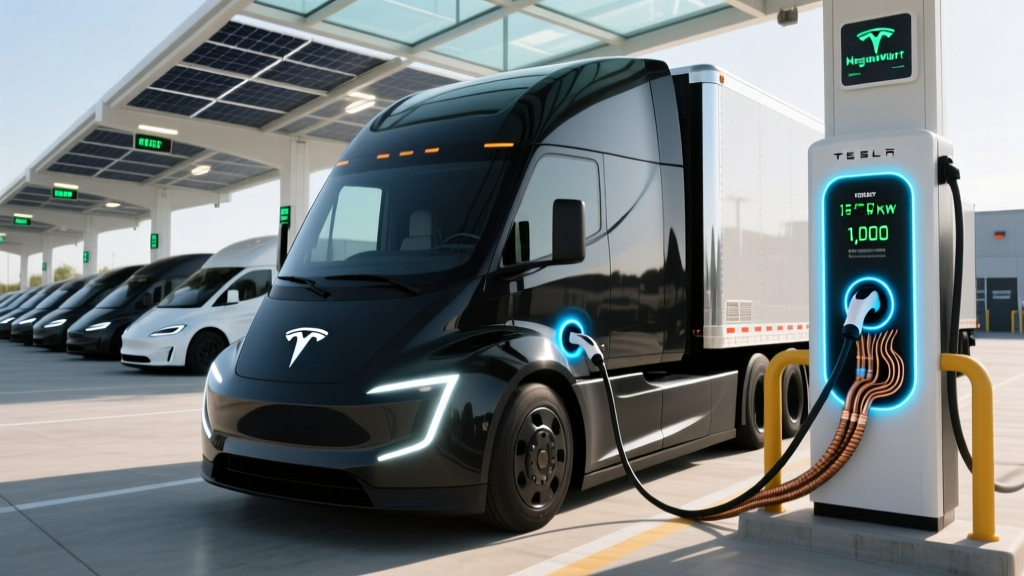
Tesla has demonstrated Megawatt Charging System (MCS) capability at its own facilities and has publicly stated that the Semi can recover up to 70% of its range in approximately 30 minutes under optimal Megawatt-class charging. But real-world charge times depend heavily on infrastructure availability, state of charge, battery temperature, and whether you're charging at a depot or on the road. Here's the data-driven breakdown.
Tesla Semi Battery and Charging Architecture
While Tesla has not published the Semi's exact usable battery capacity in an official spec sheet, industry teardowns, EPA certification filings, and Tesla's own efficiency claims (approximately 1.7 kWh per mile loaded) point to a usable pack in the 800–900 kWh range for the 500-mile variant. The 300-mile variant uses a smaller pack, estimated at roughly 500–560 kWh usable. These are NMC (nickel manganese cobalt) chemistry cells, similar to those in Tesla's Megapack stationary storage products, optimized for high cycle life and sustained high-power discharge.
The Semi uses a Megawatt Charging System (MCS) connector for its fastest charging — a standard developed by the International Organization for Standardization (ISO 15118-20) and adopted by the commercial vehicle industry. MCS connectors are rated for up to 1,250 kW (1.25 MW) at up to 1,250 volts and 1,000 amps. The Semi also supports CCS1 (Combined Charging System) via an adapter for compatibility with existing public DC fast-charging networks, though at reduced power levels.
Charging Levels Explained: What Powers a Class 8 Electric Truck
Understanding Tesla Semi charge time requires distinguishing between kW (kilowatts) — the rate of power delivery — and kWh (kilowatt-hours) — the total energy stored in the battery. A 1 MW (1,000 kW) charger delivering power for one hour would add 1,000 kWh of energy. The Semi's massive battery means even extremely high-power chargers need meaningful time to fill it.
| Level | Voltage | Max Power (kW) | Miles Added Per Hour (Semi, ~1.7 kWh/mi) | Typical Use Case |
|---|---|---|---|---|
| Level 1 (AC) | 120V | 1.4 kW | ~0.8 miles/hr | Not practical for Class 8 |
| Level 2 (AC) | 208–240V | 19.2–80 kW | ~11–47 miles/hr | Depot overnight charging |
| DC Fast (CCS1) | 400–1,000V | 150–350 kW | ~88–206 miles/hr | Public truck stops, en-route |
| Megawatt (MCS) | Up to 1,250V | 600–1,250 kW | ~353–735 miles/hr | Dedicated fleet depots, future public MCS stations |
For context, a Level 2 AC charger at 19.2 kW — common for commercial depot installations — would take approximately 42–47 hours to charge a 500-mile Semi from 10% to 80%. That's why Megawatt-class DC charging is not optional for commercial operations; it's the only viable path to same-shift turnaround.
Tesla Semi Charge Time: 10–80% Scenarios by Charger Type
Tesla's headline claim — 70% range recovered in roughly 30 minutes — aligns with sustained Megawatt-class charging at approximately 750–1,000 kW average during the bulk of the charge curve. However, as with all lithium-ion batteries, charging speed tapers significantly above 80% state of charge (SoC) to protect cell health. Here's how charge times break down by infrastructure type for the 500-mile (approximately 850 kWh usable) variant:
| Charger Type | Peak Power | Estimated Avg. Power (10–80%) | Estimated 10–80% Time | Miles Recovered |
|---|---|---|---|---|
| Megawatt (MCS) — Tesla Megacharger | ~1,000+ kW | ~750–900 kW | ~30–40 minutes | ~350 miles |
| DC Fast (CCS1) — 350 kW | 350 kW | ~250–300 kW | ~2.0–2.5 hours | ~350 miles |
| DC Fast (CCS1) — 150 kW | 150 kW | ~120–130 kW | ~4.5–5.5 hours | ~350 miles |
| Level 2 Depot (80 kW AC) | 80 kW | ~75 kW | ~8–9 hours | ~350 miles |
| Level 2 Depot (19.2 kW AC) | 19.2 kW | ~18 kW | ~33+ hours | ~350 miles |
Megawatt Charging Infrastructure: What Exists in 2026
As of 2026, Megawatt-class public charging infrastructure for heavy-duty trucks remains limited but growing. Tesla operates its own Megacharger stations at select locations, primarily along freight corridors in California and Nevada near its Gigafactory operations. The broader industry is building out MCS infrastructure through initiatives like the WattConnect project and deployments by charging networks including Electrify America and startup Terawatt Infrastructure.
For fleet operators, the most practical near-term strategy is depot-based charging — installing Level 2 AC chargers (40–80 kW per stall) or DC fast chargers (150–350 kW CCS1) at the fleet yard. This allows trucks to charge overnight during off-peak electricity rates and top up during driver breaks. The IRS §30C Alternative Fuel Vehicle Refueling Property Credit covers up to 30% of charging equipment and installation costs (capped at $100,000 per item for commercial property), which significantly offsets depot buildout expenses.
Depot Charging Installation: Electrical Requirements and Costs
Installing commercial-grade EV charging for a Tesla Semi fleet is a major electrical project. Each 80 kW Level 2 depot charger requires a dedicated 480V three-phase circuit at approximately 100 amps. A DC fast charger at 150–350 kW requires medium-voltage utility service (often 12.47 kV stepped down via a dedicated transformer) and switchgear rated for the aggregate load.
| Component | Level 2 (80 kW AC) | DC Fast (150–350 kW CCS1) |
|---|---|---|
| Charger Equipment | $15,000–$30,000 | $75,000–$150,000 |
| Electrical Panel / Transformer | $5,000–$20,000 | $30,000–$100,000 |
| Wiring, Conduit, Switchgear | $3,000–$10,000 | $15,000–$50,000 |
| Permits and Engineering | $2,000–$8,000 | $10,000–$30,000 |
| Utility Service Upgrade (if needed) | $0–$50,000 | $50,000–$300,000+ |
| Total Per Stall | $25,000–$118,000 | $180,000–$630,000 |
These costs vary enormously based on existing utility capacity at the site, trenching distance from the transformer to the charger pad, local permit requirements, and whether a utility demand-management agreement can offset infrastructure costs. Fleet operators should engage a licensed electrical contractor and their utility's commercial EV team early in the planning process.
Connector Compatibility: MCS, CCS1, and Adapter Requirements
The Tesla Semi's native charging port is MCS (Megawatt Charging System), which is physically larger than CCS1 and designed for the high-current demands of Class 8 vehicles. For compatibility with the existing CCS1 public charging network, Tesla provides or supports an adapter, though charging speed will be limited to the CCS1 charger's maximum output (typically 150–350 kW).
| Connector | Max Power | Compatibility | Notes |
|---|---|---|---|
| MCS (Megawatt) | Up to 1,250 kW | Native — built in | Required for fastest charging; limited public availability in 2026 |
| CCS1 | Up to 350 kW | Via adapter | Wider public availability; significantly slower charge times |
| CHAdeMO | Up to 62.5 kW (theoretical) | Not supported | Legacy standard; not relevant for Class 8 vehicles |
| NACS (Tesla passenger) | Up to 250 kW (V3 Supercharger) | Not compatible | NACS is designed for light-duty vehicles; insufficient power for Semi |
A critical planning note: NACS (North American Charging Standard), which Tesla uses for its passenger vehicles and which other automakers have adopted, is not designed for Megawatt-class power delivery. The Semi's MCS connector is a separate, purpose-built standard for heavy-duty applications. Fleet operators should not conflate Tesla Supercharger V3/V4 stations (NACS, up to 250–350 kW) with Megacharger infrastructure.
Cost to Charge: Electricity vs. Diesel Per Mile
The Tesla Semi's efficiency of approximately 1.7 kWh per mile (loaded, highway driving) is the baseline for calculating operating costs. Electricity rates vary dramatically by region, time of use, and whether charging occurs at a depot or public station.
| Scenario | Rate | Cost Per Mile (Semi) | Cost Per Mile (Diesel, 6.5 MPG, $4.20/gal) |
|---|---|---|---|
| Depot Off-Peak (Commercial) | $0.08–$0.12/kWh | $0.14–$0.20 | $0.65 |
| Depot On-Peak (Commercial) | $0.15–$0.25/kWh | $0.26–$0.43 | $0.65 |
| Public DC Fast (CCS1) | $0.35–$0.55/kWh | $0.60–$0.94 | $0.65 |
| Public Megawatt (MCS, future) | $0.40–$0.70/kWh (est.) | $0.68–$1.19 | $0.65 |
The economics are clear: depot charging at off-peak commercial rates delivers the lowest per-mile cost — roughly one-third to one-quarter the fuel cost of diesel. Public DC fast charging, however, can exceed diesel costs per mile, making it suitable for occasional en-route top-ups rather than primary fueling strategy. This is why nearly every fleet electrification plan centers on depot charging as the backbone.
According to fueleconomy.gov, the Tesla Semi's efficiency translates to roughly 120–130 MPGe (miles per gallon equivalent) — more than double the efficiency of a typical diesel Class 8 truck at 6–7 MPG. This efficiency advantage is what makes the per-mile electricity cost compelling even when public charging rates are high.
Equipment Recommendations for Depot Charging
For fleet operators planning Tesla Semi depot charging, the following commercial-grade charger categories represent the current market in 2026:
Level 2 AC Depot Charger (40–80 kW)
Examples: ChargePoint Express 250 (AC mode), Tritium RTM75
Power Output: 40–80 kW (480V 3-phase)
Connector: CCS1 (MCS adapter may be required)
Smart Features: Load balancing, OCPP 2.0.1 network management, RFID authentication, remote monitoring
Price Range: $15,000–$30,000 (equipment only)
Best For: Overnight depot charging; lowest-cost infrastructure per stall
DC Fast Charger (150–350 kW)
Examples: ABB Terra 360, ChargePoint Express 600, BTC Power Gen 4
Power Output: 150–360 kW (CCS1)
Connector: CCS1 (dual-cable options available)
Smart Features: Power sharing between stalls, integrated payment terminal, OCPP compliance, utility demand-response integration
Price Range: $75,000–$150,000 (equipment only)
Best For: Daytime top-up, mixed fleet operations, semi-public depot locations
Megawatt Charger (600–1,200 kW)
Examples: Tesla Megacharger (proprietary), Tritium MCS prototype, ABB Megawatt concept
Power Output: 600–1,250 kW (MCS connector)
Connector: MCS (Megawatt Charging System)
Smart Features: Fleet management API integration, battery preconditioning scheduling, grid-interactive capability
Price Range: $250,000–$500,000+ (equipment only; utility infrastructure costs additional)
Best For: High-utilization fleets requiring same-shift turnaround; future-proofing depot infrastructure
Safety, Code, and Utility Considerations
Commercial EV charging installations must comply with NFPA 70 (National Electrical Code) Article 625, which governs electric vehicle charging systems. Key requirements include:
- Dedicated circuits: Each charger must have its own dedicated branch circuit with appropriate overcurrent protection.
- GFCI protection: Ground-fault circuit-interrupter protection is required for all outdoor and accessible charging equipment.
- Outdoor rating: Outdoor chargers must carry a NEMA 3R or NEMA 4 enclosure rating for weather resistance.
- Ventilation: While EV chargers don't produce emissions, enclosed charging bays may require ventilation for thermal management of both the charger electronics and the vehicle battery during high-power sessions.
- Utility coordination: Most commercial installations exceeding 100 kW aggregate require a utility interconnection agreement, demand-charge analysis, and potentially a dedicated medium-voltage service drop.
Fleet operators should also evaluate demand charges — the utility fees based on peak power draw rather than total energy consumed. A depot with ten 80 kW chargers running simultaneously could create a 800 kW demand spike, triggering substantial monthly demand charges. Solutions include staggered charging schedules, on-site battery buffer storage (such as Tesla Megapack), and solar-canopy installations to flatten the demand curve.
Frequently Asked Questions
How much does it cost to install a Tesla Semi charger at a fleet depot?
For a single Level 2 AC depot charger (80 kW), expect total installed costs of $25,000–$118,000 including equipment, electrical work, permits, and potential utility upgrades. For a DC fast charger (150–350 kW CCS1), costs range from $180,000–$630,000 per stall. Megawatt-class chargers exceed $500,000 per stall when accounting for the substantial utility infrastructure required. The IRS §30C credit can offset up to 30% of these costs for qualifying commercial installations.
How fast will each charging level add range to the Tesla Semi?
At the Semi's efficiency of approximately 1.7 kWh per mile: Level 2 at 80 kW adds roughly 47 miles per hour; DC fast at 350 kW CCS1 adds about 206 miles per hour; and Megawatt charging at 1,000 kW adds approximately 588 miles per hour (theoretically). Real-world rates are lower due to charge-curve tapering, especially above 80% SoC.
Which connector does the Tesla Semi use?
The Tesla Semi uses the MCS (Megawatt Charging System) connector natively for its fastest charging. It can also use CCS1 via an adapter at public DC fast-charging stations, though at reduced power (up to 350 kW). The NACS connector used by Tesla passenger vehicles is not compatible with the Semi.
How much does charging a Tesla Semi cost per mile compared to diesel?
At off-peak commercial depot rates ($0.08–$0.12/kWh), the Semi costs roughly $0.14–$0.20 per mile to charge — about 70% less than diesel at $0.65/mile. However, public DC fast charging at $0.35–$0.55/kWh can cost $0.60–$0.94/mile, potentially exceeding diesel costs. Depot charging is essential for favorable economics.
What electrical upgrades might a fleet depot need for Semi charging?
Most fleet depots will need a utility service upgrade to accommodate the aggregate load of multiple high-power chargers. This can include a new medium-voltage transformer (12.47 kV to 480V), upgraded switchgear, new conduit runs, and potentially a dedicated utility feeder line. Costs for utility upgrades alone can range from $50,000 to over $300,000 depending on existing infrastructure and distance from the nearest medium-voltage line. Early engagement with the local utility is critical.
Can the Tesla Semi charge at a regular Tesla Supercharger?
No. Tesla Superchargers use the NACS connector and deliver up to 250–350 kW — designed for passenger vehicles. The Semi requires an MCS connector and far more power for practical charge times. Tesla's dedicated Megacharger stations are the Supercharger equivalent for the Semi, but availability remains limited to select corridors as of 2026.