Why Your Charging Strategy Directly Impacts Tesla Range
Your Tesla's EPA-estimated range is a starting point, not a guarantee. A 2025 Model Y Long Range carries an EPA rating of 320 miles, but real-world highway driving at 75 mph typically yields 260–285 miles, and cold-weather commutes can drop that to 220 miles or below. How you charge — the speed, the state of charge (SoC) you target daily, and the equipment you use — affects both your usable daily miles and long-term battery health.
This guide breaks down every charging tier available to Tesla owners, what home installation actually costs in 2026, which connectors and adapters you need for non-Tesla networks, and how charging expenses compare to gasoline on a per-mile basis.
Charging Levels Explained: Speeds, Power, and Real-World Range Added
The single most common confusion for new EV owners is the difference between kW (kilowatts — a measure of power, or how fast energy flows) and kWh (kilowatt-hours — a measure of energy, or how much the battery stores). Think of kW as the flow rate of a hose and kWh as the size of the bucket. A 75 kWh battery charged at 11.5 kW takes roughly 7.5 hours from empty; at 250 kW, the math is different because charge curves taper (more on that below).
| Level | Voltage / Amperage | Max Power (kW) | Miles of Range Added per Hour | Best For |
|---|---|---|---|---|
| Level 1 (Standard Outlet) | 120V / 12A | ~1.4 kW | 3–5 mi/hr | Overnight top-offs, PHEVs, low-mileage drivers |
| Level 2 (Home / Workplace) | 240V / 32–48A | 7.7–11.5 kW | 25–44 mi/hr | Daily home charging, full overnight replenishment |
| DC Fast Charging (Supercharger / public) | 400V+ DC | 150–250+ kW | 200–1,000+ mi/hr (peak) | Road trips, rapid top-ups, fleet turnaround |
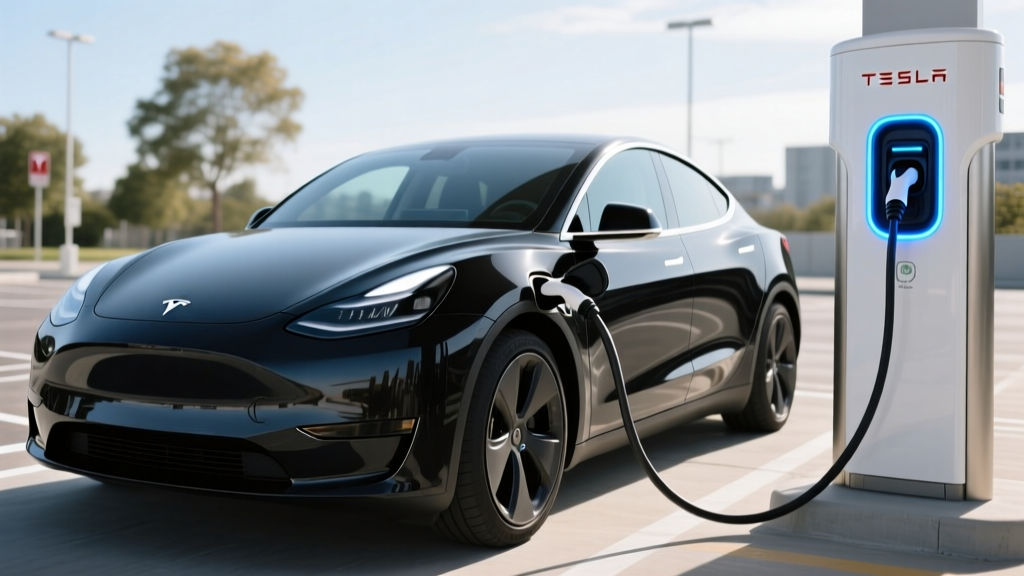
For a Tesla Model 3 Long Range (75 kWh usable battery, ~341 mi EPA), a Level 2 home charger at 11.5 kW (48A) replenishes roughly 44 miles of range per hour — enough to fully recharge overnight. On a V3 Supercharger peaking at 250 kW, that same vehicle can add approximately 200 miles in 15 minutes under ideal conditions, though the charge curve tapers significantly above 60% SoC, and a realistic 10–80% session takes about 25–28 minutes.
Home Charger Installation: Electrical Requirements, Costs, and Gotchas
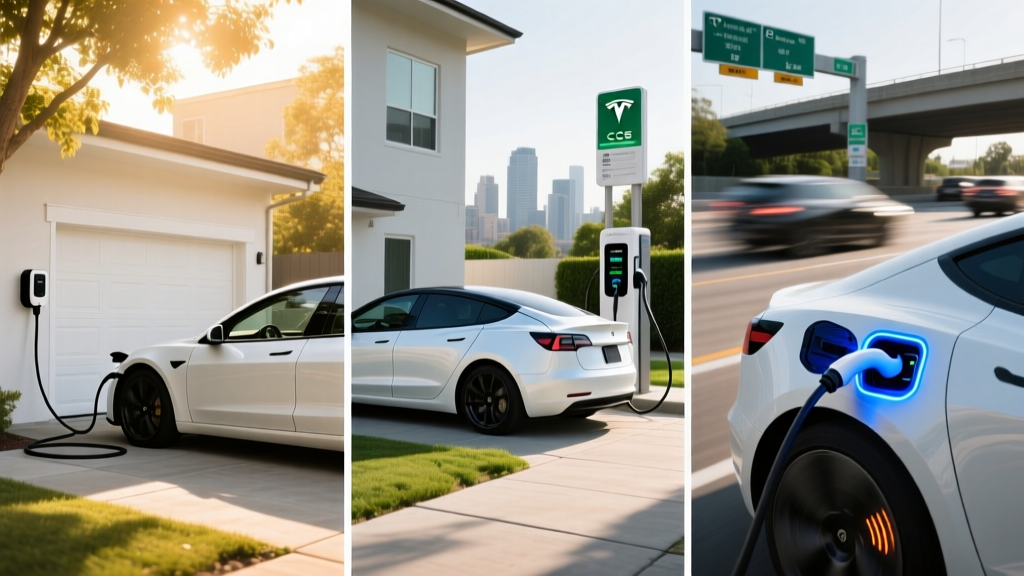
Installing a Level 2 home charger is the single most impactful upgrade for daily Tesla ownership. It eliminates public-charging dependency for routine driving and lets you wake up to a full battery every morning. But the total cost varies enormously depending on your home's electrical panel.
Core Electrical Requirements
A standard Level 2 Tesla Wall Connector requires a 240V dedicated circuit. The Gen 3 Wall Connector supports up to 48A continuous draw, which requires a 60A breaker (the National Electrical Code mandates that continuous loads use only 80% of a breaker's rated capacity). If your panel lacks the spare capacity for a 60A breaker, a 40A breaker (supporting 32A continuous / 7.7 kW) is a common fallback.
Panel Upgrade Reality Check
Homes built before 2000 often have 100A or 150A main panels that may already be near capacity with HVAC, electric ranges, dryers, and water heaters. Adding a 60A EV circuit to a maxed-out 150A panel typically requires a panel upgrade to 200A, which adds $1,500–$3,500 to the project. In some older homes with knob-and-tube wiring or outdated breaker panels (e.g., Federal Pacific or Zinsco), a full service replacement can exceed $4,000.
Some utilities and municipalities now permit panel-load management devices (like the Emporia VUE with automatic load shedding) that let you install a high-amperage charger without upgrading the main panel. Check with your local building department and a licensed electrician to see if this is permitted in your jurisdiction.
| Component | Typical Cost Range | Notes |
|---|---|---|
| EVSE Equipment (Tesla Wall Connector or equivalent) | $400–$650 | Tesla Wall Connector Gen 3: ~$475 |
| Electrical Permit | $50–$250 | Varies by municipality; some utilities cover this |
| Electrician Labor (standard install, panel nearby) | $600–$1,500 | Short wire run, same wall as panel |
| Electrician Labor (complex install, long run or sub-panel) | $1,500–$3,000+ | Conduit, trenching, or garage on opposite side of house |
| Panel Upgrade (if needed) | $1,500–$4,000 | 100A→200A service upgrade |
| Total: Simple Install (no panel upgrade) | $1,050–$2,400 | Most common scenario for newer homes |
| Total: Complex Install (with panel upgrade) | $3,000–$7,000+ | Older homes, detached garages |
Always hire a licensed electrician who will pull a permit. Unpermitted EV charger installations can void home insurance coverage and create fire risk, particularly if the circuit is undersized for continuous EV loads.
Connector Compatibility: NACS, CCS, and Adapter Requirements
Tesla's proprietary connector — now formally adopted as the North American Charging Standard (NACS) — is the dominant charging connector in North America as of 2026. Nearly every major automaker (Ford, GM, Rivian, Hyundai, Volvo, and others) has transitioned to NACS for new vehicles. But if you drive a Tesla and use non-Tesla public chargers, or if you own a non-Tesla EV and want to use Superchargers, adapter compatibility matters.
| Connector | Who Uses It (2026) | Tesla Compatibility | Non-Tesla Compatibility |
|---|---|---|---|
| NACS (Tesla) | All Teslas; Ford, GM, Rivian, Hyundai, Volvo 2025+ models | Native — no adapter needed | Non-Tesla NACS vehicles: native at Superchargers |
| CCS1 | Older non-Tesla EVs (pre-2025 VW, BMW, older Hyundai/Kia) | Tesla CCS Adapter (~$175) required for non-Tesla DC networks | Native on most non-Tesla DC fast networks |
| CHAdeMO | Nissan Leaf (legacy); being phased out | Not compatible — no official adapter | Declining infrastructure; Electrify America has dropped CHAdeMO at most sites |
| J1772 (Level 2 AC) | All non-Tesla EVs for Level 2 charging | Tesla includes J1772-to-NACS adapter with every vehicle | Native on all non-Tesla Level 2 chargers |
Every new Tesla ships with a J1772 adapter (for Level 2 public chargers) and a Mobile Connector with NEMA 14-50 and 120V plug heads. Tesla also sells a CCS1 adapter for accessing non-Tesla DC fast-charging networks. As of 2026, Tesla has opened many Supercharger stalls to non-Tesla NACS-equipped vehicles via the Tesla app — check Tesla's Supercharger page for current network access policies.
Cost to Charge: Home Electricity vs. Public Networks vs. Gasoline
The economics of EV ownership hinge on where you charge. Home charging on a residential electricity rate is almost always cheaper than gasoline per mile, but public DC fast charging can approach or exceed gas-car fuel costs in some markets.
| Charging Scenario | Rate ($/kWh) | Cost for 75 kWh (Model 3 LR) | Cost per Mile (341 mi EPA) | Gas Equivalent (30 MPG at $3.50/gal) |
|---|---|---|---|---|
| Home Off-Peak (utility TOU rate) | $0.08–$0.12 | $6.00–$9.00 | $0.018–$0.026 | $0.117/mile |
| Home Standard Rate (national avg.) | $0.16–$0.18 | $12.00–$13.50 | $0.035–$0.040 | $0.117/mile |
| Tesla Supercharger (member pricing) | $0.25–$0.35 | $18.75–$26.25 | $0.055–$0.077 | $0.117/mile |
| Third-Party DC Fast (EA, EVgo peak) | $0.35–$0.55 | $26.25–$41.25 | $0.077–$0.121 | $0.117/mile |
At home off-peak rates, a Tesla Model 3 costs roughly $0.02–$0.04 per mile to fuel — about one-third to one-quarter the cost of a 30 MPG gasoline car. Even at Supercharger rates, you're saving 30–50% per mile versus gas. The only scenario where EV charging approaches gas costs is peak-rate third-party DC fast charging in high-electricity-cost states (California, Hawaii, parts of the Northeast).
For current residential electricity rates by state, check the U.S. Energy Information Administration (EIA) monthly averages.
Equipment Recommendations: Best Home Chargers for Tesla Owners
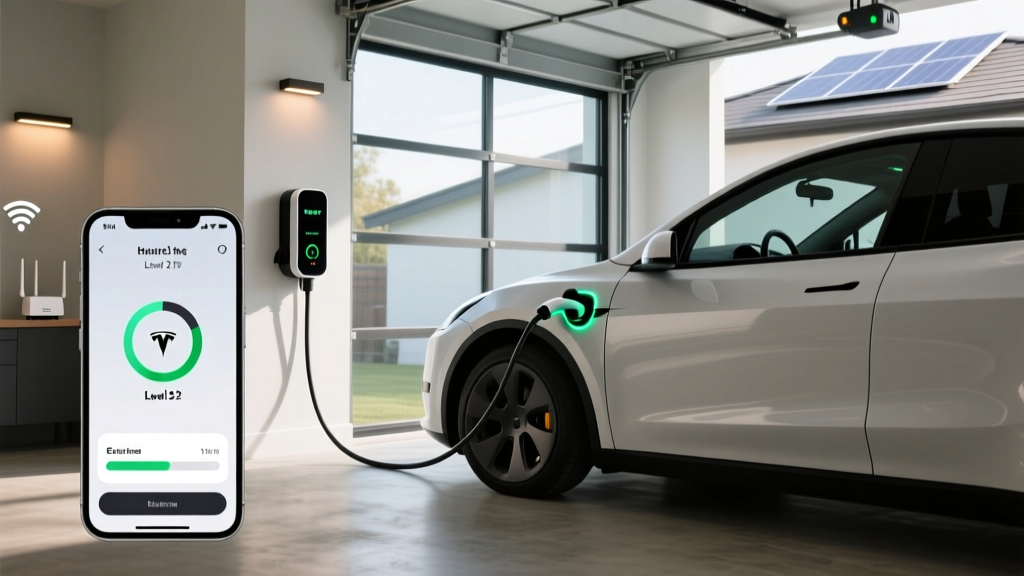
Not all Level 2 chargers are equal. Smart chargers with Wi-Fi connectivity enable scheduled charging (to exploit off-peak utility rates), energy monitoring, and load management. Here are the top picks for Tesla owners in 2026:
Tesla Wall Connector (Gen 3)
- Power Output: Up to 11.5 kW (48A, 240V)
- Connector: NACS (native Tesla); no adapter needed
- Cable Length: 24 ft
- Smart Features: Wi-Fi, OTA firmware updates, Power Sharing (link two units on one circuit), Tesla app integration
- Price: ~$475
- Best For: Tesla-only households; cleanest integration with vehicle scheduling
ChargePoint Home Flex
- Power Output: Up to 12 kW (50A, 240V) — configurable via dip switch
- Connector: J1772 (NACS adapter included for Teslas) or NACS pigtail version available
- Cable Length: 23 ft
- Smart Features: Wi-Fi, ChargePoint app scheduling, Alexa integration, detailed energy reports
- Price: ~$550–$650
- Best For: Multi-EV households (Tesla + non-Tesla); flexible amperage for older panels
Emporia Vue Level 2 Charger
- Power Output: Up to 11.5 kW (48A, 240V)
- Connector: J1772 (NACS adapter needed for Tesla)
- Cable Length: 24 ft
- Smart Features: Whole-home energy monitoring integration, solar-aware charging, load management without panel upgrade, utility demand-response compatible
- Price: ~$400 (charger) + $100–$200 (Emporia VUE monitor)
- Best For: Solar-equipped homes; panel-constrained installs needing load management
All three units are hardwired (recommended for 48A+ circuits) or available with NEMA 14-50 plugs. Hardwired installations are safer for continuous high-amperage use and avoid the NEC requirement for GFCI breakers on receptacle-based EV circuits — a source of nuisance trips that Tesla itself warns about in their installation documentation.
Safety, Code, and Installation Best Practices
EV charging is a continuous high-draw electrical load — more demanding on your home wiring than almost any other appliance. Follow these non-negotiable guidelines:
- Dedicated circuit: Your EV charger must have its own dedicated breaker — never share a circuit with other appliances.
- Breaker sizing: Continuous loads (3+ hours) must use ≤80% of breaker capacity. A 48A charger needs a 60A breaker; a 32A charger needs a 40A breaker.
- GFCI considerations: The 2020 NEC requires GFCI protection on receptacle-based (plug-in) EV circuits. Hardwired installations are exempt from this requirement and are generally more reliable. Discuss with your electrician.
- Outdoor rating: If your charger is mounted outside, ensure it carries a NEMA 4 or IP65 rating. The Tesla Wall Connector and ChargePoint Home Flex are both outdoor-rated.
- Wire gauge: A 60A circuit requires 6 AWG copper wire (or 4 AWG aluminum). Your electrician will size this based on run length and local code.
- Permit and inspection: Always pull an electrical permit. The inspection ensures your installation meets code and protects your insurance coverage.
Charging Time Benchmarks for Common Tesla Battery Sizes
Charge times vary by battery size, ambient temperature, and SoC. Tesla batteries precondition automatically when you navigate to a Supercharger, warming the pack to optimize charge speed. Without preconditioning (e.g., arriving at a DC fast charger without navigation), peak speeds may be 30–50% lower.
| Vehicle / Battery | Level 2 at 11.5 kW (0–100%) | DC Fast 10–80% (V3 Supercharger, 250 kW peak) | DC Fast 10–80% (V4 / newer stalls) |
|---|---|---|---|
| Model 3 RWD (57.5 kWh, LFP) | ~5.5 hours | ~28 min | ~25 min |
| Model 3 Long Range (75 kWh, NMC) | ~7 hours | ~25 min | ~22 min |
| Model Y Long Range (75 kWh, NMC) | ~7 hours | ~27 min | ~23 min |
| Model S (100 kWh, NMC) | ~9 hours | ~30 min | ~26 min |
| Cybertruck (123 kWh, NMC) | ~11 hours | ~35 min | ~28 min |
LFP vs. NMC charging note: Tesla's rear-wheel-drive Model 3 and Model Y use lithium iron phosphate (LFP) batteries. Tesla recommends charging LFP packs to 100% at least once per week for accurate state-of-charge calibration. NMC packs (Long Range, Performance) are best kept between 20–80% for daily use to minimize degradation — only charge to 100% before road trips.
Frequently Asked Questions
How much does it cost to install a home EV charger for my Tesla?
A straightforward Level 2 installation in a home with adequate panel capacity typically costs $1,050–$2,400, including the Tesla Wall Connector ($475), electrician labor, and permit. If your home requires a 200A panel upgrade, expect $3,000–$7,000+ total. Get three quotes from licensed electricians and ask specifically about continuous-load calculations.
How fast will each charging level add range to my Tesla?
Level 1 (120V) adds 3–5 miles per hour — only practical for plug-in hybrids or very low-mileage drivers. Level 2 (240V, 48A) adds roughly 44 miles per hour, enough to fully recharge any Tesla overnight. DC fast charging at a V3 Supercharger can add up to 200 miles in 15 minutes under optimal conditions, though the charge curve tapers significantly above 60% SoC.
Which connector and charger is compatible with my Tesla?
All Teslas use the NACS connector natively. At home, the Tesla Wall Connector plugs directly in with no adapter. For non-Tesla Level 2 public chargers, use the J1772 adapter included with your vehicle. For non-Tesla DC fast chargers (Electrify America, EVgo), purchase the Tesla CCS adapter (~$175). As of 2026, NACS is the dominant standard, so adapter needs are shrinking.
How much does charging a Tesla cost per mile versus gas?
At home off-peak rates ($0.08–$0.12/kWh), a Tesla Model 3 costs approximately $0.02–$0.03 per mile to fuel. A comparable 30 MPG gas car at $3.50/gallon costs about $0.12 per mile. Even at Supercharger rates ($0.25–$0.35/kWh), the Tesla costs $0.06–$0.08 per mile — roughly half the cost of gasoline. Annual fuel savings for a 12,000-mile driver range from $700 (all Supercharging) to $1,200+ (all home off-peak).
What electrical upgrades might I need for a home charger?
If your home has a 200A panel with spare breaker slots and load capacity, you likely need no upgrades — just a dedicated 60A circuit. Homes with 100A or 150A panels, older wiring, or panels already near capacity (common with electric heat, A/C, dryer, and range) may need a panel upgrade to 200A, costing $1,500–$4,000. Load-management devices can sometimes avoid a full panel upgrade — consult a licensed electrician.
Does frequent DC fast charging degrade my Tesla battery faster?
Yes, but the effect is modest with modern thermal management. Data aggregated by fueleconomy.gov and independent fleet studies show that Tesla batteries charged primarily on DC fast chargers lose roughly 2–4% more capacity over 100,000 miles compared to Level 2-only charging. Tesla's battery management system limits peak charge rates when the pack is cold or near full to protect longevity. For daily driving, Level 2 home charging is gentler and cheaper; reserve DC fast charging for road trips.
Can I charge my Tesla with solar panels?
Yes. Smart chargers like the Emporia Vue or Tesla Wall Connector (with Powerwall integration) can be configured to charge only when excess solar production is available. This effectively reduces your per-mile fuel cost to near zero during sunny months, though charging speed will fluctuate with cloud cover and time of day.