If you've been searching for a Tesla range extender, you've likely encountered a confusing mix of aftermarket gadgets, misleading ads, and forum rumors. Here's the blunt truth from years of owning and testing Teslas: there is no plug-in device, fuel tank, or bolt-on accessory that legitimately extends a Tesla's range. What does exist is a set of proven charging strategies, battery-care practices, and driving techniques that can recover lost miles and maximize the range your Model 3, Model Y, Model S, or Model X already has.
This guide breaks down exactly what works—with real numbers on charging speeds, costs, and the equipment you need—so you stop chasing snake oil and start optimizing your actual setup.
Why There Is No Real Tesla Range Extender
Teslas are pure battery-electric vehicles (BEVs). They have no internal combustion engine, no fuel tank, and no architecture to support a range-extending generator like the one found in a BMW i3 REx or the upcoming Ramcharger EREV. Any product marketed as a "Tesla range extender" falls into one of three categories:
- Software/efficiency tips repackaged as hardware: Legitimate advice (tire pressure, preconditioning, regen settings) dressed up as a product.
- Aftermarket battery modules: Unproven, uninsured, and likely to void your Tesla warranty and violate NHTSA safety standards.
- Solar trickle panels: Roof-mounted solar panels that add perhaps 1-3 miles of range per day under ideal conditions—far below what marketing claims suggest.
The real "range extenders" for Tesla owners are proper home charging infrastructure, smart driving habits, and battery health management. Let's cover each with hard data.
Charging Levels Explained: How Fast Each One Adds Range
Understanding charging speed is the foundation of range management. Power is measured in kW (kilowatts—the rate of energy flow), while your battery capacity is measured in kWh (kilowatt-hours—the total energy stored). Confusing these two is the single most common EV mistake.
| Level | Voltage | Power (kW) | Miles of Range Added per Hour | Best For |
|---|---|---|---|---|
| Level 1 (120V) | 120V / 12A | ~1.4 kW | 3–5 mi/hr | Emergency/overnight trickle |
| Level 2 (240V) | 240V / 32–48A | 7.7–11.5 kW | 25–44 mi/hr | Daily home charging |
| DC Fast Charging | 400V+ architecture | 50–250+ kW | 150–1,000+ mi/hr (peak) | Road trips, rapid top-ups |
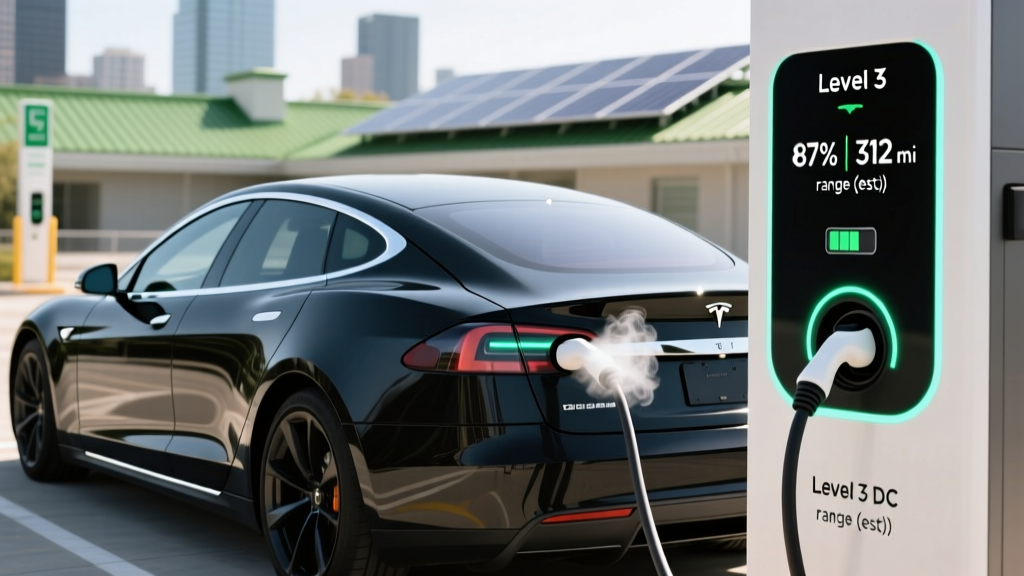
Real-world context: A Tesla Model Y Long Range (75 kWh usable battery, EPA 320 miles) charging on Level 2 at 11.5 kW will go from 10% to 80% in roughly 4.5 hours. On a V3 Supercharger peaking at 250 kW, that same 10–80% session takes approximately 25–30 minutes, though the charge curve tapers significantly above 60% State of Charge (SoC). Peak kW is never sustained across the full session—this is the biggest misconception new EV owners have about fast charging.
Home Charger Installation: Requirements, Costs, and Gotchas
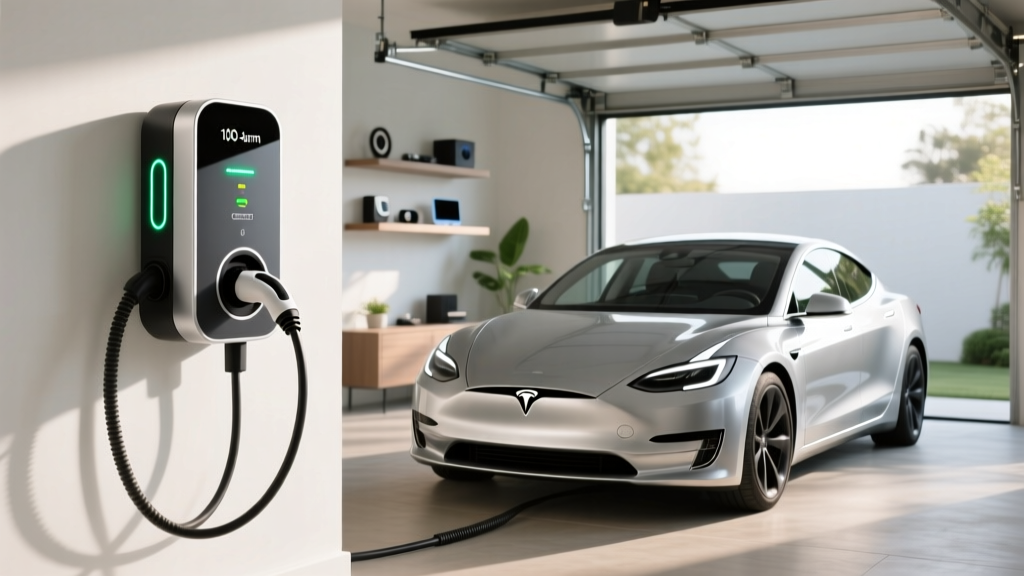
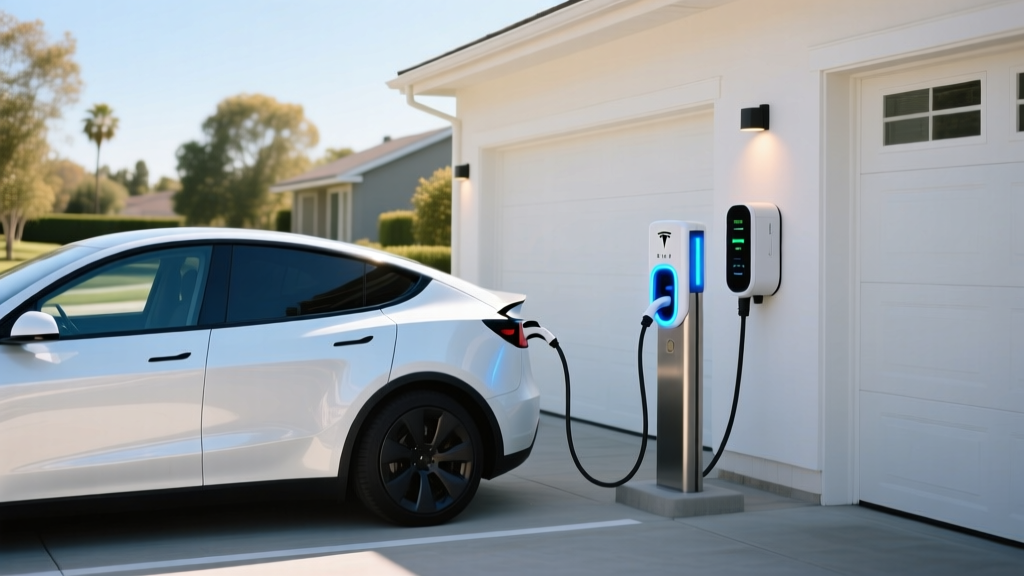
The single most impactful "range extender" for any Tesla owner is a properly installed Level 2 home charger. Waking up to a full battery every morning eliminates range anxiety more effectively than any gadget.
Electrical Requirements
A Level 2 Tesla Wall Connector requires a 240V dedicated circuit. The most common configurations:
- 48A charger → 60A breaker: NEC code requires the circuit breaker to be rated at 125% of the continuous load. A 48A charger needs a 60A breaker and 6 AWG copper wire.
- 32A charger → 40A breaker: Uses 8 AWG copper wire. Suitable for panels with less spare capacity.
- Hardwired vs. NEMA 14-50 outlet: Hardwired installations support higher amperage (up to 48A) and avoid the GFCI breaker requirement that NEMA outlets now trigger under NEC 2020+. A NEMA 14-50 outlet is limited to 40A continuous (32A charging).
Installation Cost Breakdown
| Component | Low End | High End | Notes |
|---|---|---|---|
| Tesla Wall Connector (equipment) | $420 | $475 | Gen 3, 24' cable, Wi-Fi enabled |
| Third-party Level 2 charger | $350 | $700 | ChargePoint Home Flex, Emporia, Grizzl-E |
| Electrician labor (standard install) | $500 | $1,500 | Depends on panel-to-garage distance |
| Electrical permit | $50 | $250 | Varies by municipality |
| Panel upgrade (if needed) | $1,500 | $4,000+ | 100A → 200A service; older homes |
| Total (no panel upgrade) | $970 | $2,225 | Typical scenario |
| Total (with panel upgrade) | $2,470 | $6,225+ | Homes with 100A or older panels |
Which Connectors and Chargers Work with Teslas?
Tesla uses the North American Charging Standard (NACS) connector, which has become the dominant standard in North America. Here's how connector compatibility works in 2026:
| Connector | Used By | Tesla Compatibility |
|---|---|---|
| NACS (Tesla) | All Tesla vehicles; Ford, GM, Rivian, Hyundai, and most others from 2025+ | Native—no adapter needed |
| CCS1 | Older non-Tesla EVs (pre-2025 models from VW, Hyundai, BMW, etc.) | Tesla Superchargers: requires Tesla CCS adapter (~$175) |
| CHAdeMO | Nissan Leaf, Mitsubishi (legacy) | Not compatible with Tesla; network is largely retired |
| J1772 (Level 2) | All non-Tesla EVs for AC charging | Tesla includes a J1772-to-NACS adapter in the glovebox |
Key takeaway for Tesla owners: Your vehicle charges natively at all 20,000+ Tesla Superchargers and at any NACS-equipped public charger. For older CCS-only public stations, the Tesla CCS adapter (available from Tesla's shop) unlocks access. The included J1772 adapter lets you use virtually any public Level 2 station.
Charging Cost Per Mile: EV vs. Gas in 2026
One of the strongest arguments for optimizing your Tesla charging setup is the cost advantage over gasoline. Here's how the numbers break down:
| Scenario | Rate | Cost per Mile (Model Y, ~3.5 mi/kWh) | Cost per Mile (30 MPG gas car at $3.50/gal) |
|---|---|---|---|
| Home charging (off-peak) | $0.08–$0.12/kWh | $0.023–$0.034 | $0.117 |
| Home charging (standard rate) | $0.14–$0.18/kWh | $0.040–$0.051 | $0.117 |
| Public Level 2 | $0.25–$0.40/kWh | $0.071–$0.114 | $0.117 |
| DC Fast (Supercharger/EA) | $0.30–$0.50/kWh | $0.086–$0.143 | $0.117 |
At national average electricity rates, home-charging a Tesla Model Y costs roughly $0.03–$0.05 per mile—about one-third to one-quarter the cost of fueling a comparable gas vehicle. Even at public DC fast-charger rates, the cost per mile is competitive with gas, though exclusive reliance on public fast charging erodes the savings advantage.
According to fueleconomy.gov, the 2025 Tesla Model Y Long Range achieves 122 MPGe combined, translating to approximately 28 kWh per 100 miles.
Equipment Recommendations: Best Home Chargers for Teslas
Tesla Wall Connector (Gen 3)
- Power Output: Up to 11.5 kW (48A / 240V)
- Connector: NACS (native Tesla)
- Cable Length: 24 feet
- Smart Features: Wi-Fi, OTA firmware updates, load sharing with a second unit, access control
- Price: ~$420–$475
- Verdict: Best overall for Tesla-only households. Clean integration, fastest Level 2 speeds on a 60A circuit.
ChargePoint Home Flex
- Power Output: Up to 12 kW (50A / 240V, configurable)
- Connector: NACS (2025+ models) or J1772 with adapter
- Cable Length: 23 feet
- Smart Features: Wi-Fi, app scheduling, Alexa integration, amperage adjustable via app
- Price: ~$550–$650
- Verdict: Best multi-EV household pick. Adjustable amperage is ideal if your panel can't support a full 60A circuit.
Grizzl-E Smart
- Power Output: Up to 9.6 kW (40A / 240V)
- Connector: NACS or J1772 options
- Cable Length: 24 feet
- Smart Features: Wi-Fi, OCPP protocol, adjustable amperage, extreme cold rating (-40°F)
- Price: ~$449–$549
- Verdict: Best for cold climates and outdoor installs. Built in Canada, rugged enclosure, no-nonsense reliability.
Battery Health: The Real Long-Term Range Extender
Your Tesla's range is directly tied to its battery's State of Health (SoH). A battery that's degraded 10% has 10% less usable range. Here's how to minimize degradation:
- Daily charge limit: For NMC chemistry batteries (Model S, Model X, Long Range Model 3/Y), Tesla recommends setting the daily charge limit to 80%. Reserve 100% charges for road trips. LFP batteries (Model 3/Y Rear-Wheel Drive) should be charged to 100% at least once per week per Tesla's guidance—LFP chemistry handles full charges better and needs periodic full charges for accurate SoC calibration.
- Avoid prolonged low SoC: Don't let your Tesla sit below 20% for extended periods. If you're traveling without the car, leave it plugged in at 50%.
- Minimize DC fast charging: Frequent Supercharging accelerates degradation slightly. Tesla's own data and independent studies (including those cited by the National Renewable Energy Laboratory) show that predominantly Level 2 charging yields better long-term SoH than daily DC fast charging.
- Thermal management: Teslas actively manage battery temperature. In extreme heat, the car runs its cooling system even while parked—this is normal and protective. In cold weather, use preconditioning (scheduled departure or manually via the app) to warm the battery before driving and charging. A cold battery delivers less range and charges slower.
Driving Techniques That Actually Extend Range
Beyond charging and battery care, these practices measurably increase miles per kWh:
- Tire pressure: Keep tires at the door-jamb sticker pressure (typically 42 PSI for Model Y). Every 2 PSI below spec costs roughly 1–2% efficiency.
- Speed management: Aerodynamic drag increases with the square of speed. Driving 65 mph vs. 75 mph on the highway can improve efficiency by 10–15%—that's 30+ extra miles on a long trip.
- Regenerative braking: Use Standard regen and practice one-pedal driving to recapture kinetic energy. In stop-and-go traffic, regen can recover 15–25% of energy that would otherwise be lost to friction brakes.
- Climate control: Use seat heaters and the steering wheel heater instead of cranking cabin heat. The heat pump in 2021+ Model 3/Y is significantly more efficient than resistive heating, but seat heaters use roughly 50W vs. 2,000–5,000W for cabin air heating.
- Reduce weight and drag: Remove roof racks when not in use (a roof box can reduce range by 10–17%) and clear out unnecessary cargo.
Frequently Asked Questions
Is there any aftermarket product that genuinely extends Tesla range?
No. There is no legitimate bolt-on range extender for any Tesla. Products claiming otherwise—solar panels, plug-in modules, aerodynamic add-ons—deliver negligible gains (under 5 miles) at best and may void your warranty or violate safety regulations. Invest in a home Level 2 charger and proper tire maintenance instead.
How much does it cost to install a home EV charger for my Tesla?
Expect $970–$2,225 for a standard installation (Tesla Wall Connector + electrician + permit) if your electrical panel has sufficient capacity. If a panel upgrade from 100A to 200A is needed, add $1,500–$4,000+. Always get a licensed electrician's load calculation first.
How fast will a Level 2 charger add range to my Tesla?
At 11.5 kW (48A on a 60A circuit), a Tesla Wall Connector adds approximately 44 miles of range per hour to a Model Y Long Range. A full overnight charge (8 hours) adds roughly 350 miles—more than enough to replenish a full battery.
Which connector does my Tesla use, and do I need adapters?
All Teslas use the NACS connector natively. Your Tesla comes with a J1772 adapter (for non-Tesla Level 2 stations). For CCS1 public DC fast chargers, purchase Tesla's CCS adapter (~$175). CHAdeMO is not compatible and is largely a retired network.
How much does charging a Tesla cost per mile compared to gas?
Home charging at typical off-peak rates ($0.08–$0.12/kWh) costs approximately $0.025–$0.035 per mile in a Model Y. Gas at $3.50/gallon in a 30 MPG vehicle costs $0.117 per mile. That's a 70–78% fuel cost reduction when charging at home.
What electrical upgrades might I need for a Tesla home charger?
If your panel is 100A or fully loaded, you may need a 200A panel upgrade ($1,500–$4,000). The charger requires a dedicated 240V circuit (60A breaker for 48A charging, or 40A breaker for 32A charging). Homes with 200A panels and spare breaker slots typically need no upgrade.
Does Tesla's battery warranty cover range degradation?
Tesla's battery warranty guarantees 70% capacity retention over 8 years / 120,000 miles (Model 3/Y Long Range) or 8 years / 150,000 miles (Model S/X), per Tesla's official warranty terms. If your battery degrades below 70% within that window, Tesla will repair or replace it. In practice, Tesla batteries typically lose 5–10% capacity over the first 100,000 miles with proper care.