Tesla Range in 2026: What the EPA Says vs. What You'll Actually Get
When shoppers ask what is the range of a Tesla, the answer depends on which model, which trim, and — critically — how and where you charge. Tesla's 2026 lineup spans from the refreshed Model 3 to the Cybertruck, and EPA estimates only tell part of the story. Real-world range shifts with highway speed, cold weather, elevation, and battery preconditioning.
Below is the current Tesla lineup with EPA range figures, usable battery capacity, and real-world expectations based on mixed driving testing.
| Model / Trim | EPA Range | Usable Battery (kWh) | MPGe (Combined) | Real-World Expectation |
|---|---|---|---|---|
| Model 3 RWD | 272 mi | ~60 kWh (LFP) | 132 MPGe | 230–250 mi (highway/cold: ~200 mi) |
| Model 3 Long Range AWD | 363 mi | ~79 kWh (NMC) | 134 MPGe | 300–330 mi (highway: ~280 mi) |
| Model 3 Performance | 315 mi | ~79 kWh (NMC) | 119 MPGe | 260–290 mi |
| Model Y Long Range AWD | 320 mi | ~79 kWh (NMC) | 122 MPGe | 270–300 mi (highway: ~250 mi) |
| Model Y Performance | 285 mi | ~79 kWh (NMC) | 111 MPGe | 240–265 mi |
| Model S Long Range | 402 mi | ~100 kWh (NMC) | 124 MPGe | 340–375 mi |
| Model S Plaid | 359 mi | ~100 kWh (NMC) | 116 MPGe | 300–330 mi |
| Model X Long Range | 335 mi | ~100 kWh (NMC) | 110 MPGe | 280–310 mi |
| Cybertruck AWD | 340 mi | ~123 kWh (NMC) | 99 MPGe | 270–310 mi (towing: ~180 mi) |
For official EPA figures across all trims, fueleconomy.gov remains the definitive source.
How Charging Levels Determine Your Usable Tesla Range
Range is only useful if you can replenish it efficiently. Understanding the three charging levels — and the critical difference between kW (power, or how fast energy flows) and kWh (energy, or how much the battery stores) — is essential. Think of kW as the width of a hose and kWh as the size of the bucket.
| Level | Voltage / Power | Typical kW Output | Miles of Range Added per Hour | Best Use Case |
|---|---|---|---|---|
| Level 1 | 120V AC / 1.4–1.9 kW | ~1.4 kW | 3–5 mi/hr | Overnight top-up, low daily mileage |
| Level 2 | 240V AC / 3.3–19.2 kW | 7.7–11.5 kW (typical home) | 25–44 mi/hr | Daily home charging, overnight full charge |
| DC Fast Charging | 400V+ DC / 50–350 kW | 150–250 kW (Tesla peak) | 500–1,000+ mi/hr (at peak) | Road trips, rapid top-ups |
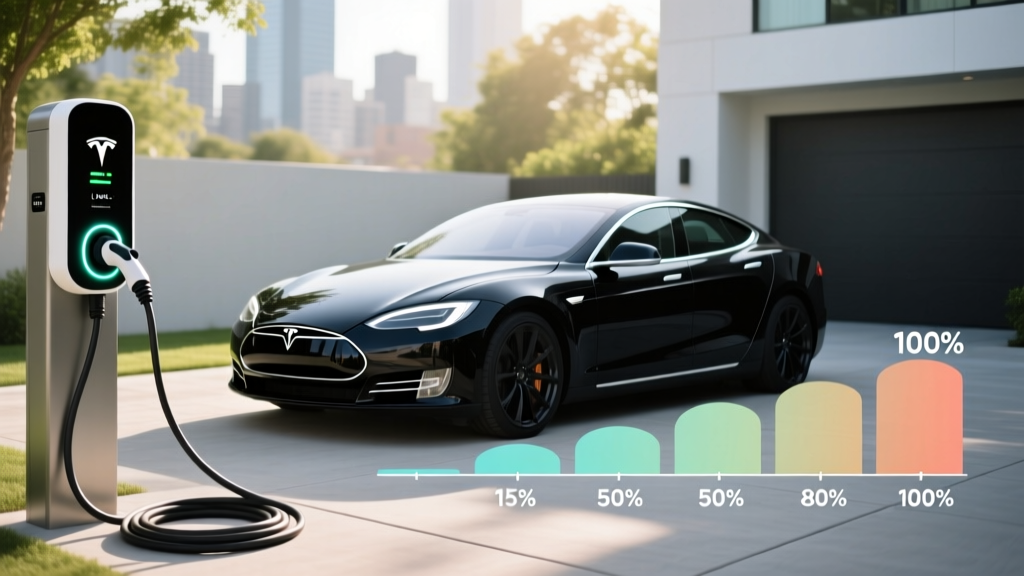
A Tesla Model 3 Long Range with a ~79 kWh battery charging at 11.5 kW (Level 2) will go from 10% to 80% in roughly 5 hours. The same session on a 250 kW Supercharger takes approximately 25–30 minutes — but only because the charge curve tapers significantly above 80%. Peak charge rates are never sustained for the full session.
How Much Does It Cost to Install a Home EV Charger?
Home Level 2 charging is where most Tesla owners replenish their range. But installation costs vary enormously depending on your home's electrical panel, the distance from the panel to the charger location, and local permit requirements.
| Component | Typical Range | Notes |
|---|---|---|
| Level 2 Charger (Equipment) | $300–$700 | Tesla Wall Connector ~$420; third-party smart chargers $400–$700 |
| Electrician Labor (standard install) | $500–$1,500 | Assumes 240V/50A circuit, <40 ft run from panel |
| Electrical Permit | $50–$250 | Varies by municipality; required in most jurisdictions |
| Panel Upgrade (if needed) | $1,500–$3,500 | Older 100A panels often need upgrade to 200A; homes built after ~2000 usually fine |
| Total (no panel upgrade) | $850–$2,450 | Most homes with 200A service fall in this range |
| Total (with panel upgrade) | $2,350–$5,950 | Common in homes built before 1990 or with existing high electrical loads |
The Tesla Wall Connector delivers up to 11.5 kW (48A) on a 60A dedicated circuit and includes a 24-foot cable. It uses the native NACS connector, so no adapter is needed for any Tesla vehicle. For non-Tesla EVs in your household, you'd need a J1772-to-NACS adapter or a separate J1772 charger.
What Electrical Upgrades Might I Need?
A licensed electrician will evaluate your panel's available amperage. A Level 2 charger on a 60A circuit draws 48A continuous — your panel needs at least 60A of spare capacity. Homes with 100A service, electric ranges, electric dryers, and central AC may need a panel upgrade to 200A. Some utilities offer rebates that offset this cost. Always have a licensed electrician perform the final load calculation — this is not a DIY project.
Connector Compatibility: NACS, CCS, and CHAdeMO Explained
Tesla pioneered the North American Charging Standard (NACS), which has become the dominant connector for new EVs starting in 2025. Here's what you need to know for compatibility at home and on the road.
| Connector | Used By | AC Level 2 | DC Fast Charging | Adapter Needed for Tesla? |
|---|---|---|---|---|
| NACS (Tesla) | Tesla (all), Ford, GM, Rivian, Volvo, Hyundai/Kia (2025+), others | Yes | Yes (Supercharger + third-party) | None for Teslas |
| CCS1 | Legacy models: older Ford Mach-E, VW ID.4, BMW i4, etc. | Yes (J1772 portion) | Yes | CCS-to-NACS adapter (~$200–$250) for Supercharger access |
| CHAdeMO | Nissan Leaf (legacy/discontinued in US) | No | Yes (limited stations) | No direct adapter to Tesla; network is shrinking |
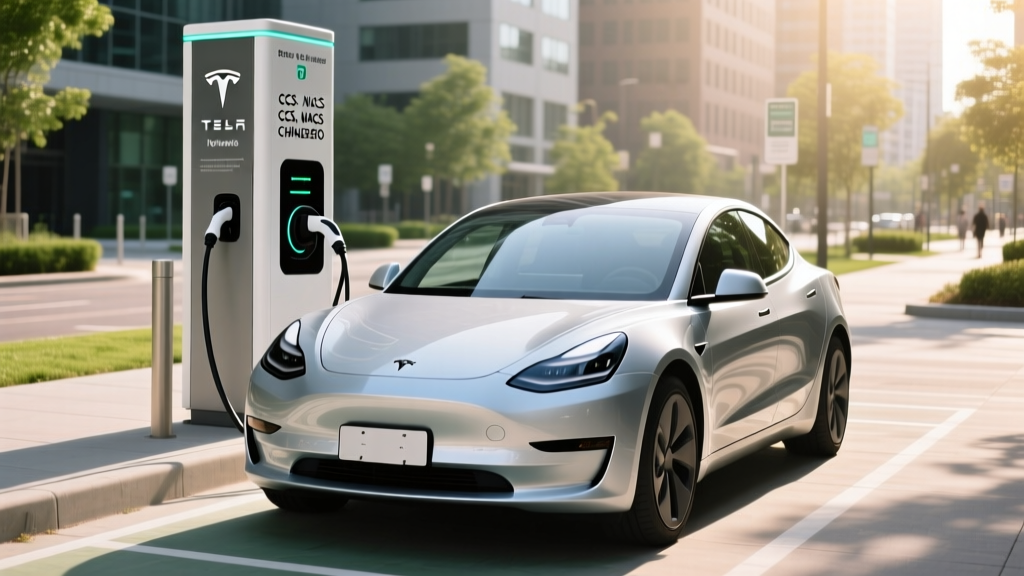
All 2026 Tesla vehicles ship with the NACS port natively. Tesla also sells a CCS Combo 1 Adapter (~$250) for accessing non-Tesla DC fast chargers that still use CCS connectors — useful at Electrify America or EVgo stations in areas where Supercharger coverage is sparse. The CHAdeMO network is effectively discontinued in the US, and no practical adapter path exists.
Charging Cost per Mile: Tesla vs. Gas
The economics of replenishing Tesla range depend heavily on where and when you charge. Below are realistic cost scenarios based on 2026 national averages.
| Scenario | Rate | Cost per kWh | Cost per Mile (Model 3 LR at ~3.8 mi/kWh) | Annual Cost (12,000 mi) |
|---|---|---|---|---|
| Home (off-peak utility rate) | $0.09–$0.13/kWh | ~$0.11 avg | $0.029 | $348 |
| Home (standard rate) | $0.14–$0.20/kWh | ~$0.17 avg | $0.045 | $540 |
| Public Level 2 (ChargePoint, etc.) | $0.25–$0.49/kWh | ~$0.35 avg | $0.092 | $1,104 |
| Tesla Supercharger (V3/V4) | $0.28–$0.48/kWh | ~$0.36 avg | $0.095 | $1,140 |
| Gas Vehicle (28 MPG combined, $3.40/gal) | — | — | $0.121 | $1,452 |
Home charging on an off-peak rate delivers fuel costs roughly 75% lower than a comparable gas sedan. Even exclusive Supercharger use costs less per mile than gasoline in most states. The key takeaway: a Tesla's range is cheapest to replenish at home, and most owners do 85–95% of their charging there.
Recommended Home Charging Equipment for Tesla Owners
Not all Level 2 chargers are equal. Here are top picks for Tesla owners in 2026, each selected for power output, reliability, and smart features.
Tesla Wall Connector (Gen 4)
- Power Output: Up to 11.5 kW (48A on 60A circuit)
- Connector: Native NACS — no adapter needed
- Cable Length: 24 feet
- Smart Features: Wi-Fi, OTA updates, load sharing with second unit, Powerwall integration
- Price: ~$420
- Best For: Tesla-only households; simplest setup with native integration
ChargePoint Home Flex (NACS version)
- Power Output: Up to 12 kW (50A on 60A circuit); adjustable down to 16A
- Connector: NACS (2025+ model) or J1772 with adapter
- Cable Length: 23 feet
- Smart Features: App scheduling, utility demand-response, Alexa, detailed energy tracking
- Price: ~$550–$650
- Best For: Multi-EV households; utility rebate programs requiring smart chargers
Emporia Vue Level 2 EV Charger
- Power Output: Up to 11.5 kW (48A)
- Connector: J1772 (use NACS adapter) or NACS (2025+ version)
- Cable Length: 24 feet
- Smart Features: Whole-home energy monitoring integration, solar-aware scheduling, load management
- Price: ~$400–$500
- Best For: Solar-panel households wanting integrated energy management
All three chargers require a dedicated 240V circuit and should be installed by a licensed electrician. The Tesla Wall Connector offers the cleanest experience for Tesla-only homes, while the ChargePoint and Emporia options add flexibility for mixed fleets.
Safety, Code, and Installation Best Practices
EV charging equipment draws significant continuous current — far more than most household appliances. Proper installation isn't optional; it's a safety and code requirement.
- Dedicated Circuit: Level 2 chargers require their own dedicated 240V circuit (typically 50A or 60A). Never share the circuit with other major appliances.
- GFCI Protection: The 2023 NEC (National Electrical Code) requires GFCI protection for EV charging outlets in garages and outdoors. Hardwired installations (like the Tesla Wall Connector) may be exempt in some jurisdictions — your electrician will advise.
- Outdoor Rating: If installing outside, ensure the charger carries a NEMA 4 or IP65 weather rating. The Tesla Wall Connector and ChargePoint Home Flex are both rated for outdoor use.
- Permit and Inspection: Most municipalities require an electrical permit and post-installation inspection. Skipping this can void home insurance coverage and cause issues at resale.
- Wire Gauge: A 60A circuit requires 6 AWG copper wire minimum (4 AWG for runs over 50 feet). Your electrician handles this spec.
Frequently Asked Questions
What is the range of a Tesla Model 3 in real-world driving?
The 2026 Model 3 Long Range AWD carries an EPA rating of 363 miles. In real-world mixed driving at moderate temperatures, expect 300–330 miles. Sustained highway speeds above 75 mph reduce that to roughly 280 miles, and winter driving in sub-freezing temperatures can drop range to 240–270 miles due to battery heating demands and cabin climate use.
How fast will each charging level add range to my Tesla?
Level 1 (120V) adds roughly 3–5 miles per hour — suitable only for overnight top-ups if your daily drive is under 30 miles. Level 2 (240V, 11.5 kW) adds approximately 40–44 miles per hour, fully recharging a Model 3 Long Range overnight in about 8–9 hours. DC fast charging on a Tesla V3 Supercharger (250 kW peak) can add up to 200 miles in roughly 15 minutes under ideal conditions, though the charge curve tapers significantly above 80% SoC.
Which connector and charger are compatible with my Tesla?
All 2026 Tesla vehicles use the NACS connector natively. At home, the Tesla Wall Connector plugs directly in. On the road, Tesla Superchargers use NACS. For non-Tesla DC fast chargers with CCS1 connectors, Tesla sells a CCS Combo 1 Adapter (~$250). CHAdeMO stations are essentially obsolete in the US market.
How much does charging a Tesla cost per mile compared to gas?
Home charging on off-peak electricity (~$0.11/kWh) costs approximately $0.029 per mile in a Model 3 Long Range — roughly 75% less than a 28 MPG gas car at $3.40/gallon ($0.121/mile). Even exclusive Supercharger use (~$0.36/kWh) costs about $0.095/mile, still below gasoline. The savings multiply with higher annual mileage.
What electrical upgrades might I need for a home charger?
Homes with 200A electrical service (most built after ~2000) typically have enough capacity for a 60A dedicated EV circuit without upgrades. Older homes with 100A service, or homes with multiple large electric loads (electric range, dryer, HVAC, hot tub), may require a panel upgrade to 200A — adding $1,500–$3,500 to the project. A licensed electrician will perform a load calculation to determine your specific needs. Some utilities and states offer rebates covering part of the panel upgrade cost when paired with EV charger installation.
Does the Tesla federal tax credit apply to home charger installation?
The §30D federal tax credit covers EV purchases, not home charging equipment. However, a separate provision — the Alternative Fuel Vehicle Refueling Property Credit (IRC §30C) — may cover up to 30% of home charger equipment and installation costs (capped at $1,000), subject to income and census-tract eligibility. Check current rules at irs.gov and consult a tax professional, as eligibility requirements are specific and change periodically.