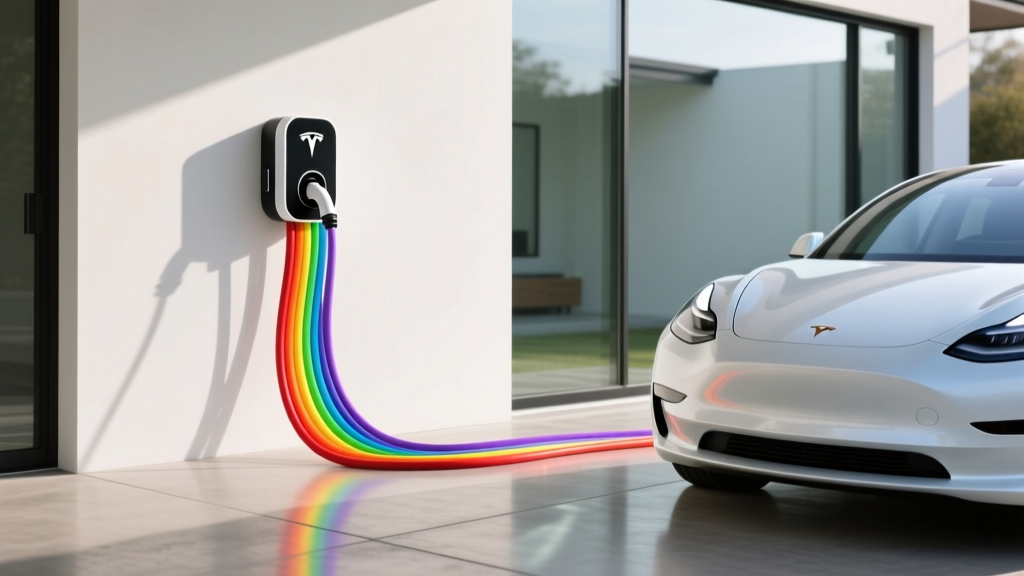
If you've walked past a Tesla Supercharger at night or glanced at the charge port on a Model Y, you've likely noticed the pulsing ring of colors around the plug. Owners call it "Tesla rainbow charging" — the sequence of greens, blues, whites, and reds that communicate exactly what your car and the charger are doing. But those lights are more than aesthetic: they're a real-time diagnostic system that tells you whether you're pulling 250 kW or staring at a fault code.
This guide decodes every color in the Tesla charging light spectrum, then walks you through the full ecosystem behind those lights: Level 1, Level 2, and DC fast charging speeds; what a home installation actually costs in 2026; which connectors fit which cars; and how charging economics compare to gasoline on a per-mile basis.
What Tesla's Rainbow Charging Colors Actually Mean
The LED ring on Tesla's charge port (and on the Supercharger handle itself) cycles through specific colors and patterns to indicate charging state. Here's the full decoder:
- Flashing Green: Charging is initializing. The car and charger are performing a handshake — negotiating voltage, current, and safety checks before power flows.
- Solid/Pulsing Green: Active charging. The pulse rate increases as the state of charge (SoC) rises. This is the "rainbow" state most owners see during a normal session.
- Blue: The vehicle is plugged in but charging is scheduled or delayed (e.g., you've set off-peak charging to start at midnight).
- Solid White: The charge port door is open, but no cable is inserted, or the car is ready to accept a connection.
- Flashing White: The charge port door is closing, or the car is waking to accept a plug.
- Red: Fault detected. This could be a connector issue, a ground fault, a thermal limit on the cable, or a Supercharger stall malfunction. Unplug, wait 30 seconds, and retry. If it persists, try another stall.
- Rainbow/Cycle Pattern: Seen during firmware updates or when the vehicle is in a diagnostic/service mode. Also occasionally appears briefly during initial Supercharger handshake on newer V4 stalls.
- Amber/Orange (2025+ models): Charge rate is thermally limited — the battery is cold and hasn't preconditioned, or ambient temps are extreme. Precondition via the Tesla app before plugging in for full kW.
Understanding these colors saves real time at public chargers. A red light means move to the next stall immediately rather than waiting. An amber light means you should have preconditioned the battery using the car's navigation routing to the Supercharger, which warms the pack for optimal charge-curve acceptance.
The Three Charging Levels: Speeds in kW and Miles Per Hour
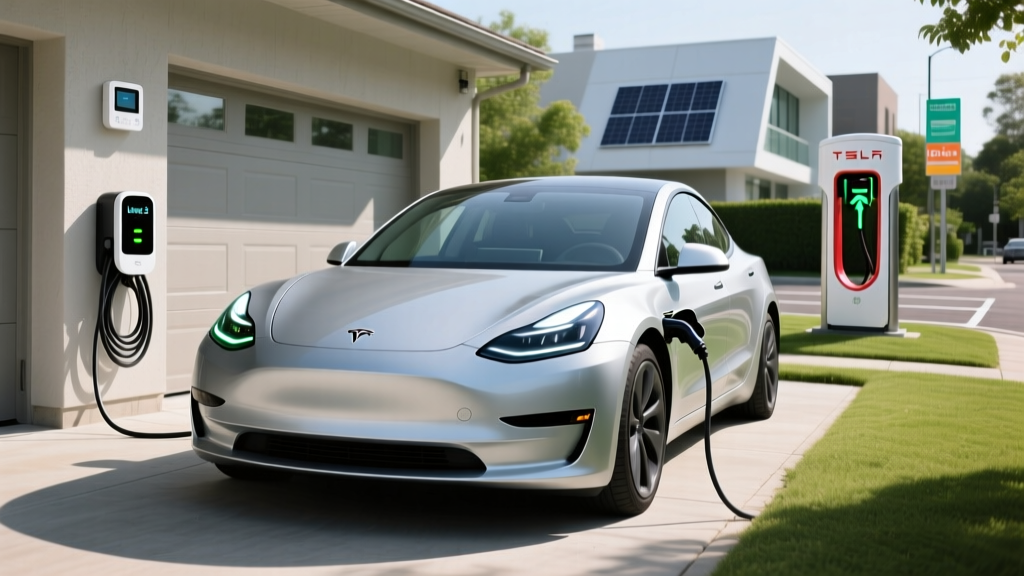
Before you install anything at home or plan a road trip, you need to understand the three charging tiers. The critical distinction: kW (kilowatts) measures power — the rate of energy flow. kWh (kilowatt-hours) measures energy — the total capacity stored in your battery. A 75 kWh battery charged at 11 kW takes roughly 7 hours from empty; at 150 kW, it takes about 30 minutes to reach 80%.
| Level | Voltage | Power (kW) | Miles of Range Added Per Hour | Typical Use Case |
|---|---|---|---|---|
| Level 1 | 120V AC | 1.0–1.4 kW | 3–5 mi/hr | Overnight trickle; PHEVs; emergency backup |
| Level 2 | 240V AC | 3.3–19.2 kW | 12–75 mi/hr | Home daily charging; workplace; shopping centers |
| DC Fast Charge | 400–800V DC | 50–350 kW | 150–1,200+ mi/hr (peak) | Road trips; highway corridors; 10–80% in 15–30 min |
Real-world context: A Tesla Model Y Long Range (75 kWh usable battery, EPA 320 miles) charging at 11.5 kW (a typical 48A Level 2 home charger) adds about 37 miles of range per hour — enough to fully replenish overnight. On a V3 Supercharger at 250 kW peak, that same Model Y goes from 10–80% in approximately 22 minutes, though the charge curve tapers significantly above 80% SoC. Expect the full 10–80% session to average closer to 150 kW sustained, not the peak number.
Home Charger Installation: Electrical Requirements and Real Costs
The single biggest variable in home EV charging isn't the charger itself — it's whether your electrical panel can support a dedicated 240V circuit. Here's what a Level 2 installation requires:
Electrical Specifications
- Voltage: 240V (same as a clothes dryer or electric oven)
- Amperage: 40A or 48A circuit is standard for most homes; 60A for higher-output chargers
- Breaker: Must be rated 125% of continuous load — a 48A charger requires a 60A breaker
- Circuit: Dedicated — no sharing with other appliances
- Wiring: 6 AWG copper (for 48A) or 4 AWG (for 60A) in conduit
Panel Upgrade Considerations
Most homes built after 1990 have a 200A main panel, which typically supports a 40–60A EV circuit alongside existing loads. Older homes with 100A service almost certainly need a panel upgrade ($2,500–$5,000) or a load-management device like the Emporia Smart Load Manager (~$300) that dynamically reduces charger draw when other appliances activate.
Always have a licensed electrician perform a load calculation per NEC Article 220 before committing to a circuit size. This is not optional — it's a code requirement and a fire-safety necessity.
| Component | Cost Range | Notes |
|---|---|---|
| Level 2 Charger (Equipment) | $350–$700 | Hardwired or NEMA 14-50 plug; 40A–48A |
| Electrician Labor (standard install) | $500–$1,500 | Short run from panel to garage; longer runs cost more |
| Permit & Inspection | $50–$250 | Varies by municipality; some jurisdictions waive for EV |
| Electrical Panel Upgrade (if needed) | $2,500–$5,000 | 100A → 200A service upgrade |
| Load Management Device (if needed) | $250–$400 | Alternative to panel upgrade |
| Total (no panel upgrade) | $900–$2,450 | Typical suburban home with 200A panel |
| Total (with panel upgrade) | $3,400–$7,450 | Older home requiring full service upgrade |
The IRS Residential Clean Energy Credit (25C/25D) may cover up to 30% of charger equipment and installation costs (capped at $1,000 for the EV charger credit under §30C). Check current-year eligibility on irs.gov — rules and caps change, and state-level rebates from utilities often stack on top.
Connector Compatibility: NACS, CCS1, CHAdeMO, and Adapters
The connector landscape shifted dramatically between 2023 and 2026. Tesla's North American Charging Standard (NACS) has been adopted by Ford, GM, Rivian, Hyundai, Kia, BMW, and most major automakers, effectively becoming the dominant DC fast-charging connector in North America. Here's where things stand:
| Connector | Brands Using It (Native) | Adapter Needed? |
|---|---|---|
| NACS (Tesla) | Tesla, Ford (2025+), GM (2025+), Rivian (2025+), Hyundai/Kia (2026+), BMW, Mercedes | Older CCS vehicles need NACS adapter (~$150–$250) |
| CCS1 | Legacy VW ID.4, older Ford Mustang Mach-E, older Hyundai Ioniq 5, Stellantis | CCS-to-NACS adapters available; Tesla Superchargers now open to CCS via Magic Dock |
| CHAdeMO | Nissan Leaf (legacy); effectively discontinued for new vehicles | No reliable adapter to NACS; limited DC fast-charge future |
If you're buying a new EV in 2026, prioritize a native NACS port. It grants direct access to Tesla's Supercharger network — over 25,000 stalls in North America — without an adapter, and the connector is physically smaller and lighter than CCS1. For existing CCS-ported vehicles, the Tesla Magic Dock adapter built into newer Supercharger stalls provides access, though charge speeds may be slightly reduced compared to native NACS vehicles.
Level 2 Home Charger Recommendations: 2026 Picks
Not all Level 2 chargers are equal. The critical specs are power output (kW), amperage, cable length, connector type, and whether the unit is hardwired or plug-in (NEMA 14-50). Hardwired units support higher amperage (48A+) and avoid the NEC requirement that plug-in receptacles in garages be GFCI-protected — a breaker that can nuisance-trip on EV loads.
Tesla Wall Connector (Gen 4)
- Power: 11.5 kW (48A) on a 60A circuit
- Connector: NACS native; J1772 adapter included
- Cable: 24 ft
- Smart features: Wi-Fi, OTA updates, load sharing with second unit, Tesla app integration
- Price: ~$475
- Best for: Tesla owners wanting seamless integration and the cleanest aesthetic
ChargePoint Home Flex (2nd Gen)
- Power: Up to 12 kW (50A) on a 60A circuit; adjustable down to 16A
- Connector: NACS or J1772 (select at purchase)
- Cable: 23 ft
- Smart features: Wi-Fi, ChargePoint app, Alexa/Google Home, scheduling, energy tracking
- Price: ~$550–$650
- Best for: Multi-EV households or those wanting detailed energy dashboards
Emporia Level 2 EV Charger
- Power: 11.5 kW (48A) on a 60A circuit
- Connector: NACS or J1772
- Cable: 24 ft
- Smart features: Wi-Fi, Emporia app, integrates with Emporia Vue energy monitor, solar-aware charging
- Price: ~$399
- Best for: Budget-conscious buyers or homes with solar panels wanting time-of-use optimization
Grizzl-E Smart (United Chargers)
- Power: 10 kW (40A) on a 50A circuit
- Connector: J1772 (NACS adapter available)
- Cable: 24 ft
- Smart features: Wi-Fi, app scheduling, OCPP support, built in Canada for extreme cold (-40°C rated)
- Price: ~$499
- Best for: Cold-climate owners needing rugged outdoor-rated equipment
Charging Cost Per Mile: EV Electricity vs. Gasoline
The economic argument for home charging is overwhelming — if you have access. Public DC fast charging narrows the gap but rarely beats gasoline on cost alone. Here's how the numbers work across real scenarios:
| Scenario | Rate | Vehicle Efficiency | Cost Per Mile |
|---|---|---|---|
| Home Level 2 (off-peak utility rate) | $0.10/kWh | 3.5 mi/kWh (Model Y) | $0.029/mi |
| Home Level 2 (national avg residential) | $0.17/kWh | 3.5 mi/kWh (Model Y) | $0.049/mi |
| Public Level 2 (ChargePoint, etc.) | $0.25–$0.39/kWh | 3.5 mi/kWh | $0.071–$0.111/mi |
| DC Fast Charge (Tesla Supercharger avg) | $0.28–$0.36/kWh | 3.5 mi/kWh | $0.080–$0.103/mi |
| DC Fast Charge (Electrify America) | $0.36–$0.52/kWh | 3.5 mi/kWh | $0.103–$0.149/mi |
| Gasoline (28 MPG combined, $3.30/gal) | $3.30/gal | 28 mi/gal | $0.118/mi |
| Gasoline (22 MPG combined, $3.30/gal) | $3.30/gal | 22 mi/gal | $0.150/mi |
The takeaway: home charging at off-peak rates costs roughly 75% less per mile than gasoline. Even at national average residential rates, you save 55–60%. Public DC fast charging approaches gas-car costs but still undercuts a 22 MPG vehicle. The economics only work fully if you can charge at home — this is why Level 2 installation is the single highest-ROI purchase an EV owner makes.
Safety, Code, and Installation Best Practices
EV charging draws sustained high current for hours — a duty cycle unlike any other household appliance. Code compliance isn't bureaucracy; it's fire prevention.
- Dedicated circuit: Your EV charger must have its own breaker. Never share a circuit with a dryer, oven, or HVAC compressor.
- GFCI considerations: NEC 2020+ requires GFCI protection on 14-50 receptacles in garages. However, GFCI breakers can nuisance-trip on EV charger loads. The recommended solution is to hardwire the charger, which exempts it from the GFCI requirement and provides a more reliable connection.
- Outdoor rating: If your charger is mounted outside, it must carry a NEMA 4 (weatherproof) rating. All chargers listed above meet this standard.
- Cable management: Use a holster or retractable reel to keep cables off garage floors. Damaged cables are a shock and fire hazard.
- Permit and inspection: Most jurisdictions require a permit for a new 240V circuit. The inspection verifies wire gauge, breaker sizing, grounding, and proper torque on connections. Skipping this voids homeowner's insurance coverage for electrical fires.
- Thermal monitoring: Quality chargers like the Tesla Wall Connector and ChargePoint Home Flex include internal temperature sensors that reduce output if the unit overheats — a critical feature for hot-climate outdoor installs.
Frequently Asked Questions
How much does it cost to install a home EV charger?
A typical Level 2 home installation with a 200A panel runs $900–$2,450 all-in (equipment, electrician labor, and permit). If your home has a 100A panel requiring a service upgrade, budget $3,400–$7,450. A load-management device ($250–$400) can sometimes avoid the panel upgrade entirely.
How fast will each charging level add range?
Level 1 (120V) adds 3–5 miles per hour — adequate only for PHEVs with small batteries. Level 2 (240V, 48A) adds 30–44 miles per hour, fully recharging most EVs overnight. DC fast charging adds 150–1,200+ miles per hour at peak, with 10–80% sessions taking 15–30 minutes depending on the vehicle's charge-curve profile and battery preconditioning.
Which connector/charger is compatible with my EV?
If you drive a Tesla, Ford (2025+), GM (2025+), Rivian, Hyundai/Kia (2026+), or BMW, your car has a native NACS port. Older CCS vehicles can use a NACS adapter (~$150–$250) or access Tesla Superchargers with the built-in Magic Dock. CHAdeMO vehicles (Nissan Leaf) have increasingly limited DC fast-charging options. For home Level 2, all EVs accept J1772 or NACS — most chargers include or offer both.
How much does charging cost per mile vs gas?
Home charging at off-peak rates costs about $0.03/mile — roughly 75% cheaper than a 28 MPG gas car at $0.12/mile. Even at average residential electricity rates ($0.17/kWh), you'll pay about $0.05/mile. Public DC fast charging at $0.28–$0.52/kWh costs $0.08–$0.15/mile, comparable to or slightly less than gasoline depending on the vehicle's fuel economy.
What electrical upgrades might I need?
The most common upgrade is a panel capacity increase from 100A to 200A service ($2,500–$5,000). If your panel is already 200A but fully loaded, a smart load-management device ($250–$400) dynamically throttles the charger when high-draw appliances activate. In rare cases, the utility may need to upgrade the service drop from the street — this is typically free or low-cost but can add 2–4 weeks of lead time.
Why does my Tesla show rainbow lights at a Supercharger?
The "rainbow" cycling pattern typically appears during firmware updates, diagnostic modes, or the initial handshake on newer V4 Supercharger stalls. It's normal behavior. If the lights settle into pulsing green, charging is proceeding normally. If they turn red, a fault has been detected — move to another stall.
Does cold weather affect charging speed?
Yes, significantly. A cold lithium-ion battery (below 50°F/10°C) cannot accept high charge rates without risking lithium plating. Tesla's thermal management system will precondition the battery if you navigate to a Supercharger, warming it for optimal acceptance. Without preconditioning, expect DC fast-charge speeds to be 30–50% slower in freezing weather, and expect 15–30% range loss on the EPA sticker. Per fueleconomy.gov, cold-weather EV range reduction is a documented factor all buyers should plan for.