The North American Charging Standard (NACS) — commonly called the Tesla NACS plug — has become the dominant EV connector in the United States. Originally proprietary to Tesla, the design was opened to the industry in late 2022, and by 2026 virtually every major automaker has either adopted NACS natively or committed to it for upcoming models. For EV owners and shoppers, this shift raises practical questions: What charger should you install at home? Do you need an adapter? And what does the whole setup actually cost?
This guide breaks down the Tesla NACS plug ecosystem from a real-world ownership perspective — charging speeds at every level, home installation requirements with honest cost ranges, connector compatibility across brands, and the per-mile economics compared to gasoline.
What Is the Tesla NACS Plug and Why It Matters Now
The NACS connector (formally SAE J3400) is physically smaller and lighter than the CCS1 connector it's replacing. It uses the same pins for both AC Level 2 charging and DC fast charging, eliminating the separate DC pins that make CCS1 bulkier. Tesla validated the design over billions of charging miles on the Supercharger network, giving it a reliability track record that no other connector in North America can match.
As of 2026, vehicles shipping with a native NACS port include all Tesla models (Model 3, Model Y, Model S, Model X, Cybertruck), the Ford F-150 Lightning and Mustang Mach-E (2025+ refresh), Rivian R1T and R1S (2025+), the Cadillac Lyriq, the Chevrolet Equinox EV and Blazer EV, the Hyundai Ioniq 5 (2026 refresh), and several others. Legacy CCS1 vehicles from BMW, Volkswagen, Hyundai/Kia (pre-2026), and Stellantis brands require a NACS-to-CCS adapter to access Tesla Superchargers.
Charging Levels Explained: Speeds in kW and Miles Per Hour
Before evaluating chargers, you need to understand the three charging levels and how they translate to actual range recovery. The critical distinction: kW (kilowatts) measures power — the rate of energy delivery, while kWh (kilowatt-hours) measures energy — the total capacity of your battery. Think of kW as how fast water flows from a hose, and kWh as the size of the bucket you're filling.
| Level | Voltage / Phase | Power (kW) | Miles of Range Added Per Hour | Typical Use Case |
|---|---|---|---|---|
| Level 1 | 120V / Single | 1.0–1.9 kW | 3–5 miles | Overnight trickle; emergency top-up |
| Level 2 | 240V / Single | 3.3–19.2 kW | 12–75 miles | Home daily charging; workplace; destination |
| DC Fast Charging | 200–800V / DC | 50–350+ kW | 150–1,000+ miles (equivalent) | Road trips; rapid top-up; 10–80% in 15–40 min |
Real-world charging time examples (Level 2 at 11.5 kW / 48A):
- Tesla Model Y Long Range (75 kWh usable): 0–100% in approximately 6.5 hours; 10–80% in about 4.5 hours.
- Ford F-150 Lightning Extended Range (131 kWh usable): 0–100% in approximately 11.4 hours; 10–80% in about 8 hours.
- Hyundai Ioniq 5 (77.4 kWh usable): 0–100% in approximately 6.7 hours; 10–80% in about 4.7 hours.
DC fast charging reality check: Peak kW ratings are never sustained for the full session. A vehicle rated at 250 kW peak (like the Tesla Model 3 Long Range) will typically hold that rate only between roughly 10–30% State of Charge, then taper progressively. Expect a 10–80% session on a V3 Supercharger (250 kW capable) to take 25–30 minutes, not the 15 minutes that simple math might suggest. Battery preconditioning — which Tesla automatically initiates when you navigate to a Supercharger — is essential to reaching peak rates, especially in cold weather.
Home Charger Installation: Electrical Requirements and Costs
Installing a Level 2 home charger with a NACS connector is the single most impactful upgrade an EV owner can make. Most daily driving (the U.S. average is under 40 miles round-trip) is easily replenished overnight, and you'll rarely visit a public charger except on road trips.
Electrical Requirements
A typical high-performance home NACS charger requires:
- Circuit: Dedicated 60-amp breaker (for a 48-amp continuous charger) or 50-amp breaker (for 40-amp continuous). NEC code requires the circuit breaker to be rated at 125% of the continuous load.
- Voltage: 240V single-phase (standard residential split-phase service).
- Wire gauge: 6 AWG copper for 60A circuits; 8 AWG for 50A circuits (varies by run length and local code).
- Connection: Hardwired (recommended for 48A+ chargers and required by code in many jurisdictions) or NEMA 14-50 receptacle (common for 40A chargers and offers portability).
Panel Capacity and Upgrade Considerations
Your home's electrical panel must have sufficient spare capacity for a new 50A or 60A circuit. A licensed electrician will perform a load calculation per NEC Article 220 to determine if your panel can handle the additional draw alongside existing appliances (HVAC, electric range, dryer, water heater).
Homes with 100-amp service — common in houses built before the 1990s — often cannot support a 48A EV charger without a panel upgrade to 200 amps. This is the single largest variable in installation cost and can add $1,500–$3,500 to the project. Homes with existing 200-amp service usually have sufficient headroom, but it depends on what else is drawing power.
| Component | Low-End Estimate | High-End Estimate | Notes |
|---|---|---|---|
| Level 2 NACS charger (hardware) | $400 | $750 | Varies by brand, power output, cable length |
| Electrician labor (installation) | $300 | $1,200 | Depends on run length, wall type, conduit needs |
| Permit and inspection fees | $50 | $250 | Required in most jurisdictions; varies by locality |
| Electrical panel upgrade (if needed) | $1,500 | $3,500 | 100A → 200A service; not always required |
| TOTAL (no panel upgrade) | $750 | $2,200 | Most common scenario for modern homes |
| TOTAL (with panel upgrade) | $2,250 | $5,700 | Older homes with 100A service |
Pro tip: The federal Residential Clean Energy Credit (IRS Form 5695) covers 30% of home EV charger equipment and installation costs, up to $1,000. This credit is separate from the §30D vehicle purchase credit. Check current-year IRS rules for eligibility, as income caps and equipment requirements apply. Some utilities also offer rebates of $200–$500 for Level 2 charger installations — contact your local provider.
Connector Compatibility: NACS, CCS1, and CHAdeMO
Understanding which connector your vehicle uses — and what adapters exist — is essential for both home charging and public DC fast charging access.
| Connector | Vehicles Using It (2026) | AC Home Charging | DC Fast Charging | Adapter Available? |
|---|---|---|---|---|
| NACS (SAE J3400) | Tesla (all), Ford, Rivian, GM, Hyundai (2026+), Volvo, Polestar, Mercedes, Nissan (Ariya 2026+) | Native | Native (Supercharger + open networks) | NACS → CCS1 adapter ($150–$250) for non-Tesla CCS chargers |
| CCS1 | BMW, VW, Kia (pre-2026), Hyundai (pre-2026), Stellantis, Subaru, Toyota (bZ4X) | J1772 inlet (separate from DC) | Native at Electrify America, EVgo, ChargePoint | CCS1 → NACS adapter ($200–$300) for Tesla Supercharger access |
| CHAdeMO | Nissan Leaf (legacy), Mitsubishi Outlander PHEV (older) | J1772 inlet | Declining availability | Limited; not recommended for new purchases |
Adapter reality check: While adapters enable cross-network charging, they add a point of failure and slightly increase resistance. Tesla's official CCS1-to-NACS adapter (for non-Tesla EVs accessing Superchargers) is rated for 250 kW DC, but real-world throughput may be 5–10% lower than a native connection. For home Level 2 charging, adapters are unnecessary if you install a charger with the correct native connector for your vehicle.
Best NACS Home Chargers for 2026: Equipment Picks
The market for NACS home chargers has matured significantly. Here are the top options based on power output, build quality, smart features, and value:
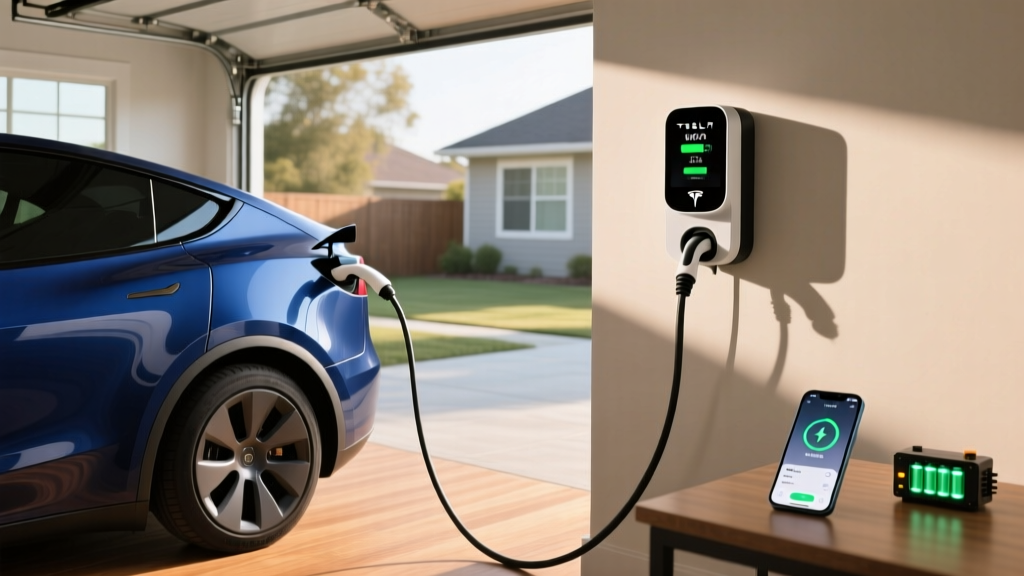
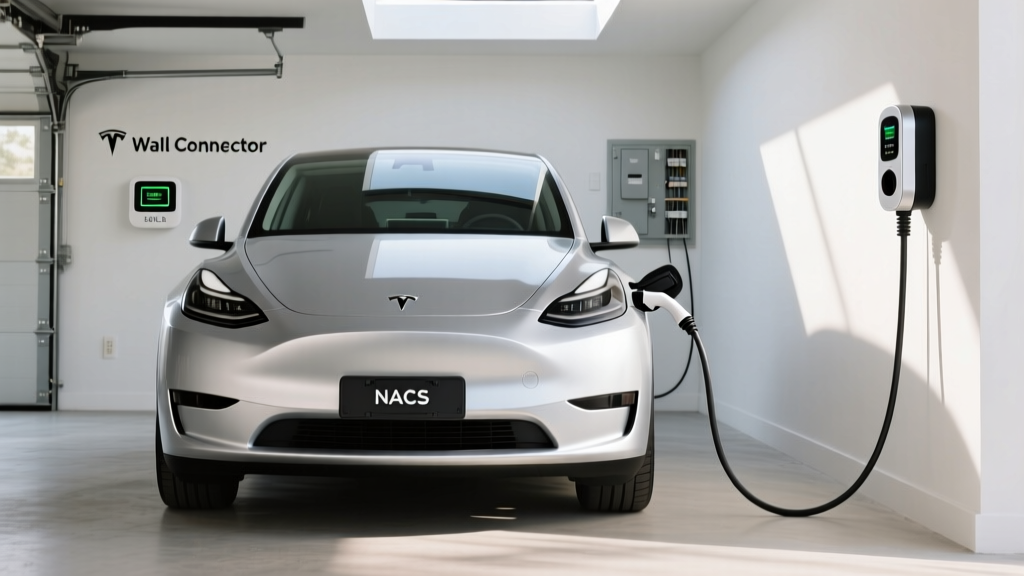
Tesla Wall Connector (NACS)
- Power: Up to 11.5 kW (48A at 240V)
- Cable length: 24 feet
- Connector: Native NACS
- Smart features: Wi-Fi, OTA updates, load sharing with multiple units, Power-Share with Tesla Powerwall
- Price: ~$475
- Best for: Tesla owners wanting seamless integration; also works with any NACS-equipped vehicle
ChargePoint Home Flex (NACS)
- Power: Up to 12 kW (50A at 240V)
- Cable length: 23 feet
- Connector: Native NACS (2025+ models); J1772 with adapter also available
- Smart features: Wi-Fi, app scheduling, Alexa/Google integration, amperage adjustable via dip switch
- Price: ~$650
- Best for: Multi-EV households with mixed connector needs; excellent app
Grizzl-E Smart (NACS)
- Power: Up to 11.5 kW (48A at 240V)
- Cable length: 24 feet
- Connector: Native NACS
- Smart features: Wi-Fi, OCPP support, adjustable amperage, extreme cold rating (-40°F)
- Price: ~$450
- Best for: Cold-climate owners; budget-conscious buyers who want smart features; Canadian-built durability
Emporia Vue Level 2 (NACS)
- Power: Up to 11.5 kW (48A at 240V)
- Cable length: 24 feet
- Connector: Native NACS
- Smart features: Wi-Fi, energy monitoring integration with Emporia Vue panel monitor, solar-aware scheduling
- Price: ~$400
- Best for: Solar-panel owners who want to charge from excess generation; lowest-cost smart NACS charger
Important safety note: All chargers listed above are UL-listed (or ETL-listed to UL standards), which is required for code compliance and insurance coverage. Never install a non-certified charger — it may void your homeowner's insurance in the event of an electrical fire. For outdoor installations, confirm the charger carries a NEMA 4 (weatherproof) rating; all four picks above meet this standard.
Charging Cost Per Mile: Home vs. Public vs. Gasoline
One of the strongest arguments for home charging with a NACS Level 2 setup is economics. Here's how the numbers break down:
| Scenario | Rate | Cost Per Mile* | Annual Cost (12,000 mi) |
|---|---|---|---|
| Home Level 2 (off-peak utility rate) | $0.09/kWh | $0.027 | $324 |
| Home Level 2 (national avg. residential) | $0.16/kWh | $0.048 | $576 |
| Public Level 2 (network pricing) | $0.25–$0.40/kWh | $0.075–$0.12 | $900–$1,440 |
| DC Fast Charging (Supercharger / EA) | $0.30–$0.50/kWh | $0.09–$0.15 | $1,080–$1,800 |
| Gasoline vehicle (25 MPG avg.) | $3.40/gallon | $0.136 | $1,632 |
*Based on an EV efficiency of 3.3 miles per kWh (approximately 100 MPGe combined), which represents the average across popular 2026 EVs including the Tesla Model Y, Ford Mustang Mach-E, and Hyundai Ioniq 5. Source: fueleconomy.gov
The takeaway is clear: home charging at off-peak rates delivers fuel costs roughly 80% lower than gasoline. Even at standard residential rates, you're saving 60–65%. The economics flip if you rely exclusively on DC fast charging — at $0.45–$0.50/kWh, some public fast chargers approach or exceed the per-mile cost of an efficient gasoline car. This is why a home Level 2 NACS charger isn't just a convenience; it's the financial foundation of EV ownership.
Safety, Code Compliance, and Installation Best Practices
EV charging draws sustained high current for hours — a fundamentally different load profile than most household appliances. Proper installation isn't optional; it's a safety requirement.
- Dedicated circuit: Your Level 2 charger must be on its own dedicated breaker — never shared with other outlets or appliances.
- GFCI protection: NEC 2023 (and carried forward in 2026) requires GFCI protection for all EV charging outlets (receptacle-based installations). Hardwired installations may be exempt in some jurisdictions, but many electricians include GFCI breakers regardless for added safety.
- Outdoor rating: If your charger is mounted outside or in an unsealed garage, it must carry at minimum a NEMA 4 rating for weather resistance. All chargers recommended above meet this standard.
- Permit and inspection: Most municipalities require an electrical permit for EV charger installation. The inspection ensures the work meets NEC standards and protects your insurance coverage. Budget $50–$250 and 1–3 weeks for this process.
- Cable management: A 24-foot cable weighs 15–20 pounds. Install a cable organizer or retractable mount to prevent tripping hazards and cable damage from being run over.
- Future-proofing: If you're running new conduit, consider installing wire rated for 60A even if your current charger only draws 40A. Upgrading to a higher-power charger later will require only a unit swap, not a rewire.
Frequently Asked Questions
How much does it cost to install a home NACS EV charger?
For most homes with 200-amp electrical service, total installation (charger + electrician + permit) ranges from $750 to $2,200. If your home has older 100-amp service and needs a panel upgrade, the total can reach $2,250–$5,700. The federal Residential Clean Energy Credit covers 30% of costs up to $1,000. Always get at least three quotes from licensed electricians — prices vary significantly by region and job complexity.
How fast will each charging level add range to my EV?
Level 1 (120V) adds roughly 3–5 miles of range per hour — sufficient only for PHEVs or very low-mileage drivers. Level 2 at 48 amps (11.5 kW) adds approximately 35–45 miles per hour, fully replenishing most EV batteries overnight in 5–8 hours. DC fast charging at 150–250 kW can add 150–300 miles in 20–30 minutes, though charge-curve taper means peak speeds are only sustained at low State of Charge.
Which connector and charger is compatible with my EV?
If your vehicle has a native NACS port (all Teslas, 2025+ Ford, Rivian, GM, 2026+ Hyundai), install a NACS home charger. If your vehicle uses CCS1 (most BMWs, VWs, pre-2026 Kias and Hyundais), you'll need a J1772 or CCS1 home charger and a CCS1-to-NACS adapter to access Tesla Superchargers. Check your owner's manual or the charge port door for the connector type.
How much does charging cost per mile compared to gasoline?
At home off-peak rates (~$0.09/kWh), EV charging costs approximately $0.027 per mile — roughly 80% less than gasoline at $3.40/gallon in a 25 MPG vehicle ($0.136/mile). Even at the national average residential rate of $0.16/kWh, you're paying $0.048/mile. Public DC fast charging at $0.35–$0.50/kWh narrows the gap to $0.10–$0.15/mile, making home charging the economic sweet spot.
What electrical upgrades might my home need for a Level 2 charger?
The most common upgrade is a panel capacity increase from 100A to 200A service, needed in roughly 20–30% of older homes. Your electrician will perform a load calculation to determine if your existing panel has spare capacity. Other potential upgrades include adding a sub-panel near the garage, upgrading the service drop from the utility, or replacing outdated wiring. Budget for a panel upgrade if your home was built before 1990 and hasn't had electrical work since.
Can I use a Tesla Wall Connector with a non-Tesla NACS vehicle?
Yes. The Tesla Wall Connector outputs standard AC power through the NACS connector and is fully compatible with any NACS-equipped vehicle, including the Ford F-150 Lightning, Rivian R1T, Cadillac Lyriq, and 2026 Hyundai Ioniq 5. The Tesla app is not required for non-Tesla vehicles — the charger operates as a standard Level 2 unit.
Sources: EPA Fuel Economy, IRS Residential Clean Energy Credit, NHTSA, manufacturer specification sheets. Electrical installation requirements vary by jurisdiction — always consult a licensed electrician for final specifications. Tax credit eligibility depends on individual circumstances; consult a tax professional.