If you own a Tesla—or are about to buy one—the single most practical question you will face is how long it actually takes to charge. Tesla motors charging time varies dramatically depending on the charging level you use, the specific model and battery size, and whether you are charging at home or on the road. This guide breaks down exact charge rates in kilowatts (kW), real-world 10–80% times, home installation requirements, and the true cost per mile compared to gasoline.
A quick note on terminology that trips up many new EV owners: kW (kilowatts) measures power—the rate at which energy flows into your car, like water pressure from a hose. kWh (kilowatt-hours) measures energy—the total capacity of your battery, like the size of the tank. A higher kW charge rate fills your kWh battery faster. We will use both correctly throughout this guide.
Charging Levels and How Fast Each Adds Range
Tesla vehicles support three charging tiers. Each delivers a fundamentally different experience in terms of speed, cost, and daily practicality. Here is how they stack up for current 2026 Tesla models (Model 3, Model Y, Model S, Model X, and Cybertruck):
| Charging Level | Power (kW) | Voltage / Amperage | Miles of Range Added per Hour | Typical Use Case |
|---|---|---|---|---|
| Level 1 (Standard 120V Outlet) | 1.0–1.4 kW | 120V / 12A | 3–5 miles/hr | Emergency / overnight trickle |
| Level 2 (Home 240V or Wall Connector) | 7.2–11.5 kW | 240V / 32–48A | 25–44 miles/hr | Daily home charging |
| DC Fast Charging (Supercharger V3/V4) | 150–325 kW (peak) | 400–800V DC | Up to 200+ miles in 15 min | Road trips, rapid top-ups |
Tesla Motors Charging Time by Model and Battery Size
Charging time depends directly on your battery's usable capacity (kWh) and the power (kW) available. Here are approximate 10–80% charging times for current Tesla models, based on Tesla's published specifications and real-world testing data:
| Model / Trim | Usable Battery (kWh) | Level 2 at 11.5 kW (hrs) | DC Fast (V3, 250 kW peak) | DC Fast (V4, 325 kW peak) |
|---|---|---|---|---|
| Model 3 RWD (LFP) | ~57.5 kWh | ~3.5 hrs | ~25 min | N/A (LFP limited curve) |
| Model 3 Long Range AWD | ~75 kWh | ~4.5 hrs | ~27 min | ~20 min |
| Model Y Long Range AWD | ~75 kWh | ~4.5 hrs | ~27 min | ~22 min |
| Model S Plaid | ~95 kWh | ~5.8 hrs | ~30 min | ~22 min |
| Cybertruck AWD | ~123 kWh | ~7.5 hrs | ~35 min | ~25 min |
LFP battery note: The Model 3 RWD uses a lithium iron phosphate (LFP) battery. LFP cells tolerate—and actually benefit from—regular charging to 100%, unlike NMC (nickel manganese cobalt) batteries found in Long Range and Performance trims, which Tesla recommends keeping between 20–90% for daily use to minimize degradation. However, LFP batteries typically accept lower peak DC fast-charging rates, so their charge curve above 60% SoC tapers more aggressively.
Home Charging Installation: Electrical Requirements and Costs
Installing a dedicated Level 2 home charger is the single biggest quality-of-life upgrade for any Tesla owner. Here is what the installation actually involves and what it costs in 2026.
Electrical Requirements
A Tesla Wall Connector or equivalent Level 2 charger requires a dedicated 240V circuit. The most common configurations are:
- 40-amp circuit / 32A continuous: Delivers up to 7.7 kW. Requires 8 AWG copper wire. Adequate for most daily charging needs (adds ~25–30 miles per hour).
- 50-amp circuit / 40A continuous: Delivers up to 9.6 kW. Requires 6 AWG copper wire. A popular sweet spot for Tesla owners.
- 60-amp circuit / 48A continuous: Delivers up to 11.5 kW. Requires 4 AWG copper wire. Maximum output for the Tesla Wall Connector. Requires a 200-amp electrical panel in most homes.
Panel Upgrade Reality
Many homes built before 2000 have 100-amp or 150-amp electrical panels. Adding a 50A or 60A dedicated EV circuit may push total load beyond 80% of panel capacity (the National Electrical Code's continuous-load rule). If your panel lacks headroom, expect a panel upgrade to 200A—adding $1,500–$3,500 to the project. Some utilities offer rebates for panel upgrades tied to EV adoption.
Installation Cost Breakdown
| Component | Low Estimate | High Estimate | Notes |
|---|---|---|---|
| Tesla Wall Connector (hardware) | $400 | $475 | Gen 3, 24 ft cable, Wi-Fi enabled |
| Electrician labor (standard install) | $600 | $1,500 | Varies by run length, wall type, conduit |
| Permit and inspection | $50 | $300 | Required in most jurisdictions |
| Electrical panel upgrade (if needed) | $1,500 | $3,500 | 100A → 200A service upgrade |
| Total (no panel upgrade) | $1,050 | $2,275 | Typical scenario for modern homes |
| Total (with panel upgrade) | $2,550 | $5,775 | Common in older homes |
Connector Compatibility: NACS, CCS, and Adapters
As of 2026, the North American Charging Standard (NACS)—originally developed by Tesla—has become the dominant connector across the EV industry. Here is how compatibility breaks down:
| Connector Type | Tesla Vehicles | Non-Tesla EVs | Notes |
|---|---|---|---|
| NACS (Tesla native) | ✅ Native | ✅ (Ford, GM, Rivian, Hyundai, others now equipped) | Standard on all new Tesla vehicles; adopted by most major OEMs |
| CCS1 | ❌ (adapter needed) | ✅ (legacy non-Tesla EVs) | Tesla offers a CCS adapter (~$175) for non-Tesla DC networks |
| CHAdeMO | ❌ (adapter available) | ✅ (Nissan Leaf, older models) | Declining standard; limited new infrastructure |
| J1772 (Level 2 AC) | ✅ (Tesla includes J1772 adapter) | ✅ Native | Standard for public Level 2; Tesla ships adapter with every vehicle |
What this means practically: Tesla owners in 2026 have the broadest charging access of any EV brand. You can use the entire Tesla Supercharger network natively, and with the included J1772 adapter, you can charge at any public Level 2 station. The optional CCS adapter opens up Electrify America, EVgo, and other CCS-equipped networks. Non-Tesla EVs with NACS ports can now access Tesla Superchargers directly.
Cost to Charge: Per-Mile Comparison vs. Gasoline
Charging cost depends heavily on where and when you plug in. Here are realistic $/kWh scenarios for 2026 and the resulting cost per mile for a Tesla Model Y Long Range (averaging ~3.5 miles per kWh, or roughly 28.5 kWh/100 mi):
| Charging Scenario | Cost per kWh | Cost per Mile (Model Y LR) | Equivalent Gas Price for Same Cost* |
|---|---|---|---|
| Home (off-peak utility rate) | $0.08–$0.12 | $0.023–$0.034 | $0.78–$1.16/gal |
| Home (average US residential) | $0.16 | $0.046 | $1.56/gal |
| Public Level 2 (ChargePoint, etc.) | $0.25–$0.49 | $0.071–$0.140 | $2.42–$4.76/gal |
| Tesla Supercharger (V3/V4) | $0.28–$0.48 | $0.080–$0.137 | $2.72–$4.66/gal |
| Gasoline (25 MPG combined, $3.50/gal) | — | $0.140 | $3.50/gal |
*Assumes 25 MPG combined for gas comparison vehicle. Based on fueleconomy.gov data and national average gas prices.
The bottom line: Home charging on an off-peak rate is roughly one-quarter to one-third the per-mile cost of gasoline. Even public DC fast charging is generally comparable to or slightly cheaper than gas—though convenience and pricing vary by network and region. The biggest savings come from charging at home overnight.
Recommended Home Charging Equipment for Tesla Owners
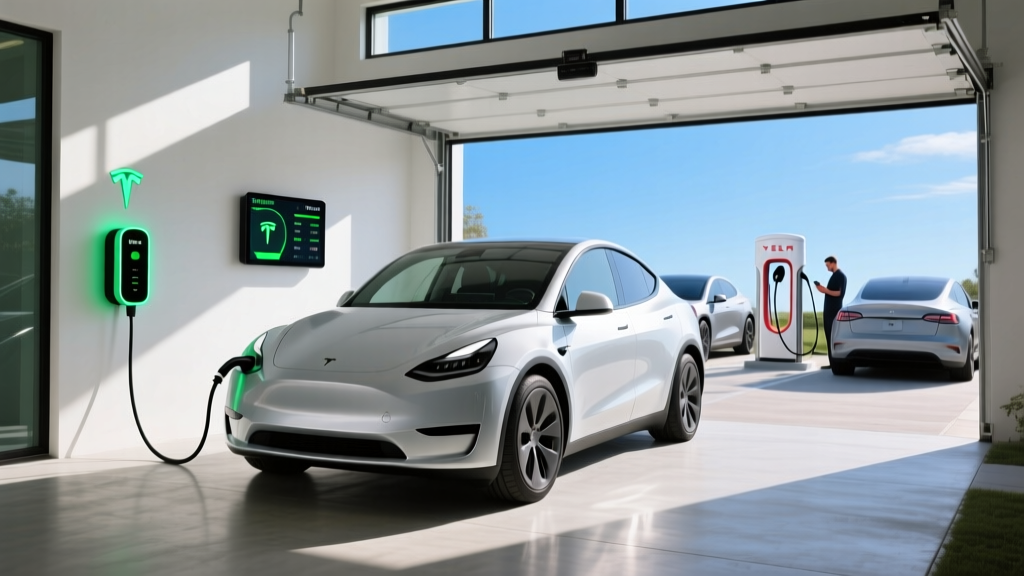
While the Tesla Wall Connector is the default choice, several third-party chargers work well with Tesla vehicles via the J1772 adapter (included with every Tesla) or, increasingly, with native NACS connectors. Here are top picks for 2026:
Tesla Wall Connector (Gen 3)
- Power Output: Up to 11.5 kW (48A on 240V)
- Connector: NACS (native Tesla)
- Cable Length: 24 feet
- Smart Features: Wi-Fi enabled, OTA updates, load sharing (pair two units on one circuit), access control
- Price: ~$400–$475
- Best For: Tesla-only households wanting maximum charge speed and seamless integration
ChargePoint Home Flex (NACS version)
- Power Output: Up to 12 kW (50A adjustable, 240V)
- Connector: NACS (2026 model) or J1772
- Cable Length: 23 feet
- Smart Features: Wi-Fi, ChargePoint app scheduling, Alexa integration, amperage configurable via DIP switch
- Price: ~$550–$650
- Best For: Mixed-EV households or those wanting a robust third-party app experience
Emporia Vue Level 2 Charger
- Power Output: Up to 11.5 kW (48A, 240V)
- Connector: J1772 (NACS adapter available)
- Cable Length: 24 feet
- Smart Features: Integrated energy monitoring, solar-aware charging, Emporia app, load management
- Price: ~$350–$400
- Best For: Budget-conscious buyers or homes with solar panels wanting energy tracking
Safety, Electrical Code, and Installation Best Practices
EV charging involves sustained high-current draw over many hours—a fundamentally different load profile than typical household appliances. Following electrical code and safety best practices is non-negotiable:
- Dedicated circuit: Your Level 2 charger must have its own dedicated circuit—never shared with other appliances. A 50A charger needs a 50A (or larger) breaker with no other loads on that circuit.
- GFCI protection: The 2023 NEC (National Electrical Code) requires GFCI protection for all EV charging outlets. Hardwired installations (like the Tesla Wall Connector) may be exempt in some jurisdictions, but a licensed electrician will advise on local requirements.
- Outdoor rating: If installing outdoors, ensure the charger is rated NEMA 4 (weather-resistant). The Tesla Wall Connector is NEMA 4 rated and suitable for outdoor mounting. Verify that all conduit and junction boxes are also outdoor-rated.
- Wire gauge: Undersized wire is a fire hazard. For a 60A circuit, use 4 AWG copper (or 2 AWG aluminum). Your electrician will calculate based on run length and voltage drop.
- Permit and inspection: Nearly all jurisdictions require an electrical permit for EV charger installation. The inspection ensures code compliance and protects your homeowner's insurance coverage. Skipping the permit risks denied claims in the event of an electrical fire.
- Load calculation: A licensed electrician should perform a full load calculation on your panel before installation. This determines whether your panel can handle the added continuous load or requires an upgrade.
Frequently Asked Questions
How much does it cost to install a home EV charger for a Tesla?
Expect $1,050–$2,275 for a standard installation (Tesla Wall Connector + electrician + permit) if your electrical panel has sufficient capacity. If a panel upgrade from 100A to 200A is required, total costs range from $2,550–$5,775. The federal §30C tax credit may cover 30% of installation costs up to $1,000, depending on your census tract eligibility.
How fast will each charging level add range to my Tesla?
Level 1 (120V) adds roughly 3–5 miles of range per hour. Level 2 at 11.5 kW (48A, 240V) adds approximately 35–44 miles per hour, depending on the model. DC fast charging at a Tesla V3 Supercharger (250 kW peak) can add up to 175 miles in 15 minutes under ideal conditions, though real-world sessions average 120–150 kW over a 10–80% charge due to the charge curve taper.
Which connector and charger is compatible with my Tesla?
All Tesla vehicles use the NACS connector natively. The Tesla Wall Connector is the most seamless home option. For public Level 2 charging, Tesla includes a J1772 adapter with every vehicle. For non-Tesla DC fast-charging networks (Electrify America, EVgo), you need Tesla's optional CCS adapter (~$175). As of 2026, the Supercharger network is also open to non-Tesla EVs equipped with NACS ports.
How much does charging a Tesla cost per mile compared to gas?
Home charging at the US average residential rate ($0.16/kWh) costs approximately $0.046 per mile in a Model Y Long Range—about one-third the cost of gasoline at $3.50/gallon and 25 MPG ($0.14/mile). Off-peak home rates can push costs as low as $0.023–$0.034 per mile. Public DC fast charging ranges from $0.08–$0.14 per mile, making it comparable to or slightly cheaper than gas.
What electrical upgrades might I need for a Tesla home charger?
The most common upgrade is a panel increase from 100A or 150A to 200A service, needed when your existing panel lacks capacity for a dedicated 50–60A circuit. Other potential upgrades include running new conduit from the panel to the garage or carport, upgrading the meter base, or adding a sub-panel if the charger is far from the main panel. A licensed electrician's load calculation will determine exactly what is needed.
Does preconditioning affect Tesla charging time?
Yes, significantly. Tesla's navigation system automatically preconditioning the battery when you route to a Supercharger, warming the cells to optimal temperature for faster charge acceptance. In cold weather (below 40°F), arriving at a Supercharger without preconditioning can reduce peak charge rates by 30–50% and extend 10–80% times by 10–15 minutes. Always navigate to the charger using the Tesla app or in-car navigation to trigger preconditioning.
How does cold weather affect Tesla charging time?
Cold temperatures slow the electrochemical reactions inside lithium-ion cells, reducing charge acceptance rates. In sub-freezing conditions, expect Level 2 charging to be 10–15% slower and DC fast charging to take 20–40% longer if the battery has not been preconditioned. Range also drops by roughly 20–30% in cold weather due to increased cabin heating demands and reduced battery efficiency. Tesla's heat pump (standard on all current models) helps mitigate cabin energy draw.