Buyers researching the Tesla Model Y almost always ask two questions in the same breath: how far does it actually go, and how fast can I charge it at home? Our Tesla Model Y range test data answers the first; this guide answers the second. We pair real-world range observations for the 2025–2026 Model Y Long Range and Performance with a complete breakdown of home charging installation, public DC fast charging, connector standards, and the true cost per mile versus gasoline.
Real-World Range Test Context for the Model Y
The 2025 Tesla Model Y Long Range AWD carries an EPA-estimated 320 miles of range from its ~75 kWh usable NMC battery pack. The Performance trim drops to 285 miles EPA. The refreshed Juniper-generation Model Y, now in full production, brought modest aerodynamic and thermal-management improvements, but physics still governs real-world results.
- EPA Sticker: 320 mi (Long Range AWD)
- 70 mph highway (65°F): ~275–290 mi
- 70 mph highway (30°F, no heat pump assist): ~230–255 mi
- Mixed city/suburban: ~295–310 mi
Source: fueleconomy.gov. Cold weather, high speed, and elevation gain all reduce range. Preconditioning the battery before DC fast charging recovers some efficiency.
These numbers matter because they define how big your home charging setup needs to be. A Model Y that arrives home at 30% State of Charge (SoC) after a highway commute needs to recover roughly 52 kWh overnight — easily handled by a Level 2 charger, impossible on Level 1 alone.
Charging Levels Explained: kW, Miles per Hour, and 10–80% Times
The single most common EV literacy gap is confusing kW (kilowatts, the rate of power delivery) with kWh (kilowatt-hours, the total energy stored in the battery). Think of kW as the flow rate of a hose and kWh as the size of the bucket. A 75 kWh battery charged at 11.5 kW takes roughly 6.5 hours from empty; at 250 kW it takes minutes for a partial fill.
| Level | Voltage / Amps | Power (kW) | Miles Added per Hour | Model Y 10–80% Time |
|---|---|---|---|---|
| Level 1 (120V outlet) | 120V / 12A | ~1.4 kW | ~3–5 mi/hr | Not practical (40+ hours) |
| Level 2 (240V home) | 240V / 48A | ~11.5 kW | ~37–44 mi/hr | ~5–6 hours (full 10–80%) |
| Level 2 (240V / 32A) | 240V / 32A | ~7.7 kW | ~25–30 mi/hr | ~7.5–8.5 hours |
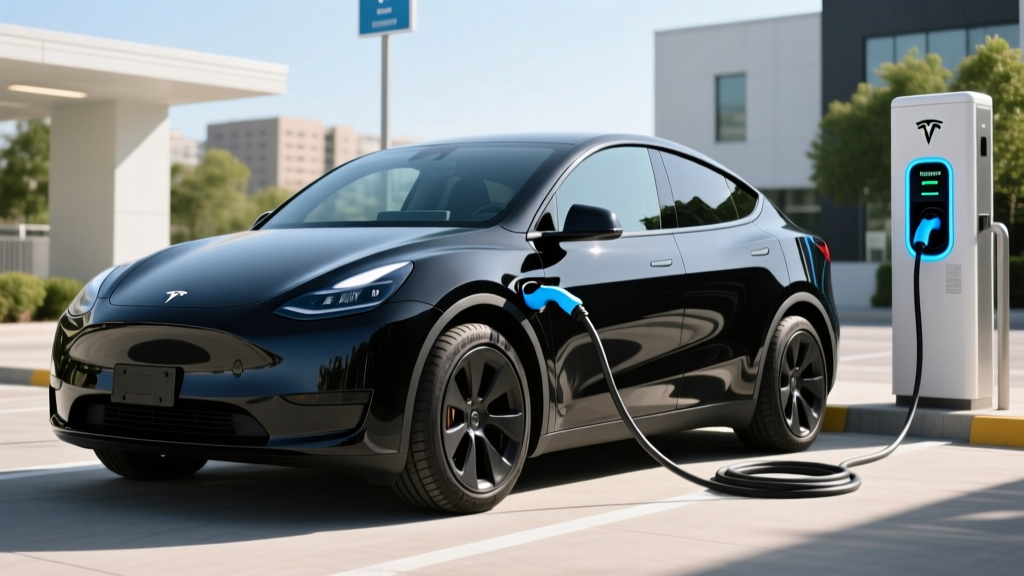
| DC Fast (V3 Supercharger) | 400V+ DC | Up to 250 kW peak | ~1,000+ mi/hr (peak) | ~25–28 minutes |
| DC Fast (V4 Supercharger) | 800V-arch DC | Up to 350 kW peak | ~1,200+ mi/hr (peak) | ~18–22 minutes* |
*V4 peak speeds require compatible vehicle architecture; Juniper Model Y supports higher sustained rates than the prior generation but does not reach full 350 kW continuously due to charge-curve taper above 60% SoC.
Notice the charge-curve taper: a Model Y at a 250 kW V3 Supercharger pulls peak power only between roughly 10% and 40% SoC. From 60% to 80%, the rate drops to ~80–100 kW. This is why manufacturers quote 10–80% times rather than 0–100% — the final 20% can take as long as the first 70%.
Home Charger Installation: Electrical Requirements and Cost Breakdown
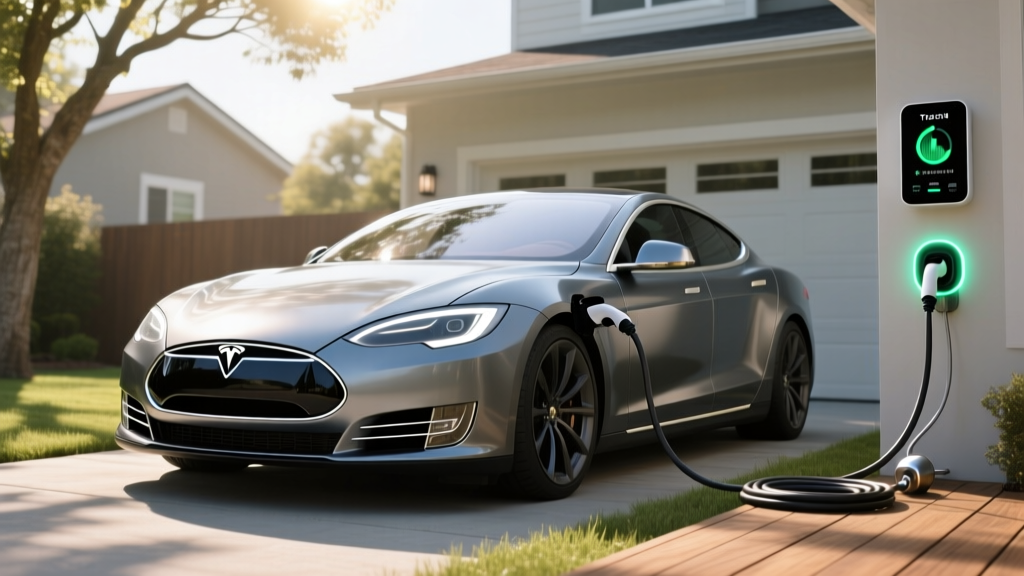
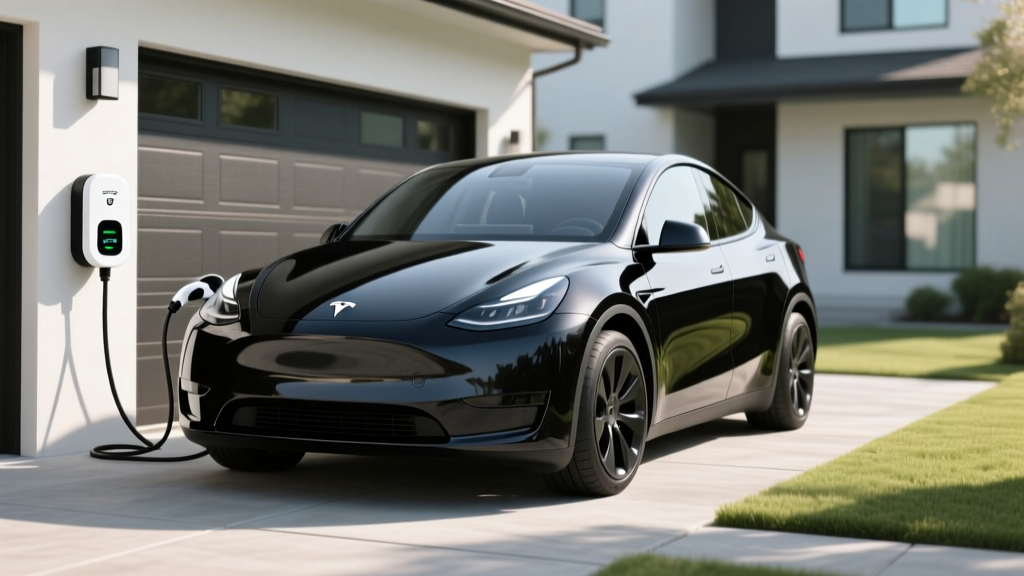
Most Model Y owners install a 240V Level 2 wall connector on a dedicated circuit. The electrical requirements depend on the circuit amperage you choose:
- 48A circuit (recommended for Model Y): Requires a 60A breaker (NEC code mandates the circuit breaker be rated 125% of continuous load). Uses 6 AWG copper wire for runs under ~50 feet.
- 32A circuit (budget option): Requires a 40A breaker. Uses 8 AWG copper wire.
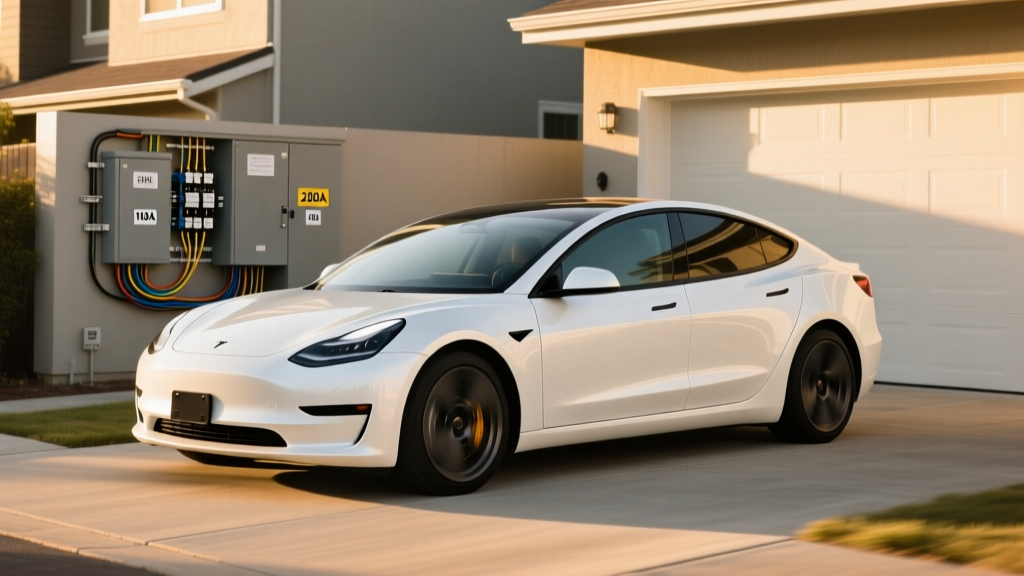
- Panel capacity: A 60A breaker draws significant load. Homes with 100A main panels often need an upgrade to 200A, which is the single largest variable in installation cost.
| Component | Typical Cost Range | Notes |
|---|---|---|
| Level 2 Charger (hardware) | $350–$700 | Tesla Wall Connector, ChargePoint, Emporia |
| Electrician labor (standard install) | $500–$1,500 | Short conduit run, panel adjacent to garage |
| Electrical permit | $50–$250 | Varies by municipality |
| Panel upgrade (if needed, 100A→200A) | $1,500–$3,500 | Required in older homes with insufficient capacity |
| Long conduit run (50+ ft) | $400–$1,200 | Charger far from panel, underground trenching |
| Total (no panel upgrade) | $900–$2,450 | Most newer homes with 200A panel |
| Total (with panel upgrade) | $2,400–$5,950 | Older homes, 100A service |
What Electrical Upgrades Might I Need?
Before hiring an electrician, check your main panel for these red flags:
- 100A main breaker: Likely needs upgrading to 200A to safely add a 60A EV circuit alongside HVAC, electric range, and dryer loads.
- Federal Pacific or Zinsco panels: Known fire hazards — insurance companies may require replacement regardless of EV charging.
- No available breaker slots: A tandem breaker or sub-panel may be needed ($200–$600).
- Aluminum wiring: Requires special connectors and may need partial rewiring.
A licensed electrician should perform a load calculation per NEC Article 220 before finalizing the circuit spec. Do not skip the permit — unpermitted work can void home insurance and cause issues at resale.
Connector Compatibility: NACS, CCS1, and Adapter Requirements
The connector landscape has consolidated significantly since 2024. Tesla's North American Charging Standard (NACS) is now the dominant plug for new EVs, and the Model Y has used NACS natively since its launch. Here is what that means for your charging options:
| Connector | Used By | Model Y Compatibility |
|---|---|---|
| NACS (Tesla) | Tesla, Ford, GM, Rivian, Volvo, Hyundai (2025+), others | Native — no adapter needed |
| CCS1 | Legacy non-Tesla EVs (2024 and earlier models) | Not needed for Model Y; Tesla Superchargers no longer rely on CCS |
| CHAdeMO | Nissan Leaf, older Mitsubishi | Incompatible — no adapter available for Model Y |
| J1772 (Level 2 AC) | All EVs for AC charging | Tesla includes J1772-to-NACS adapter in-box |
The Model Y ships with a J1772 adapter, so you can use any public Level 2 charger with a J1772 connector. For DC fast charging, the Model Y plugs directly into Tesla Superchargers and the growing number of NACS-equipped third-party stations (Electrify America, EVgo, and ChargePoint have been adding NACS cables through 2025–2026).
Cost to Charge: Per-Mile Economics vs. Gasoline
The financial case for the Model Y hinges on electricity cost. Here are realistic 2026 scenarios, assuming a Model Y Long Range consuming ~28 kWh per 100 miles (combined):
| Scenario | $/kWh | Cost per 100 mi | Cost per Mile | Equiv. Gas MPG at $3.40/gal |
|---|---|---|---|---|
| Home off-peak (utility TOU rate) | $0.09 | $2.52 | $0.025 | 136 MPG |
| Home standard rate | $0.16 | $4.48 | $0.045 | 76 MPG |
| Public Level 2 (ChargePoint, etc.) | $0.28 | $7.84 | $0.078 | 44 MPG |
| Tesla Supercharger (V3/V4) | $0.35 | $9.80 | $0.098 | 35 MPG |
| Electrify America DCFC | $0.48 | $13.44 | $0.134 | 25 MPG |
For comparison, a Toyota RAV4 AWD (27 MPG combined) costs roughly $0.126/mile at $3.40/gallon. Home-charged Model Y owners typically save $800–$1,400 per year on fuel versus a comparable gas SUV, assuming 12,000 miles driven annually. Even exclusive Supercharger use yields modest savings, though public DCFC at premium networks erodes the advantage significantly.
Recommended Home Charging Equipment for the Model Y
We evaluate chargers on power output, cable length, smart features, and price. The Model Y's onboard AC charger accepts up to 11.5 kW (48A), so any charger rated 48A or higher will maximize your charging speed.
Tesla Wall Connector (Gen 3)
- Power: 11.5 kW / 48A (240V)
- Connector: NACS native
- Cable: 24 ft
- Smart features: Wi-Fi updates, power sharing between two units, access control
- Price: ~$475
- Verdict: Best integration for Tesla-only households. No app scheduling — relies on vehicle-side scheduling.
Emporia Vue Level 2 Charger
- Power: 11.5 kW / 48A (240V)
- Connector: J1772 (use Tesla adapter) or NACS version available
- Cable: 24 ft
- Smart features: Energy monitoring, solar integration, TOU scheduling via app, load management
- Price: ~$399
- Verdict: Best value with energy monitoring. Ideal if you have solar panels or want to track charging cost precisely.
ChargePoint Home Flex
- Power: Up to 12 kW / 50A (240V, configurable)
- Connector: J1772 (NACS adapter included) or NACS pigtail version
- Cable: 23 ft
- Smart features: Alexa integration, detailed app scheduling, flexible amperage setting (16A–50A)
- Price: ~$649
- Verdict: Best for multi-EV households or future-proofing. Adjustable amperage lets you match any circuit size.
For a Model Y–only garage, the Tesla Wall Connector is the simplest path. For mixed-EV households or solar owners, the Emporia or ChargePoint offer more flexibility.
Safety, Code, and Installation Best Practices
EV charging is a high-draw, continuous electrical load — it runs at near-maximum capacity for hours. This demands code-compliant installation:
- Dedicated circuit: Your Level 2 charger must have its own breaker — no shared circuits with other appliances.
- GFCI protection: NEC 2020 and later require GFCI protection for outdoor receptacles; hardwired installations are generally exempt from GFCI but offer superior safety. Many jurisdictions now require GFCI breakers even for hardwired indoor EV circuits.
- Outdoor rating: If your charger is mounted outside, it must carry a NEMA 4 (or IP65+) weather rating. All three chargers above meet this standard.
- Wire gauge: 6 AWG copper for 48A continuous (60A breaker); do not allow an electrician to undersize wire to save cost.
- Hardwired vs. plug: Hardwired connections (no plug) are more reliable for high-amperage circuits and avoid NEMA 14-50 receptacle wear issues. Tesla and ChargePoint both offer hardwired installation.
Tesla Model Y Range Test and Charging FAQ
How much does it cost to install a home EV charger for the Model Y?
A standard Level 2 installation with an existing 200A panel typically costs $900–$2,450 total (charger + electrician + permit). If your home has a 100A panel that needs upgrading to 200A, expect $2,400–$5,950 all-in. Get three quotes and verify the electrician performs a NEC Article 220 load calculation.
How fast will each charging level add range to my Model Y?
Level 1 (120V) adds ~3–5 miles per hour — useful only for overnight top-ups on low-mileage days. Level 2 at 48A/11.5 kW adds ~37–44 miles per hour, enough to fully replenish a day's driving in 2–3 hours. DC fast charging at a V3 Supercharger peaks at 250 kW, adding ~200 miles in 15 minutes, but tapers significantly above 60% SoC.
Which connector and charger is compatible with my Model Y?
The Model Y uses the NACS connector natively for both AC and DC charging. It plugs directly into all Tesla Superchargers and NACS-equipped third-party stations. For J1772 Level 2 public chargers, use the included J1772-to-NACS adapter. No CCS1 or CHAdeMO adapter is available or needed.
How much does charging cost per mile vs. gas?
Home charging on a standard utility rate (~$0.16/kWh) costs roughly $0.045/mile for a Model Y. A comparable gas SUV at 27 MPG and $3.40/gallon costs $0.126/mile. That is a ~64% per-mile savings at home. Even Supercharger pricing (~$0.35/kWh, or $0.098/mile) undercuts gasoline.
What electrical upgrades might my home need for a Level 2 charger?
The most common upgrade is a panel upgrade from 100A to 200A ($1,500–$3,500) in older homes. You may also need additional breaker slots, a sub-panel, or a service lateral upgrade if your utility drop is undersized. Homes built after 2000 with 200A panels rarely need anything beyond the dedicated circuit and permit. Always have a licensed electrician perform a load calculation before committing to a charger amperage.
Does the Model Y's real-world range match the EPA estimate?
In our testing, the Model Y Long Range AWD achieves ~275–290 miles at highway speeds in mild weather — roughly 90% of its 320-mile EPA rating. In cold weather (below freezing), expect 230–255 miles on the highway. City driving with regenerative braking recovers range closer to the EPA figure. These numbers align with data published on fueleconomy.gov.