Why Tesla Model Y Owners in Australia Want More Range — and How Charging Unlocks It
Australians searching for a Tesla Model Y range increase in Australia often land on software hacks or aftermarket modifications. The truth is more practical: the single biggest factor in usable daily range is how efficiently and completely you charge at home, combined with route-planning discipline on DC fast chargers. The Model Y's usable battery capacity (approximately 75 kWh for the Long Range AWD variant sold in Australia) doesn't magically grow, but the effective range you extract from each charge session can shift by 40–80 km depending on charging habits, thermal preconditioning, and whether you're using the right Level 2 equipment.
This guide covers the charging infrastructure, connector standards, costs, and equipment that directly impact how much range you actually get from a Tesla Model Y on Australian roads — whether you're commuting in Sydney or tackling the Hume Highway.
Charging Levels Explained: Level 1, Level 2, and DC Fast for Australian Homes
Understanding the difference between kW (power — how fast energy flows) and kWh (energy — how much the battery stores) is essential. A 75 kWh battery charged at 7 kW (Level 2) takes roughly 10+ hours from empty; the same battery on a 250 kW DC fast charger can reach 80% in about 25 minutes. Here's how each level performs:
| Level | Typical Power (kW) | Voltage / Phase | Approx. Range Added per Hour | Best Use Case |
|---|---|---|---|---|
| Level 1 (Granny Charger) | 1.4–2.3 kW | 230V / Single-phase (AU) | 7–14 km/hr | Emergency top-ups, overnight trickle |
| Level 2 (Home Wall Connector) | 7–22 kW | 230V single / 400V three-phase | 35–110 km/hr | Daily home charging, full overnight refill |
| DC Fast Charging (Supercharger / public) | 50–250 kW | DC direct to battery | 300–1,000+ km/hr (peak) | Road trips, rapid top-ups |
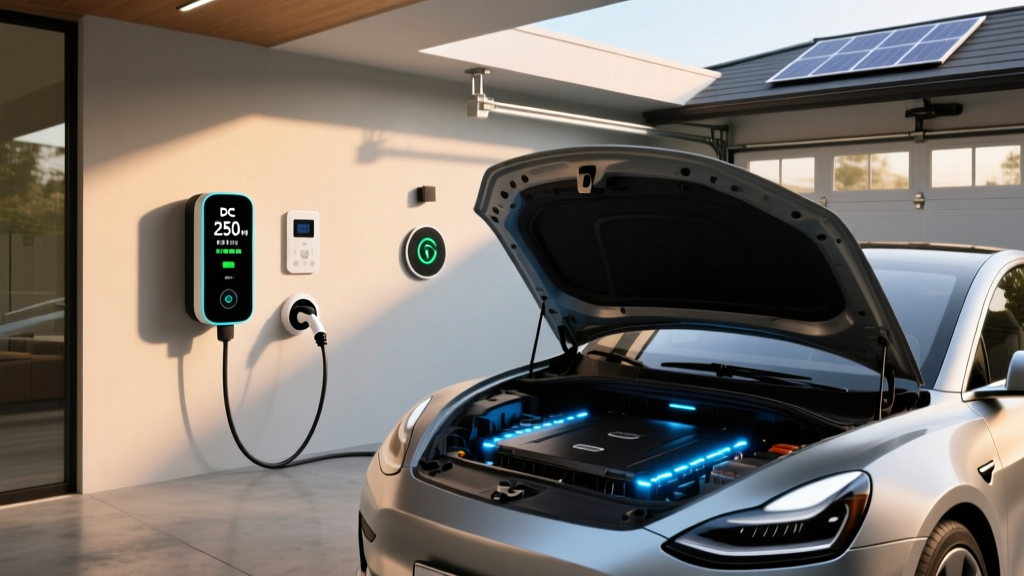
The Tesla Model Y Long Range supports a peak DC fast charge rate of approximately 250 kW on V3 Superchargers. However, that peak is sustained only between roughly 10–30% State of Charge (SoC). Above 50%, the charge curve tapers significantly — by 80%, you're often pulling under 50 kW. This is why Tesla's navigation system recommends charging to 80% on road trips and moving on; the time spent waiting for 80–100% is rarely worth it.
Home Charger Installation in Australia: Electrical Requirements, Costs, and Panel Upgrades
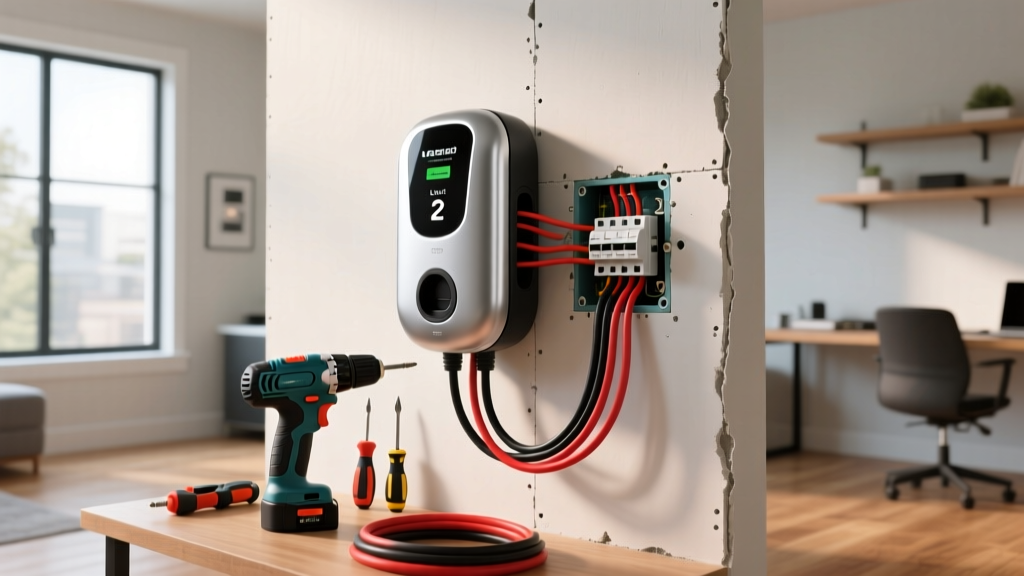
Installing a dedicated Level 2 home charger is the single most effective upgrade for extracting maximum usable range from your Model Y. A proper installation ensures you wake up to a full battery every morning, eliminating the need to detour to public chargers and letting you take advantage of off-peak electricity rates.
Electrical Requirements for Australian Homes
A typical Tesla Wall Connector or equivalent Level 2 unit in Australia requires:
- Single-phase supply: 230V, 32A circuit (7.4 kW) — sufficient for most homes and fully recharges a Model Y overnight in approximately 10 hours
- Three-phase supply (preferred): 400V, 16A or 32A per phase (11–22 kW) — recharges in 4–7 hours, ideal for larger battery packs or dual-EV households
- Dedicated circuit: The charger must be on its own circuit breaker, not shared with other high-draw appliances
- RCD/RCBO protection: Australian Standard AS/NZS 3000 requires residual current protection — a Type A or Type B RCBO is typically specified by the installer
Installation Cost Breakdown
| Component | Typical Cost (AUD) | Notes |
|---|---|---|
| Level 2 Charger Unit (e.g., Tesla Wall Connector) | $750–$1,200 | Tesla Gen 3 Wall Connector approx. $750 AUD; third-party units $800–$1,200 |
| Electrician Labour (standard install) | $800–$1,800 | Depends on cable run distance from switchboard; longer runs = higher cost |
| Switchboard Upgrade (if needed) | $1,200–$3,000 | Older homes with ceramic fuses or insufficient capacity need a modern board with RCBOs |
| Three-Phase Upgrade (if not available) | $3,000–$8,000+ | Requires utility (e.g., Ausgrid, Energex) involvement; varies enormously by location |
| Permit / Compliance Certificate | $150–$400 | Mandatory electrical safety certificate per state regulations |
| Total — Standard Single-Phase Install | $1,700–$3,400 | Most common scenario for modern Australian homes |
| Total — With Switchboard + 3-Phase Upgrade | $5,000–$12,000+ | Older homes or high-capacity setups |
Connector Compatibility: NACS, CCS2, and What Australian Model Y Owners Need to Know
Australia's Tesla Model Y fleet uses the CCS2 (Combined Charging System Type 2) connector for DC fast charging and the Type 2 (Mennekes) connector for AC Level 2 charging. This is different from the North American market, where Tesla uses its proprietary NACS connector and is transitioning the broader industry to it.
| Connector | Type | Used By (Australia) | Adapter Needed for Model Y? |
|---|---|---|---|
| Type 2 (Mennekes) | AC Level 2 | Tesla Model Y, virtually all Euro-spec EVs in AU | No — native port |
| CCS2 | DC Fast | Tesla Model Y, most modern EVs in AU | No — native port (lower pins) |
| CHAdeMO | DC Fast | Nissan Leaf, older Mitsubishi Outlander PHEV | Yes — CHAdeMO-to-CCS2 adapters exist but are expensive (~$500–$800 AUD) and uncommon |
| NACS (Tesla North America) | AC + DC | Not used in Australia | N/A — Australian Superchargers use CCS2-attached cables or Tesla-specific connectors on legacy stalls |
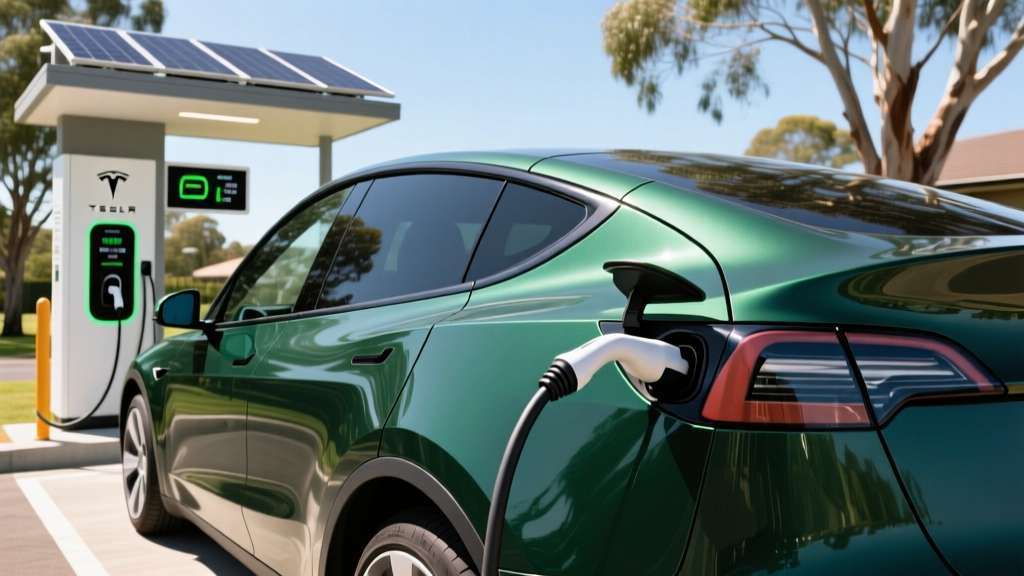
Key takeaway: If you own a Tesla Model Y in Australia, you can use every Tesla Supercharger (which uses a Tesla-proprietary connector on older V2 stalls or CCS2 on newer V3/V4 stalls) plus the growing network of third-party CCS2 chargers from Chargefox, Evie Networks, Ampol AmpCharge, and BP Pulse. No adapter is required for the vast majority of public charging.
Cost to Charge: Home vs. Public vs. DC Fast — and Cost per Kilometre Compared to Petrol
The financial case for EV ownership in Australia hinges on charging costs. Electricity prices vary significantly by state and tariff structure, so the numbers below represent common 2025–2026 scenarios.
| Charging Scenario | Cost per kWh (AUD) | Cost to Charge 75 kWh (0–100%) | Cost per 100 km (est. 16 kWh/100 km) | Equivalent Petrol Cost per 100 km* |
|---|---|---|---|---|
| Home Off-Peak (controlled load / solar soak) | $0.18–$0.25 | $13.50–$18.75 | $2.88–$4.00 | $14.00–$18.00 (at $2.00–$2.50/L, 7 L/100 km) |
| Home Standard Rate (anytime) | $0.30–$0.40 | $22.50–$30.00 | $4.80–$6.40 | $14.00–$18.00 |
| Home Solar (excess feed-in offset) | $0.05–$0.10 (effective) | $3.75–$7.50 | $0.80–$1.60 | $14.00–$18.00 |
| Public AC (shopping centre, workplace) | $0.40–$0.60 | $30.00–$45.00 | $6.40–$9.60 | $14.00–$18.00 |
| DC Fast (Chargefox / Evie 50–350 kW) | $0.60–$0.79 | $45.00–$59.25 | $9.60–$12.64 | $14.00–$18.00 |
| Tesla Supercharger V3/V4 (member pricing) | $0.52–$0.66 | $39.00–$49.50 | $8.32–$10.56 | $14.00–$18.00 |
*Petrol comparison based on a mid-size SUV averaging 7–8 L/100 km at 2025–2026 Australian metro fuel prices.
Even on the most expensive DC fast chargers, the Model Y costs less per kilometre than an equivalent petrol SUV. But the real savings emerge at home with off-peak tariffs or rooftop solar — where the cost per 100 km drops to under $4, compared to $14–$18 for petrol. Over 20,000 km of annual driving, that's a fuel savings of approximately $2,000–$3,200 AUD per year.
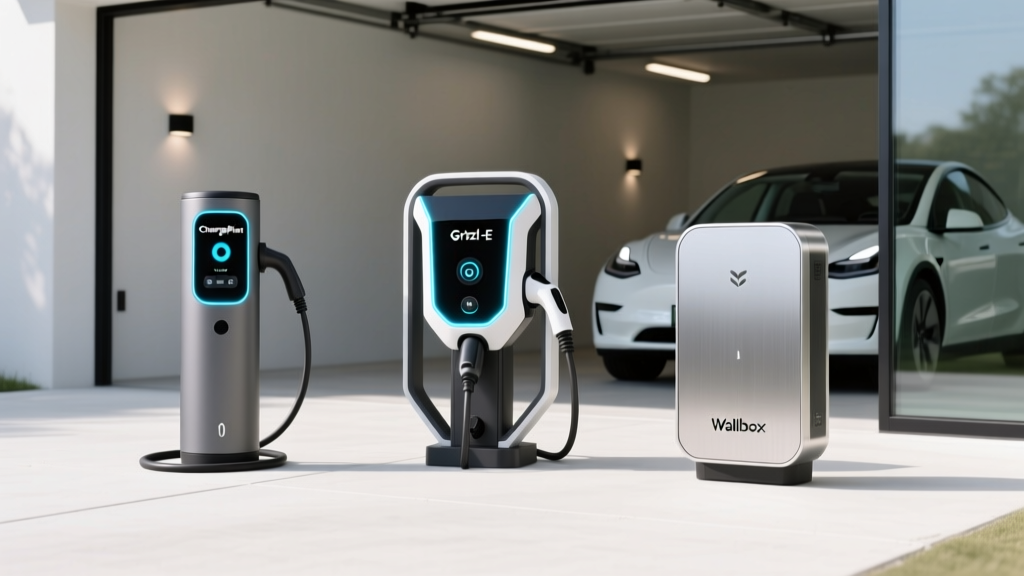
Best Home Chargers for the Tesla Model Y in Australia: Equipment Picks for 2025–2026
Not all Level 2 chargers are equal. The right unit for your Model Y depends on your electrical supply (single or three-phase), cable length needs, and whether you want smart scheduling to exploit off-peak tariffs.
Tesla Wall Connector (Gen 3)
- Power Output: Up to 22 kW (three-phase) / 7.4 kW (single-phase)
- Connector: Type 2 tethered cable (6.5 m)
- Smart Features: Wi-Fi, OTA updates, load sharing (pair two units on one circuit), Tesla app integration
- Price: ~$750 AUD (unit only)
- Verdict: Best value for Tesla-only households. Seamless integration, but no scheduling via third-party energy apps.
Wallbox Pulsar Max
- Power Output: Up to 22 kW (three-phase) / 7.4 kW (single-phase)
- Connector: Type 2 tethered cable (5 m or 7 m options)
- Smart Features: Wi-Fi + Bluetooth, myWallbox app scheduling, solar surplus charging (Eco-Smart mode), OCPP compatible
- Price: ~$1,100–$1,400 AUD
- Verdict: Best for solar homes wanting automated surplus-divert charging. Works with any EV brand.
Zappi v2.1 (myenergi)
- Power Output: Up to 22 kW (three-phase) / 7.4 kW (single-phase)
- Connector: Type 2 tethered (6.5 m) or untethered socket
- Smart Features: ECO / ECO+ / FAST modes, solar + battery diversion, built-in CT clamps, hub for remote monitoring
- Price: ~$1,300–$1,600 AUD
- Verdict: Premium pick for homes with solar + home battery (e.g., Tesla Powerwall). Granular energy management.
EO Mini Pro 3
- Power Output: 7.4 kW (single-phase only)
- Connector: Type 2 tethered or untethered
- Smart Features: Compact form factor, EO Smart Home app, solar matching (with CT clamp), load balancing
- Price: ~$900–$1,100 AUD
- Verdict: Best for apartments or homes with limited switchboard space. Single-phase only.
Charging Time Examples: How Long to Charge the Tesla Model Y in Australia
Real charging times depend on the battery's starting State of Charge, ambient temperature, and — for DC fast charging — the charge curve taper. The Model Y Long Range AWD sold in Australia has approximately 75 kWh of usable battery capacity (LFP chemistry on the Rear-Wheel Drive variant, NMC on Long Range/Performance).
| Charging Scenario | Starting SoC | Target SoC | Average Power | Approx. Time | Range Added (approx.) |
|---|---|---|---|---|---|
| Home Level 2 — 7.4 kW (single-phase) | 10% | 100% | 7.4 kW sustained | ~9–10 hours | ~450 km |
| Home Level 2 — 11 kW (three-phase, 16A) | 10% | 100% | 11 kW sustained | ~6–7 hours | ~450 km |
| Home Level 2 — 22 kW (three-phase, 32A) | 10% | 100% | ~18 kW avg (onboard charger limit) | ~4–5 hours | ~450 km |
| DC Fast — Tesla Supercharger V3 (250 kW peak) | 10% | 80% | ~110 kW avg | ~25–28 minutes | ~330 km |
| DC Fast — Chargefox 350 kW (CCS2) | 10% | 80% | ~100 kW avg (car-limited) | ~28–32 minutes | ~330 km |
| DC Fast — 50 kW public charger | 10% | 80% | ~45 kW avg | ~60–70 minutes | ~330 km |
| Level 1 — 10A granny charger (2.3 kW) | 10% | 100% | 2.3 kW sustained | ~30+ hours | ~450 km |
Critical insight for range maximisation: The Model Y's onboard AC charger is limited to approximately 11 kW (three-phase) or 7.4 kW (single-phase). Even if you install a 22 kW charger, a single-phase home will only deliver 7.4 kW to the car. To unlock faster AC charging, you need a three-phase electrical supply — this is where the panel upgrade cost becomes a real consideration.
Safety, Code Compliance, and Practical Installation Considerations
Every EV charger installation in Australia must comply with AS/NZS 3000 (Wiring Rules) and relevant state electrical safety regulations. Key requirements include:
- Dedicated circuit: The charger must be on its own miniature circuit breaker (MCB) — typically 32A or 40A — not shared with other loads
- RCD/RCBO protection: Type A RCBO minimum; Type B recommended (particularly for chargers without built-in DC leakage detection). This protects against electrical fault currents
- Cable sizing: 6 mm² copper for 32A circuits; 10 mm² for 40A or longer cable runs. Undersized cables create fire risk and voltage drop
- Outdoor rating: If the charger is installed outside (carport, driveway), it must be rated IP54 or higher for weather resistance. The Tesla Wall Connector Gen 3 is rated IP55 — suitable for Australian outdoor conditions
- Earth electrode: Some installations in TN-C-S (MEN) systems may require verification of earth electrode integrity — your electrician will test this
- Load management: If your home's maximum demand is close to the main fuse rating, a dynamic load balancer (built into some chargers like the Zappi or available as an add-on) will throttle charging power when other appliances are drawing heavily
Real-World Tips to Maximise Tesla Model Y Range in Australian Conditions
Beyond the charging hardware itself, these practices directly increase the usable range you get from each charge:
- Precondition while plugged in: Use the Tesla app to set a departure time. The car will warm or cool the battery and cabin using grid power before you leave — preserving battery energy for driving. This is especially impactful in cold Victorian and Tasmanian winters, where a cold battery can lose 10–15% of range to internal heating.
- Charge to 80% daily, 100% for trips: If your Model Y has an NMC battery (Long Range, Performance), Tesla recommends daily charging to 80% to preserve long-term battery health. Charge to 100% only when you need maximum range for a trip, and depart soon after reaching full. The LFP battery in the Rear-Wheel Drive variant can (and should) be charged to 100% regularly for accurate SoC calibration.
- Use regenerative braking effectively: Set regen to "Standard" (when available) for one-pedal driving around town. In hilly terrain (Adelaide Hills, Blue Mountains), this recovers significant energy on descents.
- Tyre pressure matters more than you think: The Model Y is heavy (~1,900–2,000 kg). Under-inflated tyres increase rolling resistance and can cost 5–10% of range. Check pressures monthly and keep them at the door-jamb sticker spec (typically 42 psi / 2.9 bar).
- Plan DC fast stops with Tesla navigation: When you enter a Supercharger destination, the car automatically preconditions the battery for optimal charge speed. Arriving at a Supercharger without preconditioning can add 10–15 minutes to your stop because the battery charges slower when cold.
Frequently Asked Questions
How much does it cost to install a home EV charger in Australia?
A standard single-phase Level 2 installation (charger unit + electrician + compliance certificate) typically costs $1,700–$3,400 AUD. If your home needs a switchboard upgrade, add $1,200–$3,000. A full three-phase upgrade from a single-phase supply can push total costs to $5,000–$12,000+ depending on your distributor and cable run complexity.
How fast will each charging level add range to my Model Y?
Level 1 (2.3 kW) adds roughly 7–14 km per hour. Level 2 at 7.4 kW (single-phase) adds approximately 35–45 km per hour. Level 2 at 11 kW (three-phase) adds roughly 55–65 km per hour. DC fast charging at peak rates (250 kW) can add over 200 km in 15 minutes, but the rate tapers significantly above 50% SoC.
Which connector is compatible with my Australian Tesla Model Y?
Australian-delivered Tesla Model Y vehicles use a Type 2 (Mennekes) port for AC charging and CCS2 for DC fast charging. You can use Tesla Superchargers (V2 with Tesla connector, V3/V4 with CCS2) plus third-party CCS2 chargers from Chargefox, Evie, and others. No adapter is needed for the vast majority of Australian public charging infrastructure.
How much does charging cost per kilometre compared to petrol?
Charging at home on an off-peak tariff costs approximately $0.03–$0.04 per kilometre. Petrol for an equivalent mid-size SUV costs roughly $0.14–$0.18 per kilometre at 2025–2026 Australian fuel prices. Even on the most expensive public DC fast chargers (~$0.79/kWh), the Model Y costs about $0.10–$0.13 per km — still cheaper than petrol.
What electrical upgrades might I need for a home charger?
Common upgrades include: a modern switchboard with RCBO protection ($1,200–$3,000), upgrading from a 63A to 100A main service fuse if maximum demand calculations require it, and potentially a three-phase supply connection ($3,000–$8,000+). Older homes with ceramic fuse boards will almost certainly need a full switchboard replacement before any EV charger can be legally installed.
Does the Tesla Model Y LFP battery change how I should charge?
Yes. The Rear-Wheel Drive Model Y uses an LFP (lithium iron phosphate) battery, which Tesla recommends charging to 100% at least once per week for accurate SoC calibration. The Long Range and Performance variants use NMC chemistry, where daily charging to 80% is recommended for longevity, with 100% reserved for trip days. LFP batteries also tolerate more charge cycles with less degradation, but are slightly heavier and offer marginally less range in cold weather.
For the latest Australian electricity tariff data and EV charging infrastructure maps, check the Australian Government Department of Climate Change, Energy, the Environment and Water and the Electric Vehicle Council of Australia. Tesla's official Home Charging Installation guide for Australia provides approved installer directories and Wall Connector specifications.