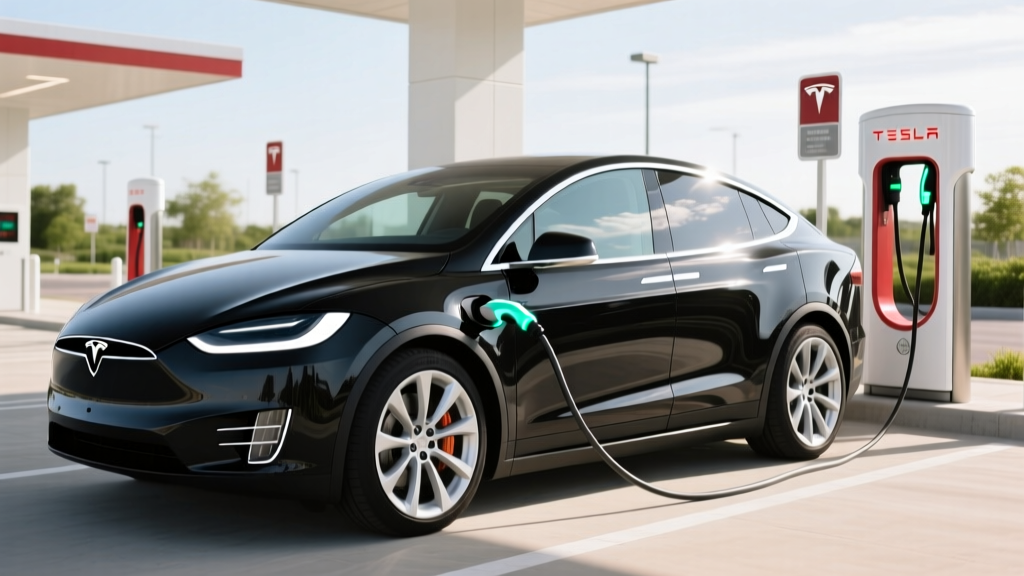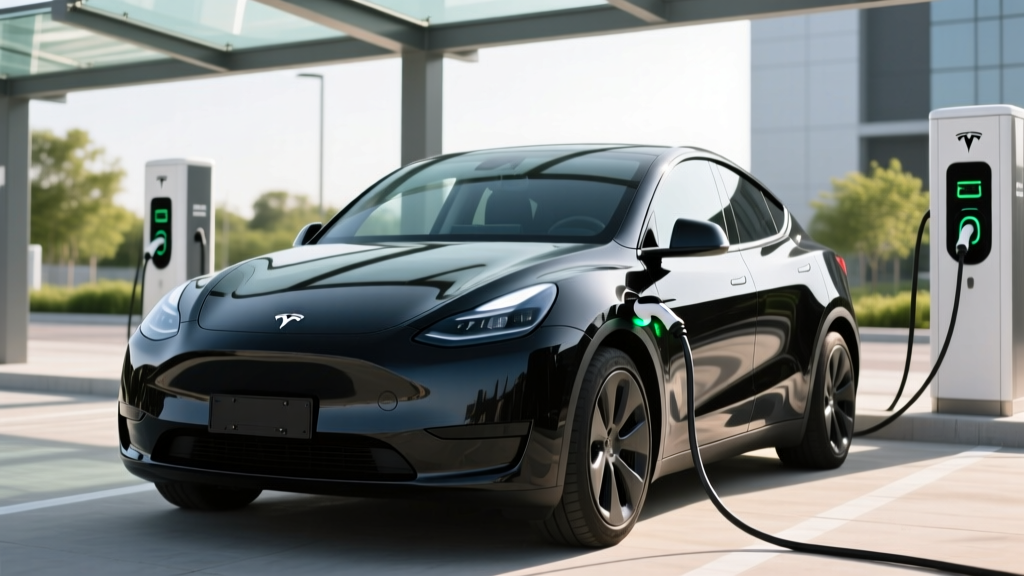
If you own or are considering a Tesla Model Y, understanding how charging directly impacts your real-world miles is the single most important ownership skill you can develop. The 2025 Tesla Model Y Long Range AWD carries an EPA-rated 320 miles of range from its ~75 kWh usable NMC battery pack, but how you charge—and how fast—determines how many of those miles you actually use and how much you pay per mile driven.
This guide maps every charging option available to Model Y owners in 2026, from overnight Level 2 home charging to DC fast charging on road trips, with exact speeds, costs, and installation requirements.
How Charging Levels Affect Your Tesla Model Y Miles Range
The three charging levels differ fundamentally in power delivery, measured in kilowatts (kW). Power (kW) is the rate of energy flow; energy (kWh) is what fills your battery. Think of kW as the speed of water through a hose and kWh as the total gallons in your bucket. The Model Y Long Range's ~75 kWh battery needs different amounts of time depending on the kW rate.
| Level | Power (kW) | Voltage / Amperage | Miles of Range Added per Hour | Full 10–80% Time |
|---|---|---|---|---|
| Level 1 (120V) | 1.0–1.4 kW | 120V / 12A | 3–5 mi/hr | ~50+ hours (impractical) |
| Level 2 (240V) | 7.7–11.5 kW | 240V / 32–48A | 25–44 mi/hr | ~5–7 hours |
| DC Fast (Supercharger) | Up to 250 kW peak | 400V architecture | Up to ~1,000 mi/hr (peak) | ~25 min (10–80%) |
Home Charging Installation: Requirements, Costs, and Upgrades
For most Model Y owners, a Level 2 home charger is the backbone of daily driving. You wake up every morning with a full battery, and your cost per mile drops to a fraction of gasoline. But installation isn't as simple as plugging in an appliance.
Electrical Requirements
The Tesla Wall Connector (Gen 3) delivers up to 11.5 kW on a 240V / 48A dedicated circuit. This requires a NEMA 14-50 outlet (if using the Mobile Connector) or a hardwired connection rated for 60A (the circuit breaker must be rated at 125% of continuous load, per NEC 625). Most newer homes with 200A electrical panels can accommodate this without a panel upgrade, but older homes with 100A service may need a panel upgrade costing $1,500–$3,500.
| Component | Low Estimate | High Estimate | Notes |
|---|---|---|---|
| EV Charger (Tesla Wall Connector) | $400 | $475 | 24 ft cable, Wi-Fi, NACS native |
| Electrician Labor | $500 | $2,000 | Varies by run length, conduit, drywall work |
| Permit & Inspection | $50 | $300 | Required in most jurisdictions |
| Electrical Panel Upgrade (if needed) | $1,500 | $3,500 | 100A → 200A service upgrade |
| Total (no panel upgrade) | $950 | $2,775 | Most common scenario |
| Total (with panel upgrade) | $2,450 | $6,275 | Older homes |
Load management alternative: If a panel upgrade is cost-prohibitive, devices like the Emporia Smart Load Center or Tesla's built-in load management can throttle charger amperage dynamically based on household draw, allowing a Level 2 install on a 100A panel at reduced power (e.g., 24A / 5.8 kW). This still delivers ~22 miles of range per hour—enough for overnight replenishment.
Connector Compatibility: NACS, CCS, and Adapters
The 2025 Tesla Model Y uses the North American Charging Standard (NACS) connector natively—no adapter needed at Tesla Superchargers. However, the broader charging landscape in 2026 includes CCS1 stations from Electrify America, EVgo, and others. Here's what fits:
| Connector Type | Native Compatibility? | Adapter Needed? | Max DC Charge Rate |
|---|---|---|---|
| NACS (Tesla Supercharger) | Yes — native | No | 250 kW (V3 stalls), 325 kW (V4) |
| CCS1 (Electrify America, EVgo) | No — adapter required | Tesla CCS Adapter (~$175) | ~170 kW (adapter-limited) |
| CHAdeMO (Nissan Leaf standard) | No | No reliable adapter exists | N/A |
| J1772 (Level 2 public) | No — adapter required | Tesla J1772 Adapter (included) | Up to 11.5 kW (Level 2) |
The Tesla CCS Adapter is essential for road-tripping outside the Supercharger network. Tesla also sells a NACS-to-CCS adapter that allows non-Tesla EVs to use Superchargers, but for Model Y owners, the critical adapter is the CCS1 adapter for accessing third-party DC fast chargers.
Cost to Charge: Home vs. Public vs. Gasoline
The Model Y Long Range AWD achieves approximately 28 kWh per 100 miles (or ~124 MPGe combined per EPA data). That efficiency figure lets us calculate exact per-mile costs across scenarios:
| Charging/Fuel Scenario | Rate | Cost per 100 Miles | Cost per Mile |
|---|---|---|---|
| Home (off-peak utility rate) | $0.12/kWh | $3.36 | $0.034 |
| Home (average US residential) | $0.17/kWh | $4.76 | $0.048 |
| Public Level 2 (ChargePoint, etc.) | $0.30/kWh | $8.40 | $0.084 |
| Tesla Supercharger (avg 2026) | $0.35/kWh | $9.80 | $0.098 |
| Electrify America DC Fast | $0.48/kWh | $13.44 | $0.134 |
| Gasoline crossover (28 MPG, $3.40/gal) | $3.40/gal | $12.14 | $0.121 |
Even at peak DC fast-charging prices, the Model Y costs less per mile than a 28 MPG gasoline crossover. At home off-peak rates, the savings are dramatic: roughly $0.034/mile versus $0.121/mile—a 72% reduction. Over 15,000 annual miles, home charging saves approximately $1,300–$1,500 per year versus gasoline.
Recommended Home Charging Equipment for the Model Y
Tesla Wall Connector (Gen 3) — Best Overall
- Power Output: Up to 11.5 kW (48A on 240V/60A circuit)
- Connector: NACS (native, no adapter)
- Cable Length: 24 feet
- Smart Features: Wi-Fi, OTA updates, load sharing between two units, Power-Share with Tesla Powerwall
- Price: ~$400–$475
- Why it wins: Native NACS means no adapter fumbling. Load sharing lets you install two Wall Connectors on one 60A circuit, splitting amperage dynamically. Wi-Fi enables scheduling and energy tracking via the Tesla app.
Emporia Vue Level 2 Charger — Best Budget Smart Charger
- Power Output: Up to 11.5 kW (48A) or configurable down to 32A
- Connector: J1772 (requires Tesla's included J1772 adapter)
- Cable Length: 24 feet
- Smart Features: Energy monitoring, solar integration, time-of-use scheduling, load management
- Price: ~$300–$350
- Trade-off: Requires the J1772 adapter every session. Excellent for homes with solar panels due to surplus-solar charging mode.
ChargePoint Home Flex — Best for Non-Tesla Households
- Power Output: Up to 12 kW (50A) on 240V/60A circuit; configurable from 16A–50A
- Connector: J1772 (NACS version announced for 2026)
- Cable Length: 23 feet
- Smart Features: Alexa integration, detailed app analytics, flexible amperage dial
- Price: ~$550–$700
- Trade-off: Higher price, J1772 connector requires adapter for Tesla. The adjustable amperage is ideal for homes with limited electrical capacity.
Safety, Code, and Panel Considerations
National Electrical Code (NEC) Article 625 governs EV charging installations. Key requirements for Model Y owners:
- Dedicated circuit: Your Level 2 charger must be on its own dedicated breaker—no sharing with other appliances.
- Breaker sizing: Continuous loads (like EV charging, which can run 8+ hours) require a breaker rated at 125% of the load. A 48A charger needs a 60A breaker.
- GFCI protection: NEC 2020 and later require GFCI protection for outdoor receptacles used for EV charging. Hardwired installations may exempt you from this requirement in some jurisdictions.
- Outdoor rating: If mounting outdoors, the charger must carry a NEMA 4 or IP56 weather rating. The Tesla Wall Connector is rated NEMA 4 (suitable for outdoor use).
- Permit and inspection: Most municipalities require an electrical permit and post-installation inspection. Skipping this can void homeowner's insurance coverage for electrical fires.
Panel capacity check: Before installing, have a licensed electrician perform a load calculation on your panel. A 200A panel typically supports a 60A EV circuit without upgrade. A 100A panel often does not—requiring either a panel upgrade or a load-management device.
DC Fast Charging and Battery Longevity
The 2025 Model Y Long Range supports peak DC fast charging at 250 kW on V3 Superchargers and up to 325 kW on newer V4 stalls. However, peak rate is not sustained rate. The charge curve tapers significantly:
- 10–30%: Near-peak ~250 kW (fastest segment)
- 30–60%: Gradual taper to ~150 kW
- 60–80%: Further taper to ~90–110 kW
- 80–100%: Sharp taper to <30 kW (why you rarely charge past 80% on road trips)
A 10–80% session takes approximately 25 minutes at a V3 Supercharger. Plan road-trip stops around 15–20 minute breaks—the point at which charging past 80% yields diminishing returns.
Preconditioning matters: When you navigate to a Supercharger in the Model Y, the car automatically preconditions the battery (heating it to optimal temperature). This can shave 5–10 minutes off your charge session, especially in cold weather. Always navigate to the charger rather than just driving there—preconditioning makes a measurable difference.
For battery longevity, Tesla recommends daily charging to 80% for NMC batteries and reserving 100% charges for road trips. The 8-year/120,000-mile battery warranty covers degradation below 70% capacity retention (Tesla warranty).
Frequently Asked Questions
How much does it cost to install a home EV charger for a Tesla Model Y?
Expect $950–$2,775 for a standard Tesla Wall Connector installation on a 240V/60A circuit without a panel upgrade. If your home has an older 100A panel that needs upgrading to 200A, total costs can reach $2,450–$6,275. The Tesla Wall Connector itself costs ~$400–$475.
How fast will each charging level add range to my Model Y?
Level 1 (120V) adds 3–5 miles per hour—only practical for emergencies or plug-in hybrid top-offs. Level 2 (240V, 48A) adds ~44 miles per hour, fully replenishing a depleted Model Y overnight. DC fast charging at a V3 Supercharger adds up to ~200 miles in 15 minutes at peak rate, with a 10–80% session taking ~25 minutes.
Which connector and charger is compatible with my Tesla Model Y?
The 2025 Model Y uses NACS natively for both AC and DC charging. At home, the Tesla Wall Connector (NACS) plugs directly in. For CCS1 public fast chargers (Electrify America, EVgo), you need the Tesla CCS Adapter (~$175). The included J1772 adapter handles public Level 2 stations.
How much does charging a Model Y cost per mile vs. gas?
At a national average residential rate of $0.17/kWh, the Model Y costs ~$0.048/mile to charge at home. A comparable gasoline crossover at 28 MPG and $3.40/gallon costs ~$0.121/mile. Home charging saves roughly $1,300–$1,500 annually over 15,000 miles.
What electrical upgrades might I need for a home charger?
Homes with a 200A electrical panel typically need no upgrade for a 48A Level 2 charger on a 60A breaker. Homes with 100A service may require a panel upgrade ($1,500–$3,500) or can use a smart load-management device to cap charger amperage dynamically, avoiding the upgrade entirely.