Why Tesla Model Y Long Range Weight Matters for Charging and Efficiency
The Tesla Model Y Long Range tips the scales at approximately 4,398 lbs (1,995 kg) curb weight. That mass — driven by its ~75 kWh (usable) NMC battery pack, dual motors, and structural components — directly shapes how efficiently it consumes energy, how quickly it charges, and what kind of home electrical infrastructure you need to support it.
Heavier EVs require more energy per mile. The Model Y Long Range's EPA efficiency rating sits at roughly 3.6 miles per kWh (or about 28 kWh/100mi), translating to an EPA-estimated range of 310–320 miles depending on model year and wheel configuration. But real-world factors — highway speeds, cold temperatures, elevation changes, and yes, vehicle weight under load — compress that number.
Understanding the relationship between the Tesla Model Y Long Range's weight, its battery capacity, and your charging options is essential for sizing a home charger correctly and budgeting for installation.
Charging Levels Explained: kW Speeds and Miles Per Hour
EV charging is measured in kilowatts (kW), which represents power delivery rate — not to be confused with kilowatt-hours (kWh), which measures total energy capacity. Think of kW as how fast water flows through a hose, and kWh as the total volume in the bucket. The Model Y Long Range's ~75 kWh battery is the bucket; your charger's kW rating determines how quickly it fills.
| Level | Power (kW) | Miles Added/Hour | Full Charge Time (0-100%) | Typical Use |
|---|---|---|---|---|
| Level 1 (120V) | 1.0–1.4 kW | 3–5 mi/hr | 50–75+ hours | Emergency / overnight trickle |
| Level 2 (240V) | 7.2–19.2 kW | 25–52 mi/hr | 4–10 hours | Home daily charging |
| DC Fast (480V+) | 50–250 kW | 150–1,000+ mi/hr | 10–80% in ~20–25 min | Road trips / public stations |
The Model Y Long Range's onboard charger accepts up to 11.5 kW on Level 2 (48A), meaning a 60A dedicated circuit delivers optimal home charging speed — roughly 44 miles of range per hour. On DC fast charging, it peaks at approximately 250 kW at V3/V4 Superchargers, though sustained rates taper significantly above 50–60% state of charge (SoC). A typical 10–80% session takes about 20–25 minutes at a V3 Supercharger, but expect 30–35 minutes at older 150 kW stations or in cold weather without adequate battery preconditioning.
Home Charger Installation: Electrical Requirements and Costs
Installing a Level 2 home charger for a Model Y Long Range requires a 240V dedicated circuit. The most common configurations are:
- 40A circuit / 32A continuous — delivers 7.7 kW (29 mi/hr). Minimum viable for daily use.
- 50A circuit / 40A continuous — delivers 9.6 kW (37 mi/hr). A popular middle ground.
- 60A circuit / 48A continuous — delivers 11.5 kW (44 mi/hr). Matches Model Y's max onboard acceptance.
National Electrical Code requires circuits to be rated at 125% of continuous load, so a 48A charger needs a 60A breaker. Your home's electrical panel must have sufficient spare capacity — typically 200A service for modern homes, though older homes with 100A panels may require a costly upgrade.
| Component | Basic (40A) | Standard (60A) | With Panel Upgrade |
|---|---|---|---|
| EVSE Equipment (charger) | $400–$700 | $450–$750 | $450–$750 |
| Electrician Labor | $500–$1,200 | $800–$1,800 | $1,200–$2,500 |
| Permit & Inspection | $100–$300 | $150–$400 | $200–$500 |
| Panel Upgrade (if needed) | N/A | N/A | $2,000–$5,000 |
| Total Estimated Cost | $1,000–$2,200 | $1,400–$2,950 | $3,850–$8,750 |
Homes built after 2000 with 200A service and a nearby garage outlet location typically land in the $1,200–$2,000 range for a 60A hardwired install. If your panel is at capacity or located far from the charging location (requiring long conduit runs through walls or underground), costs climb quickly. Always get a load calculation from a licensed electrician before committing.
Connector Compatibility: NACS, CCS1, and Adapters
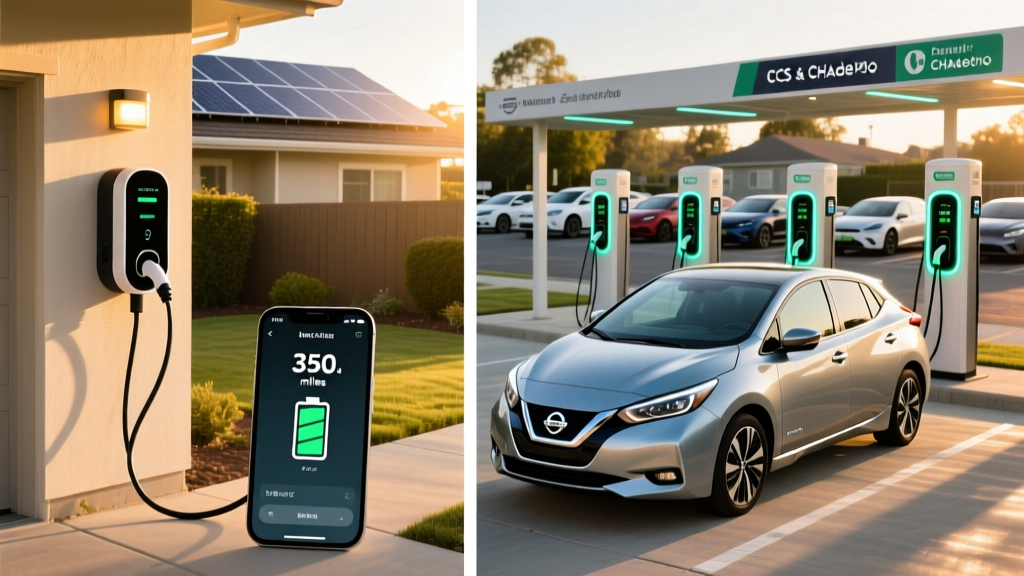
The Model Y Long Range uses Tesla's North American Charging Standard (NACS) connector natively. As of 2025–2026, NACS has become the dominant North American standard, with Ford, GM, Rivian, Hyundai, and most major automakers adopting it. However, some public charging infrastructure — particularly older Electrify America stations — still primarily uses CCS1.
| Connector | Model Y Compatibility | Network Availability | Adapter Needed? |
|---|---|---|---|
| NACS (Tesla) | Native — built in | Tesla Superchargers (17,000+ stalls), growing third-party | No |
| CCS1 | Via Tesla CCS Adapter (~$250) | Electrify America, EVgo, ChargePoint DC stations | Yes — Tesla CCS1 adapter |
| CHAdeMO | Not supported (no adapter available) | Declining — mostly legacy Nissan Leaf infrastructure | N/A |
| J1772 (Level 2) | Via included J1772 adapter | Universal at public Level 2 stations | Included with vehicle |
Tesla includes a J1772 adapter with the Model Y for public Level 2 use. For DC fast charging on non-Tesla networks, the CCS1 adapter is a worthwhile $250 investment if you travel in areas with limited Supercharger coverage. CHAdeMO is effectively obsolete for new Tesla owners.
Cost to Charge: Home vs. Public vs. Gas Comparison
One of the strongest ownership arguments for the Model Y Long Range — especially given its 4,398-lb weight requiring more energy per mile than lighter EVs — is the cost advantage of home charging versus gasoline.
| Scenario | Rate | Cost for Full 75 kWh | Cost Per Mile (310 mi) |
|---|---|---|---|
| Home (national avg) | $0.16/kWh | $12.00 | $0.039/mi |
| Home (off-peak TOU) | $0.08–$0.12/kWh | $6.00–$9.00 | $0.019–$0.029/mi |
| Public Level 2 | $0.25–$0.49/kWh | $18.75–$36.75 | $0.060–$0.119/mi |
| DC Fast (Supercharger/EA) | $0.28–$0.48/kWh | $21.00–$36.00 | $0.068–$0.116/mi |
| Gasoline Equivalent (25 MPG, $3.50/gal) | $3.50/gallon | $43.40 | $0.140/mi |
At the national average residential electricity rate of ~$0.16/kWh, a full charge of the Model Y Long Range's 75 kWh battery costs about $12 — roughly a quarter of the cost to fuel a comparable 25 MPG gas SUV the same distance. With time-of-use (TOU) rates and overnight charging, that cost drops to $6–$9 per full charge.
However, the Model Y's weight-driven efficiency penalty (28 kWh/100mi vs. ~24 kWh/100mi for lighter EVs like the Hyundai Ioniq 6) means you pay slightly more per mile than more aerodynamic sedans. On DC fast charging exclusively, costs approach gas parity — home charging is where the economics truly work.
Recommended Home Charging Equipment
For the Model Y Long Range, a 48A-capable Level 2 charger on a 60A circuit extracts maximum value from the onboard charger. Here are three proven options:
Tesla Wall Connector (Gen 3)
- Power: 11.5 kW (48A)
- Connector: NACS native
- Cable: 24 ft
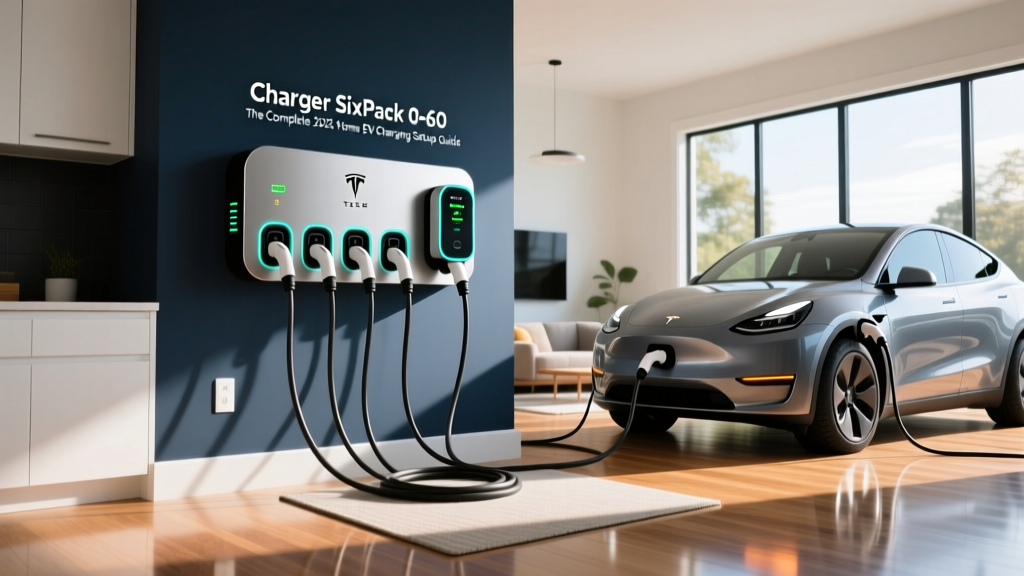
- Smart Features: Wi-Fi, OTA updates, power sharing (daisy-chain up to 6 units), load management
- Price: ~$475
- Best For: Tesla-only households seeking seamless integration
ChargePoint Home Flex
- Power: Up to 12 kW (50A configurable)
- Connector: J1772 (NACS adapter included or use Tesla's)
- Cable: 23 ft
- Smart Features: Wi-Fi, Alexa/Google Home, scheduling, energy tracking, flexible amperage (16A–50A)
- Price: ~$550–$650
- Best For: Multi-EV households or future-proofing for non-Tesla vehicles
Emporia Level 2 EV Charger
- Power: 11.5 kW (48A)
- Connector: J1772 (NACS version available)
- Cable: 24 ft
- Smart Features: Wi-Fi, energy monitoring, solar integration, scheduling, load management
- Price: ~$400–$500
- Best For: Budget-conscious buyers wanting energy monitoring
The Tesla Wall Connector remains the default pick for Model Y owners: native NACS plug, excellent build quality, and the ability to share a single circuit among multiple Wall Connectors via power-sharing firmware. The ChargePoint Home Flex earns its place in mixed-fleet garages where a CCS-equipped vehicle may join later.
Safety, Code, and Electrical Considerations
EV charging draws sustained high current for hours — far longer than most household appliances. This makes proper installation non-negotiable:
- Dedicated circuit: Your EVSE must be on its own breaker — no sharing with other outlets or appliances.
- GFCI protection: NEC 2020 and later require GFCI protection for all EV receptacles. Hardwired units are exempt but still recommended.
- Outdoor rating: If installing outside, the EVSE must carry a NEMA 4 (or IP65+) weather rating. The Tesla Wall Connector and ChargePoint Home Flex both qualify.
- Wire gauge: A 60A circuit requires 6 AWG copper wire (or 4 AWG aluminum). Long conduit runs may require upsizing to manage voltage drop.
- Permit required: Virtually all jurisdictions require an electrical permit and inspection for EVSE installation. Skipping this risks insurance claim denial and code violations.
For homes with solar panels, smart chargers like the Emporia or Tesla Wall Connector can integrate with energy management systems to charge only during solar production hours — maximizing self-consumption and minimizing grid draw.
Frequently Asked Questions
How much does it cost to install a home EV charger for a Tesla Model Y?
A standard 60A hardwired installation in a home with adequate panel capacity typically runs $1,400–$2,950 (equipment, electrician, and permit combined). Homes requiring a panel upgrade from 100A to 200A service can see total costs of $3,850–$8,750. The federal Residential Clean Energy Credit does not cover EV chargers for most taxpayers after 2022, though some state and utility rebates still apply.
How fast will each charging level add range to the Model Y Long Range?
Level 1 (120V): 3–5 miles per hour. Level 2 (240V, 48A): ~44 miles per hour. DC Fast Charging (V3 Supercharger, 250 kW peak): 10–80% in approximately 20–25 minutes, adding roughly 200 miles in that window. The Model Y's weight and 75 kWh battery mean it needs more total energy than lighter EVs, so Level 1 is impractical for daily use.
Which connector is compatible with my Tesla Model Y?
The Model Y uses the NACS connector natively for both Level 2 and DC fast charging at Tesla Superchargers. For public CCS1 stations, you need Tesla's CCS1 adapter (~$250). A J1772 adapter (included with the car) handles public Level 2 stations. CHAdeMO is not supported.
How much does charging the Model Y cost per mile compared to gas?
At the national average electricity rate of $0.16/kWh, home charging costs approximately $0.039/mile. Off-peak TOU rates drop this to $0.019–$0.029/mile. A comparable gas SUV at 25 MPG with $3.50/gallon fuel costs $0.14/mile. Even exclusive DC fast charging at $0.35/kWh averages ~$0.09/mile — still below gasoline.
What electrical upgrades might I need for a home charger?
If your home has 100A electrical service, a panel upgrade to 200A ($2,000–$5,000) is likely required before adding a 60A EV circuit. Even with 200A service, if your panel is near capacity (heavy HVAC, electric range, pool equipment), a load calculation may show insufficient headroom. Solutions include a panel upgrade, a load-management device (like the Emporia or Sense smart panel monitor), or installing a lower-amperage 40A circuit instead.
Does the Model Y Long Range's weight affect battery degradation?
Weight itself doesn't directly accelerate battery degradation — thermal management and charging habits do. However, the Model Y Long Range's heavier mass means higher energy draw per mile, which translates to more total charge cycles over the vehicle's lifetime compared to a lighter EV driven the same distance. Tesla's NMC battery is warrantied for 8 years/120,000 miles with a minimum 70% capacity retention threshold. Real-world data from Tesla's impact reports suggest average degradation of ~12% at 200,000 miles.