Why Your Charging Strategy Directly Impacts Model Y Long Range Mileage
The 2026 Tesla Model Y Long Range carries an EPA-estimated 330 miles of range from its ~78 kWh usable NMC battery pack. But the real-world mileage you extract — and how quickly you replenish it — depends almost entirely on your charging setup. A well-configured home Level 2 charger means you wake up to a full battery every morning, while reliance on poorly planned public charging can leave you staring at a tapered charge curve and a shrinking road-trip buffer.
This guide breaks down exactly what you need — from electrical panel capacity to the right wall connector — to keep your Model Y Long Range on the road and your cost per mile firmly below what any gas crossover can match.
Charging Levels Explained: Speeds, Power, and Miles Per Hour
Before buying equipment or calling an electrician, understand the three charging tiers. The critical distinction: kW (kilowatts) measures power — the rate of energy delivery — while kWh (kilometers-hours) measures energy capacity, the size of your battery. Think of kW as the width of a hose and kWh as the size of the bucket.
| Level | Voltage / Amperage | Max Power (kW) | Miles of Range Added Per Hour | Full Charge Time (0–100%) |
|---|---|---|---|---|
| Level 1 (120V household outlet) | 120V / 12A | ~1.4 kW | 3–5 miles/hr | ~55–70 hours |
| Level 2 (240V home/public) | 240V / 48A | 11.5 kW | 37–44 miles/hr | ~7–9 hours |
| DC Fast Charging (Supercharger) | 400V architecture | Peak 250 kW | Up to ~1,000 mi/hr (peak) | 10–80% in ~20 min |
Charge curve reality check: The Model Y Long Range peaks at ~250 kW only at low state of charge (roughly 5–20%). By 50% SoC, power tapers to ~150 kW; above 80%, it drops below 60 kW to protect battery longevity. That's why the industry standard metric is 10–80% time — approximately 20 minutes at a V3 Supercharger — not a full 0–100% fill, which takes considerably longer due to the taper.
Home Charger Installation: Electrical Requirements and Cost Breakdown
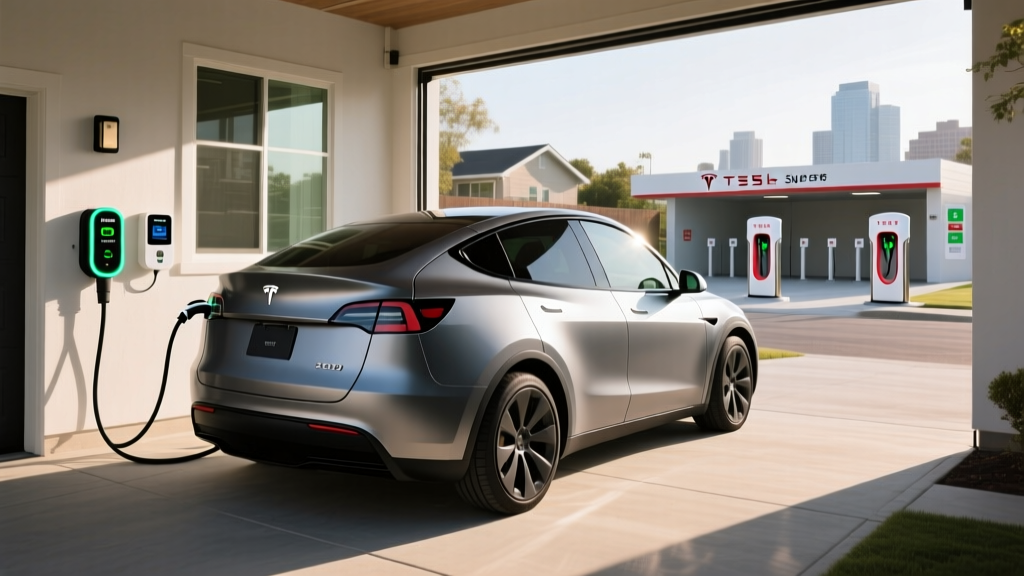
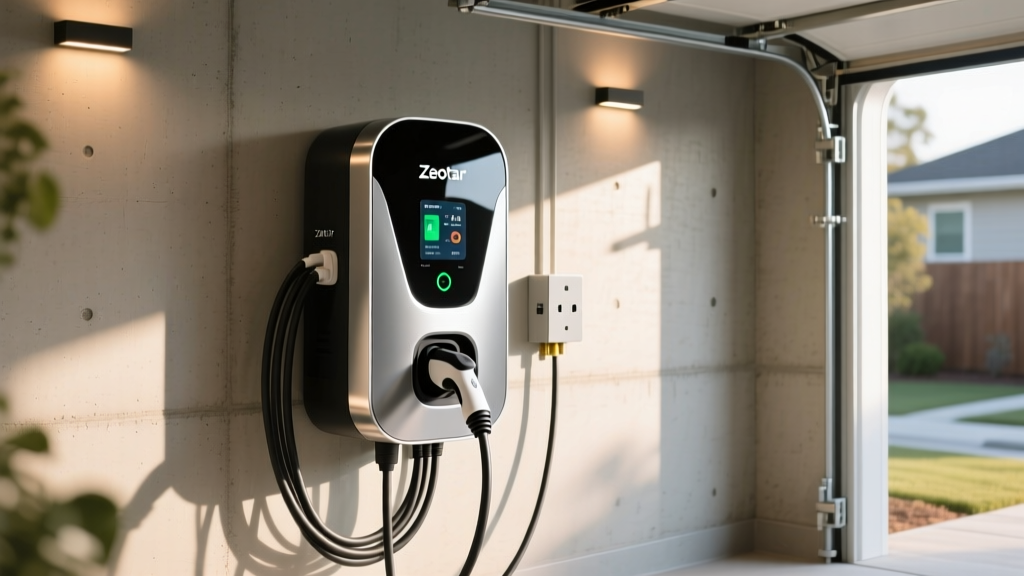
Level 2 home charging is the backbone of practical Tesla ownership. The Tesla Wall Connector delivers up to 11.5 kW (48A) on a 240V circuit and adds roughly 44 miles of range per hour — enough to fully replenish the Model Y's battery overnight.
What Your Electrical Panel Needs
A 48A continuous load requires a 60-amp dedicated breaker per National Electrical Code (NEC) rules, which mandate that continuous loads not exceed 80% of a breaker's rating. Here's what to verify before scheduling an electrician:
- Panel capacity: Most modern 200A panels can accommodate a 60A EV breaker. Older 100A panels often cannot — requiring a panel upgrade ($1,500–$3,500) or a lower-amperage circuit (e.g., 30A breaker / 24A charging).
- Wire gauge: 6 AWG copper for a 60A circuit; 4 AWG aluminum is a cheaper alternative for longer runs.
- Dedicated circuit: The EV charger must have its own breaker — no sharing with dryers or ovens.
- GFCI protection: NEC 2020+ requires GFCI breakers for garage receptacles; hardwired Wall Connectors may bypass this depending on local code interpretation.
- Outdoor rating: If installing outside, ensure a NEMA 3R-rated enclosure or an outdoor-rated connector.
Installation Cost Breakdown
| Item | Simple Install (Panel Adjacent) | Complex Install (Long Run / Panel Upgrade) |
|---|---|---|
| Tesla Wall Connector (48A, 24ft cable) | $475 | $475 |
| Electrician labor + materials | $500–$900 | $1,500–$3,000 |
| Electrical permit | $50–$150 | $100–$250 |
| Panel upgrade (if needed) | N/A | $1,500–$3,500 |
| Total Estimated Cost | $1,025–$1,525 | $3,575–$7,225 |
The wide range is real. A homeowner with a 200A panel and a garage wall directly behind the main service panel might pay under $1,200 total. A 1970s home with a 100A panel needing an upgrade and a 60-foot wire run through an attic could exceed $6,000. Always get 2–3 quotes from licensed electricians who have EV charger experience — and confirm they pull a permit, which protects you for insurance and resale purposes.
Connector Compatibility: NACS, CCS, and Adapter Realities
The 2026 Tesla Model Y Long Range ships with the NACS (North American Charging Standard) connector — Tesla's proprietary plug that has now become the de facto industry standard. Ford, GM, Rivian, Volvo, and most major automakers have adopted NACS for their 2025+ models.
| Connector Type | Native Support? | Adapter Needed? | Notes |
|---|---|---|---|
| NACS (Tesla) | ✅ Yes — native | None | Superchargers, Tesla Wall Connector, most new public chargers |
| CCS1 | ❌ No | Tesla CCS Adapter (~$175) | Needed for Electrify America, older ChargePoint DC stations |
| CHAdeMO | ❌ No | Third-party adapter (~$300+) | Largely obsolete; few new stations being built |
| J1772 (Level 2) | ✅ Yes (adapter included) | Included with vehicle | For public Level 2 stations with J1772 plugs |
Practical tip: Buy the Tesla CCS adapter and keep it in the frunk. While the Supercharger network covers most highway corridors, Electrify America and other CCS-equipped networks fill gaps in rural areas and urban centers where Superchargers are scarce. According to fueleconomy.gov, understanding your local charging infrastructure is key to minimizing range anxiety on unplanned trips.
Cost to Charge: Home vs. Public vs. Gas — The Per-Mile Math
One of the strongest arguments for the Model Y Long Range is operating cost. Let's run the numbers against a comparable gas crossover averaging 26 MPG combined.
| Scenario | Rate / Price | Model Y Cost Per Mile | Gas Crossover Cost Per Mile |
|---|---|---|---|
| Home (off-peak utility rate) | $0.12/kWh | $0.034 | $0.13 (at $3.30/gal) |
| Home (avg. US residential) | $0.17/kWh | $0.048 | $0.13 |
| Tesla Supercharger (avg.) | $0.32/kWh | $0.091 | $0.13 |
| Third-party DC fast (EA, etc.) | $0.43/kWh | $0.122 | $0.13 |
Key takeaway: Home charging at off-peak rates costs roughly $0.03–$0.05 per mile — a quarter of what gas costs. Even Supercharging at $0.32/kWh undercuts gas by ~30%. The only scenario where the Model Y approaches gas costs is exclusive reliance on premium-priced third-party DC fast chargers. The math strongly favors installing a home Level 2 charger.
The Model Y Long Range achieves an EPA-rated 122 MPGe combined (roughly 28 kWh/100mi). In real-world highway driving, expect 30–33 kWh/100mi, which slightly increases per-mile costs but still dramatically undercuts gasoline.
Best Home Charging Equipment for the Model Y Long Range
Not all Level 2 chargers are created equal. Here are the top picks for Tesla owners in 2026, based on power delivery, reliability, smart features, and value.
🏆 Best Overall: Tesla Wall Connector
- Power output: Up to 11.5 kW (48A at 240V)
- Cable length: 24 feet
- Connector: NACS native
- Smart features: Wi-Fi OTA updates, load sharing (pair two units on one circuit), access control
- Price: ~$475
- Best for: Tesla-only households wanting maximum charge speed and seamless app integration
🔌 Best Universal: ChargePoint Home Flex
- Power output: Up to 12 kW (50A at 240V, adjustable down to 16A)
- Cable length: 23 feet
- Connector: NACS (2025+ models) or J1772 with adapter
- Smart features: Alexa integration, scheduling, detailed energy tracking, flexible amperage
- Price: ~$549
- Best for: Multi-EV households (Tesla + non-Tesla) or renters who may move
💰 Best Budget: Emporia Vue EV Charger
- Power output: Up to 11.5 kW (48A)
- Cable length: 24 feet
- Connector: NACS or J1772 variants
- Smart features: Energy monitoring, solar integration, scheduling
- Price: ~$399
- Best for: Cost-conscious owners who still want smart features and full 48A
⚡ Best Portable: Tesla Mobile Connector
- Power output: Up to 7.2 kW (32A at 240V with NEMA 14-50 adapter)
- Cable length: 20 feet
- Connector: NACS with interchangeable adapters
- Smart features: None (plug-and-charge simplicity)
- Price: ~$200 (Gen 2 bundle)
- Best for: Apartment dwellers, travel, or backup — not primary daily charging
Charging Times for the Model Y Long Range: Real-World Scenarios
How long does it actually take to charge the Model Y's ~78 kWh battery in common scenarios?
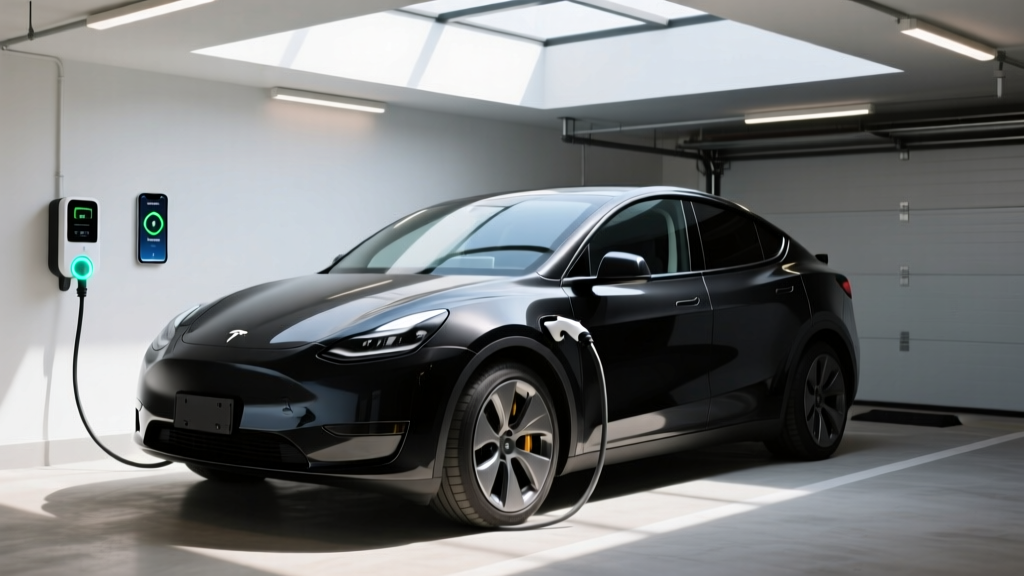
- Overnight home charge (Level 2, 11.5 kW): 0–100% in roughly 7.5 hours. Plug in at 10 PM, wake up to a full battery at 6 AM — every single day.
- Road trip Supercharger stop (V3, 250 kW peak): 10–80% in ~20 minutes. Plan bathroom and food breaks around this window.
- Partial top-up (Level 2, 6 hours after work): Adds ~240 miles — more than enough for next-day commuting and errands.
- Emergency Level 1 (120V trickle): Adds ~4 miles per hour. A 12-hour overnight session yields ~48 miles — viable only for emergencies or very low-mileage days.
Pro tip — preconditioning: When navigating to a Supercharger in the Tesla app or vehicle nav, the car automatically warms the battery to optimal charging temperature. This can shave 5–10 minutes off your 10–80% time in cold weather. Without preconditioning, a cold battery may initially accept only 50–80 kW before ramping up.
Safety, Code Compliance, and the Panel-Upgrade Question
EV charging draws sustained high current for hours — unlike a dryer that cycles on and off. This makes proper installation non-negotiable.
- NEC compliance: All EV charger installations must meet NEC Article 625. Your electrician should be familiar with these requirements.
- Dedicated circuit: Never share the EV charger circuit with other appliances. A tripped shared breaker means a dead car in the morning.
- Hardwired vs. plug: Hardwired Wall Connectors avoid the NEMA 14-50 receptacle that some jurisdictions now require GFCI protection on — which can cause nuisance tripping with certain EVSE units. Hardwired is generally preferred for Tesla Wall Connectors.
- Outdoor installations: The Tesla Wall Connector is rated NEMA 3R (suitable for outdoor use), but any junction boxes or conduit fittings must also be outdoor-rated.
- Panel upgrade trigger: If your electrician's load calculation shows your panel is already near capacity (common in homes with electric heat, AC, and a dryer), a panel upgrade from 100A to 200A — or even adding a secondary sub-panel — may be required. Budget $1,500–$3,500 for this work, and check with your utility about any available rebates for panel upgrades tied to EV adoption.
For detailed federal incentive information on energy-efficient home improvements (which may cover some electrical upgrades), refer to IRS Energy Efficient Home Improvement Credit guidelines. Note that the §30D Clean Vehicle Credit applies to vehicle purchases, not charger installation, though some utility companies and states offer separate rebates for Level 2 equipment and installation.
Frequently Asked Questions
How much does it cost to install a home EV charger for a Tesla Model Y?
A straightforward installation with a Tesla Wall Connector typically costs $1,025–$1,525 (equipment + electrician + permit). Complex installs requiring long wire runs, conduit, or a panel upgrade can range from $3,575–$7,225. Always get multiple quotes and ensure permits are pulled.
How fast will each charging level add range to my Model Y Long Range?
Level 1 (120V) adds 3–5 miles per hour. Level 2 (240V, 48A) adds 37–44 miles per hour — enough for a full overnight charge. DC fast charging at a V3 Supercharger peaks at ~250 kW and can add up to 200 miles in 15 minutes at low state of charge, though the charge curve tapers significantly above 80%.
Which connector is compatible with my 2026 Tesla Model Y?
The 2026 Model Y uses the NACS connector natively — this plugs directly into Tesla Superchargers and the Tesla Wall Connector. For CCS-equipped public chargers (like Electrify America), you'll need Tesla's CCS adapter (~$175). A J1772 adapter for public Level 2 stations is included with the vehicle.
How much does charging cost per mile compared to gas?
Home charging at off-peak rates costs roughly $0.03–$0.05 per mile. Supercharging averages $0.09 per mile. A comparable 26 MPG gas crossover costs about $0.13 per mile at $3.30/gallon. Home charging saves $700–$1,000+ annually for a driver covering 12,000 miles per year.
What electrical upgrades might I need for a Level 2 charger?
You'll need a 60A dedicated breaker on a 240V circuit for a full 48A Tesla Wall Connector. If your panel is a 100A service or is already near capacity, a panel upgrade to 200A may be required ($1,500–$3,500). Older homes may also need updated wiring, proper grounding, or a sub-panel addition. A licensed electrician will perform a load calculation to determine exact requirements.
Should I charge my Model Y Long Range to 100% every night?
Tesla recommends setting the daily charge limit to 80–90% for NMC batteries to maximize long-term battery health. Reserve 100% charges for road trips. The Model Y's battery management system includes a buffer that protects against extreme degradation, but limiting peak SoC extends the pack's useful life. According to Tesla's battery care guidelines, regular partial cycling is preferable to full charge-discharge cycles.