The 2023 Tesla Model Y Long Range remains one of the most popular electric vehicles on the road in 2026, and for good reason: an EPA-rated 330 miles of range, access to Tesla's Supercharger network, and a usable battery capacity of roughly 75 kWh (NMC chemistry). But owning an EV is only half the equation — charging it efficiently and affordably is where the real ownership experience is won or lost.
This guide covers everything a current or prospective Model Y Long Range owner needs to know about charging: the three charging levels and what they mean in real miles per hour, home installation costs and electrical requirements, connector compatibility, public charging economics, and specific equipment recommendations that pair well with this vehicle.
Understanding Charging Levels: Level 1, Level 2, and DC Fast Charging
EV charging happens at three distinct levels, each defined by voltage, power output (measured in kilowatts, or kW), and how quickly they replenish your battery's energy capacity (measured in kilowatt-hours, or kWh). Confusing kW with kWh is the single most common mistake new EV owners make — think of kW as the speed of water flowing through a hose, and kWh as the total volume of water in the bucket.
| Level | Voltage | Max Power (kW) | Miles of Range Added per Hour | Typical Use Case |
|---|---|---|---|---|
| Level 1 (120V) | 120V AC | ~1.4 kW | 3–5 mi/hr | Emergency/trickle; overnight top-off |
| Level 2 (240V) | 240V AC | 11.5 kW (48A) | 30–44 mi/hr | Daily home & workplace charging |
| DC Fast Charging | 400V+ DC | 250 kW (peak) | ~1,000+ mi/hr (at peak) | Road trips; 10–80% in ~20–25 min |
The Model Y Long Range's onboard charger accepts up to 11.5 kW on Level 2 (48 amps at 240V). This means a full 0–100% charge at home takes approximately 7–8 hours. On DC fast charging, the Model Y peaks at 250 kW at Tesla Supercharger V3 stations, though sustained rates taper significantly above 50% state of charge (SoC). Expect a 10–80% charge in roughly 20–25 minutes under ideal conditions, with the curve slowing to under 40 kW past 80%.
Home Charger Installation: Electrical Requirements and Costs
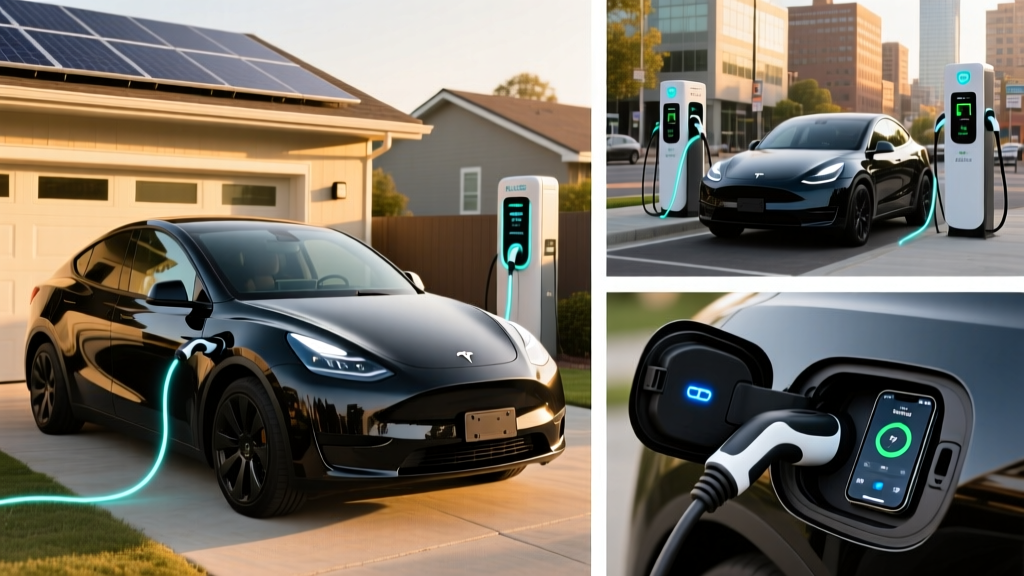
Installing a Level 2 home charger is the single highest-impact upgrade an EV owner can make. For the Model Y Long Range, a 240V/48A circuit unlocks the vehicle's full 11.5 kW onboard charging capability, adding roughly 44 miles of range per hour of charging — enough to fully replenish a daily commute overnight.
Electrical Requirements
To support a 48A continuous load, the National Electrical Code (NEC) requires a dedicated 60-amp breaker (EV chargers are considered continuous loads, so the circuit must be rated at 125% of the actual draw: 48A × 1.25 = 60A). You will need:
- A 240V dedicated circuit with a 60A breaker
- 6 AWG copper wire (or 4 AWG aluminum) for runs up to ~100 feet; thicker gauge for longer runs
- A NEMA 14-60 outlet (if using a plug-in charger) or hardwired connection (required for some higher-amperage units and preferred by many electricians for safety)
- Sufficient panel capacity: at least 60A of available headroom on your electrical panel
Panel Upgrade Considerations
Homes with 100-amp electrical service — common in houses built before the 1990s — often cannot support a 60A EV circuit without a panel upgrade to 200A. A panel upgrade typically costs $1,500–$3,500 depending on your region, utility requirements, and whether a new meter base is needed. This is the single biggest variable in home charger installation cost and one that many online guides gloss over.
If your panel is already 200A but nearly maxed out, an electrician may recommend a load management device (such as the Emporia Vue with smart panel monitoring) that dynamically reduces charger amperage when other heavy loads are active, potentially avoiding a panel upgrade entirely.
| Component | Low Estimate | High Estimate | Notes |
|---|---|---|---|
| Level 2 Charger (Equipment) | $350 | $700 | 48A smart charger, NACS or J1772 |
| Electrician Labor | $500 | $2,000 | Varies by run length, wall type, conduit needs |
| Electrical Materials (wire, conduit, breaker) | $150 | $600 | Longer wire runs increase cost significantly |
| Permit & Inspection | $50 | $300 | Required in most jurisdictions; varies by municipality |
| Panel Upgrade (if needed) | $1,500 | $3,500 | 100A → 200A service upgrade |
| Total (No Panel Upgrade) | $1,050 | $3,600 | Most homes with 200A service |
| Total (With Panel Upgrade) | $2,550 | $7,100 | Older homes with 100A service |
Always hire a licensed electrician and pull a permit. Unpermitted EV charger installations can void homeowner's insurance claims and create fire hazards. The NEC requires GFCI protection for outdoor outlets, and many jurisdictions now require it for indoor EV circuits as well.
Connector Compatibility: NACS, CCS, and Adapters
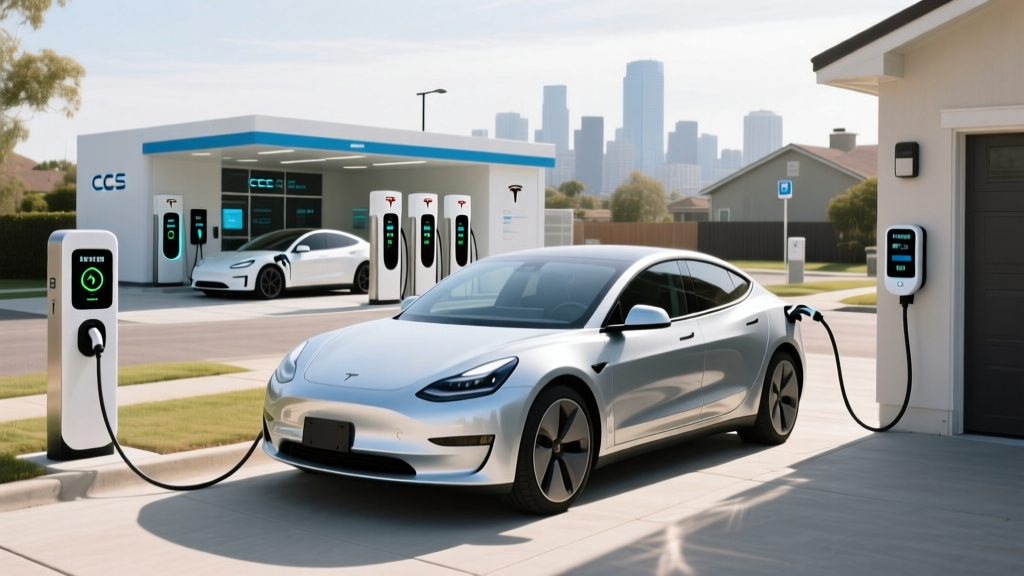
The 2023 Tesla Model Y Long Range comes equipped with Tesla's proprietary North American Charging Standard (NACS) connector. In 2026, NACS has become the dominant connector in North America, adopted by Ford, GM, Rivian, Volvo, and most other major automakers. This is a significant advantage for Tesla owners: you have native access to the Tesla Supercharger network — the largest and most reliable DC fast-charging network in the U.S. — without any adapter.
| Connector Type | Native Support? | Adapter Needed? | Network Access |
|---|---|---|---|
| NACS (Tesla) | Yes — built in | No | Tesla Superchargers, Destination Chargers, many new third-party stations |
| CCS1 | No | Yes — Tesla sells a CCS adapter (~$175) | Electrify America, EVgo, ChargePoint DC stations |
| CHAdeMO | No | Not available for Tesla | Largely legacy; Nissan Leaf, older stations |
| J1772 (Level 2 public) | No | Yes — included with vehicle (Tesla J1772 adapter) | Public Level 2 stations, workplaces, hotels |
The Tesla CCS adapter is worth purchasing if you frequently travel in areas where Electrify America or other CCS-only networks are more convenient than Superchargers. However, for most Model Y owners, the native NACS connector and Supercharger network cover the vast majority of road-trip needs. According to Tesla's Supercharger page, there are over 6,500 Supercharger stations in North America as of 2026.
Cost to Charge: Home vs. Public vs. Gas Comparison
One of the strongest economic arguments for the Model Y Long Range is the cost-per-mile advantage over gasoline vehicles. But the savings vary dramatically depending on where and when you charge.
| Scenario | Rate ($/kWh) | Cost for Full Charge (0–100%) | Cost per Mile | Equivalent MPG Gas Cost |
|---|---|---|---|---|
| Home (off-peak utility rate) | $0.08–$0.14 | $6.00–$10.50 | $0.018–$0.032 | $0.58–$1.02/gal |
| Home (average U.S. residential) | $0.16 | $12.00 | $0.036 | $1.15/gal |
| Tesla Supercharger V3 (average) | $0.28–$0.36 | $21.00–$27.00 | $0.064–$0.082 | $2.05–$2.62/gal |
| Electrify America (CCS w/ adapter) | $0.35–$0.48 | $26.25–$36.00 | $0.080–$0.109 | $2.56–$3.49/gal |
| Comparable gas SUV (25 MPG, $3.50/gal) | — | $46.20 (per 330 mi) | $0.140 | $3.50/gal |
At the U.S. average residential electricity rate of approximately $0.16/kWh (per EIA data), charging the Model Y Long Range at home costs roughly $0.036 per mile. A comparable gasoline SUV averaging 25 MPG at $3.50/gallon costs $0.14 per mile — nearly four times as much. Over 15,000 miles of annual driving, that's a fuel savings of approximately $1,560 per year.
Even at Tesla Supercharger rates, the Model Y is cheaper to "fuel" than a 25-MPG gas SUV. However, exclusive reliance on DC fast charging erodes the cost advantage and accelerates battery wear. For optimal economics and battery longevity, plan to do 80–90% of your charging at home on Level 2.
Best Level 2 Chargers for the Model Y Long Range
Since the Model Y uses the NACS connector natively, you have two paths for home charging: a NACS-equipped charger (direct plug-in, no adapter needed) or a J1772 charger with the Tesla adapter that ships with the car. In 2026, more manufacturers offer native NACS chargers than ever before.
Tesla Wall Connector (Gen 3)
- Power Output: Up to 11.5 kW (48A at 240V)
- Connector: NACS (native Tesla)
- Cable Length: 24 feet
- Smart Features: Wi-Fi updates, power sharing between multiple units, load management
- Price: ~$475
- Best For: Tesla-only households seeking seamless integration
Emporia Vue Level 2 Charger
- Power Output: Up to 11.5 kW (48A at 240V)
- Connector: NACS or J1772 (configurable)
- Cable Length: 24 feet
- Smart Features: Energy monitoring, solar integration, scheduled charging, load management with Vue panel monitor
- Price: ~$399
- Best For: Solar-equipped homes and budget-conscious buyers
ChargePoint Home Flex (NACS)
- Power Output: Up to 12 kW (50A at 240V)
- Connector: NACS (2025+ models)
- Cable Length: 23 feet
- Smart Features: App scheduling, Alexa integration, flexible amperage (16A–50A DIP switch)
- Price: ~$599
- Best For: Adjustable amperage to match panel capacity
Grizzl-E Smart (NACS)
- Power Output: Up to 10 kW (40A at 240V)
- Connector: NACS
- Cable Length: 24 feet
- Smart Features: OCPP-compatible, app control, extreme cold rated (-40°F)
- Price: ~$449
- Best For: Cold-climate owners needing rugged build
For the Model Y Long Range, the Tesla Wall Connector is the default recommendation — it delivers the vehicle's maximum 11.5 kW charge rate, requires no adapter, and integrates with Tesla's ecosystem. The Emporia Vue is a strong alternative if you want granular energy monitoring or have solar panels, and its lower price point makes it a value leader.
Safety, Code Compliance, and Installation Best Practices
EV charging involves sustained high-current draw over many hours — more similar to running an electric furnace than plugging in a phone. Proper installation is non-negotiable for safety and insurance compliance.
- Dedicated circuit: Your EV charger must have its own dedicated breaker — never share a circuit with other appliances.
- GFCI protection: Required for all outdoor installations under NEC 2020 and later. Many jurisdictions now require it indoors as well. Hardwired chargers with built-in GFCI protection simplify compliance.
- Outdoor rating: If your charger is mounted outdoors, ensure it carries a NEMA 4 (or IP65+) weather rating. All chargers listed above meet this standard.
- Permit and inspection: Most municipalities require an electrical permit for EV charger installation. The inspection ensures proper wire gauge, breaker sizing, and grounding. Skipping this step can void insurance coverage in the event of an electrical fire.
- Cable management: Use a wall-mounted cable organizer to prevent tripping hazards and cable damage. Never run charging cables across walkways or driveways without protective covers.
DC Fast Charging on Road Trips: Supercharger Strategy
The Model Y Long Range's 250 kW peak DC fast-charging capability makes it one of the faster-charging EVs available, though real-world charging sessions are governed by the charge curve — not the peak number.
Here's what a typical Supercharger session looks like:
- 10–30% SoC: Peak rates of 200–250 kW, adding roughly 5–7 miles per minute
- 30–50% SoC: Sustained 150–180 kW, adding roughly 4–5 miles per minute
- 50–80% SoC: Tapering from ~120 kW down to ~60 kW, adding 2–3 miles per minute
- 80–100% SoC: Below 40 kW — charging above 80% is slow and best avoided on road trips
The practical takeaway: plan road-trip stops around 10–80% charges, which take approximately 20–25 minutes at a V3 Supercharger. Charging to 100% adds another 20–30 minutes and is only worth doing if you need the full range for the next leg. Tesla's navigation system automatically preconditions the battery when you navigate to a Supercharger, warming it to optimal temperature for faster charging — a feature that can shave 5–10 minutes off your session in cold weather.
Frequently Asked Questions
How much does it cost to install a home EV charger for the Model Y?
Expect $1,050–$3,600 if your home already has a 200-amp electrical panel with sufficient spare capacity. If you need a panel upgrade from 100A to 200A, total costs range from $2,550–$7,100. The equipment itself (a quality 48A Level 2 charger) costs $350–$700, with the remainder going to electrician labor, materials, and permits.
How fast will each charging level add range to my Model Y Long Range?
Level 1 (120V) adds 3–5 miles per hour — essentially overnight trickle charging. Level 2 (240V/48A) adds 30–44 miles per hour, fully replenishing the battery in 7–8 hours. DC fast charging at a Tesla Supercharger V3 can add up to 200+ miles in 15 minutes at peak rates, though a typical 10–80% session takes 20–25 minutes.
Which chargers and connectors are compatible with my 2023 Model Y?
Your Model Y uses the NACS connector natively. This works directly with all Tesla Superchargers, Tesla Wall Connectors, and an increasing number of third-party NACS stations. For CCS stations (Electrify America, EVgo), you'll need Tesla's CCS adapter (~$175). The included J1772 adapter lets you use public Level 2 chargers with the older standard connector.
How much does charging cost per mile compared to gasoline?
At the U.S. average residential electricity rate ($0.16/kWh), home charging costs approximately $0.036 per mile. A comparable 25-MPG gasoline SUV at $3.50/gallon costs $0.14 per mile — nearly 4× more. Even at Tesla Supercharger rates ($0.28–$0.36/kWh), the Model Y costs $0.064–$0.082 per mile, still significantly cheaper than gasoline. According to fueleconomy.gov, the Model Y Long Range achieves 122 MPGe combined.
What electrical upgrades might I need for a home charger?
You need a dedicated 240V circuit with a 60-amp breaker (for 48A continuous charging). If your electrical panel is 200A with available capacity, you likely only need the new circuit, breaker, and wiring. If your panel is 100A or nearly maxed out, a panel upgrade to 200A will be required, adding $1,500–$3,500 to the project. A licensed electrician can assess your panel capacity during a site visit — most offer this evaluation for free or a small fee applied toward the installation.