The Tesla Model Y remains one of the most popular EVs on the road, and whether you're a current owner or shopping for one, understanding Tesla Model Y charging times across every charging scenario is essential for daily planning and road trips alike. The Long Range variant carries a 75 kWh usable battery (NMC chemistry), while the Rear-Wheel Drive (Standard Range) uses a ~60 kWh LFP pack. Those different chemistries and capacities mean charging behavior varies by trim — and real-world speeds rarely match the marketing headline numbers.
This guide breaks down exactly how fast each charging level replenishes a Model Y, what home installation actually costs in 2026, which equipment to buy, and how charging expenses compare to gasoline on a per-mile basis.
Tesla Model Y Charging Times by Level: The Full Breakdown
EV charging is measured in kW (kilowatts), which represents the rate of power delivery — think of it as the speed of water flowing through a hose. The battery capacity is measured in kWh (kilowatt-hours), the total volume of energy stored. Confusing these two is the single most common mistake in EV ownership. A 250 kW charger doesn't deliver 250 kWh; it delivers energy at a rate of 250 kW, filling the battery's kWh capacity over time.
| Charging Level | Power (kW) | Voltage / Amps | Miles of Range Per Hour | 10–80% Time (Long Range 75 kWh) |
|---|---|---|---|---|
| Level 1 (Standard 120V outlet) | 1.0–1.4 kW | 120V / 12A | 3–5 mi/hr | ~45–52 hours |
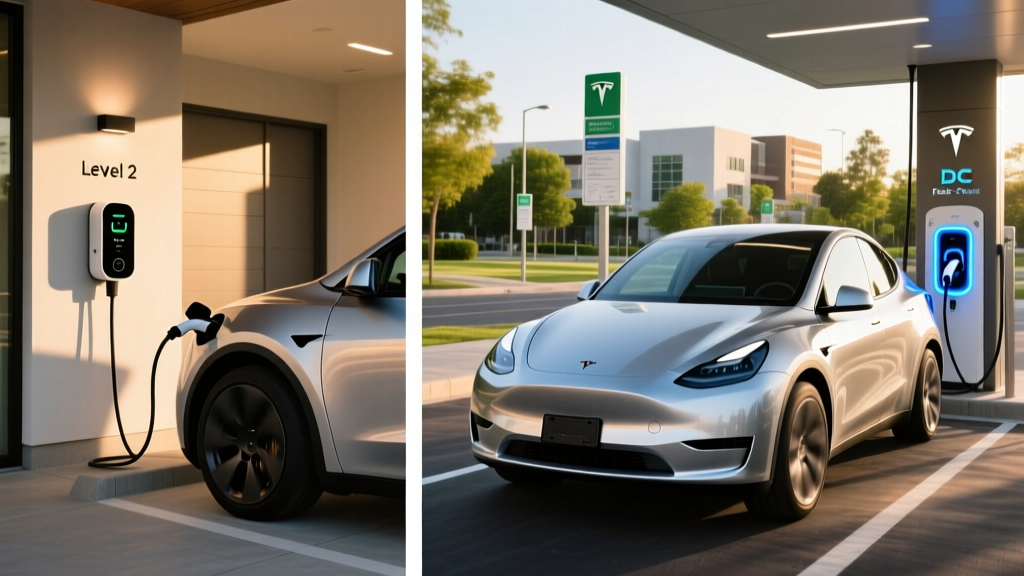
| Level 2 (240V home / destination) | 7.7–11.5 kW | 240V / 32–48A | 25–44 mi/hr | ~5.5–8 hours |
| DC Fast Charging (V3 Supercharger) | Up to 250 kW peak | 400V architecture | Up to ~1,000 mi/hr (peak) | ~25–28 minutes |
| DC Fast Charging (V4 Supercharger) | Up to 325 kW peak | 400V architecture | Up to ~1,100 mi/hr (peak) | ~20–24 minutes |
Home Charger Installation: Requirements, Costs & Panel Upgrades
Most Model Y owners charge at home overnight, and a Level 2 setup is the practical minimum for daily usability. The Model Y's onboard charger accepts up to 11.5 kW (48A on a 60A circuit), which is the fastest Level 2 speed the vehicle can accept. To achieve this, you need a 240V circuit rated at 60 amps with hardwired equipment — or a 50A circuit with a NEMA 14-50 outlet for slightly slower 40A/9.6 kW charging.
Electrical Requirements
- Minimum viable: 240V / 40A circuit (NEMA 14-50 outlet or hardwired) → 9.6 kW to the car
- Maximum for Model Y: 240V / 60A circuit (hardwired only) → 11.5 kW to the car
- Panel capacity: Most homes need a 200A main panel to support a 60A EV circuit without overload. Older homes with 100A panels will likely require an upgrade.
- Dedicated circuit: NEC code requires a dedicated breaker — you cannot share the circuit with a dryer or oven.
- GFCI protection: Required for outdoor outlets under NEC 2020+; hardwired indoor installations may not require GFCI depending on local code.
| Item | Basic Install (NEMA 14-50, Near Panel) | Standard Install (Hardwired 60A, ~30ft Run) | Complex Install (Panel Upgrade + Long Run) |
|---|---|---|---|
| Charger Equipment | $400–$600 | $400–$700 | $400–$700 |
| Electrician Labor | $300–$600 | $600–$1,500 | $1,500–$3,000 |
| Permit & Inspection | $50–$150 | $100–$300 | $150–$400 |
| Panel Upgrade (if needed) | N/A | N/A | $2,000–$4,500 |
| Total Estimated Cost | $750–$1,350 | $1,100–$2,500 | $4,050–$8,600 |
Connector Compatibility: NACS, CCS & Adapter Realities
Tesla uses the North American Charging Standard (NACS) connector natively on all Model Y vehicles. As of 2025–2026, most major automakers have adopted NACS as well, and the legacy CCS1 connector is being phased out at new installations. However, many public DC fast-charging stations — particularly Electrify America and some older ChargePoint sites — still use CCS1 connectors.
| Connector Type | Native Compatibility | Adapter Needed? | Where You'll Find It |
|---|---|---|---|
| NACS (Tesla) | Yes — native port | No | Tesla Superchargers, Tesla Destination Chargers, new ChargePoint/EVgo NACS stalls |
| CCS1 | No | Yes — Tesla CCS Adapter (~$175–$250) | Electrify America, older ChargePoint/ChargePoint, EVgo CCS stalls |
| CHAdeMO | No | Third-party adapter (rare, ~$300+) | Legacy Nissan Leaf-era stations; being decommissioned |
| J1772 (Level 2 public) | No | Yes — Tesla J1772 Adapter (included with car) | Public Level 2 stations, hotels, workplaces |
The Tesla CCS1 adapter is essential for road trips outside the Supercharger network. Tesla sells the official adapter through its shop, and third-party options from brands like Lectron are available. Maximum charge speed through the CCS adapter is typically capped around 150–180 kW depending on the station, slightly below native NACS Supercharger speeds.
Cost to Charge a Tesla Model Y: Per-Mile vs. Gasoline
Electricity pricing varies enormously by location, time of day, and whether you're charging at home or on the road. The Model Y Long Range achieves approximately 3.6–4.0 miles per kWh (EPA-rated at 122 MPGe combined, per fueleconomy.gov). That efficiency figure lets us calculate real cost per mile.
| Charging Scenario | Rate ($/kWh) | Cost Per Mile | Full 10–80% Session Cost (~52.5 kWh) |
|---|---|---|---|
| Home — Off-Peak TOU Rate | $0.08–$0.14 | $0.02–$0.04 | $4.20–$7.35 |
| Home — Standard Residential Rate | $0.14–$0.22 | $0.04–$0.06 | $7.35–$11.55 |
| Public Level 2 (ChargePoint, etc.) | $0.25–$0.49 | $0.07–$0.13 | $13.13–$25.73 |
| Tesla Supercharger (V3/V4) | $0.28–$0.48 | $0.07–$0.13 | $14.70–$25.20 |
| Electrify America / Third-Party DCFC | $0.35–$0.58 | $0.09–$0.15 | $18.38–$30.45 |
| Gas Equivalent (28 MPG avg, $3.40/gal) | — | $0.12 | — |
At home on off-peak rates, the Model Y costs roughly 3–4 cents per mile to fuel — about one-quarter the cost of a comparable gasoline crossover. Even at Supercharger prices, you're roughly at parity with gasoline. The savings case is strongest when you charge at home overnight on a time-of-use (TOU) plan. Contact your utility about EV-specific rate plans; many utilities in 2026 offer rates as low as $0.06–$0.10/kWh during overnight hours.
Best Home Chargers for the Tesla Model Y: 2026 Equipment Picks
Because the Model Y uses NACS natively, you have two paths: buy a NACS-equipped charger (simplest) or buy a J1772 charger and use the included Tesla adapter. NACS-native chargers eliminate the adapter hassle and are increasingly the standard.
Tesla Wall Connector (Gen 3)
- Power: Up to 11.5 kW (48A / 240V)
- Connector: NACS native
- Cable Length: 24 ft
- Smart Features: Wi-Fi updates, load sharing with other Wall Connectors, power-sharing across units
- Price: ~$425
- Best For: Tesla-only households wanting maximum charge speed
ChargePoint Home Flex (NACS)
- Power: Up to 12 kW (50A / 240V, adjustable down)
- Connector: NACS (2025+ models)
- Cable Length: 23 ft
- Smart Features: App scheduling, energy tracking, Alexa integration, adjustable amperage
- Price: ~$550–$650
- Best For: Multi-EV households (NACS + adapter flexibility)
Emporia Level 2 EV Charger
- Power: Up to 11.5 kW (48A / 240V)
- Connector: J1772 (use Tesla adapter) or NACS (newer model)
- Cable Length: 24 ft
- Smart Features: Energy monitoring, solar integration, utility demand-response compatible
- Price: ~$350–$400
- Best For: Budget-conscious buyers, solar-panel households
For the fastest Level 2 charge on a Model Y, ensure your electrician installs a 60A dedicated circuit with hardwired connection. The Tesla Wall Connector at 48A delivers the car's maximum 11.5 kW acceptance rate — adding roughly 44 miles of range per hour of charging.
DC Fast Charging on Road Trips: Supercharger Network & Curve Reality
Tesla's Supercharger network remains the most reliable DC fast-charging ecosystem in North America, with over 6,000 V3 and V4 stalls across the US as of early 2026 (per Tesla's Supercharger page). The Model Y Long Range can accept up to 250 kW on V3 and up to 325 kW on newer V4 stalls — but those peak numbers require ideal conditions.
10–30% SoC: ~5–6 minutes (peak 200–250 kW)
30–50% SoC: ~6–7 minutes (150–200 kW)
50–80% SoC: ~14–16 minutes (75–120 kW, tapering)
Total 10–80%: ~25–28 minutes
Charging above 80% slows dramatically — an 80–100% session can take an additional 25–35 minutes. For road trips, plan stops around the 10–80% window and move on rather than waiting for a full charge.
Preconditioning matters. When you set a Supercharger as your navigation destination, the Model Y automatically warms or cools the battery to optimal charging temperature. Without preconditioning — especially in cold weather below 40°F — peak charge rates can drop by 30–50%, extending your 10–80% time to 35–40 minutes. Always navigate to the charger; don't just drive there manually.
Safety, Code & Installation Best Practices
EV charging draws sustained high current for hours — this is fundamentally different from a dryer or oven that cycles on and off. Proper installation protects your home and your investment.
- Dedicated circuit: NEC Article 625 requires a dedicated branch circuit for EV supply equipment. No shared circuits.
- Breaker sizing: Continuous loads (defined as 3+ hours) require a breaker rated at 125% of the load. A 48A charger needs a 60A breaker; a 40A charger needs a 50A breaker.
- Wire gauge: 6 AWG copper for 60A circuits; 8 AWG for 40A circuits (confirm with your electrician based on run length and local amendments).
- Outdoor rating: If mounting outdoors, the charger must carry a NEMA 4 or IP65 weather rating. All Tesla Wall Connectors and major brands meet this.
- GFCI: Required for outdoor receptacle-based (plug-in) installations under NEC 2020 and later. Hardwired installations may be exempt depending on jurisdiction.
- Permit & inspection: Most municipalities require an electrical permit and post-installation inspection. Budget $50–$400 and 1–3 weeks depending on your locality. Skipping the permit risks insurance claim denial in the event of an electrical fire.
Always hire a licensed electrician experienced with EV charger installations. Ask for a load calculation on your panel before work begins, and get at least two quotes — pricing varies significantly by region and contractor (NEC/NFPA guidelines apply nationally, but local amendments differ).
Frequently Asked Questions
How much does it cost to install a home EV charger for a Tesla Model Y?
A straightforward Level 2 installation with a NEMA 14-50 outlet near your electrical panel typically costs $750–$1,350 including equipment, electrician labor, and permit. A hardwired 60A installation with a longer wire run costs $1,100–$2,500. If your home needs a panel upgrade from 100A to 200A, total costs can reach $4,000–$8,600.
How fast will each charging level add range to my Model Y?
Level 1 (120V) adds 3–5 miles per hour — essentially overnight trickle charging. Level 2 (240V) adds 25–44 miles per hour depending on amperage, enough to fully replenish overnight. DC fast charging at a Supercharger adds up to ~200 miles in 15 minutes at peak rate, though sustained averages are lower due to charge-curve taper above 50% SoC.
Which connector and charger is compatible with my Tesla Model Y?
The Model Y uses the NACS connector natively. Tesla Superchargers and Destination Chargers work without adapters. For CCS1-equipped public DC fast chargers (Electrify America, some EVgo stations), you need Tesla's CCS adapter (~$175–$250). For J1772 Level 2 public stations, the J1772 adapter included with your car works fine.
How much does charging a Model Y cost per mile compared to gas?
At home on off-peak electricity ($0.08–$0.14/kWh), the Model Y costs approximately $0.02–$0.04 per mile. A comparable gasoline crossover at 28 MPG with $3.40/gallon fuel costs about $0.12 per mile. Even at public DC fast-charger rates ($0.28–$0.48/kWh), EV charging costs roughly $0.07–$0.13 per mile — at or slightly above gasoline parity. Home charging is where the economics strongly favor EVs.
What electrical upgrades might I need for a home charger?
Homes with a 200A electrical panel typically support a 60A EV circuit without upgrades. Homes with 100A panels — common in pre-2000 construction — often require a panel upgrade to 200A, costing $2,000–$4,500. Your electrician will perform a load calculation considering all existing appliances (dryer, oven, HVAC, water heater) to determine if your current panel can handle the added EV load. Some utilities offer rebates of $500–$1,500 toward panel upgrades for EV adoption.