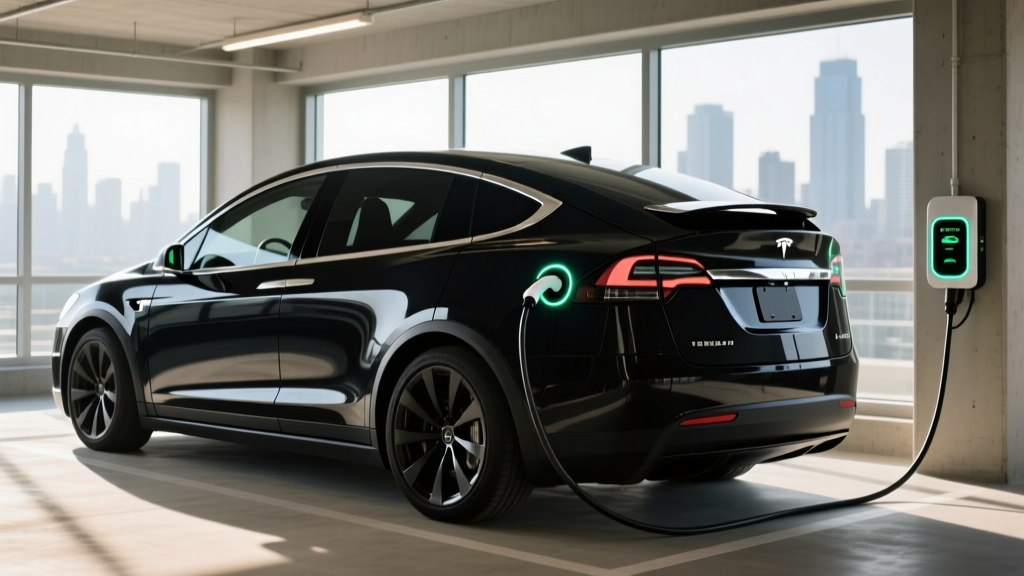
The Tesla Model X remains one of the most capable electric SUVs on the road, but extracting its full EPA-rated range depends far more on how you charge it than most owners realize. Whether you're running the current Long Range AWD variant (335 miles EPA) or the performance-oriented Plaid, your charging infrastructure directly impacts daily usability, battery longevity, and cost per mile. This guide walks through every charging scenario a Model X owner will encounter — from the 120V outlet in your garage to a 250 kW Supercharger on a cross-country road trip.
Understanding the Model X Battery and Range Baseline
Before selecting charging equipment, you need the hard numbers. The current Tesla Model X Long Range carries a usable battery capacity of approximately 95 kWh (NMC chemistry) and delivers an EPA-estimated 335 miles of range. The Plaid variant, with its tri-motor setup producing 1,020 horsepower, drops to roughly 326 miles EPA due to higher energy consumption.
| Spec | Model X Long Range | Model X Plaid |
|---|---|---|
| EPA Range | 335 mi | 326 mi |
| Usable Battery | ~95 kWh (NMC) | ~95 kWh (NMC) |
| Peak DC Charge Rate | 250 kW | 250 kW |
| 10–80% DC Fast Charge | ~31 min | ~31 min |
| Level 2 Max Acceptance | 11.5 kW (48A) | 11.5 kW (48A) |
| Horsepower | 670 hp | 1,020 hp |
| 0–60 mph | 3.8 sec | 2.5 sec |
| Efficiency (MPGe) | 98 MPGe combined | 96 MPGe combined |
| Base MSRP | ~$79,990 | ~$94,990 |
| Battery Warranty | 8 yr / 150,000 mi | 8 yr / 150,000 mi |
Source: fueleconomy.gov and Tesla Model X specifications.
Charging Levels Explained: Speeds in kW and Miles Per Hour
The single most common confusion among new EV owners is the difference between kW (kilowatts) and kWh (kilowatt-hours). Think of kW as the speed of energy delivery — like water pressure from a hose. kWh is the total amount of energy delivered — like gallons in a bucket. Your Model X's battery holds roughly 95 kWh of energy; the charger's kW rating determines how quickly that bucket fills.
| Charging Level | Voltage | Power (kW) | Miles of Range Added Per Hour | Typical Use Case |
|---|---|---|---|---|
| Level 1 | 120V AC | 1.0–1.4 kW | 3–4 mi/hr | Emergency / overnight trickle |
| Level 2 (24A) | 240V AC | 5.8 kW | 17–19 mi/hr | Basic home charging |
| Level 2 (48A) | 240V AC | 11.5 kW | 34–38 mi/hr | Optimal home charging for Model X |
| Level 2 (80A) | 240V AC | 19.2 kW | 56–62 mi/hr | Tesla Wall Connector max (Model X caps at 48A/11.5 kW) |
| DC Fast (Tesla Supercharger V3) | 400V DC | Up to 250 kW | ~1,000+ mi/hr (peak) | Road trips, rapid top-ups |
A critical nuance: the Model X's onboard charger maxes out at 11.5 kW (48 amps). Even if you install an 80-amp Tesla Wall Connector capable of 19.2 kW, your Model X will only draw 11.5 kW. The extra capacity isn't wasted — it future-proofs your installation for a next-gen vehicle or supports a second EV on a load-sharing circuit.
Home Charger Installation: Electrical Requirements and Costs
Installing a Level 2 home charger for your Model X involves more than plugging in a box. Here's the full breakdown of what's required, what it costs, and where older homes often hit snags.
Electrical Requirements for Optimal Model X Charging
- Circuit: Dedicated 60-amp breaker (to support continuous 48-amp draw — NEC requires circuits rated at 125% of continuous load)
- Voltage: 240V split-phase (standard US residential)
- Wire gauge: 6 AWG copper (THHN in conduit) or 4 AWG aluminum
- Connector: NACS (North American Charging Standard) — native Tesla plug, no adapter needed
- Panel capacity: Minimum 200-amp main service panel recommended; 100-amp panels will almost certainly need an upgrade
Installation Cost Breakdown
| Component | Low Estimate | High Estimate | Notes |
|---|---|---|---|
| Charging Equipment (Tesla Wall Connector) | $420 | $475 | 24-foot cable, Wi-Fi enabled, NACS native |
| Electrician Labor | $600 | $2,500 | Varies by run length, wall type, conduit needs |
| Electrical Materials (wire, conduit, breaker) | $150 | $600 | Longer runs from panel = higher cost |
| Permit & Inspection | $50 | $300 | Varies by municipality |
| Panel Upgrade (if needed: 100A → 200A) | $1,500 | $4,000 | Common in homes built before 1990 |
| Total (no panel upgrade) | $1,220 | $3,875 | |
| Total (with panel upgrade) | $2,720 | $7,875 |
Equipment Recommendations for Model X Owners
Given the Model X's 11.5 kW onboard charger cap and native NACS connector, here are the chargers that make the most sense in 2026:
Tesla Wall Connector (Gen 3)
- Max Output: 11.5 kW (48A) on a 60A circuit — matches Model X perfectly
- Connector: NACS native (no adapter needed)
- Cable Length: 24 feet
- Smart Features: Wi-Fi connectivity, OTA firmware updates, power sharing with second Wall Connector, load management
- Price: ~$425
- Verdict: Best default choice. Seamless Tesla integration, cleanest install, and power-sharing capability for two-EV households.
ChargePoint Home Flex (NACS version)
- Max Output: 12 kW (50A) on a 60A circuit — Model X will draw 11.5 kW
- Connector: NACS (available natively as of 2025)
- Cable Length: 23 feet
- Smart Features: Wi-Fi, app scheduling, Alexa integration, detailed energy reporting
- Price: ~$599
- Verdict: Strong alternative if you want detailed app analytics or plan to own a non-Tesla EV alongside your Model X (J1772 adapter included).
Emporia Vue Level 2 Charger
- Max Output: 11.5 kW (48A) on a 60A circuit
- Connector: NACS or J1772 (select at purchase)
- Cable Length: 24 feet
- Smart Features: Integration with Emporia energy monitor for whole-home load tracking, solar-aware charging
- Price: ~$399
- Verdict: Best budget smart charger. Ideal if you have solar panels and want to charge exclusively on excess solar production.
Connector Compatibility: NACS, CCS, and Adapters
The Model X uses the NACS (North American Charging Standard) connector natively. As of 2026, NACS has become the dominant standard in North America, adopted by Ford, GM, Rivian, Hyundai, and most major manufacturers. Here's how compatibility breaks down across charging scenarios:
| Charging Network / Scenario | Connector | Model X Compatibility |
|---|---|---|
| Tesla Superchargers (V2/V3/V4) | NACS | Native — plug and charge |
| Tesla Destination Chargers | NACS | Native — plug and charge |
| Electrify America | CCS1 | Requires Tesla CCS adapter (~$175) or NACS-equipped EA stations (expanding through 2026) |
| EVgo | CCS1 / NACS | NACS stalls available at newer locations; CCS adapter needed at legacy stalls |
| ChargePoint (public Level 2) | J1772 | Tesla Mobile Connector J1772 adapter included with vehicle |
| Non-Tesla home chargers (J1772) | J1772 | Use included J1772-to-NACS adapter |
The Tesla CCS adapter is worth purchasing if you regularly travel routes where Supercharger coverage is sparse — particularly in parts of the rural Midwest and Mountain West where Electrify America or EVgo may be the only DC fast option.
Cost to Charge: Home vs. Public vs. Gas Comparison
Charging cost is where the Model X delivers its most compelling ownership advantage — but only if you charge smart. Here's what the math actually looks like.
| Charging Scenario | $/kWh | Cost for Full 95 kWh Battery | Cost Per Mile (based on ~310 real-world mi) |
|---|---|---|---|
| Home (off-peak utility rate) | $0.08–$0.13 | $7.60–$12.35 | $0.025–$0.040 |
| Home (standard residential rate) | $0.14–$0.18 | $13.30–$17.10 | $0.043–$0.055 |
| Tesla Supercharger (V3) | $0.28–$0.36 | $26.60–$34.20 | $0.086–$0.110 |
| Electrify America / EVgo | $0.32–$0.48 | $30.40–$45.60 | $0.098–$0.147 |
| Gas equivalent (22 MPG SUV at $3.40/gal) | — | — | $0.155 |
At home off-peak rates, a full Model X charge costs roughly $8–$12 and delivers around 270–310 real-world miles. That's 2.5 to 4 cents per mile — roughly one-quarter to one-sixth the cost of fueling a comparable gas SUV like the BMW X5 or Mercedes GLE at $3.40/gallon and 22 MPG combined.
Even at Supercharger rates, the Model X costs about $0.09–$0.11 per mile — still cheaper than gasoline. The key takeaway: home charging is where the economics shine. If you can't charge at home and rely exclusively on public DC fast charging, your per-mile cost approaches or occasionally exceeds gas, and you'll subject the battery to more high-rate charging cycles, which accelerates degradation over time.
Charging Times for the Model X: Real-World Scenarios
Here's what to expect when charging the Model X's ~95 kWh battery from common state-of-charge (SoC) starting points:
- Level 1 (120V, 1.2 kW): Adding 30 miles overnight (10 hours) — adequate only for emergency trickle or vehicles driven under 20 miles daily.
- Level 2 (240V, 48A / 11.5 kW): Full charge from 10% to 100% in approximately 8–9 hours. A typical overnight session (8 hours) adds roughly 270 miles — enough to replenish a nearly depleted battery.
- DC Fast Charge (Tesla Supercharger V3, 250 kW peak): 10–80% in approximately 31 minutes. Note that the charge curve tapers significantly above 80% — going from 80–100% at a Supercharger can add another 25–30 minutes. Tesla's navigation system automatically preconditions the battery when you route to a Supercharger, which is essential for achieving peak charge rates.
Safety, Code, and Installation Best Practices
A Level 2 charger installation is a permanent electrical modification to your home. Cutting corners here risks fire, failed inspections, and voided insurance claims.
- Dedicated circuit: Your 60-amp EV circuit must be dedicated — it cannot share with other appliances. This is a NEC (National Electrical Code) requirement.
- GFCI protection: NEC 2020 and later requires GFCI (Ground Fault Circuit Interrupter) protection for outdoor receptacles. Hardwired Wall Connectors typically satisfy this via the breaker; plug-in units using a NEMA 14-60 outlet may need a GFCI breaker, which adds $50–$80.
- Outdoor rating: If mounting outdoors, ensure the charger is rated for outdoor use (the Tesla Wall Connector is NEMA 4 rated for outdoor installation). Use a weatherproof mounting surface and drip loop on the conduit entry.
- Permit and inspection: Most municipalities require an electrical permit for a new 240V circuit. The inspection ensures proper wire gauge, breaker sizing, grounding, and bonding. Permit fees typically range from $50–$300.
- Use a licensed electrician: While some jurisdictions allow homeowner electrical work, a 60-amp 240V circuit carries significant arc-flash risk if improperly installed. A licensed electrician carries liability insurance and ensures code compliance. Always verify their EV charger installation experience.
Frequently Asked Questions
How much does it cost to install a home EV charger for a Tesla Model X?
Expect $1,200–$3,900 for a standard installation (Tesla Wall Connector, 60-amp circuit, electrician labor, materials, and permit) if your electrical panel has sufficient capacity. If a panel upgrade from 100A to 200A is needed, add $1,500–$4,000, bringing the total to $2,700–$7,900. The Tesla Wall Connector itself costs approximately $425.
How fast will each charging level add range to the Model X?
Level 1 (120V) adds roughly 3–4 miles per hour. Level 2 at 48 amps (240V) adds approximately 34–38 miles per hour — a full overnight session restores about 270 miles. DC fast charging at a Tesla V3 Supercharger adds up to 200 miles in 15 minutes at peak rate, though the 10–80% session takes about 31 minutes total due to charge-curve taper.
Which connector and charger is compatible with my Model X?
The Model X uses the NACS (North American Charging Standard) connector natively. At home, the Tesla Wall Connector is the ideal match. For non-Tesla public Level 2 chargers (J1772), use the J1772-to-NACS adapter included with your vehicle. For non-Tesla DC fast chargers (CCS1), you'll need the Tesla CCS adapter, sold separately for approximately $175.
How much does charging a Model X cost per mile versus gas?
Home charging at off-peak utility rates costs approximately $0.025–$0.040 per mile. Supercharging costs roughly $0.086–$0.110 per mile. A comparable gas SUV at 22 MPG with fuel at $3.40/gallon costs about $0.155 per mile. Home charging saves 70–85% per mile; even Supercharging saves roughly 30–45% per mile versus gasoline.
What electrical upgrades might I need for a home charger?
The most common upgrade is a panel replacement from 100 amps to 200 amps ($1,500–$4,000), especially in homes built before 1990. You may also need a new conduit run from the panel to the charger location (cost varies with distance and wall type), a GFCI breaker for outdoor installations, and potentially a utility service upgrade if your transformer cannot support the additional load. A licensed electrician's load calculation will determine exactly what's required.
Does frequent DC fast charging hurt the Model X battery?
Occasional DC fast charging (road trips) has minimal impact. However, relying on DC fast charging as your primary method accelerates degradation compared to Level 2 home charging. Tesla's battery management system and thermal preconditioning mitigate this, but data from high-mileage Tesla fleets shows roughly 2–4% additional capacity loss over 100,000 miles for vehicles that predominantly DC fast charge versus those that charge at Level 2. For optimal longevity, charge at home on Level 2 for daily use and reserve Supercharging for road trips.
Is the Tesla Model X eligible for the federal EV tax credit?
Under current IRS §30D rules, the Model X may qualify for up to $7,500 in federal tax credits, but eligibility depends on multiple factors: buyer income caps ($300,000 joint / $150,000 single AGI), the vehicle's MSRP cap ($80,000 for SUVs), battery critical-mineral sourcing requirements, and final assembly in North America. The Long Range base MSRP of ~$79,990 falls within the cap, but adding options can push it over. Always verify current eligibility on IRS.gov and consult a tax professional — rules and sourcing requirements change periodically.
Optimizing your Tesla Model X range starts long before you turn the key — it starts with the right charging infrastructure. A properly installed 48-amp Level 2 home charger delivers the best balance of speed, cost, and battery health. Budget realistically for installation, understand your panel's capacity, and keep DC fast charging as a road-trip tool rather than a daily habit. Your Model X will reward you with years of reliable, efficient electric driving.