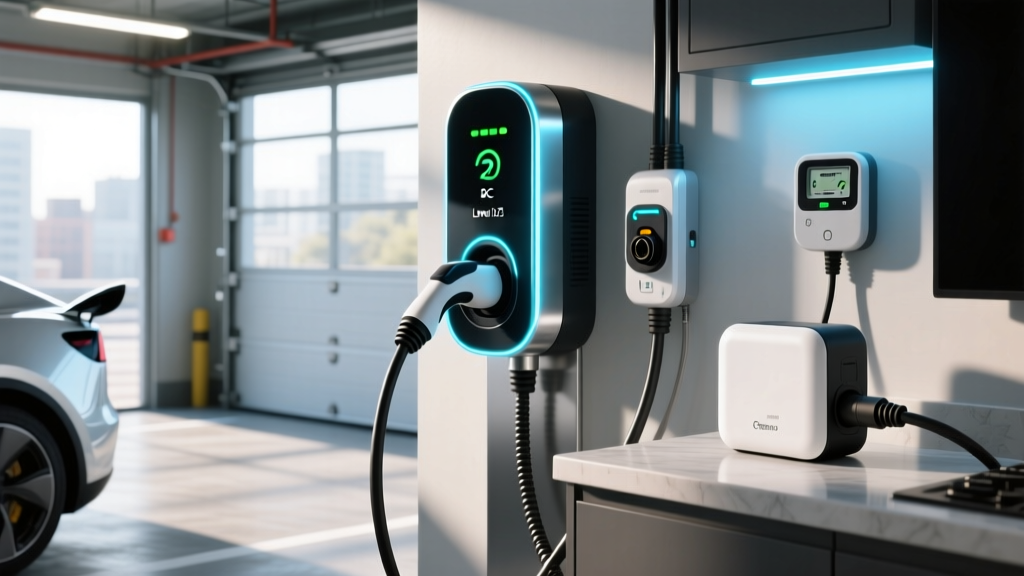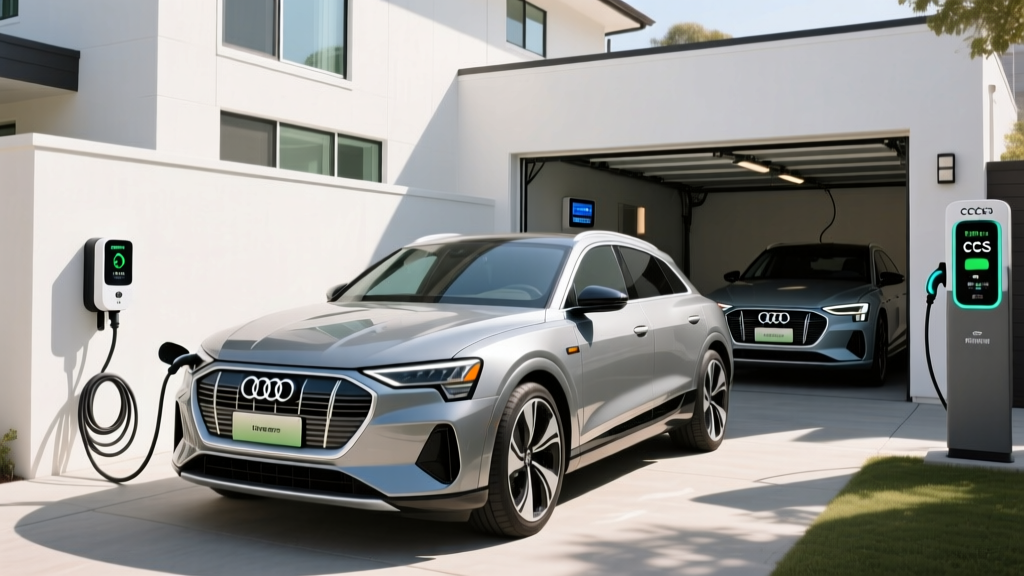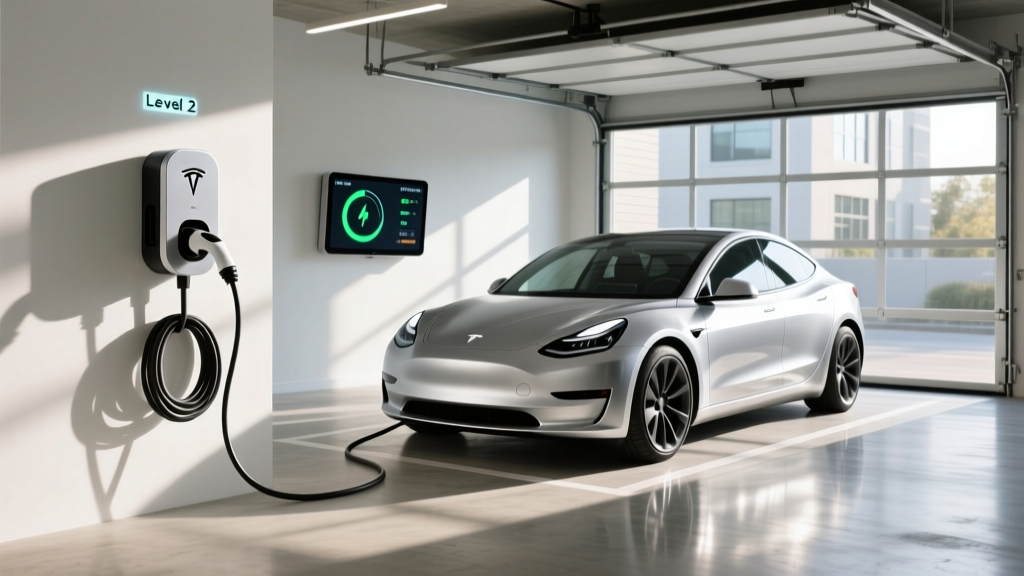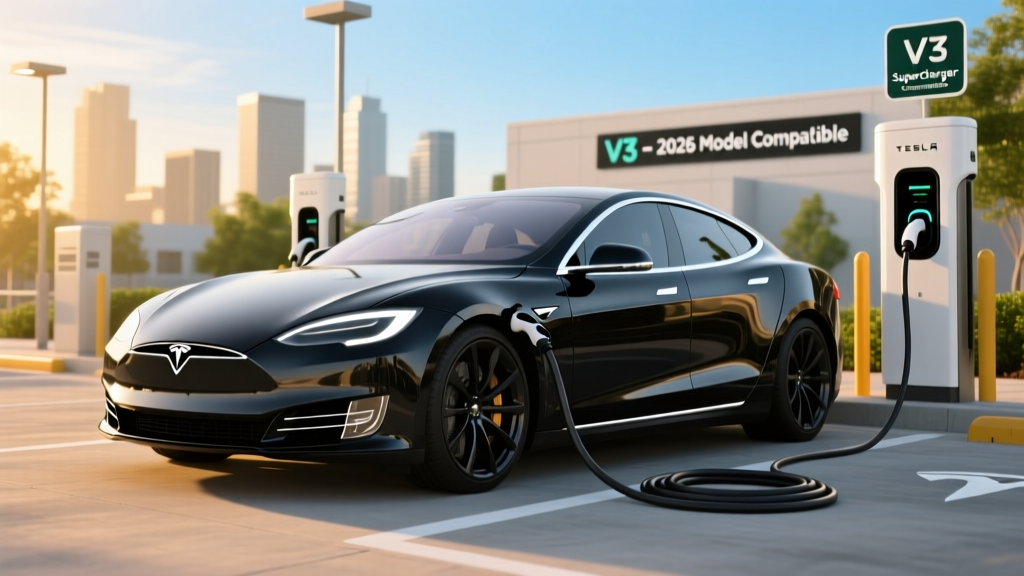
The Tesla Model S remains one of the longest-range electric sedans on the market, but its EPA sticker number only tells part of the story. How you charge, where you charge, and what equipment you install at home directly determines whether you see 402 miles on a full battery or fall short on a cold highway run. This guide breaks down the Tesla Model S range in real-world conditions, maps every charging level to actual miles-per-hour recovery, and walks through the exact electrical requirements for a home Level 2 setup in 2026.
Tesla Model S Range: EPA vs. Real-World Expectations
The 2026 Tesla Model S Long Range carries an EPA-estimated 402 miles of range from its 100 kWh (usable ~95 kWh) battery pack. The Plaid variant, with its tri-motor performance tuning, drops to an EPA-estimated 359 miles. But EPA testing uses a mixed city/highway cycle at moderate temperatures — conditions rarely replicated on a 75 mph interstate in January.
- Mild weather, mixed driving: ~370–390 mi
- Highway (70–75 mph sustained): ~310–340 mi
- Cold weather (below 32°F), highway: ~260–300 mi
- Cold weather + cabin heat + mountain terrain: ~230–270 mi
Source: fueleconomy.gov for EPA data; real-world estimates based on aggregated owner telemetry and third-party testing.
The Model S uses a heat pump for cabin and battery thermal management, which reduces cold-weather range loss compared to resistive heating systems. Still, any battery-electric vehicle loses 20–35% of range in sub-freezing conditions due to increased cabin heating demand, reduced regenerative braking efficiency, and the energy cost of warming the battery pack. Preconditioning the battery while plugged in — using the Tesla app's scheduled departure feature — recovers some of that loss by warming the pack on grid power rather than battery power.
Charging Levels Explained: Speeds in kW and Miles Per Hour
Understanding EV charging requires distinguishing between kW (kilowatts — the rate of power delivery) and kWh (kilowatt-hours — the total energy stored in the battery). Think of kW as how fast water flows through a hose, and kWh as the size of the bucket. The Model S Long Range has a ~95 kWh usable bucket. How fast you fill it depends on the charger's kW output.
| Charging Level | Voltage | Max Power (kW) | Miles of Range Added Per Hour | Typical Use Case |
|---|---|---|---|---|
| Level 1 | 120V AC | 1.0–1.4 kW | 3–5 mi/hr | Emergency / overnight trickle |
| Level 2 (Home/Public) | 240V AC | 7.2–19.2 kW | 22–60 mi/hr | Daily home charging, workplace, destinations |
| DC Fast Charging | 400V+ DC | 50–250 kW | 150–800+ mi/hr (peak) | Road trips, rapid top-ups |
The Model S accepts up to 11.5 kW on Level 2 AC (48A at 240V) using its onboard charger. On DC fast charging, it peaks at 250 kW at a V3 or V4 Tesla Supercharger. At peak rate, the Model S can add roughly 200 miles of range in 15 minutes — but that peak is not sustained. The charging curve tapers significantly above 50% state of charge (SoC), and more aggressively above 80%.
Charging Time Examples: 10–80% SoC
| Charger Type | Power | 10–80% Time (Model S LR ~95 kWh) | Notes |
|---|---|---|---|
| Tesla Wall Connector (Level 2) | 11.5 kW | ~5.5–6 hours | Full overnight charge; ideal daily use |
| Generic Level 2 (32A) | 7.7 kW | ~8–8.5 hours | Common public/destination charger speed |
| Tesla V3 Supercharger | Peak 250 kW | ~25–30 minutes | Peak rate only below ~50%; tapers above |
| Tesla V4 Supercharger | Peak 250+ kW | ~22–28 minutes | Newer cabinet; similar curve to V3 for Model S |
| CCS DC Fast (with adapter) | 50–150 kW | ~45–70 minutes | Varies by station; non-Tesla networks |
The charge curve taper is the most misunderstood aspect of DC fast charging. A 250 kW peak does not mean 250 kW sustained. The Model S typically holds 200–250 kW from roughly 10–35% SoC, then steps down to ~150 kW through 50%, ~100 kW through 65%, and drops below 50 kW above 80%. This is why Tesla's navigation system recommends charging to 80% on road trips — the last 20% can take as long as the first 50%.
Home Charger Installation: Electrical Requirements and Costs
Installing a Level 2 home charger is the single biggest quality-of-life upgrade for a Model S owner. But the cost varies enormously depending on your home's electrical panel, the distance from panel to charger location, and local permit requirements.
Electrical Requirements for a Model S Home Charger
The Tesla Wall Connector delivers up to 11.5 kW (48 amps continuous) on a 240V circuit. National Electrical Code (NEC) requires that continuous loads not exceed 80% of a circuit breaker's rating, so a 48A charger needs a dedicated 60A breaker. If your panel doesn't have 60A of spare capacity, you can configure the Wall Connector to lower amperage (e.g., 40A on a 50A breaker for 9.6 kW, or 32A on a 40A breaker for 7.7 kW).
Key electrical specifications:
- Circuit: Dedicated 60A (for full 48A/11.5 kW output)
- Wire gauge: 6 AWG copper (or 4 AWG aluminum) for runs up to ~50 feet; larger gauge for longer runs
- Breaker: 60A double-pole, GFCI if required by local code (NEC 2020+ requires GFCI for new EV circuits in many jurisdictions)
- Panel capacity: Minimum 200A service recommended; older 100A panels may need an upgrade
Installation Cost Breakdown
| Component | Low-End Estimate | High-End Estimate | Notes |
|---|---|---|---|
| Tesla Wall Connector (equipment) | $420 | $475 | 24-foot cable, Wi-Fi enabled, NACS connector |
| Third-party Level 2 charger | $350 | $700 | ChargePoint, Emporia, Grizzl-E, etc. |
| Electrician labor (standard install) | $500 | $1,500 | Short run, accessible panel, no conduit complications |
| Electrician labor (complex install) | $1,500 | $3,500+ | Long wire run, conduit through walls, attic/crawlspace |
| Permit and inspection | $50 | $300 | Varies by municipality; some jurisdictions waive for EV |
| Electrical panel upgrade (if needed) | $1,500 | $4,000+ | 100A to 200A service upgrade; not always required |
| Total (no panel upgrade) | $970 | $2,275 | Typical scenario for modern homes with 200A panel |
| Total (with panel upgrade) | $2,470 | $6,275+ | Older homes, limited panel capacity |
A licensed electrician should perform a load calculation on your panel before installation. If your home has 200A service and significant spare capacity, a standard install typically lands in the $1,000–$1,800 range (equipment + labor + permit). Homes with 100A service, maxed-out panels, or long wire runs from panel to garage should budget higher. Some utilities offer rebates of $250–$500 for Level 2 charger installation — check with your local provider. The IRS Residential Clean Energy Credit (IRC §25C) may cover up to 30% of charger equipment and installation costs, capped at $1,000 annually, through 2032. Consult a tax professional for eligibility.
Connector Compatibility: NACS, CCS, and Adapter Needs
The Tesla Model S uses the North American Charging Standard (NACS) connector natively — the same connector Tesla has used since its inception, now adopted by Ford, GM, Rivian, Hyundai, and most major automakers for 2025+ models. This means the Model S plugs directly into all Tesla Superchargers and Destination Chargers without an adapter.
| Connector Type | Native to Model S? | Adapter Needed? | Where You'll Find It |
|---|---|---|---|
| NACS (Tesla) | Yes | No | Tesla Superchargers, Destination Chargers, growing non-Tesla networks |
| CCS1 (Combo) | No | Yes — NACS-to-CCS adapter (~$200–$250) | Electrify America, EVgo, ChargePoint DC fast stations |
| CHAdeMO | No | Yes — limited availability, ~$300+ | Largely legacy; Nissan Leaf stations, some older networks |
| J1772 (Level 2 AC) | No | Yes — included with Model S (J1772-to-NACS adapter) | Public Level 2 stations, non-Tesla destination chargers |
Tesla includes a J1772-to-NACS adapter in the glovebox of every new Model S, so public Level 2 charging is accessible out of the box. For DC fast charging on non-Tesla networks (Electrify America, EVgo), you'll need a NACS-to-CCS adapter. Tesla sells an official CCS adapter, and third-party options from Lectron and A2Z exist. Note that CHAdeMO is effectively a dead standard in North America — investing in a CHAdeMO adapter is rarely worthwhile unless you regularly travel in areas where only CHAdeMO stations exist.
One important caveat: while non-Tesla EVs can now access many Supercharger stations using a built-in CCS-to-NACS adapter or magic-dock connector, the reverse — a Tesla accessing a CCS-only station — depends on the adapter's communication handshake. Most adapters work reliably, but occasional firmware mismatches can prevent a session from starting. Keep the Tesla app and your adapter firmware updated.
Cost to Charge: Home vs. Public vs. Gas Comparison
The per-mile cost advantage of electric driving is substantial, but it varies dramatically based on where and when you charge. Electricity rates range from ~$0.08/kWh in off-peak residential settings to $0.48+/kWh at some DC fast chargers.
| Charging Scenario | $/kWh | Cost for Full 95 kWh Charge | Cost Per Mile (at 3.5 mi/kWh) | Equivalent Gas Price (at 30 MPG) |
|---|---|---|---|---|
| Home off-peak (TOU rate) | $0.09 | $8.55 | $0.026 | $0.77/gallon |
| Home standard rate | $0.15 | $14.25 | $0.043 | $1.29/gallon |
| Public Level 2 (ChargePoint, etc.) | $0.25 | $23.75 | $0.071 | $2.14/gallon |
| Tesla Supercharger (avg.) | $0.30 | $28.50 | $0.086 | $2.57/gallon |
| Electrify America DC fast | $0.43 | $40.85 | $0.123 | $3.68/gallon |
| Gasoline (2026 national avg.) | — | — | $0.107 (at $3.20/gal, 30 MPG) | $3.20/gallon |
The Model S Long Range achieves roughly 3.5 miles per kWh (120 MPGe combined, per fueleconomy.gov). At home off-peak rates, that translates to under $0.03 per mile — roughly a quarter of what a 30 MPG gas sedan costs at 2026 fuel prices. Even at Supercharger rates, the per-mile cost undercuts most gasoline vehicles.
The key economic insight: home charging is where the savings live. If you charge 85% of your miles at home on off-peak rates and 15% on DC fast chargers during road trips, your blended per-mile cost lands around $0.04–$0.05 — roughly half the cost of a comparable gas sedan. If you rely exclusively on public DC fast charging (apartment living, no home access), the cost advantage narrows significantly, and in some markets, DC fast charging at $0.40+/kWh approaches gas parity.
Recommended Home Charging Equipment for the Model S
The home charger market has matured considerably. Here are proven Level 2 units that pair well with the Model S, with exact specs:
Tesla Wall Connector (Gen 3.5 / 2025+)
- Max output: 11.5 kW (48A)
- Connector: NACS (native Tesla)
- Cable length: 24 feet
- Smart features: Wi-Fi, OTA updates, power sharing (link up to 6 units on one circuit), scheduled charging via Tesla app
- Price: ~$420–$475
- Best for: Tesla-only households wanting seamless integration
Emporia Vue / Emporia Level 2 Charger
- Max output: 11.5 kW (48A)
- Connector: J1772 (use included adapter for Tesla) or NACS version available
- Cable length: 24 feet
- Smart features: Wi-Fi, energy monitoring, solar integration, load management, Time-of-Use scheduling
- Price: ~$399
- Best for: Solar-equipped homes, multi-EV households, budget-conscious buyers
ChargePoint Home Flex (2nd Gen)
- Max output: 12 kW (50A) — configurable down to 16A
- Connector: J1772 or NACS
- Cable length: 23 feet
- Smart features: Wi-Fi, Alexa integration, ChargePoint app scheduling, flexible amperage
- Price: ~$599–$699
- Best for: Mixed-fleet households (Tesla + non-Tesla), smart home integration
Grizzl-E Smart (United Chargers)
- Max output: 10 kW (40A)
- Connector: J1772 or NACS
- Cable length: 24 feet
- Smart features: OCPP-compatible, app control, extreme cold rated (-40°F), rugged aluminum enclosure
- Price: ~$499
- Best for: Cold-climate garages, outdoor installs, durability priority
For a Tesla-only household, the Tesla Wall Connector is the obvious choice: native NACS, power sharing for multi-charger setups, and the lowest price for 48A output. If you plan to add a non-Tesla EV in the future, the ChargePoint Home Flex or Emporia provides more connector flexibility. For outdoor installations in extreme cold, the Grizzl-E's -40°F rating and rugged build stand out.
Safety, Code, and Installation Best Practices
EV charging draws sustained high current for hours — this is not the same as plugging in a dryer for 45 minutes. Safety and code compliance protect your home and your investment.
- Dedicated circuit: Your Level 2 charger must be on its own dedicated circuit — never shared with other appliances. A 60A breaker for a 48A charger is NEC-required.
- GFCI protection: NEC 2020 and later requires GFCI (Ground Fault Circuit Interrupter) protection for EV charging outlets in many jurisdictions. Hardwired installations may have different requirements than plug-in (NEMA 14-50) setups. Your electrician will determine what your local code mandates.
- Outdoor rating: If installing outdoors, ensure the charger is NEMA 4 rated (weatherproof). The Tesla Wall Connector, ChargePoint Home Flex, and Grizzl-E all carry outdoor ratings. Use an in-use cover for plug-in receptacle installations.
- Permit and inspection: Most municipalities require an electrical permit for new 240V circuits. The inspection verifies proper wire gauge, breaker sizing, grounding, and GFCI compliance. Skipping the permit risks insurance claim denials if an electrical fire occurs.
- Wire gauge and conduit: 6 AWG copper THHN in conduit is standard for 48A/60A circuits. Longer runs (over 50 feet from panel) may require 4 AWG to prevent voltage drop. Your electrician will calculate this based on the specific run.
- Hardwired vs. plug-in: Hardwired installations (direct wire from panel to charger) eliminate the NEMA 14-50 receptacle as a potential failure point and are generally preferred for permanent garage installations. Plug-in setups offer portability but require a properly installed and torqued receptacle — loose 14-50 outlets have been linked to overheating incidents.
Frequently Asked Questions
How much does it cost to install a home EV charger for a Tesla Model S?
A typical Level 2 home installation with a Tesla Wall Connector runs $970–$2,275 including equipment, electrician labor, and permit — assuming your home has a 200A electrical panel with spare capacity. If your panel needs an upgrade from 100A to 200A service, add $1,500–$4,000+. Always get a load calculation from a licensed electrician before committing.
How fast will each charging level add range to my Model S?
Level 1 (120V standard outlet) adds 3–5 miles per hour — essentially useless for daily driving but adequate for emergency trickle charging. Level 2 (240V, 48A) adds approximately 35–44 miles per hour, fully replenishing the Model S overnight. DC fast charging at a Tesla Supercharger peaks at roughly 200 miles in 15 minutes, but this rate tapers significantly above 50% state of charge.
Which charger connector is compatible with the Tesla Model S?
The Model S uses the NACS (Tesla) connector natively. It plugs directly into all Tesla Superchargers and Destination Chargers. For J1772 public Level 2 stations, use the included J1772-to-NACS adapter. For CCS1 DC fast stations (Electrify America, EVgo), purchase a NACS-to-CCS adapter (~$200–$250). CHAdeMO adapters exist but the standard is largely obsolete in North America.
How much does charging a Model S cost per mile compared to gas?
At home off-peak rates (~$0.09/kWh), the Model S costs about $0.026 per mile — equivalent to $0.77/gallon gasoline in a 30 MPG car. At average Supercharger rates (~$0.30/kWh), it's $0.086/mile, equivalent to ~$2.57/gallon. A comparable gas sedan at 2026 national average fuel prices (~$3.20/gallon, 30 MPG) costs $0.107 per mile. Home charging delivers the strongest economic advantage.
What electrical upgrades might I need for a Level 2 charger?
If your home has a 200A electrical panel with sufficient spare capacity, you likely need only a new 60A double-pole breaker and wiring run. Older homes with 100A service, panels near capacity, or sub-panels may require a panel upgrade ($1,500–$4,000+) or a service upgrade from the utility. An energy management system (like Emporia's or the Tesla Powerwall integration) can sometimes avoid a panel upgrade by dynamically limiting charger draw when other loads are high.
Does the Tesla Model S come with a mobile charger?
As of the 2025 model year, Tesla no longer includes the Mobile Connector in the box — it's available as a ~$200 accessory. The Mobile Connector delivers up to 3 kW on a NEMA 14-50 outlet (240V, 24A) or ~1 kW on a standard 120V outlet. It's useful for travel but too slow for daily charging of a 95 kWh battery. A dedicated Wall Connector is strongly recommended for primary home use.
Should I charge my Model S to 100% every day?
The Model S Long Range uses an NMC (nickel manganese cobalt) battery chemistry, which degrades faster when held at 100% state of charge for extended periods. Tesla recommends setting the daily charge limit to 80–90% and only charging to 100% when needed for long trips. The battery management system includes a top and bottom buffer to protect against extreme states, but habitual 100% charges accelerate long-term capacity loss. For NMC packs, the 20–80% window is the longevity sweet spot.