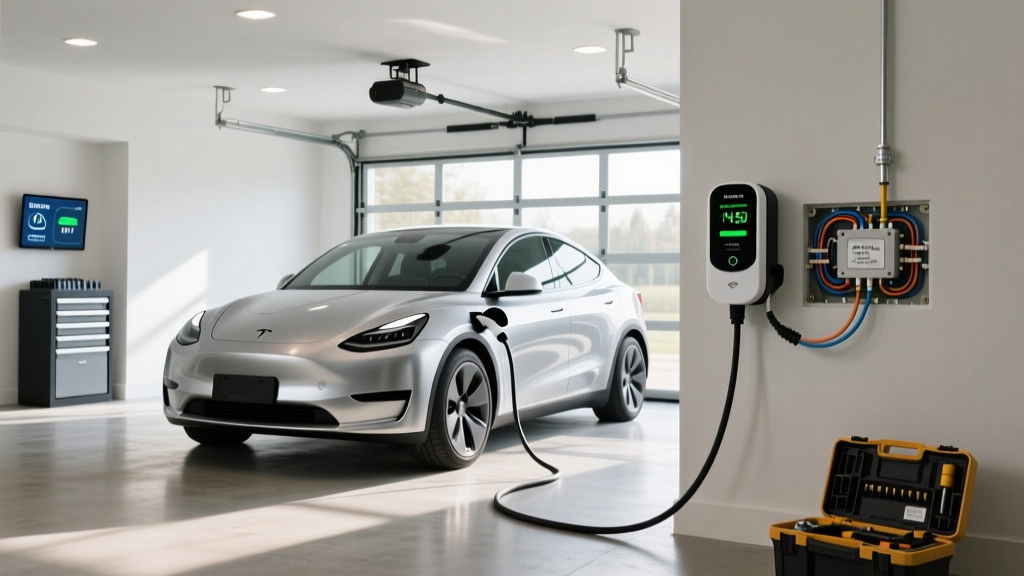
If you own or are shopping for a Tesla, understanding your real-world charging time across different scenarios is the single most practical piece of EV literacy you can develop. Marketing materials quote peak kW numbers, but your actual Tesla model charging time depends on battery size, charging equipment, ambient temperature, and the physics of lithium-ion charge curves. This guide breaks down exact numbers for the current Tesla lineup — Model 3, Model Y, Model S, Model X, and the Cybertruck — across Level 1, Level 2, and DC fast charging.
Tesla Model Charging Time by Charging Level
Before diving into Tesla-specific numbers, you need to understand the three charging tiers and what they actually deliver. Power is measured in kW (kilowatts) — the rate at which energy flows. Energy is measured in kWh (kilowatt-hours) — the total amount stored in your battery. Think of kW as the width of a hose and kWh as the size of the bucket. A wider hose fills the bucket faster, but the bucket size determines how much you ultimately need to fill.
| Level | Voltage | Power (kW) | Miles of Range Added per Hour | Typical Use Case |
|---|---|---|---|---|
| Level 1 (120V) | 120V AC | 1–1.4 kW | 3–5 miles/hr | Emergency top-ups, overnight trickle for low-mileage drivers |
| Level 2 (240V) | 240V AC | 7.2–19.2 kW | 23–56 miles/hr | Home daily charging, workplace, hotels, shopping centers |
| DC Fast Charging | 400–800V DC | 50–350+ kW | 150–400+ miles/hr (peak) | Road trips, highway corridors, Supercharger network |
For context, the average American drives roughly 37 miles per day according to FHWA data. That means Level 2 home charging — even at a modest 7.2 kW — replenishes a full day's driving in under two hours. Level 1 is viable only if your daily driving stays below 30 miles and you can plug in for 10+ hours overnight.
Exact Tesla Model Charging Times: 10–80% at DC Fast Chargers
Tesla vehicles use the North American Charging Standard (NACS) connector, which Tesla opened to the industry in late 2022 and which has since been adopted by Ford, GM, Rivian, Hyundai, and most major automakers. At Tesla Superchargers, you plug directly in — no adapter needed. At non-Tesla DC fast chargers with CCS1 cables, you'll need a NACS-to-CCS adapter (Tesla sells one for approximately $250).
DC fast charging doesn't deliver peak power for the entire session. The charge curve tapers significantly above 50–60% State of Charge (SoC) to protect battery health. A "250 kW peak" rating means the car may hit 250 kW briefly at low SoC, then drop to 150 kW, then 80 kW, then 40 kW as it approaches 80%. This is why manufacturers and reviewers quote 10–80% times — it's the most honest representation of usable fast-charging speed.
| Model (2025–2026) | Battery (usable kWh) | Peak DC Charge Rate | 10–80% Time | 15 min Added Range (peak) |
|---|---|---|---|---|
| Model 3 Long Range AWD | ~79 kWh (NMC) | 250 kW | ~25–28 min | ~175 miles |
| Model 3 Performance | ~79 kWh (NMC) | 250 kW | ~25–28 min | ~170 miles |
| Model Y Long Range AWD | ~78 kWh (NMC) | 250 kW | ~25–28 min | ~168 miles |
| Model Y Performance | ~78 kWh (NMC) | 250 kW | ~25–28 min | ~160 miles |
| Model S Long Range | ~95 kWh (NMC) | 250 kW | ~30–35 min | ~200 miles |
| Model X Long Range | ~95 kWh (NMC) | 250 kW | ~30–35 min | ~180 miles |
| Cybertruck AWD | ~123 kWh (NMC) | 350 kW (800V arch) | ~22–26 min | ~170 miles |
Real-world caveat: These times assume battery preconditioning is active (the car has warmed or cooled the battery pack en route to the charger via navigation). If you arrive at a Supercharger without preconditioning — for example, driving there without using the car's navigation — expect 10–80% times to increase by 5–10 minutes, especially in cold weather below 40°F. Cold batteries accept charge far more slowly due to lithium plating risk.
Level 2 Home Charging: Tesla Wall Connector vs. Third-Party Options
Home Level 2 charging is where most Tesla owners do 85–95% of their charging. Tesla's own Wall Connector is an excellent choice, but it's not the only option. Here's how the top choices compare for Tesla vehicles.
| Charger | Max Power Output | Connector | Cable Length | Smart Features | Price (approx.) |
|---|---|---|---|---|---|
| Tesla Wall Connector | 11.5 kW (48A on 60A circuit) | NACS (native) | 24 ft | Wi-Fi, OTA updates, power sharing, load management | $475 |
| ChargePoint Home Flex (NACS) | 12 kW (50A on 60A circuit) | NACS | 23 ft | Wi-Fi, app scheduling, Alexa, Energy Star | $650 |
| Emporia Vue Level 2 | 11.5 kW (48A) | NACS (2025+ model) | 24 ft | Wi-Fi, solar integration, energy monitoring | $400 |
| Grizzl-E Smart | 10 kW (40A on 50A circuit) | NACS adapter or J1772 + adapter | 24 ft | Wi-Fi, OCPP, extreme weather rated | $550 |
The Tesla Wall Connector at 11.5 kW will fully recharge a Model 3 Long Range (79 kWh) from 10% to 100% in roughly 7–8 hours — easily covering overnight replenishment. If your electrical panel supports a 100A circuit, you can push the Wall Connector to 19.2 kW (80A), cutting that time to about 4.5 hours, though most residential panels don't have spare capacity for a 100A dedicated circuit.
Critical note on kW vs. circuit amperage: Electrical code requires that continuous loads (like EV charging) use only 80% of a circuit's rated capacity. A 60A breaker supports 48A continuous (11.5 kW at 240V). A 50A breaker supports 40A continuous (9.6 kW). Never install a charger rated for more than 80% of the breaker size.
How Much Does It Cost to Install a Home Tesla Charger?
The total installed cost of a Level 2 home charger varies enormously based on your home's electrical infrastructure. Here's a realistic breakdown based on national averages and typical 2025–2026 electrician rates.
| Component | Simple Install (panel nearby, no upgrade) | Complex Install (long run, sub-panel) | Full Panel Upgrade (200A service) |
|---|---|---|---|
| Charger equipment | $400–$650 | $400–$650 | $400–$650 |
| Electrical permit | $50–$200 | $100–$300 | $150–$400 |
| Electrician labor (2–4 hrs typical) | $300–$800 | $800–$2,000 | $1,500–$3,500 |
| Wiring, conduit, breaker | $100–$400 | $400–$1,200 | $500–$1,500 |
| Panel upgrade (if needed) | $0 | $0 | $2,000–$5,000 |
| Total estimated cost | $850–$2,050 | $1,700–$4,150 | $4,550–$11,050 |
Panel upgrade reality check: Homes built before 1990 often have 100A electrical service. Adding a 60A EV circuit to a 100A panel that's already near capacity (electric stove, dryer, HVAC) may require upgrading to 200A service — a $2,000–$5,000 job on its own. Before committing to a charger install, have a licensed electrician perform a load calculation on your panel. Some utilities and states offer rebates specifically for panel upgrades to support EV adoption — check the DSIRE database for local incentives.
Safety and code requirements to verify:
- Dedicated circuit — your EV charger must have its own breaker, not shared with other appliances
- GFCI protection — NEC 2020 and later require GFCI breakers for EV outlets in garages
- NEMA 14-50 outlet vs. hardwired — hardwired installations avoid the GFCI requirement and are generally more reliable (no plug to loosen over time)
- Outdoor rating — if mounting outside, the charger must carry a NEMA 4 or IP65 weather rating
- Permit and inspection — always pull a permit; unpermitted electrical work can void homeowner's insurance and create fire risk
Connector Compatibility: NACS, CCS1, and CHAdeMO for Tesla Owners
Tesla pioneered the NACS connector, and as of 2025–2026, it is becoming the dominant DC fast-charging standard in North America. Here's what you need to know about plugging in.
| Connector Type | Where You'll Find It | Tesla Native? | Adapter Needed? | Notes |
|---|---|---|---|---|
| NACS (Tesla) | Tesla Superchargers, Destination Chargers, growing number of third-party stations | Yes — native on all Tesla vehicles | No | Standard for all Tesla AC and DC charging in North America |
| CCS1 | Electrify America, EVgo, ChargePoint, most non-Tesla DCFC | No | Yes — Tesla NACS-to-CCS adapter (~$250) | Required for non-Tesla DC fast chargers; Tesla now sells an official adapter |
| CHAdeMO | Limited legacy stations (Nissan, older infrastructure) | No | No official Tesla adapter exists | Effectively incompatible with Tesla; CHAdeMO is being phased out in the US |
| J1772 (AC Level 2) | Public Level 2 stations, older home chargers | No (NACS is native) | Yes — J1772-to-NACS adapter (included with most Teslas) | Tesla ships a J1772 adapter with new vehicles; useful for public Level 2 |
For Tesla owners in 2026, the practical reality is straightforward: Superchargers work natively, and the growing network of NACS-equipped third-party chargers (Electrify America and EVgo have committed to adding NACS cables) will reduce adapter dependence over time. Keep the CCS adapter in your frunk or trunk for road trips through areas with limited Supercharger coverage.
Cost to Charge a Tesla: Per-Mile Cost vs. Gasoline
Charging cost is where Tesla ownership delivers its most tangible financial advantage — but the savings vary dramatically depending on where and when you charge.
| Scenario | Cost per kWh | Cost to Charge 79 kWh (Model 3 LR) | Cost per Mile (at 3.5 mi/kWh) | Gas Equivalent (30 MPG at $3.50/gal) |
|---|---|---|---|---|
| Home — off-peak utility rate | $0.08–$0.14 | $6.32–$11.06 | $0.023–$0.040 | $0.117 |
| Home — standard residential rate | $0.14–$0.20 | $11.06–$15.80 | $0.040–$0.057 | $0.117 |
| Home — peak/TOU high rate | $0.25–$0.40 | $19.75–$31.60 | $0.071–$0.113 | $0.117 |
| Tesla Supercharger (average US) | $0.28–$0.36 | $22.12–$28.44 | $0.080–$0.102 | $0.117 |
| Third-party DCFC (EA, EVgo) | $0.35–$0.55 | $27.65–$43.45 | $0.100–$0.157 | $0.117 |
The takeaway: Home charging at off-peak rates delivers fuel costs roughly 65–80% lower than gasoline. Supercharging approaches gas parity, and expensive third-party DC fast charging can actually exceed gasoline cost per mile. This is why home charging access is the single most important factor in EV ownership satisfaction and economics.
To maximize savings, enroll in your utility's time-of-use (TOU) rate plan and schedule charging for overnight hours (typically 11 PM – 6 AM). The Tesla app allows you to set scheduled charging windows directly from your phone. According to fueleconomy.gov, the 2025 Model 3 Long Range achieves 132 MPGe combined, translating to roughly 25 kWh per 100 miles — among the most efficient vehicles in its class.
What Electrical Upgrades Might Your Home Need?
Before ordering a Wall Connector, assess your home's readiness:
Panel capacity: Open your panel and check the main breaker rating (100A, 150A, or 200A). Then add up the amperage of all existing breakers — if the total is already near or above the main rating, you'll need a panel upgrade or a load-management device like the Emporia VUE or Tesla's built-in power-sharing feature, which dynamically reduces charger amperage when other loads are active.
Distance from panel to charger location: Wire cost scales with distance. A 60A circuit using 6 AWG copper wire costs roughly $3–$6 per foot. A 100-foot run from panel to garage adds $300–$600 in wire alone, plus conduit and labor. If your panel is on the opposite side of the house from your parking spot, expect the higher end of the cost ranges above.
240V outlet availability: Some homes already have a 240V outlet (NEMA 14-50) from a previous electric dryer or range. If it's on a dedicated 50A or 60A circuit and in good condition, you can plug in a Mobile Connector or Wall Connector with a plug adapter — saving the cost of a new circuit. Have an electrician inspect any existing outlet before relying on it for daily EV charging; worn contacts can overheat under sustained high-amperage loads.
Utility incentives: Many utilities offer $200–$1,000 rebates for Level 2 charger installation, especially if you enroll in a TOU rate plan. Some provide free or discounted panel upgrades for EV adopters. Check with your local utility before scheduling an electrician.
Tesla Charging Time: Frequently Asked Questions
How long does it take to charge a Tesla Model 3 at home on a standard 120V outlet?
A standard 120V household outlet delivers approximately 1–1.4 kW (Level 1). For a Model 3 Long Range with a 79 kWh battery, a full 0–100% charge would take roughly 55–80 hours. In practice, Level 1 adds about 3–5 miles of range per hour. It's suitable for emergency use or for drivers covering fewer than 30 miles daily who can plug in for 10+ hours overnight.
Does preconditioning really affect Tesla charging speed?
Yes, significantly. When you navigate to a Supercharger using the Tesla's built-in navigation, the car automatically preconditioning the battery — warming it in cold weather or cooling it in hot weather — to optimize charge acceptance. Without preconditioning, especially below 40°F, peak charge rates can be cut by 30–50%, adding 10–15 minutes to a 10–80% session. Always navigate to the charger rather than just driving there from memory.
Can I use a non-Tesla charger with my Tesla?
Yes. With the official Tesla NACS-to-CCS adapter ($250), you can use Electrify America, EVgo, and most CCS-equipped DC fast chargers. For Level 2 public stations with J1772 connectors, Tesla includes a J1772-to-NACS adapter with new vehicles. The growing adoption of NACS by third-party networks means native Tesla compatibility is expanding rapidly through 2026.
Is it bad to DC fast charge my Tesla every day?
Occasional DC fast charging has minimal impact on battery health, but daily DCFC use — particularly to high states of charge (90%+) — can accelerate degradation slightly over years. Tesla's battery management system is sophisticated, and data from high-mileage Teslas shows that even frequent Supercharger users typically see only 8–12% degradation over 150,000 miles. For daily charging, Level 2 at home set to 80% SoC is optimal for long-term battery health. Tesla's battery warranty covers 8 years/120,000 miles (Model 3/Y) or 8 years/150,000 miles (Model S/X) with a guaranteed minimum 70% capacity retention, per Tesla's warranty documentation.
How much does it cost to install a Tesla Wall Connector at home?
The Tesla Wall Connector itself costs $475. Professional installation typically adds $500–$2,000 for a straightforward setup (panel has capacity, charger is near the panel). If your home needs a panel upgrade from 100A to 200A service, total project cost can reach $4,500–$11,000. Always get a load calculation from a licensed electrician before committing.
Why does charging slow down above 80%?
Lithium-ion batteries accept charge fastest at low states of charge. As the battery fills, internal resistance increases, and pushing current into a nearly-full pack generates excess heat and risks lithium plating — both of which damage the battery. Tesla's BMS progressively reduces charge rate above 50–60% SoC, and dramatically above 80%. This is why 10–80% times are quoted rather than 0–100%: the last 20% can take as long as the first 70% on a DC fast charger. For road trips, charge to 80% and move on — it's faster than waiting for 100%.