If you've just taken delivery of a 2025 or 2026 Tesla Model 3, you're probably excited about two things: plugging in at home for the first time and dropping your phone onto the center-console wireless charging pad. Both are part of the same ownership experience — getting electrons into the devices that power your daily life. But while the Model 3's Qi2 wireless phone charger is a straightforward drop-and-go feature, setting up proper home EV charging and understanding public charging networks requires a bit more homework.
This guide covers the Model 3's wireless phone charging system in detail, then walks through every charging layer you'll encounter as an owner: Level 1 trickle charging, Level 2 home installations, DC fast charging on the road, connector compatibility, real cost-per-mile math, and the electrical upgrades your home might need. We'll use exact numbers — kW, kWh, minutes, dollars — because vague promises don't help you budget or plan.
Tesla Model 3 Wireless Phone Charging: What You Get
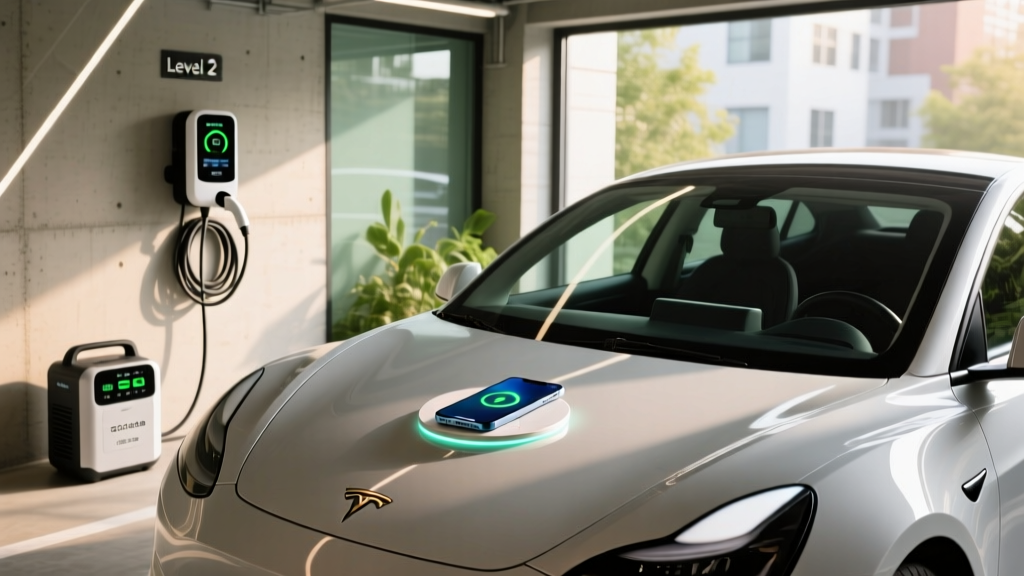
The refreshed Tesla Model 3 (often called the "Highland" and subsequent updates) includes a built-in wireless phone charging pad located in the front center console, just below the 15.4-inch touchscreen. Here's what you need to know:
- Standard: Qi-compatible (15W output on 2025–2026 models with Qi2 support)
- Positioning: Single pad on the driver-side console shelf; phone must sit flat against the surface
- Compatibility: Works with iPhone 12 and newer (MagSafe-aligned Qi2), Samsung Galaxy S21+, Google Pixel 6+, and most Qi-enabled Android devices
- Real-world behavior: Charging slows if the cabin is hot or if the phone is in a thick case. Expect ~10–12W sustained in warm conditions, not the full 15W peak
- Known quirk: Some owners report intermittent charging pauses during heavy regenerative braking events or when the car's thermal management system prioritizes battery cooling over cabin accessories
The wireless pad is convenient for navigation use, but it's not a replacement for a USB-C cable when you need fast charging. A USB-C port in the Model 3 delivers up to 27W to your phone — roughly double the wireless pad's effective output. If you're running Waze or Maps with the screen at full brightness on a summer road trip, the cable will keep up better.
Understanding EV Charging Levels: Speeds That Actually Matter
Before you install anything or plan a road trip, you need to understand the three charging levels and what they deliver in real-world terms. Note: kW (kilowatts) measures power — how fast energy flows into your battery. kWh (kilowatt-hours) measures energy — the total capacity of your battery. Think of kW as the width of a hose and kWh as the size of the bucket.
| Level | Power Source | Max Power (kW) | Miles of Range Added per Hour | Best Use Case |
|---|---|---|---|---|
| Level 1 | Standard 120V outlet | 1.4 kW | ~3–5 mi/hr | Overnight top-off, emergencies |
| Level 2 | 240V (dryer-style outlet or hardwired) | 7.6–11.5 kW | ~30–44 mi/hr | Daily home charging |
| DC Fast (Supercharger) | 480V+ public station | Up to 250 kW (V3) / 350 kW (V4) | ~200–1,000+ mi/hr (varies) | Road trips, quick top-ups |
For a 2026 Tesla Model 3 Long Range AWD with its ~75 kWh (usable) battery and EPA-estimated 363 miles of range, here's what charging times look like in practice:
- Level 1 (120V, 12A): 0–100% in roughly 50+ hours — useful only for maintaining charge or adding ~40 miles overnight
- Level 2 (240V, 48A / 11.5 kW): 10–80% in approximately 5.5–6 hours using the Tesla Mobile Connector with a NEMA 14-50 adapter, or the Tesla Wall Connector hardwired
- DC Fast (V3 Supercharger, 250 kW peak): 10–80% in approximately 25–28 minutes under ideal conditions. Note that the charge curve tapers significantly above 60% SoC — you'll see peak speeds only between 10–40% SoC, then a gradual decline. Expect ~170 miles of range added in the first 15 minutes.
Home Level 2 Charger Installation: Costs, Electrical Requirements, and Gotchas
This is where most new Model 3 owners spend the most time and money. A proper Level 2 home charging setup requires a dedicated 240V circuit, and the total cost depends heavily on your home's existing electrical panel.
Electrical Requirements
The Tesla Wall Connector (Gen 3) supports up to 48 amps continuous draw, which requires a 60-amp dedicated breaker on a 240V circuit. If you opt for the Tesla Mobile Connector with a NEMA 14-50 adapter, you're limited to 32 amps continuous (40-amp breaker). Here's the breakdown:
- Tesla Wall Connector (hardwired): 240V, 60A breaker, 48A continuous, up to 11.5 kW output, 24-foot cable
- Tesla Mobile Connector + NEMA 14-50: 240V, 50A breaker (40A continuous), 32A continuous, up to 7.6 kW output, 20-foot cable
- Panel capacity: Your home's main electrical panel must have enough spare capacity. Most modern 200-amp panels can accommodate a 60A EV circuit. Older 100-amp panels almost certainly cannot and will require an upgrade.
Installation Cost Breakdown
| Component | Low End | High End | Notes |
|---|---|---|---|
| Tesla Wall Connector (equipment) | $475 | $475 | Fixed price from Tesla; Gen 3 with Wi-Fi |
| Electrician labor (simple install) | $500 | $1,200 | Short run from panel to garage, same wall |
| Electrician labor (complex install) | $1,500 | $3,500 | Long conduit run, trenching, subpanel addition |
| Permit fees | $50 | $300 | Varies by municipality; some waive for EV |
| Electrical panel upgrade (if needed) | $2,000 | $5,000 | 100A → 200A service upgrade by licensed electrician |
| Total (no panel upgrade) | $1,025 | $4,975 | Most homes: $1,500–$2,500 |
| Total (with panel upgrade) | $3,025 | $9,975 | Common in pre-1990 homes |
Equipment Recommendations
The Tesla Wall Connector is the obvious first choice for Model 3 owners, but it's not the only option. Here's how the top chargers compare:
Tesla Wall Connector (Gen 3)
- Power: Up to 11.5 kW (48A)
- Connector: NACS (Tesla native)
- Cable: 24 ft
- Smart features: Wi-Fi, OTA updates, power sharing between units, access control
- Price: $475
- Verdict: Best for Tesla-only households. No J1772 adapter needed.
ChargePoint Home Flex
- Power: Up to 12 kW (50A) — adjustable via DIP switches
- Connector: J1772 (NACS adapter included or available)
- Cable: 23 ft
- Smart features: Wi-Fi, app scheduling, utility integration, Alexa
- Price: ~$599
- Verdict: Best multi-EV household. Works with every EV via adapter.
Emporia Level 2 EV Charger
- Power: Up to 11.5 kW (48A)
- Connector: J1772 (NACS adapter available)
- Cable: 24 ft
- Smart features: Wi-Fi, app, integrates with Emporia energy monitoring
- Price: ~$399
- Verdict: Best budget smart charger. Lacks Tesla's polish but solid value.
Connector Compatibility: NACS, CCS, and What Fits Your Model 3
Tesla's North American Charging Standard (NACS) connector has become the dominant EV charging connector in the United States. As of 2025, Ford, GM, Rivian, Volvo, and most other major automakers have adopted NACS for new vehicles, and public networks are rapidly adding NACS cables.
| Connector | Native on Model 3? | Adapter Needed? | Where You'll Find It |
|---|---|---|---|
| NACS (Tesla) | Yes — native port | No | Tesla Superchargers, Tesla Wall Connector, growing number of public stations |
| CCS1 | No | Yes — Tesla sells a CCS adapter (~$175) | Electrify America, EVgo, some ChargePoint stations |
| CHAdeMO | No | Yes — third-party adapter (~$300+) | Largely legacy; being phased out in the US |
| J1772 (Level 2 AC) | No | Yes — included with Model 3 (Tesla J1772 adapter) | Public Level 2 stations, non-Tesla home chargers |
For home charging, the Tesla Wall Connector's native NACS plug is the cleanest solution — no adapter required. If you install a J1772 charger like the ChargePoint Home Flex, simply use the J1772-to-NACS adapter that Tesla includes in the glovebox of every new Model 3.
For public DC fast charging, Tesla's Supercharger network remains the gold standard for reliability. According to Tesla's Supercharger page, there are over 6,500 V3/V4 Superchargers across North America as of early 2026. The CCS adapter is worth carrying for redundancy, especially in areas where Electrify America stations fill gaps in Supercharger coverage.
Cost to Charge: Per-Mile Math vs. Gasoline
One of the strongest arguments for the Model 3 is fuel cost savings, but the actual numbers depend entirely on how and where you charge. Here's a realistic breakdown for a 2026 Model 3 Long Range AWD, which achieves approximately 25 kWh per 100 miles (or 4 miles per kWh) in mixed driving:
| Scenario | Rate ($/kWh) | Cost per 100 Miles | Cost per Mile | Annual Cost (12,000 mi) |
|---|---|---|---|---|
| Home — off-peak utility rate | $0.08–$0.12 | $2.00–$3.00 | $0.02–$0.03 | $240–$360 |
| Home — standard residential rate | $0.14–$0.18 | $3.50–$4.50 | $0.035–$0.045 | $420–$540 |
| Tesla Supercharger (V3) | $0.25–$0.35 | $6.25–$8.75 | $0.06–$0.09 | $750–$1,050 |
| Electrify America (CCS) | $0.35–$0.48 | $8.75–$12.00 | $0.09–$0.12 | $1,050–$1,440 |
For comparison, a gas sedan averaging 30 MPG at $3.40/gallon costs roughly $0.11 per mile, or $1,360 annually at 12,000 miles. A comparable BMW 330i or Mercedes C300 in the Model 3's price bracket typically returns 26–28 MPG combined, pushing that cost to $0.12–$0.13 per mile.
Public Charging on the Road: Superchargers, Networks, and Real-World Speeds
The Model 3's navigation system automatically routes you through Tesla Superchargers on long trips and preconditions the battery when a Supercharger is set as your destination. This preconditioning warms the battery to its optimal charging temperature, which can reduce 10–80% charge times by 5–10 minutes in cold weather. Without preconditioning, you may see peak charge rates limited to 100–150 kW instead of the full 250 kW for the first several minutes.
Here's what to expect at different public charging scenarios:
- V3 Supercharger (250 kW peak): 10–80% in ~25–28 minutes. Peak rate holds from ~10–40% SoC, then tapers to ~100 kW by 60%, and ~50 kW by 75%. This is the charge curve reality that marketing materials don't show.
- V4 Supercharger (350 kW peak, limited Model 3 support): The 2026 Model 3's battery architecture peaks around 250 kW, so V4 stalls don't offer a meaningful speed advantage for this model. The Cybertruck and newer-platform vehicles benefit more.
- Electrify America (CCS, up to 350 kW stall): With the Tesla CCS adapter, expect 10–80% in ~30–35 minutes. EA station reliability has improved but still lags Tesla's Supercharger uptime. Plan for occasional out-of-service stalls.
- Destination Level 2 (hotels, restaurants): Typically 7.2–19.2 kW. Useful for overnight stays, not for quick top-ups. Add ~25–70 miles per hour of charging.
For authoritative efficiency and range data, the EPA's fueleconomy.gov lists the 2026 Model 3 variants with official MPGe ratings, kWh/100mi consumption, and range figures.
Safety, Code, and Smart Charging Practices
Home EV charger installation is electrical work that must comply with the National Electrical Code (NEC) and your local building department. Here are the critical safety considerations:
- Dedicated circuit: Your Level 2 charger must be on its own dedicated breaker — no sharing with other appliances. A 48A continuous-draw charger requires a 60A breaker per NEC 210.20(A) (125% rule for continuous loads).
- GFCI protection: NEC 2020 and later requires GFCI protection for all EV charging outlets (receptacles). Hardwired installations like the Tesla Wall Connector are exempt from this specific GFCI requirement, which is one reason many electricians prefer hardwiring.
- Outdoor rating: If your charger is installed outdoors (driveway, exterior wall), ensure the unit is rated NEMA 3R or NEMA 4. The Tesla Wall Connector is rated for indoor and outdoor use. The Mobile Connector is not rated for outdoor use while connected.
- Permitting: Most jurisdictions require an electrical permit for EV charger installations. Your electrician should pull this permit and schedule an inspection. Unpermitted work can void homeowner's insurance coverage and complicate future home sales.
- Utility notification: Some utilities offer EV-specific time-of-use (TOU) rates that can cut your charging costs by 40–60%. Contact your utility before installation to ask about EV rate plans and any available rebates for charger equipment or panel upgrades.
Federal Tax Credits and Utility Rebates for Home Charging
As of 2026, the federal Alternative Fuel Vehicle Refueling Property Credit (IRS Form 8911) provides a credit of up to 30% of the cost of home EV charger equipment and installation, capped at $1,000. However, this credit is only available if you live in a qualifying census tract (generally rural or low-income communities as defined by the IRS). Many suburban and urban tracts do not qualify.
Beyond the federal credit, many utilities and municipalities offer their own rebates:
- Utility rebates: $200–$500 for Level 2 charger equipment is common. Some utilities offer up to $1,000 if you agree to managed charging (allowing the utility to briefly pause charging during peak demand).
- State incentives: States like California, Colorado, Massachusetts, and New York offer additional rebates for charger installation, sometimes covering 50–100% of costs for income-qualified residents. Check your state energy office for current programs.
- Panel upgrade assistance: A growing number of utilities offer rebates or low-interest financing for electrical panel upgrades specifically to support EV charging.
Always consult a tax professional for your specific situation, as eligibility rules and qualifying census tracts change annually.
Frequently Asked Questions
Does the Tesla Model 3 wireless phone charger work with all phones?
It works with any Qi-compatible wireless charging phone, which covers most smartphones from 2019 onward. For optimal alignment and speed, Qi2-compatible phones (iPhone 12+, newer Samsung Galaxy and Pixel models) work best. Thick cases, metal plates, or magnetic mounts attached to the phone will block wireless charging.
How much does it cost to install a home EV charger?
For most homes with a modern 200-amp electrical panel, expect $1,500–$2,500 total (Tesla Wall Connector equipment + electrician labor + permit). Homes needing a panel upgrade should budget $3,000–$5,000+ additional. Always get 2–3 quotes from licensed electricians and confirm they pull permits.
How fast will each charging level add range to my Model 3?
Level 1 (120V) adds roughly 3–5 miles per hour. Level 2 (240V, 48A) adds roughly 44 miles per hour. DC fast charging at a V3 Supercharger can add up to 170 miles in 15 minutes, but the charge curve tapers significantly above 60% state of charge.
Which connector and charger is compatible with my Tesla Model 3?
The Model 3 uses the NACS (Tesla) connector natively. For home charging, the Tesla Wall Connector plugs directly in. For public Level 2 stations with J1772 connectors, use the included J1772-to-NACS adapter. For non-Tesla DC fast chargers with CCS1 connectors, purchase Tesla's CCS adapter (~$175).
How much does charging cost per mile vs. gas?
At home on off-peak electricity ($0.10/kWh), the Model 3 costs about $0.025 per mile. At Supercharger rates ($0.30/kWh), it's about $0.075 per mile. A comparable gas sedan at 28 MPG and $3.40/gallon costs about $0.12 per mile. Home charging saves 75–80% per mile; Supercharging saves ~35–40%.
What electrical upgrades might I need for a home charger?
The most common upgrade is a panel capacity increase from 100A to 200A service, costing $2,000–$5,000. You'll also need a dedicated 60A breaker and 240V circuit run to your garage or parking spot. If the panel is far from the charging location, long conduit runs add $500–$2,000 in labor and materials.
Is the Tesla Wall Connector worth it over cheaper alternatives?
For single-Tesla households, yes — the native NACS connector, 24-foot cable, Wi-Fi power management, and $475 price make it the most seamless option. If you have multiple EVs from different brands, a J1772 charger like the ChargePoint Home Flex ($599) offers broader compatibility with minimal adapter hassle.