Why Your Charger Choice Directly Impacts Tesla Model 3 Range
The 2026 Tesla Model 3 Long Range AWD carries an EPA-rated 341 miles of range from its ~75 kWh usable NMC battery pack (the RWD trim with its LFP battery delivers 272 miles EPA). But those stickers assume a full 100% charge under ideal conditions. In practice, highway driving at 70+ mph cuts range by roughly 10-15%, and cold weather can shave another 15-30% depending on severity. That means a realistic highway-cruise range for the Long Range is closer to 270-290 miles, and the RWD closer to 210-230 miles.
Your charging setup determines whether you start each day with a full battery or nurse a partial charge. A properly installed Level 2 home charger replenishes your Model 3 overnight, making daily range anxiety a non-issue. Let's break down exactly what that takes — in kilowatts, dollars, and hours.
Long Range AWD: EPA 341 mi → Expect ~270-290 mi highway, ~255-280 mi in freezing weather.
RWD (LFP): EPA 272 mi → Expect ~210-230 mi highway, ~190-215 mi in freezing weather.
Source: fueleconomy.gov
Charging Levels Explained: kW Speeds and Miles Added Per Hour
Before selecting equipment, understand the three charging tiers. A critical distinction: kW (kilowatts) measures charging power — how fast energy flows. kWh (kilowatt-hours) measures battery energy capacity — how much the tank holds. Confusing them is the most common EV mistake.
| Level | Voltage / Amperage | Power (kW) | Miles of Range Per Hour | Typical Use |
|---|---|---|---|---|
| Level 1 | 120V / 12A | ~1.4 kW | 3-5 mi/hr | Emergency / overnight trickle |
| Level 2 (Home) | 240V / 32-48A | 7.7 - 11.5 kW | 25-44 mi/hr | Daily home charging |
| DC Fast Charge | 400-800V DC | 50-250 kW | 150-1,000+ mi/hr | Road trips / public stations |
The 2026 Model 3's onboard charger maxes out at 11.5 kW on Level 2 (48A). That means even if you install a 60A or 80A wall connector, the car will only accept 48A. On DC fast charging, the Long Range peaks at approximately 250 kW at V3 Superchargers, achieving a 10-80% charge in roughly 25-28 minutes. The RWD with its LFP pack peaks closer to 170 kW, with 10-80% in about 30-35 minutes. Remember that charge curves taper significantly above 80% — charging from 80-100% can take as long as 10-80%.
Home Charger Installation: Electrical Requirements, Costs, and Panel Upgrades
A Level 2 home charger is the single most impactful upgrade for daily EV ownership. Here's what the installation actually involves.
Electrical Requirements
For a 48A continuous charger (the Model 3's maximum), the National Electrical Code requires the circuit be rated at 125% of continuous load — meaning you need a 60-amp dedicated circuit on a 240V line. If you opt for a 32A charger, a 40-amp circuit suffices.
Key code requirements:
- Dedicated circuit: The EV charger cannot share a breaker with other appliances.
- GFCI protection: NEC 2023/2026 requires GFCI breakers for EV charging circuits in garages and all outdoor installations.
- Outdoor rating: If mounted outside, the charger and connector must carry a NEMA 4 or NEMA 4X weather-resistance rating.
- Wire gauge: A 60A circuit typically requires 4 AWG copper wire (or 2 AWG aluminum) for runs up to ~100 feet; longer runs may need thicker wire to limit voltage drop.
Do You Need a Panel Upgrade?
This is the variable that catches many homeowners off guard. Most modern homes have a 200-amp main service panel. If your panel already runs near capacity (electric dryer, range, HVAC, water heater all drawing simultaneously), adding a 60A EV circuit may exceed the panel's safe load. A licensed electrician will perform a NEC Article 220 load calculation to determine if your panel can handle the addition.
Homes with 100-amp service (common in pre-1980 construction) almost always require a panel upgrade to 200A before adding a high-amperage EV circuit. Even some 200A panels need upgrading if they're older models with limited breaker slots or known safety issues (e.g., Federal Pacific or Zinsco panels).
Installation Cost Breakdown
| Component | Simple Install (panel nearby, no upgrade) | Complex Install (long run or panel upgrade) |
|---|---|---|
| Level 2 Charger (hardware) | $400 - $700 | $400 - $700 |
| Electrician labor (2-4 hrs typical) | $300 - $800 | $800 - $2,500 |
| Electrical permit | $50 - $150 | $100 - $300 |
| Wire, conduit, breaker | $100 - $300 | $300 - $800 |
| Panel upgrade (if needed) | $0 | $1,500 - $4,000 |
| TOTAL | $850 - $1,950 | $3,100 - $8,300 |
Always hire a licensed electrician and pull a permit — unpermitted electrical work can void your homeowner's insurance and create fire risk. Some utilities offer rebates of $250-$1,000 for Level 2 installations; check with your local provider.
Connector Compatibility: NACS, CCS1, and Adapter Realities
The 2026 Tesla Model 3 comes with the NACS (North American Charging Standard) connector natively — the same connector used across Tesla's Supercharger network. With the industry-wide shift to NACS, most new EVs from Ford, GM, Rivian, Hyundai, and others now also ship with NACS ports.
| Connector | Status in 2026 | Model 3 Compatibility |
|---|---|---|
| NACS (Tesla) | Industry standard for new EVs; 25,000+ Supercharger stalls | Native — no adapter needed |
| CCS1 | Legacy standard; still at Electrify America, EVgo stations | NACS-to-CCS adapter available (~$150-$250) |
| CHAdeMO | Effectively discontinued in North America | No adapter available; avoid |
| J1772 (Level 2 AC) | Still found on older public L2 chargers | J1772-to-NACS adapter (included with some vehicles) |
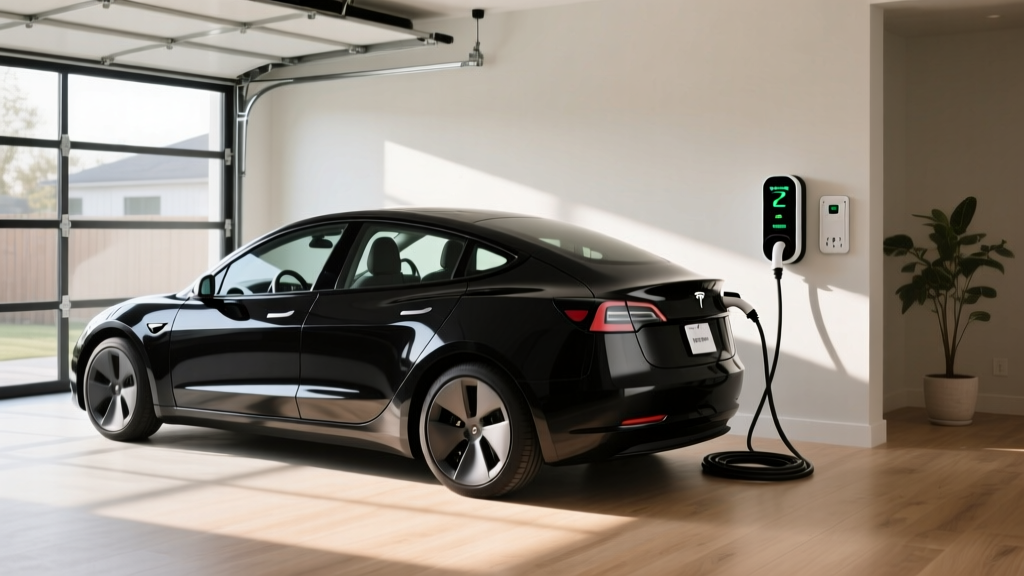
For home charging, Tesla's Wall Connector ships with a NACS plug. Third-party chargers increasingly offer NACS connectors, but many still ship with J1772 — in which case you'll use a J1772-to-NACS adapter (Tesla includes one with the car, or aftermarket options run $50-$150).
Level 2 Charger Equipment Picks for the Model 3
These chargers are selected for compatibility, reliability, and value. All support NACS natively or via adapter and match the Model 3's 11.5 kW onboard charger ceiling.
Tesla Wall Connector (Gen 4)
- Power: Up to 11.5 kW (48A)
- Connector: NACS native
- Cable length: 24 ft
- Smart features: Wi-Fi, OTA updates, power sharing with second unit, Tesla app integration
- Price: ~$475
- Best for: Tesla-only households wanting seamless integration
ChargePoint Home Flex
- Power: Up to 12 kW (50A), adjustable down to 16A
- Connector: NACS or J1772 options
- Cable length: 23 ft
- Smart features: Wi-Fi, ChargePoint app, scheduling, Alexa, energy tracking
- Price: ~$550-$650
- Best for: Multi-EV households; adjustable amperage for older panels
Emporia Vue Level 2 Charger
- Power: Up to 11.5 kW (48A)
- Connector: J1772 (adapter to NACS) or NACS
- Cable length: 24 ft
- Smart features: Wi-Fi, Emporia app, integrates with Emporia energy monitor for solar-aware charging
- Price: ~$400
- Best for: Budget-conscious buyers with solar panels
Charging Cost Per Mile: Home vs. Public vs. Gas
One of the strongest ownership arguments for the Model 3 is fuel cost. Let's quantify it with the Model 3 Long Range's efficiency of approximately 25 kWh/100 miles (or about 4.0 mi/kWh).
| Scenario | Cost per kWh | Cost per 100 Miles | Cost per Mile |
|---|---|---|---|
| Home (national avg. residential) | $0.17/kWh | $4.25 | $0.043 |
| Home (off-peak time-of-use rate) | $0.08/kWh | $2.00 | $0.020 |
| Public Level 2 (e.g., ChargePoint) | $0.25-$0.49/kWh | $6.25-$12.25 | $0.063-$0.123 |
| Tesla Supercharger (avg.) | $0.28-$0.36/kWh | $7.00-$9.00 | $0.070-$0.090 |
| Electrify America DC Fast | $0.38-$0.55/kWh | $9.50-$13.75 | $0.095-$0.138 |
| Gas car (30 MPG, $3.40/gal) | — | $11.33 | $0.113 |
At home on off-peak rates, the Model 3 costs roughly 5-6x less per mile than a comparable gas sedan. Even at Supercharger rates, you're typically saving 20-40% versus gasoline. The break-even point where DC fast charging costs more than gas is rare but possible in high-price markets like California during peak hours.
Charging Time Examples: How Long Does a Model 3 Take to Charge?
Here are practical charge times for the 2026 Model 3 Long Range (~75 kWh usable) and RWD (~57 kWh usable, LFP chemistry).
| Scenario | Long Range (75 kWh) | RWD (57 kWh, LFP) |
|---|---|---|
| Level 1 (1.4 kW) — 10-80% | ~37 hours | ~28 hours |
| Level 2 @ 7.7 kW (32A) — 10-80% | ~7 hours | ~5.3 hours |
| Level 2 @ 11.5 kW (48A) — 10-80% | ~4.5 hours | ~3.5 hours |
| DC Fast @ 250 kW — 10-80% | ~25-28 min | ~30-35 min (170 kW peak) |
LFP vs. NMC charging tip: Tesla recommends charging the RWD's LFP battery to 100% at least once per week to maintain accurate state-of-charge calibration. The Long Range's NMC battery is best kept between 20-80% for daily use, charging to 100% only before long trips. This affects your daily usable range — the Long Range effectively gives you ~273 miles of daily range (80% of 341), while the RWD LFP can use its full 272 miles daily.
Safety, Code, and Smart Charging Practices
Beyond the electrical code requirements listed above, consider these best practices:
- Cable management: Use a wall-mounted cable organizer to prevent tripping hazards and connector damage. Never run a charging cable across a driveway or public sidewalk.
- Load management: If your panel is near capacity but you want to avoid an upgrade, chargers like the ChargePoint Home Flex let you dial amperage down (e.g., to 32A/7.7 kW) to fit your panel's headroom.
- Preconditioning: The Model 3 can precondition its battery before a scheduled departure time, warming or cooling the pack for optimal charging speed and range. Set this in the Tesla app — it uses grid power while plugged in rather than draining your battery.
- Time-of-use optimization: Many utilities offer off-peak rates between 9 PM and 6 AM. Schedule charging in the Tesla app or your charger's app to automatically charge during cheap hours.
- Surge protection: Consider a whole-home surge protector ($200-$400 installed) to protect your charger and vehicle from voltage spikes, especially in areas with frequent lightning or unstable grids.
Frequently Asked Questions
How much does it cost to install a home EV charger for a Tesla Model 3?
For a straightforward installation with an adequate 200A panel and a short wire run, expect $850-$1,950 total (charger hardware + electrician + permit + materials). If your home needs a panel upgrade from 100A to 200A, or if the charger is far from the panel requiring a long conduit run, costs can reach $3,100-$8,300. Always get 2-3 quotes from licensed electricians.
How fast will each charging level add range to my Model 3?
Level 1 (120V) adds about 3-5 miles per hour — adequate only for plug-in hybrids or very low daily mileage. Level 2 at 240V/48A adds 35-44 miles per hour, easily replenishing a full day of driving overnight. DC fast charging at a Supercharger adds up to 175+ miles in 15 minutes at peak rate, though the charge curve tapers significantly above 60-70% state of charge.
Which connector and charger is compatible with my 2026 Model 3?
The 2026 Model 3 uses the NACS connector natively. For home charging, the Tesla Wall Connector is the most seamless choice. Third-party chargers with J1772 connectors work using the J1772-to-NACS adapter (typically included with the vehicle). For public DC fast charging at non-Tesla CCS1 stations, you'll need a NACS-to-CCS adapter.
How much does charging a Tesla Model 3 cost per mile compared to gas?
Charging at home on average residential rates (~$0.17/kWh), the Model 3 Long Range costs approximately $0.043 per mile. With off-peak time-of-use rates (~$0.08/kWh), that drops to $0.020 per mile. A comparable gas sedan at 30 MPG and $3.40/gallon costs $0.113 per mile. Home charging saves roughly 62-82% per mile versus gasoline.
What electrical upgrades might I need before installing a Level 2 charger?
The most common upgrade is a panel upgrade from 100A to 200A service, costing $1,500-$4,000, required in many older homes. You may also need additional breaker panel space, a new 240V circuit with appropriate wire gauge (4 AWG copper for 60A), and a GFCI breaker. A licensed electrician will perform an NEC Article 220 load calculation to determine your panel's capacity. Some homeowners opt for a lower-amperage charger (32A instead of 48A) to avoid a panel upgrade entirely.
Sources: EPA fueleconomy.gov, Tesla Model 3 specifications, IRS §30D clean vehicle credits.