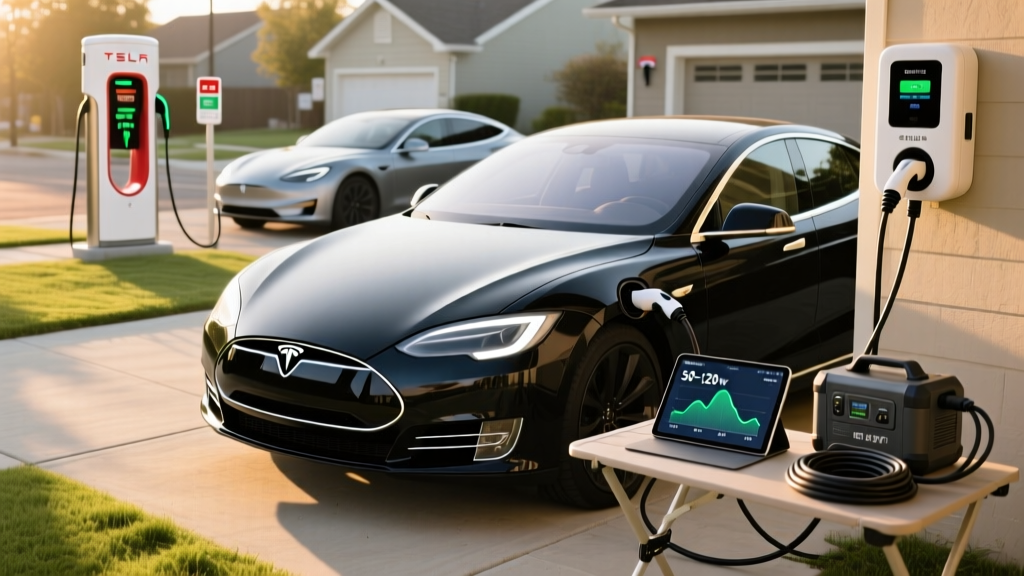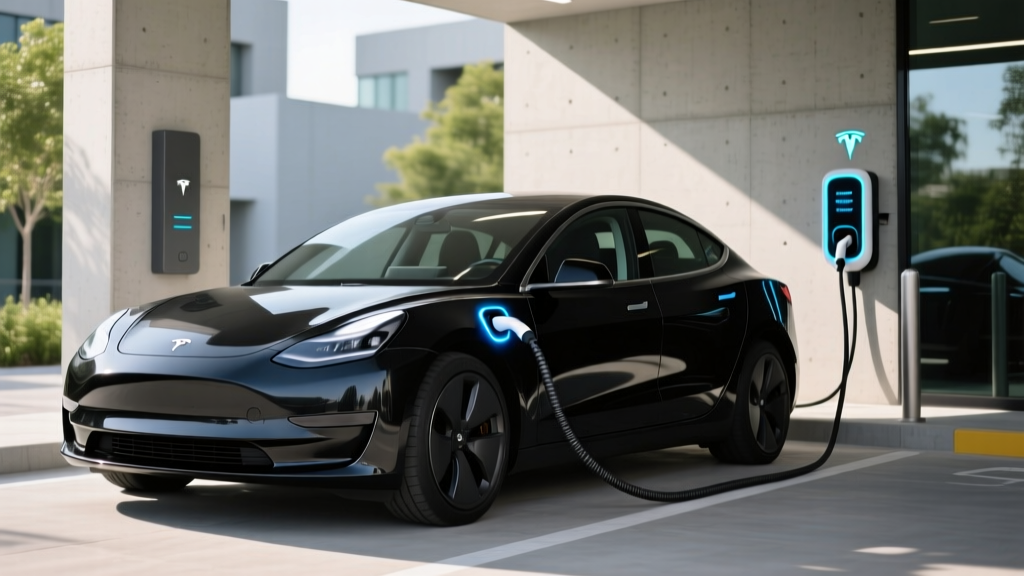
The EPA rates the 2026 Tesla Model 3 Long Range AWD at 341 miles of range from its 79 kWh (usable) LFP or NMC pack, depending on trim. But the range of a Tesla Model 3 you actually experience day-to-day depends less on the sticker number and far more on how you charge it — the equipment you install at home, the speeds you use on the road, and the habits that either preserve or erode battery health over time.
This guide breaks down every charging variable that affects your Model 3's real-world range: Level 1/2/DC speeds in exact kW and miles-per-hour, home installation requirements and costs, connector compatibility across the expanding NACS ecosystem, and the true cost per mile versus gasoline. Whether you're plugging into a standard 120V outlet or spec'ing a 48-amp wall connector, the numbers below will help you keep more miles in the pack.
Real-World Range vs. EPA: What the Model 3 Actually Delivers
2026 Model 3 Long Range AWD: EPA 341 mi — expect ~290–310 mi at sustained 75 mph highway speeds; ~250–275 mi in freezing temps (below 32°F) with cabin heat. The RWD base model (EPA 272 mi) typically yields 230–250 mi highway.
Why the gap? EPA testing uses low average speeds and includes regenerative braking in city cycles. Highway driving at 75+ mph increases aerodynamic drag exponentially, and cold weather increases battery internal resistance while demanding energy for cabin and pack heating.
According to fueleconomy.gov, the 2026 Model 3 LR AWD achieves 130 MPGe combined (26 kWh/100 mi). That efficiency figure is your baseline for calculating charging costs and understanding how charger speed translates into miles added per hour.
Charging Levels Explained: Speeds in kW and Miles Per Hour
The single most important distinction in EV charging: kW (kilowatts) measures power — how fast energy flows into the battery. kWh (kilowatt-hours) measures energy — the total capacity stored. A 60 kWh battery charged at 11.5 kW takes roughly 5.2 hours from 10% to 90%. Confusing these two is the most common EV literacy mistake.
| Level | Voltage / Amps | Power (kW) | Miles of Range Added Per Hour | Best For |
|---|---|---|---|---|
| Level 1 (120V) | 120V / 12A | ~1.4 kW | ~3–4 mi/hr | Overnight trickle, emergencies, low-mileage days |
| Level 2 (240V) | 240V / 32A–48A | 7.7–11.5 kW | ~22–44 mi/hr | Daily home charging, full overnight replenishment |
| DC Fast (Supercharger) | 400V architecture | Peak 250 kW (V3) | Up to ~175 mi in 15 min | Road trips, rapid top-ups |
The Model 3's onboard charger accepts up to 11.5 kW AC (48A at 240V). That means installing a 60A circuit with a 48A Wall Connector maxes out what the car can accept. A 32A charger (7.7 kW) still adds ~22 miles per hour — enough to replenish a full day's driving in 3–4 hours.
DC Fast Charging Reality: The Model 3 peaks at 250 kW on a V3 Supercharger, but only between roughly 10–30% state of charge. The charge curve tapers significantly above 50%, dropping to ~100 kW by 65% and ~40 kW above 85%. A typical 10–80% session takes ~25–28 minutes under optimal battery preconditioning. Without preconditioning (navigating to a Supercharger in the car activates it automatically), expect 30–35 minutes in cold weather.
Home Charger Installation: Electrical Requirements, Costs, and Panel Upgrades
Installing a Level 2 charger at home is where most Model 3 owners unlock the best ownership experience — waking up to a full battery every morning at the lowest cost per kWh. But the installation cost varies enormously based on your home's electrical infrastructure.
What You Need Electrically
- Circuit: A dedicated 60A breaker (for 48A continuous charging) or 40A breaker (for 32A continuous). EV chargers are continuous loads under NEC Article 625, meaning the circuit must be rated at 125% of the charger's max amperage.
- Wire: 6 AWG copper for 48A; 8 AWG for 32A. Run length affects voltage drop — runs over 100 feet may require 4 AWG.
- Panel capacity: Your main service panel must have room for the new breaker AND sufficient total capacity. A 200A panel with existing high-draw appliances (electric range, dryer, HVAC) may need a load calculation.
- Permit: Most jurisdictions require an electrical permit and inspection for new 240V circuits. This is non-negotiable for insurance and code compliance.
| Component | Simple Install (panel nearby) | Complex Install (panel upgrade / long run) |
|---|---|---|
| Level 2 Charger Equipment | $400–$600 | $400–$600 |
| Electrician Labor (2–4 hrs simple / 6–12 hrs complex) | $500–$1,200 | $1,500–$3,500 |
| Materials (wire, conduit, breaker) | $100–$300 | $300–$800 |
| Permit & Inspection | $50–$200 | $100–$350 |
| Panel Upgrade (if needed: 100A→200A) | N/A | $1,500–$3,000 |
| Total Estimated Cost | $1,050–$2,300 | $3,800–$8,250 |
Federal Tax Credit for Home Charging Equipment
Under IRS §30C Alternative Fuel Vehicle Refueling Property Credit, you may claim up to 30% of the cost of home charging equipment and installation, capped at $1,000. However, eligibility requires that your home be located in a qualifying census tract (generally non-urban or low-income communities). Check the IRS eligibility tool before assuming you qualify. This credit is separate from the §30D vehicle purchase credit.
Connector Compatibility: NACS, CCS, and the Adapter Question
The 2026 Tesla Model 3 comes equipped with the NACS (North American Charging Standard) connector — Tesla's proprietary design, now adopted as an industry standard. Here's what that means for compatibility:
| Connector Type | Native Compatibility? | Adapter Needed? | Where You'll Find It |
|---|---|---|---|
| NACS (Tesla) | Yes — native | None | Tesla Superchargers, Destination Chargers, growing third-party networks (Electrify America, EVgo adding NACS) |
| CCS1 | No (as of 2025+) | Tesla CCS Adapter (~$175–$250) | Legacy Electrify America, ChargePoint, EVgo stations not yet converted to NACS |
| CHAdeMO | No | Third-party adapter (rare, expensive) | Older Nissan Leaf-era stations — largely being phased out |
| J1772 (Level 2 AC) | Adapter included with car | Tesla J1772 adapter (included) | Public Level 2 stations, workplaces, hotels |
Key takeaway: The Model 3's NACS port gives you native access to the largest fast-charging network in North America (20,000+ Superchargers). For non-Tesla CCS stations still in operation, Tesla sells a CCS adapter that enables full compatibility. Carry it on road trips through areas where NACS conversion is still underway.
Charging Cost Per Mile: Home vs. Public vs. Gasoline
One of the strongest ownership arguments for the Model 3 is fuel cost. At 26 kWh/100 miles (EPA combined), the math is straightforward once you know your local electricity rate.
| Scenario | Rate / Price | Cost Per Mile | Annual Cost (12,000 mi) |
|---|---|---|---|
| Home charging (national avg. off-peak) | $0.13/kWh | $0.034 | $408 |
| Home charging (California avg.) | $0.27/kWh | $0.070 | $840 |
| Public Level 2 (ChargePoint, etc.) | $0.25–$0.49/kWh | $0.065–$0.127 | $780–$1,524 |
| Tesla Supercharger V3 (avg.) | $0.28–$0.36/kWh | $0.073–$0.094 | $876–$1,128 |
| Gasoline sedan (30 MPG combined) | $3.40/gal | $0.113 | $1,356 |
Even at California's higher electricity rates, home charging a Model 3 costs roughly half what a 30 MPG gasoline sedan costs per mile. The savings widen further if your utility offers time-of-use (TOU) plans with off-peak rates as low as $0.06–$0.09/kWh overnight — bringing the Model 3's cost per mile down to around $0.016–$0.023.
Pro tip: Set your Model 3's scheduled charging to begin at your utility's off-peak window (typically 11 PM–6 AM). The car's built-in scheduler handles this without any smart-charger dependency.
Best Level 2 Chargers for the Model 3: Equipment Picks
Tesla Wall Connector (Gen 4)
- Power Output: Up to 11.5 kW (48A at 240V)
- Connector: NACS native
- Cable Length: 24 feet
- Smart Features: Wi-Fi, OTA updates, Power Sharing (load-balance multiple units on one circuit), access control
- Price: ~$475
- Best For: Tesla-only households wanting max speed and native integration
ChargePoint Home Flex
- Power Output: Up to 12 kW (50A, configurable down to 16A)
- Connector: NACS (2025+ models) or J1772 with adapter
- Cable Length: 23 feet
- Smart Features: Wi-Fi, app scheduling, Alexa integration, flexible amperage for panel-limited homes
- Price: ~$550–$650
- Best For: Mixed-EV households, panel-limited installs (dial down to 32A or 24A without changing hardware)
Emporia Vue EV Charger
- Power Output: Up to 11.5 kW (48A)
- Connector: NACS or J1772 options
- Cable Length: 24 feet
- Smart Features: Energy monitoring via Emporia Vue panel integration, solar-aware charging, TOU scheduling
- Price: ~$400–$500
- Best For: Solar-equipped homes, budget-conscious buyers wanting energy visibility
Safety, Code, and Installation Best Practices
EV charging is a high-draw, continuous electrical load — the equivalent of running a clothes dryer for 8 hours straight. Cutting corners on installation invites fire risk, failed inspections, and insurance claim denials.
- Dedicated circuit: Your Level 2 charger must be on its own dedicated breaker. Sharing a circuit with other outlets or appliances violates NEC Article 625.
- GFCI protection: NEC 2020 and later require GFCI protection for all EV charging outlets (NEMA 14-50 receptacles). Hardwired Wall Connectors may be exempt in some jurisdictions — confirm with your electrician and local AHJ (Authority Having Jurisdiction).
- Outdoor rating: If your charger is installed outdoors or in an unsealed garage, ensure the unit carries a NEMA 4 or IP65 rating. The Tesla Wall Connector and ChargePoint Home Flex are both rated for outdoor use.
- Hardwired vs. plug: Hardwired installations (no plug) avoid the GFCI breaker requirement in many jurisdictions, eliminate a point of failure, and often cost less in materials. A NEMA 14-50 receptacle offers portability but requires a ~$60–$100 GFCI breaker.
- Never use an extension cord: No EV charger manufacturer approves extension cord use. If the cable doesn't reach your charge port, relocate the charger — don't add a cord.
Charging Habits That Preserve Model 3 Battery Health and Range
The range of a Tesla Model 3 at year five depends heavily on how you've charged it. Tesla's battery management system is sophisticated, but owner habits still matter:
- Daily charge limit: Set to 80% for NMC chemistry (Long Range/Performance trims). LFP-equipped RWD models can and should be charged to 100% regularly — Tesla recommends this for accurate SoC calibration.
- DC fast charging frequency: Occasional Supercharging causes minimal degradation. Daily DC fast charging at 250 kW accelerates wear slightly — data from Tesla's own fleet reports shows Model 3 packs retain approximately 85% capacity after 150,000 miles under mixed charging conditions.
- Avoid prolonged low SoC: Don't leave the car sitting below 10% for days. Lithium-ion cells experience stress at extreme states of charge — both high and low.
- Precondition for fast charging: Always navigate to a Supercharger in the car's built-in navigation. This activates battery preconditioning, warming the pack to optimal temperature and shaving 5–10 minutes off your charge session in cold weather.
Frequently Asked Questions
How much does it cost to install a home EV charger for a Tesla Model 3?
Expect $1,050–$2,300 for a straightforward install where your electrical panel is near the garage and has sufficient capacity. If your home needs a panel upgrade (common in pre-1990 homes with 100A service), costs can reach $3,800–$8,250 including equipment, labor, wire, permit, and the upgrade itself. Get at least two quotes from licensed electricians who have EV charger experience.
How fast will each charging level add range to my Model 3?
Level 1 (120V) adds roughly 3–4 miles per hour — useful only for overnight trickle or emergencies. Level 2 (240V, 48A) adds approximately 44 miles per hour, fully replenishing a Long Range model overnight. DC fast charging at a V3 Supercharger adds up to 175 miles in 15 minutes under ideal conditions, though the charge curve tapers above 50% SoC.
Which connector and charger is compatible with the 2026 Model 3?
The 2026 Model 3 uses the NACS connector natively. This works directly with all Tesla Superchargers and Destination Chargers, plus a growing number of third-party stations converting to NACS. For legacy CCS1 stations, Tesla sells a CCS adapter (~$175–$250). The included J1772 adapter handles public Level 2 AC stations.
How much does charging a Model 3 cost per mile versus gas?
At the national average residential electricity rate of ~$0.16/kWh and the Model 3's efficiency of 26 kWh/100 mi, home charging costs approximately $0.042 per mile. A comparable 30 MPG gasoline sedan at $3.40/gallon costs $0.113 per mile — nearly 2.7x more. Even public DC fast charging at $0.32/kWh ($0.083/mi) undercuts gasoline.
What electrical upgrades might I need for a Level 2 charger?
The most common upgrade is a panel replacement (100A to 200A, $1,500–$3,000) if your existing service can't handle the added load. Other potential needs: a new conduit run from a distant panel ($300–$800), a GFCI breaker for NEMA 14-50 receptacle installs ($60–$100), or a smart load-management device ($200–$400) if you want to avoid a panel upgrade by dynamically sharing capacity between the charger and other appliances.
Does frequent Supercharging hurt my Model 3's battery range over time?
Moderately. Tesla's fleet data indicates Model 3 batteries retain approximately 85% of original capacity after 150,000 miles with mixed charging (home Level 2 + regular Supercharging). Exclusive DC fast charging may accelerate degradation by a few percentage points, but the battery management system's thermal controls and charge-curve limiting keep this within acceptable bounds. The 8-year/120,000-mile battery warranty (70% minimum retention) provides a safety net per Tesla's warranty documentation.