The Tesla Model 3 Long Range remains one of the most efficient electric sedans on the road, but the EPA sticker only tells part of the story. What you actually get from the battery—and how quickly and cheaply you can replenish it—depends entirely on your charging setup. This guide dissects the real-world Tesla Model 3 Long Range range, maps every charging level to actual miles added per hour, and walks through the exact costs of installing a Level 2 home charger in 2026, including the panel-upgrade scenarios that catch many buyers off guard.
Real-World Range: What the EPA Sticker Doesn't Tell You
The 2026 Tesla Model 3 Long Range carries an EPA-estimated 363 miles of range from its ~82 kWh usable battery pack (NMC chemistry). That number is derived from a mix of city and highway driving at moderate temperatures. In practice, range varies significantly based on speed, climate, and terrain.
• EPA Combined: 363 miles
• Highway (70-75 mph, 70°F): ~310-325 miles
• Highway (70-75 mph, 30°F, no heat pump advantage): ~260-285 miles
• City/stop-and-go with regen: ~350-375 miles
• Mountain/steep grades: Varies widely; regen recovers significant energy on descents
Tesla's heat pump (standard on all 2026 Model 3 trims) mitigates cold-weather losses better than resistive heating, but expect a 15-25% range reduction in sustained sub-freezing highway driving. The battery's thermal management system also draws power to precondition the pack, which further reduces net range in extreme cold. According to fueleconomy.gov, the Model 3 Long Range AWD achieves 132 MPGe combined (26 kWh/100mi), which is among the best in its class.
Charging Levels Explained: Speeds, Times, and Miles Per Hour
Before choosing equipment, you need to understand the three charging tiers and what each delivers to the Model 3 Long Range's ~82 kWh battery. Remember: kW (kilowatts) measures power—how fast energy flows into the car—while kWh (kilowatt-hours) measures energy—the total capacity of the battery. Think of kW as the width of a hose and kWh as the size of the bucket.
| Level | Voltage / Amperage | Max Power (kW) | Miles Added per Hour | 10-80% Time (Model 3 LR) |
|---|---|---|---|---|
| Level 1 (120V) | 120V / 12A | ~1.4 kW | 3-5 mi/hr | ~70+ hours |
| Level 2 (240V) | 240V / 32-48A | 7.7-11.5 kW | 30-44 mi/hr | ~6-8 hours |
| DC Fast Charging | 400V+ / variable | Peak 250 kW (V3 Supercharger) | Up to 1,000+ mi/hr (peak) | ~25-30 min (10-80%) |
Charge curve reality check: The Model 3 Long Range peaks at 250 kW on a V3 Supercharger only when the battery is preconditioned and below ~30% State of Charge (SoC). Above 50% SoC, power tapers to ~100-120 kW; above 80%, it drops further to ~40-60 kW. That's why 10-80% is the standard benchmark—the last 20% takes disproportionately long and is best reserved for destination charging.
Home Level 2 Installation: Electrical Requirements and Costs
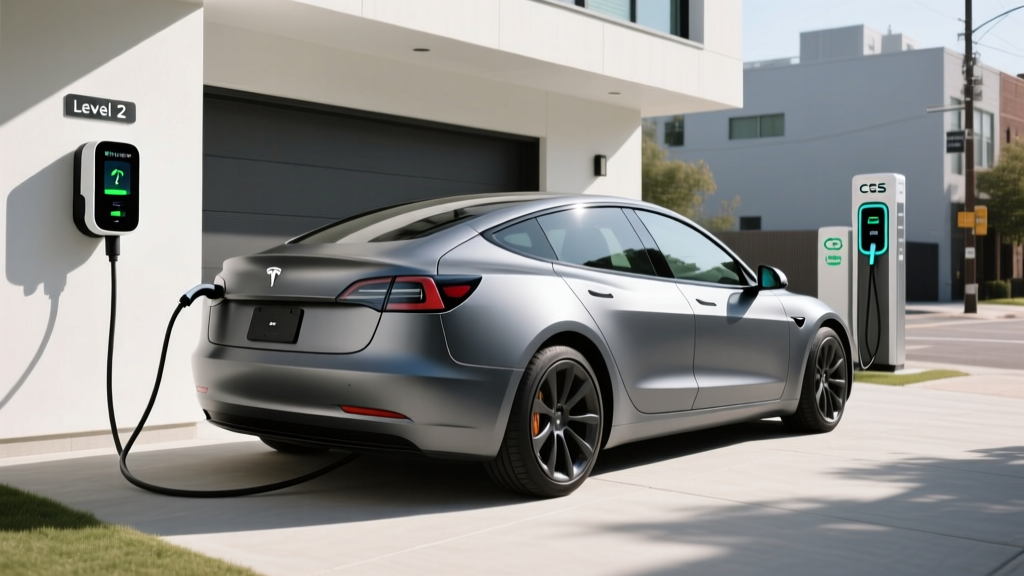
For daily ownership, a Level 2 home charger is the single most impactful upgrade you can make. The Tesla Model 3's onboard charger accepts up to 11.5 kW (48A at 240V), meaning you need a dedicated 60A circuit (EVSE must be rated at 80% of breaker capacity per NEC Article 625) to unlock maximum charging speed.
Electrical Requirements
- Minimum viable: 240V / 40A circuit (NEMA 14-50 outlet or hardwired), delivering 9.6 kW / ~36 mi/hr
- Optimal: 240V / 60A circuit (hardwired), delivering 11.5 kW / ~44 mi/hr
- Wire gauge: 6 AWG copper for 40A; 4 AWG copper for 60A (may vary by run length and local code)
- GFCI protection: Required for receptacle installations per NEC 2020+; hardwired units have built-in ground-fault protection
Do You Need a Panel Upgrade?
This is the variable that can double or triple your installation cost. Most homes built after 2000 have a 200A main service panel, which can typically support a 40-60A EV circuit if there is spare capacity. The critical calculation is the NEC Article 220 load calculation: your electrician will total your existing loads (HVAC, electric range, dryer, water heater) and determine if adding 40-60A exceeds 80% of your panel's rated capacity.
Homes with 100A or 150A panels, or those already running multiple large electric loads, often require a panel upgrade to 200A or even 400A. A panel upgrade alone runs $1,500-$4,000 before any EV charger work begins.
| Component | Simple Install (Panel has capacity) | Complex Install (Panel upgrade needed) |
|---|---|---|
| EVSE equipment (Level 2 charger) | $400-$750 | $400-$750 |
| Electrician labor (run + mount + wire) | $600-$1,500 | $800-$2,000 |
| Electrical permit | $50-$200 | $100-$350 |
| Panel upgrade (if needed) | $0 | $1,500-$4,000 |
| Conduit, wire, misc. materials | $100-$400 | $200-$600 |
| Total Estimated Range | $1,150-$2,850 | $3,000-$7,700 |
Federal incentive note: The Alternative Fuel Vehicle Refueling Property Credit (IRS §30C) may cover up to 30% of home charger equipment and installation costs (capped at $1,000) if you live in an eligible census tract. Check current eligibility on irs.gov, as census-tract qualification rules apply.
Connector Compatibility: NACS, CCS, and Adapters
The 2026 Tesla Model 3 uses the North American Charging Standard (NACS) connector natively—Tesla's proprietary plug that has been adopted by Ford, GM, Rivian, Hyundai, and most major automakers as the industry standard going forward. This gives Model 3 owners access to the Tesla Supercharger network (20,000+ stalls in North America) without any adapter.
| Connector Type | Model 3 Native? | Adapter Needed? | Network Access |
|---|---|---|---|
| NACS (Tesla) | ✅ Yes | None | Tesla Superchargers, Electrify America (new stalls), ChargePoint, EVgo NACS stalls |
| CCS1 | ❌ No | NACS-to-CCS adapter (~$200-$250) | Legacy Electrify America, EVgo, non-Tesla DCFC stations |
| CHAdeMO | ❌ No | Not practically available | Legacy Nissan/Mitsubishi network; being phased out |
| J1772 (Level 2 AC) | ❌ No | J1772-to-NACS adapter (included with Tesla) | Public Level 2 stations, non-Tesla home chargers, workplaces |
Practical tip: Tesla includes a J1772-to-NACS adapter in the glovebox of every new Model 3. This covers you at any public Level 2 station that uses the older J1772 plug (still common at workplaces, hotels, and shopping centers). For DC fast charging on non-Tesla networks, a NACS-to-CCS adapter is a worthwhile $200 investment for road trips outside Supercharger coverage.
Level 2 Charger Equipment Picks for the Model 3 Long Range
Not all Level 2 chargers are created equal. The Model 3 Long Range can accept up to 11.5 kW (48A), so pairing it with a lower-output charger leaves charging speed on the table. Here are three proven options across different budgets:
• Power: 11.5 kW (48A) max
• Connector: NACS native
• Cable length: 24 ft
• Smart features: Wi-Fi updates, load sharing (pair two units on one circuit), access control, Tesla app integration
• Price: ~$475
• Best for: Tesla-only households wanting max speed and seamless integration
• Power: Up to 12 kW (50A) — configurable 16-50A
• Connector: J1772 (use included Tesla adapter) or NACS version available
• Cable length: 23 ft
• Smart features: Wi-Fi, scheduling, energy tracking, Alexa/Google Home, flexible amperage to match circuit
• Price: ~$650-$700
• Best for: Multi-EV households (Tesla + non-Tesla) or panels with limited capacity (dial down amperage)
• Power: 11.5 kW (48A) max
• Connector: J1772 (adapter needed for Tesla) or NACS version
• Cable length: 24 ft
• Smart features: Whole-home energy monitoring integration, solar-aware scheduling, load management, budget-friendly app
• Price: ~$400-$450
• Best for: Solar-equipped homes or budget-conscious buyers wanting energy visibility
Hardwired vs. plug-in: All three units are available in hardwired or NEMA 14-50 plug-in configurations. Hardwired is preferred for 48A+ installations because NEMA 14-50 outlets are limited to 50A (40A continuous per NEC), which caps you at 9.6 kW. To get the full 11.5 kW the Model 3 can accept, you need a hardwired 60A circuit. Hardwired also eliminates the GFCI breaker requirement (saving ~$50-$100 on the breaker itself) and avoids the nuisance-tripping issues some owners report with 14-50 GFCI outlets.
Charging Cost Per Mile: Home vs. Public vs. Gas
The economics of EV charging shift dramatically depending on where and when you plug in. Below is a realistic cost comparison for the Model 3 Long Range, which consumes approximately 26 kWh per 100 miles (per EPA data).
| Charging Scenario | Avg. $/kWh | Cost per 100 Miles | Cost per Mile |
|---|---|---|---|
| Home (off-peak utility rate) | $0.11-$0.14 | $2.86-$3.64 | $0.03-$0.04 |
| Home (standard utility rate) | $0.15-$0.20 | $3.90-$5.20 | $0.04-$0.05 |
| Tesla Supercharger (avg. 2026) | $0.28-$0.36 | $7.28-$9.36 | $0.07-$0.09 |
| Third-party DCFC (EA, EVgo) | $0.35-$0.55 | $9.10-$14.30 | $0.09-$0.14 |
| Gas car (28 MPG avg, $3.40/gal) | $3.40/gal | $12.14 | $0.12 |
The bottom line: Home-charged Model 3 owners pay roughly $0.03-$0.05 per mile—about one-quarter to one-third the fuel cost of a comparable 28 MPG gas sedan. Even exclusive Supercharger use undercuts gas on a per-mile basis. The savings compound: at 12,000 miles/year, home charging saves approximately $900-$1,100 annually versus gasoline.
Safety, Code, and Permitting Essentials
EV charging installation is electrical work governed by the National Electrical Code (NEC) and local amendments. Cutting corners here risks fire, insurance claim denial, and failed home inspections. Here's what matters:
- Dedicated circuit: Your EV charger must be on its own dedicated breaker—no sharing with outlets, lights, or appliances.
- Continuous load derating: EV charging is classified as a continuous load (3+ hours). NEC requires the circuit to be rated at 125% of the charger's max draw. A 48A charger requires a 60A breaker; a 40A charger requires a 50A breaker.
- Outdoor rating: If your charger is mounted outside or in an unconditioned garage, ensure the EVSE is rated NEMA 4 (weather-resistant). All three picks above carry NEMA 4 ratings.
- Permit and inspection: Most jurisdictions require an electrical permit for EVSE installation ($50-$350 depending on locality). The inspection verifies wire gauge, breaker sizing, grounding, and GFCI compliance. Your electrician typically pulls the permit—confirm this is included in their quote.
- Utility notification: Some utilities require you to notify them before adding a Level 2 charger, especially if you're on a time-of-use (TOU) rate plan. Many offer rebates ($250-$1,000) for smart chargers that support managed charging.
Frequently Asked Questions
How much does it cost to install a home EV charger for a Tesla Model 3?
A straightforward Level 2 installation on an existing 200A panel with nearby capacity typically costs $1,150-$2,850 including equipment, electrician labor, permit, and materials. If your home needs a panel upgrade (common in older homes with 100-150A service), total costs can reach $3,000-$7,700. Always get 2-3 quotes from licensed electricians who specify the NEC load calculation in their assessment.
How fast will each charging level add range to the Model 3 Long Range?
Level 1 (120V standard outlet) adds roughly 3-5 miles per hour—adequate only for PHEVs or overnight trickle-charging a depleted battery. Level 2 (240V, 48A) adds 36-44 miles per hour, fully replenishing a depleted Model 3 Long Range overnight in about 8 hours. DC fast charging at a Tesla V3 Supercharger can add up to 175 miles in 15 minutes when the battery is preconditioned and at low SoC.
Which connector and charger is compatible with my Tesla Model 3?
The 2026 Model 3 uses the NACS connector natively for both AC Level 2 and DC fast charging. At home, the Tesla Wall Connector (NACS plug, 11.5 kW) is the most seamless option. For public Level 2 stations with J1772 plugs, use the J1772-to-NACS adapter included with your car. For non-Tesla DC fast chargers with CCS1 cables, purchase a NACS-to-CCS adapter (~$200-$250).
How much does charging a Tesla Model 3 cost per mile compared to gas?
Home charging on off-peak utility rates costs approximately $0.03-$0.04 per mile. Tesla Supercharging averages $0.07-$0.09 per mile. A comparable gas sedan at 28 MPG and $3.40/gallon costs about $0.12 per mile. Home-charged Model 3 owners save roughly $900-$1,100 per year in fuel costs at 12,000 miles driven annually.
What electrical upgrades might I need for a home charger?
The most common and costly upgrade is a main service panel upgrade from 100A or 150A to 200A ($1,500-$4,000). Other potential upgrades include: adding a sub-panel closer to the garage ($500-$1,500), upgrading service entrance wiring, or installing a smart load-management device (e.g., Emporia VUE, Span panel) that dynamically limits charger draw to avoid tripping the main breaker—this can avoid a panel upgrade entirely in some homes.
Should I charge to 100% or 80% daily?
Tesla recommends setting the daily charge limit to 80% for NMC battery chemistry (used in the Long Range) to minimize long-term degradation. Charge to 100% only when needed for road trips, and avoid leaving the car at 100% SoC for extended periods. The Model 3's built-in battery management system includes top and bottom buffers, but following the 80% daily guideline helps preserve capacity over the life of the vehicle. Tesla's battery warranty covers 8 years/120,000 miles with a minimum 70% capacity retention threshold.