Tesla Model 3 Extended Range Charging Overview: What You Need to Know
If you own or are considering a Tesla Model 3 Extended Range (also known as Long Range), understanding your charging options is essential for maximizing convenience and minimizing cost. The 2026 Tesla Model 3 Long Range AWD comes equipped with a ~75 kWh usable battery pack (NMC chemistry), an EPA-estimated 341 miles of range, and a peak DC fast-charge rate of up to 250 kW on V3 Superchargers. That translates to roughly 175 miles of range added in 15 minutes under ideal conditions, according to Tesla's official specs.
But real-world charging is more nuanced. Peak charge rates only hold briefly before tapering — a 10-80% session typically takes 25-30 minutes at a 250 kW stall, longer at older 150 kW stations. At home on a Level 2 charger, you'll add about 30-44 miles of range per hour depending on your circuit amperage. This guide breaks down every charging scenario, installation cost, and per-mile expense so you can plan with precision.
Charging Levels Explained: Speeds in kW and Miles Per Hour
EV charging is categorized into three levels. The critical distinction: kW (kilowatts) measures power — how fast energy flows into your battery. kWh (kilowatt-hours) measures energy — how much your battery stores. The Model 3 Long Range holds roughly 75 kWh of usable energy; how quickly you refill it depends on the charger's kW output.
| Level | Voltage | Max Power (kW) | Miles of Range Added/Hour | Best Use Case |
|---|---|---|---|---|
| Level 1 | 120V AC | 1.4-1.9 kW | 3-5 miles | Overnight trickle; emergency top-off |
| Level 2 | 240V AC | 7.2-11.5 kW | 22-44 miles | Daily home/work charging |
| DC Fast | 400V+ DC | Up to 250 kW (Model 3) | ~700+ miles/hour (peak) | Road trips; rapid refill |
Level 1: The Emergency Backup
Every Model 3 ships with a Mobile Connector that plugs into a standard 120V household outlet. At 12 amps, you'll see roughly 1.4 kW and about 3-4 miles of range per hour. A full 10-80% charge (~52 kWh) would take approximately 37 hours — impractical for daily use but sufficient for plug-in hybrids or low-mileage drivers who can leave the car plugged in overnight. If you drive fewer than 30 miles per day, Level 1 can technically suffice, but most Model 3 owners upgrade.
Level 2: The Daily Workhorse
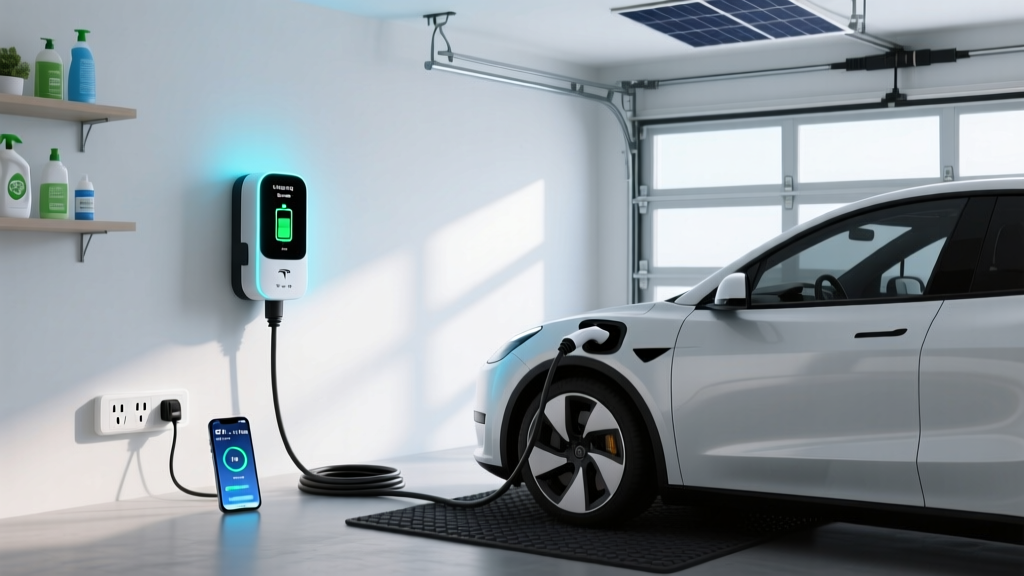
A 240V Level 2 charger is the standard for home EV ownership. The Model 3's onboard charger accepts up to 11.5 kW (48 amps) on a 60-amp circuit. At that rate, you add roughly 44 miles of range per hour. A 10-80% session (~52 kWh) completes in about 4.5-5 hours — perfect for overnight charging. Most residential installations use a 40-amp or 50-amp circuit (NEMA 14-50 outlet or hardwired wall connector), yielding 9.6-11.5 kW.
DC Fast Charging: Road Trip Essential
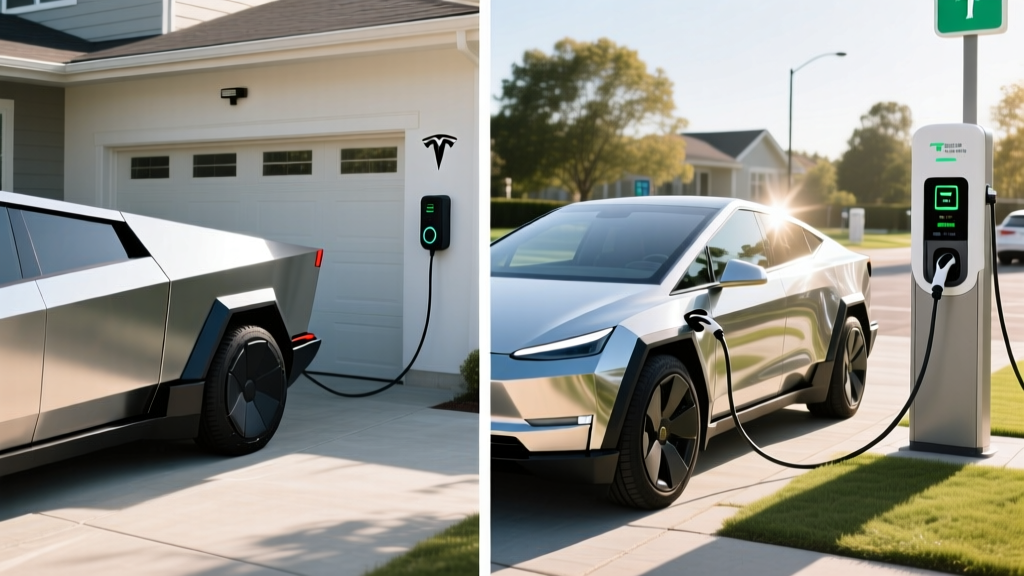
Tesla's V3 Supercharger network delivers up to 250 kW directly to the battery, bypassing the onboard charger. However, the charge curve matters: the Model 3 Long Range peaks near 250 kW only at low states of charge (10-20%), then tapers progressively. Expect roughly 25 minutes for a 10-80% session at a V3 stall, or 35-40 minutes at an older V2 (150 kW) station. Non-Tesla DC fast networks using CCS1 require the Tesla CCS adapter (sold separately, ~$250).
Home Charger Installation: Electrical Requirements and Costs
Installing a Level 2 home charger is the single biggest infrastructure decision for an EV owner. Costs vary enormously based on your home's electrical panel capacity, the distance from panel to charger location, and local permit fees.
Electrical Requirements for the Model 3 Long Range
To achieve the full 11.5 kW charge rate, you need:
- A 60-amp dedicated circuit with a 240V outlet (NEMA 14-60) or hardwired connection
- Sufficient panel capacity — typically a 200-amp main service panel
- A licensed electrician to pull permits and perform load calculations
Many homes built before 2000 have 100-amp or 150-amp panels that may already be near capacity. If your panel lacks room for a 60-amp breaker, you have options: install a lower-amperage circuit (e.g., 40A for 9.6 kW — still adequate for overnight charging), use a smart load-management device like the Sense or Emporia panel monitor, or upgrade to a 200-amp panel.
| Cost Component | Typical Range | Notes |
|---|---|---|
| Level 2 Charger (Equipment) | $400 - $700 | Tesla Wall Connector, ChargePoint Home Flex, Emporia Vue |
| Electrician Labor (Standard Install) | $500 - $1,500 | Depends on panel distance; <50 ft run is typical |
| Electrical Permit | $50 - $300 | Varies by municipality |
| Panel Upgrade (If Needed) | $2,000 - $4,500 | 100A → 200A service upgrade |
| Total (No Panel Upgrade) | $950 - $2,500 | Most common scenario for modern homes |
| Total (With Panel Upgrade) | $2,950 - $7,000 | Older homes with 100A service |
Permits and Code Requirements
Nearly all jurisdictions require an electrical permit for a new 240V circuit. Your electrician will handle this, but expect an inspection after installation. Key code considerations include:
- Dedicated circuit: EV chargers require their own breaker — no sharing with dryers or ovens
- GFCI protection: NEC 2020 and later require GFCI breakers for outdoor outlets (and some indoor garage installations depending on local code)
- Outdoor rating: If mounting outside, the charger must carry a NEMA 4 or IP65 weatherproof rating
- Wire gauge: 60A circuits require 6 AWG copper or 4 AWG aluminum wire; 40A circuits use 8 AWG copper
Connector Compatibility: NACS, CCS1, and Adapters
The 2026 Tesla Model 3 Long Range uses the NACS (North American Charging Standard) connector — Tesla's proprietary design that has become the de facto standard across the North American EV industry. Every Tesla Supercharger and Destination Charger uses NACS natively. As of 2025-2026, Ford, GM, Rivian, Volvo, and others have adopted NACS, and many Electrify America and ChargePoint stations now offer NACS cables alongside CCS1.
| Connector | Native on Model 3? | Where You'll Find It | Adapter Needed? |
|---|---|---|---|
| NACS (Tesla) | Yes — native | Tesla Superchargers, Destination Chargers, growing number of third-party stations | None |
| CCS1 | No (adapter available) | Electrify America, EVgo, ChargePoint, most non-Tesla DC fast networks | Tesla CCS Adapter (~$250) or J1772 adapter for Level 2 |
| CHAdeMO | No | Legacy Nissan Leaf infrastructure; phasing out | No adapter available from Tesla |
| J1772 (Level 2) | No (adapter included) | Public Level 2 stations, hotels, workplaces | Tesla J1772 adapter (included with vehicle) |
The Tesla CCS adapter unlocks access to Electrify America's 350 kW stalls (though the Model 3 will still cap at 250 kW), EVgo's network, and other CCS-based chargers. For most Tesla owners, the Supercharger network is the primary road-trip solution, and the CCS adapter serves as a backup for areas with sparse Supercharger coverage.
Charging Cost: Per-Mile Expense vs. Gasoline
One of the strongest financial arguments for the Model 3 Long Range is the cost-per-mile advantage over a comparable gas sedan. Here's how the numbers break down across common charging scenarios:
| Scenario | Rate ($/kWh) | Cost for 10-80% (~52 kWh) | Cost Per Mile |
|---|---|---|---|
| Home Off-Peak (Time-of-Use) | $0.08 - $0.12 | $4.16 - $6.24 | $0.015 - $0.022 |
| Home Standard Rate | $0.14 - $0.18 | $7.28 - $9.36 | $0.026 - $0.034 |
| Public Level 2 (ChargePoint, etc.) | $0.25 - $0.49 | $13.00 - $25.48 | $0.047 - $0.092 |
| Tesla Supercharger (V3) | $0.28 - $0.40 | $14.56 - $20.80 | $0.052 - $0.075 |
| Electrify America (DC Fast) | $0.35 - $0.55 | $18.20 - $28.60 | $0.066 - $0.103 |
Gas comparison: A 2026 Toyota Camry averaging 32 MPG combined at $3.40/gallon costs roughly $0.106 per mile. Even at the most expensive DC fast-charging rates, the Model 3 Long Range matches or beats gasoline on a per-mile basis. With home off-peak charging, you're paying roughly one-fifth the per-mile cost of gas — roughly $600-$800/year in electricity versus $2,500-$3,000/year in gasoline for 15,000 miles of driving.
Tax Credits and Incentives for Home Charging
The federal Alternative Fuel Vehicle Refueling Property Credit (§30C) covers up to 30% of home charger equipment and installation costs, capped at $1,000. This applies to installations in eligible census tracts. Check IRS guidelines for current eligibility rules, as census-tract qualifications and income limits may apply.
Best Home Chargers for the Tesla Model 3 Long Range
The Model 3 Long Range can accept up to 11.5 kW (48A), so choosing a charger that matches this capability ensures you're not leaving charging speed on the table. Here are the top picks for 2026:
Tesla Wall Connector (Gen 3)
- Power: Up to 11.5 kW (48A)
- Connector: NACS native
- Cable length: 24 ft
- Smart features: Wi-Fi, OTA updates, load sharing (pair two units on one circuit), Tesla app integration
- Price: ~$475
- Verdict: The default choice for Tesla-only households. Sleek, reliable, and fully integrated with the Tesla app. No CCS compatibility without an adapter on the car side.
ChargePoint Home Flex
- Power: Up to 12 kW (50A) — configurable down to 16A
- Connector: NACS (2025+ model) or J1772 (use Tesla adapter)
- Cable length: 23 ft
- Smart features: Wi-Fi, ChargePoint app scheduling, Alexa integration, flexible amperage for panel-limited homes
- Price: ~$699
- Verdict: Best for mixed-EV households or renters who may move. The configurable amperage (16A-50A) is ideal if your panel can't support a full 60A circuit.
Emporia Level 2 EV Charger
- Power: Up to 11.5 kW (48A)
- Connector: J1772 (use included Tesla adapter) or NACS (2025+ version)
- Cable length: 24 ft
- Smart features: Integrates with Emporia Vue energy monitor for solar-aware charging, load management, and whole-home energy tracking
- Price: ~$399
- Verdict: Best budget smart charger. Excellent if you have solar panels or want detailed energy consumption data. Less polished app than Tesla or ChargePoint.
Public Charging and Supercharger Etiquette
The Tesla Supercharger network remains the most reliable DC fast-charging ecosystem in North America, with over 6,000 V3 (250 kW) and V4 stalls across the U.S. as of 2026. According to fueleconomy.gov, consistent use of DC fast charging does accelerate battery degradation slightly, but Tesla's battery management system and thermal preconditioning mitigate this. Most Model 3 Long Range owners report 5-8% degradation over 100,000 miles with mixed Supercharger and home-charging use.
Preconditioning: The Key to Fast Public Charging
When you navigate to a Supercharger in the Tesla app or onboard navigation, the car automatically begins preconditioning the battery — warming it to the optimal temperature for fast charging. This can cut your 10-80% time by 5-10 minutes, especially in cold weather. Always navigate to the charger rather than just driving there; the preconditioning cycle is triggered by the navigation destination.
Supercharger Cost and Idle Fees
Supercharger pricing varies by location and time of day, typically $0.28-$0.40/kWh. Tesla imposes idle fees ($0.50-$1.00/minute) if your car remains plugged in after reaching its charge limit and the station is at 100% capacity. Set your charge limit to 80% for road-trip Supercharger stops — charging above 80% is dramatically slower (the taper effect) and ties up the stall for other drivers.
Frequently Asked Questions
How much does it cost to install a home EV charger for the Tesla Model 3?
Most homeowners spend between $950 and $2,500 for a standard Level 2 installation (equipment + electrician + permit) if no panel upgrade is needed. If your home has a 100-amp electrical panel that needs upgrading to 200 amps, total costs can reach $3,000-$7,000. The Tesla Wall Connector costs ~$475, and a standard 60A circuit installation runs $500-$1,500 in labor.
How fast will each charging level add range to the Model 3 Long Range?
Level 1 (120V): approximately 3-5 miles per hour. Level 2 (240V, 48A): approximately 44 miles per hour. DC Fast Charging (V3 Supercharger at 250 kW peak): approximately 175 miles in 15 minutes, or a full 10-80% session in about 25 minutes. Remember that peak kW rates are only sustained briefly — the charge curve tapers significantly above 50% state of charge.
Which connector is compatible with my Tesla Model 3 Extended Range?
The 2026 Model 3 Long Range uses the NACS connector natively, compatible with all Tesla Superchargers and Destination Chargers. For non-Tesla public chargers using CCS1, you'll need the Tesla CCS Adapter (~$250). For public Level 2 stations with J1772 connectors, the included J1772-to-NACS adapter (shipped with the car) works fine. CHAdeMO is not supported.
How much does charging cost per mile compared to gas?
With home off-peak charging at $0.10/kWh, the Model 3 Long Range costs approximately $0.018 per mile (at 3.5 miles/kWh efficiency). A comparable gas sedan at 32 MPG and $3.40/gallon costs $0.106 per mile. That's a savings of roughly $0.088 per mile, or about $1,320 per year at 15,000 miles. Even Supercharger rates ($0.34/kWh average) yield $0.060/mile — still cheaper than gasoline.
What electrical upgrades might I need for a Level 2 home charger?
The most common upgrade is a panel capacity increase from 100A to 200A service, which costs $2,000-$4,500. You may also need a new dedicated 60A breaker (if your panel has open slots), a sub-panel if the charger is far from the main panel, or a smart load-management device to avoid a full panel upgrade. Your electrician will perform a NEC Article 220 load calculation to determine if your existing panel can handle the additional draw.
Is daily Supercharging bad for the Model 3 Long Range battery?
Exclusive DC fast charging does accelerate degradation slightly compared to Level 2 home charging. However, Tesla's battery management system and liquid thermal cooling keep degradation manageable — most owners see 5-8% capacity loss over 100,000 miles with mixed charging. For daily use, home Level 2 charging at 80% state of charge is ideal. Reserve Supercharging for road trips and use the car's built-in charge-limit settings to avoid frequent 100% charges.