If you own or are shopping for a Tesla Model 3, charging time is the single most practical spec to understand. The sticker says one thing; real-world charging curves, connector types, and your home's electrical panel tell the real story. This guide breaks down exactly how long a Tesla Model 3 takes to charge at every level — from a Supercharger stall to a standard 120V wall outlet — and what you need to set up fast, affordable home charging.
Tesla Model 3 Battery and Charging Specs at a Glance
Before we talk time, we need to talk capacity. The 2025-2026 Tesla Model 3 lineup uses different battery packs depending on trim, and that directly dictates how long charging takes.
| Spec | Model 3 RWD | Model 3 Long Range AWD | Model 3 Performance |
|---|---|---|---|
| Battery Capacity (usable) | ~57.5 kWh (LFP) | ~75 kWh (NMC) | ~75 kWh (NMC) |
| EPA Range | 272 mi | 363 mi | 315 mi |
| Max DC Fast Charge Rate | 170 kW peak | 250 kW peak | 250 kW peak |
| Supercharger 10-80% Time | ~25 min | ~25-28 min | ~25-28 min |
| Max Level 2 AC Rate | 11.5 kW (48A) | 11.5 kW (48A) | 11.5 kW (48A) |
| Level 2 Full Charge Time | ~5.5 hr | ~7 hr | ~7 hr |
| Connector | NACS (native Tesla) | NACS (native Tesla) | NACS (native Tesla) |
Charging Levels Explained: How Fast Each Adds Range
The most common confusion in EV ownership is the difference between kW (kilowatts) and kWh (kilowatt-hours). Think of kW as the flow rate of water through a hose — it's the power or speed of charging. Think of kWh as the size of the bucket — it's the energy capacity of the battery. A 75 kWh battery charged at 11.5 kW will fill in roughly 6.5 hours (75 ÷ 11.5). A charger's kW rating tells you how fast it can push energy; your car's battery kWh tells you how much it needs.
| Level | Power Source | Max Power (kW) | Miles of Range Added Per Hour | Best For |
|---|---|---|---|---|
| Level 1 | 120V household outlet | ~1.0-1.4 kW | 3-5 mi/hr | Overnight top-ups, emergencies, low-mileage drivers |
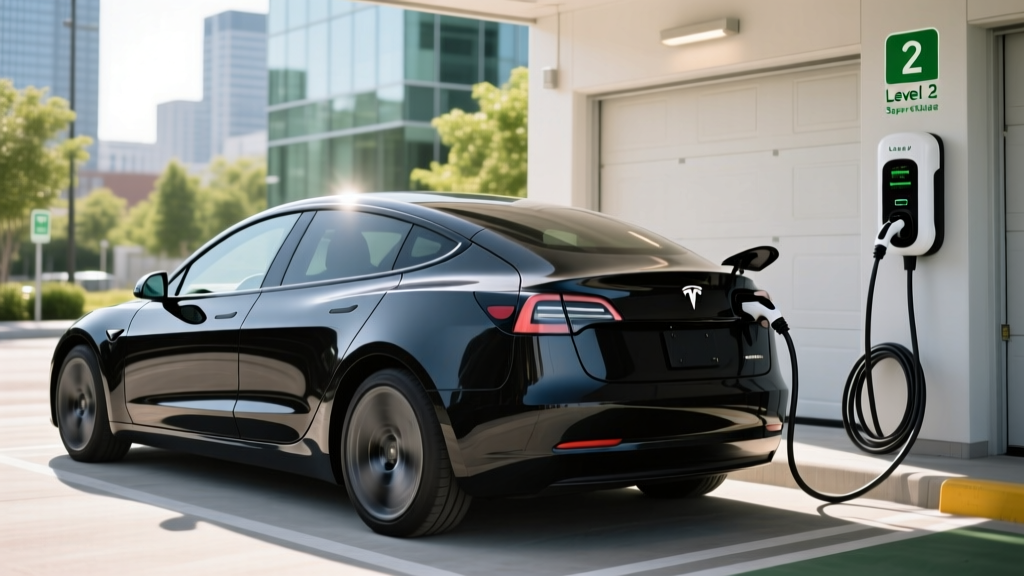
| Level 2 (Home) | 240V dedicated circuit | 7.7-11.5 kW | 25-44 mi/hr | Daily home charging, overnight full charges |
| Level 2 (Public) | 240V public station | 7.2-19.2 kW | 25-55 mi/hr | Workplace, shopping, destination charging |
| DC Fast Charge | 480V+ DC station | 170-250 kW | ~1,000+ mi/hr (at peak) | Road trips, rapid top-ups |
For the Tesla Model 3, a Level 1 charge from a standard wall outlet will add roughly 4 miles of range per hour — meaning a full charge from near-empty would take over 60 hours on the Long Range model. That's fine for a car that drives 20 miles a day and parks for 12 hours overnight, but inadequate for most owners. Level 2 at home is the practical baseline.
Tesla Model 3 Supercharger Charging Time: Real-World Data
The Supercharger network remains the benchmark for DC fast charging reliability. But the advertised "250 kW" peak rate is not what you'll sustain for the entire session. Understanding the charge curve is essential.
How the Charge Curve Works
DC fast charging follows a tapering curve. The battery accepts peak power only at low states of charge (SoC), typically below 30-40%. As the battery fills, the charge rate slows to protect cell health. Here's a realistic breakdown for a Model 3 Long Range at a V3 Supercharger (250 kW capable):
- 5-30% SoC: Peaks near 250 kW, adding ~175 miles of range in 10 minutes
- 30-60% SoC: Tapers to ~150-180 kW, still adding range quickly
- 60-80% SoC: Drops to ~80-120 kW
- 80-100% SoC: Slows dramatically to ~30-50 kW — this last 20% can take as long as the first 60%
This is why Tesla and most EV makers quote 10-80% times: charging above 80% is so slow that it's only practical for overnight Level 2 sessions, not road-trip pit stops.
Supercharger 10-80% Times by Trim
| Model 3 Trim | 10-80% at V3 Supercharger (250 kW) | 10-80% at V4 Supercharger | 10-80% at Older V2 (150 kW) |
|---|---|---|---|
| RWD (LFP, 170 kW peak) | ~25 min | ~25 min (car-limited) | ~30 min |
| Long Range AWD (250 kW peak) | ~25-28 min | ~25-28 min | ~35-40 min |
| Performance (250 kW peak) | ~25-28 min | ~25-28 min | ~35-40 min |
Home Charger Installation: Electrical Requirements and Cost
Home Level 2 charging is where most Model 3 owners will do 85-95% of their charging. But installation isn't as simple as plugging in an appliance. Here's what's involved.
Electrical Requirements
To charge a Model 3 at its maximum 11.5 kW AC rate, you need a 240V / 60A dedicated circuit with a hardwired wall connector. The National Electrical Code (NEC) requires that continuous loads (like EV charging) not exceed 80% of a circuit's rated capacity, so a 60A breaker supports a continuous 48A draw, which equals 11.5 kW at 240V.
If your electrical panel doesn't have spare capacity for a 60A circuit, common alternatives include:
- 40A circuit (32A continuous): Delivers 7.7 kW — adds ~30 miles per hour. Sufficient for most daily driving needs.
- 30A circuit (24A continuous): Delivers 5.8 kW — adds ~22 miles per hour. Adequate for drivers covering under 60 miles daily.
- 20A circuit (16A continuous): Delivers 3.8 kW — adds ~15 miles per hour. Functional but slow for larger batteries.
Panel Upgrade Reality
Homes built before 2000 often have 100A or 150A main panels. Adding a 60A EV circuit to an already-loaded panel may require a panel upgrade to 200A, which is the single largest variable in installation cost. A licensed electrician will perform a load calculation to determine if your current panel can handle the added circuit.
| Component | Simple Install (Panel has capacity, short run) | Complex Install (Panel upgrade, long conduit run) |
|---|---|---|
| Level 2 Charger (Equipment) | $400 - $700 | $400 - $700 |
| Electrician Labor | $300 - $800 | $1,200 - $3,000 |
| Electrical Permit | $50 - $150 | $50 - $200 |
| Panel Upgrade (if needed) | Not required | $1,500 - $3,500 |
| Conduit / Wiring Materials | $50 - $200 | $200 - $600 |
| Total Estimated Cost | $800 - $1,850 | $3,350 - $8,000 |
The wide range reflects real-world variability: a garage with a 200A panel and an outlet 10 feet from the breaker is a few hundred dollars in labor; a detached garage 80 feet from a 100A panel needing an upgrade is a multi-day project. Always get at least two quotes from licensed electricians, and confirm they pull a local permit — unpermitted work can void homeowner's insurance claims.
Federal Tax Credit for Home Charging
The IRS Alternative Fuel Vehicle Refueling Property Credit (IRC §30C) covers 30% of home charger equipment and installation costs, up to $1,000. This credit is subject to income limitations and must be for your primary residence. Consult a tax professional to confirm eligibility — rules can change and interact with other credits.
Connector Compatibility: NACS, CCS, and Adapters
The Tesla Model 3 uses the North American Charging Standard (NACS) connector natively. As of 2025-2026, NACS has been adopted by Ford, GM, Rivian, Volvo, and most major automakers, making it the de facto standard in North America. But if you ever need to use a non-Tesla public charger, connector compatibility matters.
| Connector | Used By | Tesla Model 3 Compatible? | Notes |
|---|---|---|---|
| NACS (Tesla) | Tesla, Ford, GM, Rivian, Volvo, Polestar, others (2025+) | Yes — native | Standard on all new Model 3 vehicles |
| CCS1 | Most non-Tesla EVs (pre-2025), VW, Hyundai, BMW | With Tesla CCS adapter (~$175) | Required for Electrify America and some ChargePoint stations |
| CHAdeMO | Nissan Leaf, Mitsubishi Outlander PHEV (legacy) | No adapter available | Being phased out in North America |
| J1772 (Level 2 AC) | All non-Tesla EVs for Level 2 | With Tesla J1772 adapter (included) | Needed for public Level 2 stations with J1772 plugs |
Tesla includes a J1772 adapter with every new Model 3. The CCS1 adapter is sold separately through Tesla's shop and is worth carrying on road trips that may route through Electrify America or other CCS-only networks, though Supercharger coverage now spans over 6,000 stations and 60,000+ stalls across North America per Tesla's network page.
Cost to Charge: Home vs. Public vs. Gas
The economics of EV charging depend heavily on where you charge. Home charging is almost always the cheapest option, while DC fast charging on the road can approach or exceed gasoline costs per mile.
| Charging / Fueling Scenario | Cost per kWh / Gallon | Cost Per Mile (Model 3 LR, ~4 mi/kWh) | Cost Per Mile (30 MPG Gas Sedan at $3.50/gal) |
|---|---|---|---|
| Home — Off-Peak Utility Rate | $0.08 - $0.12/kWh | $0.02 - $0.03 | $0.12 |
| Home — Standard Rate | $0.13 - $0.18/kWh | $0.03 - $0.05 | $0.12 |
| Public Level 2 (ChargePoint, etc.) | $0.20 - $0.35/kWh | $0.05 - $0.09 | $0.12 |
| Tesla Supercharger (V3/V4) | $0.25 - $0.40/kWh | $0.06 - $0.10 | $0.12 |
| Non-Tesla DC Fast Charger | $0.30 - $0.55/kWh | $0.08 - $0.14 | $0.12 |
For a Model 3 Long Range owner driving 12,000 miles per year and charging primarily at home on an off-peak rate of $0.10/kWh, annual fuel cost is roughly $300-$360. The same miles in a 30 MPG gasoline sedan at $3.50/gallon costs $1,400. That's a savings of over $1,000 per year — before factoring in reduced maintenance (no oil changes, fewer brake replacements due to regenerative braking).
However, if you rely exclusively on public DC fast charging at $0.40/kWh, your annual cost rises to ~$1,200, narrowing the gap significantly. This is why home charging access is the single most important factor in EV ownership economics.
Recommended Home Chargers for Tesla Model 3
The Model 3's 11.5 kW onboard charger means you can benefit from a 48A hardwired station, but a 40A or even 32A unit will serve most daily needs at lower cost. Here are top picks across budget tiers:
Tesla Wall Connector (Gen 3)
- Power Output: Up to 11.5 kW (48A hardwired)
- Connector: NACS (native Tesla)
- Cable Length: 24 ft
- Smart Features: Wi-Fi, OTA updates, load sharing with multiple units, access control
- Price: ~$475
- Best For: Tesla-only households wanting seamless integration
ChargePoint Home Flex
- Power Output: Up to 12 kW (50A, adjustable down to 16A)
- Connector: NACS or J1772 (configurable)
- Cable Length: 23 ft
- Smart Features: Wi-Fi, scheduling, energy dashboard, Alexa integration, amperage adjustable to match circuit
- Price: ~$550-$650
- Best For: Multi-EV households (Tesla + non-Tesla), flexible amperage
Emporia Level 2 EV Charger
- Power Output: Up to 11.5 kW (48A hardwired) or 9.6 kW (40A)
- Connector: J1772 (use Tesla adapter) or NACS version available
- Cable Length: 24 ft
- Smart Features: Wi-Fi, energy monitoring, solar integration, scheduling, detailed app data
- Price: ~$350-$400
- Best For: Budget-conscious buyers who want detailed energy tracking
Grizzl-E Smart
- Power Output: Up to 10 kW (40A)
- Connector: J1772 (use Tesla adapter)
- Cable Length: 24 ft
- Smart Features: OCPP-compatible, works with multiple apps, adjustable amperage, built in Canada for extreme cold
- Price: ~$450-$550
- Best For: Cold-climate durability, outdoor installs
Safety, Code, and Installation Best Practices
EV charging draws sustained high current for hours — more like running an electric furnace than plugging in a phone. Safety isn't optional:
- Dedicated circuit: Your EV charger must be on its own dedicated breaker — never share a circuit with other high-draw appliances.
- GFCI protection: NEC 2023 and later require GFCI (Ground Fault Circuit Interrupter) protection for all EV charging outlets. Hardwired installations may have different requirements depending on local code — your electrician will know.
- Outdoor rating: If installing outdoors, the charger must carry a NEMA 4 (weatherproof) rating. All four chargers listed above qualify.
- Permit and inspection: Most jurisdictions require an electrical permit for a new 240V circuit. The inspection ensures the work meets code — skip this and your homeowner's insurance may deny a related claim.
- Wire gauge: A 60A circuit requires 6 AWG copper wire (or 4 AWG aluminum). Your electrician will size this correctly, but verify — undersized wire is a fire hazard.
Frequently Asked Questions
How much does it cost to install a home EV charger for a Tesla Model 3?
A straightforward installation with an existing 200A panel and short wire run costs $800-$1,850 (equipment + electrician + permit). If your home needs a panel upgrade or has a long conduit run, expect $3,350-$8,000. The federal §30C tax credit can offset up to $1,000 (30% of cost).
How fast will each charging level add range to my Model 3?
Level 1 (120V) adds about 3-5 miles per hour. Level 2 (240V home charger) adds 25-44 miles per hour depending on amperage. DC fast charging (Supercharger) adds up to 175 miles in 10 minutes at peak rate, but tapers significantly above 60% SoC.
Which connector is compatible with my Tesla Model 3?
The Model 3 uses the NACS connector natively for both Level 2 AC and DC fast charging. It's compatible with Tesla Superchargers, Tesla Destination Chargers, and the growing network of NACS-equipped public stations from Ford, GM, and others. For CCS1 stations (like Electrify America), you'll need Tesla's CCS adapter (~$175).
How much does charging a Tesla Model 3 cost per mile compared to gas?
Charging at home on off-peak rates costs roughly $0.02-$0.03 per mile — about 4-5x cheaper than a 30 MPG gas car at $3.50/gallon ($0.12/mi). Supercharger costs average $0.06-$0.10 per mile, still competitive with gas. Per fueleconomy.gov, the Model 3 Long Range achieves 132 MPGe combined.
What electrical upgrades might I need for a home charger?
The most common upgrade is a panel capacity increase from 100A or 150A to 200A, costing $1,500-$3,500. You may also need a new dedicated 240V circuit with appropriate wire gauge and breaker. Homes with older knob-and-tube or aluminum wiring may need partial rewiring. A licensed electrician's load calculation will determine exact needs.
Does the Tesla Model 3 LFP battery charge differently than NMC?
Yes. The RWD Model 3 uses an LFP (lithium iron phosphate) battery, which Tesla recommends charging to 100% regularly — unlike NMC batteries (Long Range/Performance), which are best kept between 20-80% for daily use. LFP also has a slightly lower peak DC charge rate (170 kW vs. 250 kW), but its smaller capacity means 10-80% time is similar. LFP batteries generally exhibit slower long-term degradation.
Can I charge my Model 3 on a regular 120V outlet?
Yes, using the Tesla Mobile Connector with the 120V adapter. It adds roughly 3-5 miles of range per hour (~1.0-1.4 kW). This works for low-mileage drivers or as a backup, but a full charge from 10% would take 50+ hours on the Long Range model. It's not practical as a primary charging method for most owners.